Mapletree Logistics Trust Dividend 2026: DPU History, ~6.3% Yield & Outlook (SGX: M44U)
A comprehensive deep-dive into MLT’s distribution history, gearing, portfolio resilience, and what Singapore investors should know in 2026.
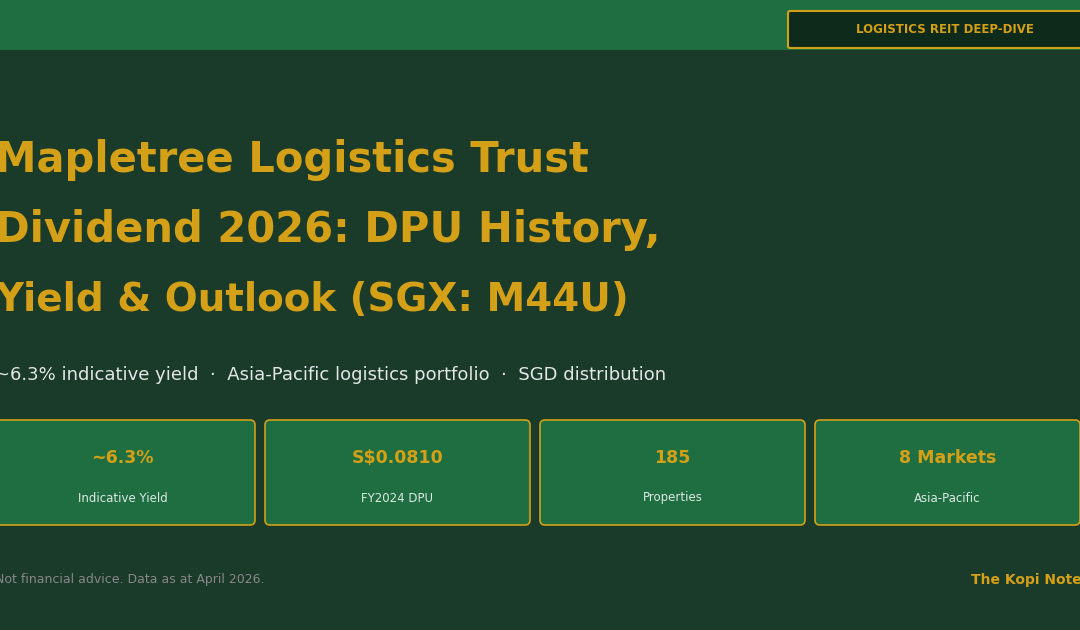
Mapletree Logistics Trust (SGX: M44U) is one of Singapore’s largest logistics-focused REITs, offering an indicative dividend yield of approximately 6.3% based on its FY2024 Distribution Per Unit (DPU) of S$0.0810 and an April 2026 unit price of around S$1.29. Sponsored by Mapletree Investments, MLT owns 185 logistics and warehouse assets across 8 Asia-Pacific markets including Singapore, Hong Kong, China, Japan, South Korea, Australia, Malaysia, and Vietnam.
Not financial advice. All figures are for educational reference only. Data as at April 2026 unless noted.
Table of Contents
Contents — Click to expand
- MLT Overview: What Is Mapletree Logistics Trust?
- MLT DPU History: FY2018 to FY2024
- MLT Dividend Yield Analysis 2026
- Portfolio Breakdown: 185 Assets Across 8 Markets
- Key Financial Metrics: Gearing, NAV, ICR
- MLT vs Peer Logistics REITs: Yield Comparison
- Risks and Outlook for 2026
- How to Buy MLT Units in Singapore
- FAQ: MLT Dividend Questions
MLT Overview: What Is Mapletree Logistics Trust?
Mapletree Logistics Trust was listed on the Singapore Exchange (SGX) in 2005, making it one of the pioneer logistics REITs in Asia. It is managed by Mapletree Logistics Trust Management Ltd, a wholly-owned subsidiary of Mapletree Investments — the private real estate arm of Temasek Holdings.
MLT’s portfolio spans 185 properties with a total assets under management (AUM) of approximately S$13.2 billion as at 31 December 2024. The trust focuses on modern logistics facilities, cold storage warehouses, and last-mile distribution centres — asset classes that have seen sustained demand growth due to e-commerce expansion and supply chain regionalisation across Asia.
Unlike office or retail REITs, logistics properties have relatively stable occupancy profiles. MLT reported a portfolio occupancy rate of approximately 95.9% for FY2024, reflecting strong demand across its core markets.
| Detail | Information |
|---|---|
| SGX Ticker | M44U |
| Listed Since | July 2005 (SGX Mainboard) |
| Manager | Mapletree Logistics Trust Management Ltd |
| Sponsor | Mapletree Investments (Temasek-linked) |
| Distribution Policy | Quarterly distributions, minimum 90% of distributable income |
| Number of Properties | 185 (as at Q3 FY2024/25) |
| Total AUM | ~S$13.2 billion |
| Markets | 8 (SG, HK, CN, JP, KR, AU, MY, VN) |
Source: Mapletree Logistics Trust Annual Report FY2024, SGX announcements, April 2026
For Singapore-based investors, MLT is particularly attractive because it distributes in Singapore dollars, offers quarterly income, and qualifies for CPF investment strategy under the CPF Investment Scheme (CPFIS). Unitholders in Singapore pay no withholding tax on REIT distributions received from Singapore-listed REITs, which is a meaningful advantage over offshore dividend stocks.
MLT DPU History: FY2018 to FY2024
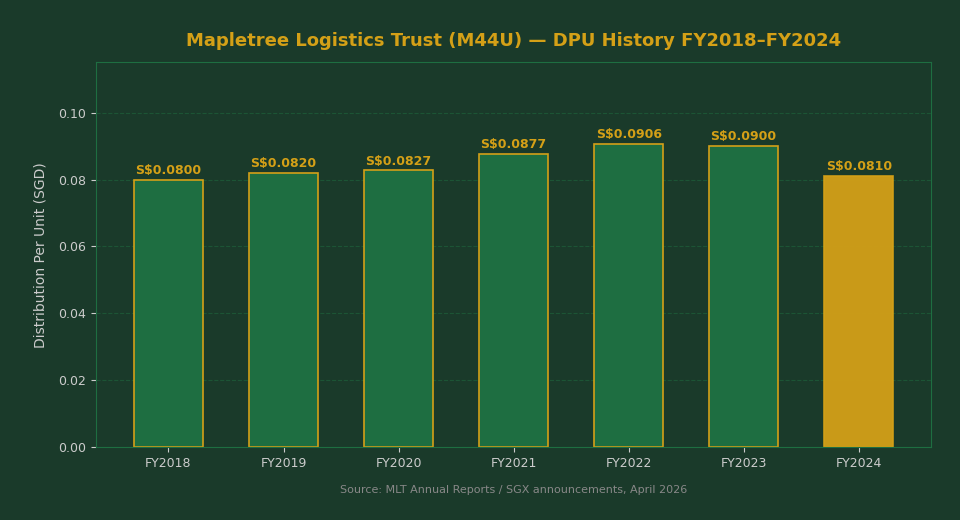
MLT has delivered consistent and growing distributions over the past decade, making it a favourite among Singapore’s dividend investors. The trust distributes quarterly, with the financial year ending 31 March. Below is the full DPU history from FY2018 to FY2024:
| Financial Year | Annual DPU (SGD cents) | YoY Change |
|---|---|---|
| FY2018 (Apr 17–Mar 18) | 8.00¢ | — |
| FY2019 (Apr 18–Mar 19) | 8.20¢ | +2.5% |
| FY2020 (Apr 19–Mar 20) | 8.27¢ | +0.9% |
| FY2021 (Apr 20–Mar 21) | 8.77¢ | +6.0% |
| FY2022 (Apr 21–Mar 22) | 9.06¢ | +3.3% |
| FY2023 (Apr 22–Mar 23) | 9.00¢ | -0.7% |
| FY2024 (Apr 23–Mar 24) | 8.10¢ | -10.0% |
Source: MLT Annual Reports, SGX announcements. FY ends 31 March. DPU figures in Singapore cents.
The FY2024 DPU decline to 8.10¢ (from 9.00¢ in FY2023) requires context. This 10% drop was driven primarily by several concurrent headwinds: higher interest costs as floating-rate debt repriced upward following the global rate hiking cycle, currency headwinds from a weakening Chinese renminbi and Hong Kong dollar relative to SGD, and asset divestments that temporarily reduced distributable income. This was not a sign of structural deterioration in MLT’s core operating model.
To put this in practical terms: a Singapore investor holding 50,000 MLT units would have received S$4,050 in distributions during FY2024 (50,000 × S$0.0810), down from S$4,500 in FY2022. The trust continues to distribute quarterly — approximately 2.025¢ per unit per quarter at the FY2024 run rate.
For a fuller picture of how MLT compares to other income instruments, see our Singapore T-bills 2026 guide and our comparison of the best S-REITs in Singapore 2026.
MLT Dividend Yield Analysis 2026
As at April 2026, MLT units trade at approximately S$1.29, giving an indicative dividend yield of approximately 6.3% based on the FY2024 DPU of S$0.0810. This represents a meaningful premium over the 10-year Singapore Government Securities (SGS) yield of around 2.8%, offering a spread of approximately 350 basis points.
For income-focused investors, this yield spread matters. S-REITs have historically traded at a 200–400 bps premium over the risk-free rate to compensate for equity risk. At 350 bps, MLT is trading roughly in line with its long-run average, suggesting neither extreme cheapness nor overvaluation relative to interest rates.
| Scenario | Units Held | Annual Income (at 8.10¢ DPU) | Quarterly Distribution |
|---|---|---|---|
| Small investor | 10,000 | S$810 | ~S$202 |
| Mid-sized holding | 50,000 | S$4,050 | ~S$1,013 |
| Larger holding | 100,000 | S$8,100 | ~S$2,025 |
Source: Based on FY2024 DPU of S$0.0810. Illustrative only. Actual distributions vary by quarter.
One key advantage for Singapore tax residents: distributions from Singapore-listed REITs are generally exempt from personal income tax. This makes MLT’s ~6.3% yield effectively a tax-free return for most Singapore individual investors — significantly more valuable than a 6.3% yield from a taxable fixed-income product. Use our REITs dividend yield calculator to model your own income scenarios.
Investors seeking to reinvest their MLT distributions can also explore our dividend reinvestment (DRIP) calculator to see how compounding distributions can grow a portfolio over 10–20 years.
Portfolio Breakdown: 185 Assets Across 8 Markets
MLT’s geographic diversification is a distinguishing feature compared to most Singapore-listed REITs. The portfolio spans 8 countries, providing exposure to multiple logistics demand drivers — from China’s e-commerce growth, Japan’s efficient distribution networks, to Vietnam’s manufacturing boom.
| Country | No. of Properties | % of Portfolio Value | Key Asset Type |
|---|---|---|---|
| China | 50 | ~26% | E-commerce & cold storage |
| Japan | 34 | ~23% | Modern logistics & distribution |
| South Korea | 16 | ~11% | Logistics & warehouse |
| Singapore | 12 | ~10% | Ramp-up & flatted factories |
| Hong Kong | 11 | ~9% | High-spec logistics |
| Australia | 26 | ~9% | Industrial & logistics |
| Malaysia | 25 | ~7% | Logistics & distribution |
| Vietnam | 11 | ~5% | Manufacturing support |
Source: MLT Annual Report FY2024 / Investor Presentation Q3 FY2024/25. Property counts approximate.
The multi-market exposure means MLT’s DPU is influenced by foreign exchange movements. Currency fluctuations — particularly a weaker RMB or HKD relative to SGD — can compress distributions when translated back to Singapore dollars. This was a key factor in the FY2024 DPU decline, and investors should factor in currency risk when assessing MLT as an income investment.
On the positive side, geographic diversification provides natural resilience: weakness in one market (e.g. slower Chinese e-commerce growth) can be offset by strength in another (e.g. Japan’s supply-chain near-shoring trend). MLT’s management has historically been adept at recycling assets — divesting older properties in lower-yield markets and redeploying capital into higher-returning assets.
Key Financial Metrics: Gearing, NAV, ICR
For any REIT investor, three metrics beyond the yield deserve attention: leverage (gearing ratio), the interest coverage ratio (ICR), and net asset value (NAV) per unit. These determine whether the trust is financially sustainable and whether its distributions are well-covered.
| Metric | Value (Q3 FY2024/25) | Commentary |
|---|---|---|
| Gearing Ratio | ~39.2% | Below the MAS 50% regulatory limit; moderate leverage |
| Interest Coverage Ratio (ICR) | ~2.6x | Above the MAS 1.5x minimum; distributions well-covered |
| NAV Per Unit | ~S$1.51 | Units trading at ~15% discount to NAV (as at April 2026) |
| % Fixed-Rate Debt | ~80% | Limits near-term refinancing risk as rates remain elevated |
| Weighted Avg Debt Maturity | ~3.5 years | No significant near-term maturity wall |
Source: MLT Q3 FY2024/25 Business Update, January 2025. Figures approximate.
The gearing ratio of ~39.2% is manageable but bears monitoring. MLT has been reducing leverage through asset divestments, which temporarily dampens DPU but improves the balance sheet. The trust has headroom of approximately S$1.6–2.0 billion before hitting the MAS 50% gearing ceiling, providing optionality for acquisitions when attractive opportunities arise.
The P/NAV discount of ~15% (trading at S$1.29 vs NAV ~S$1.51) suggests the market is pricing in risks around further DPU pressure or currency headwinds. For a long-term investor, buying below NAV provides a margin of safety — though it is not a guarantee of near-term capital appreciation. Use our S-REIT gearing ratio and ICR calculator to analyse any REIT’s leverage profile against MAS thresholds.
MLT vs Peer Logistics REITs: Yield Comparison
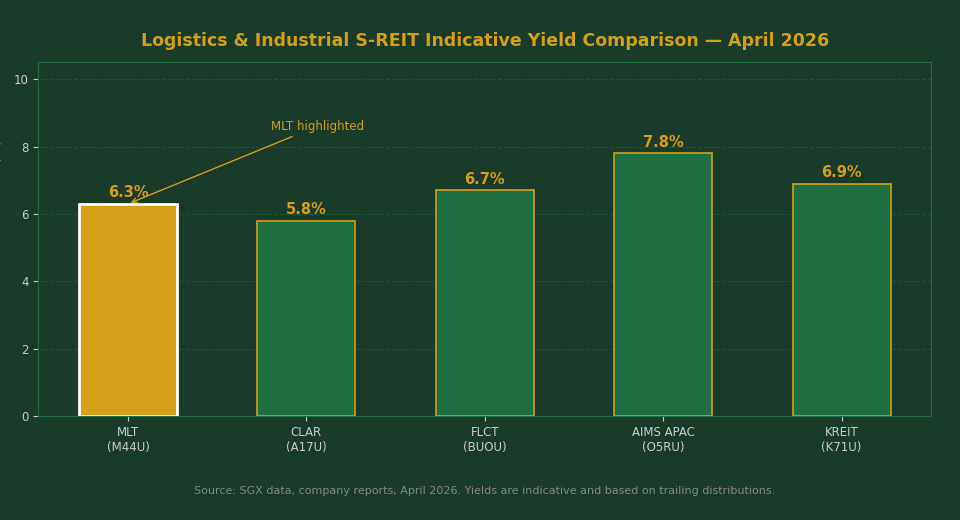
To assess whether MLT’s ~6.3% yield is attractive, it helps to compare it against peer logistics and industrial S-REITs. The table below uses indicative yields based on trailing DPU figures and April 2026 unit prices:
| REIT | SGX Ticker | Indicative Yield | Focus |
|---|---|---|---|
| Mapletree Logistics Trust | M44U | ~6.3% | Pan-Asia logistics |
| CapitaLand Ascendas REIT | A17U | ~5.8% | Industrial & logistics (SG/AU/UK/US) |
| Frasers Logistics & Commercial Trust | BUOU | ~6.7% | Logistics (AU/EU/SG) |
| AIMS APAC REIT | O5RU | ~7.8% | Industrial (SG + AU) |
| Keppel REIT | K71U | ~6.9% | Office-centric |
Source: SGX data, company announcements, April 2026. Indicative yields based on trailing distributions. Not a recommendation.
MLT sits in the middle of the peer group by yield. Higher-yielding peers like AIMS APAC REIT (smaller, SG-AU focus) offer more yield but less diversification. CLAR (A17U) offers lower yield but a global industrial portfolio with strong sponsor backing (CapitaLand). MLT’s differentiated value proposition is its exclusive Asia-Pacific logistics focus combined with Temasek-linked sponsor quality and a large, diversified portfolio.
For investors who want broader exposure to Singapore’s REIT market rather than a single name, our Singapore REIT ETF guide covers index-based options for diversified S-REIT exposure through a single fund.
Risks and Outlook for 2026
No REIT is without risk, and MLT is no exception. Investors should weigh the following key risk factors before allocating to M44U:
1. China Exposure and Rental Reversions
China accounts for approximately 26% of MLT’s portfolio by value. Slower-than-expected economic recovery in China, combined with a structural oversupply of logistics space in certain tier-2 cities, has weighed on rental reversions. Negative rental reversions — where expiring leases are renewed at lower rents — directly compress revenue and DPU. This risk remains live in 2026 as Chinese property markets stabilise slowly.
2. Currency Headwinds
MLT collects rents in 8 currencies (CNY, HKD, JPY, KRW, AUD, MYR, VND, SGD). A strong SGD relative to regional currencies translates to lower SGD-denominated distributable income. The JPY has been particularly weak, and Japan represents ~23% of MLT’s portfolio. As the Bank of Japan normalises rates gradually, JPY may strengthen over a multi-year horizon — a tailwind for MLT’s Japan income.
3. Interest Rate Sensitivity
While ~80% of MLT’s debt is fixed-rate, the remaining 20% (~S$1.0–1.3B) is floating-rate. With the US Federal Reserve having begun a gradual rate cut cycle, refinancing costs for floating-rate tranches should ease over 2026–2027. This is a modest DPU tailwind if rates continue to decline.
4. DPU Recovery Trajectory
MLT’s management has guided towards stabilising DPU through active asset management, selective divestments, and new acquisitions in higher-growth markets. Analysts broadly expect DPU to stabilise in the 8.0–8.5¢ range for FY2025, with recovery potential as China macro conditions improve and interest costs ease.
5. Structural Tailwinds
On the positive side, e-commerce penetration continues to grow across Asia, particularly in Southeast Asia and South Korea. Cold chain logistics demand (for pharmaceuticals, food, and medical supplies) is increasing across all MLT markets. These secular tailwinds support long-term demand for quality logistics assets.
For investors building a passive income portfolio around S-REITs, MLT fits best as a core holding in the logistics/industrial sleeve. It pairs well with a healthcare REIT for stability and a data centre REIT for growth exposure. Our passive income Singapore 2026 guide covers how to construct a diversified REIT income portfolio.
How to Buy MLT Units in Singapore
MLT (M44U) is listed on the Singapore Exchange (SGX) Mainboard and can be purchased through any SGX-approved brokerage. Singapore investors can also buy MLT through their CPF Investment Scheme (CPFIS) account if they have savings above the minimum balance threshold.
Key practical notes for Singapore investors:
Lot size is 100 units. At S$1.29 per unit, a minimum purchase costs approximately S$129 (plus brokerage commission). Most retail brokers charge between S$10–25 per trade for SGX-listed securities. Investors using CPFIS-OA can invest up to 35% of their Investible Savings in S-REITs, with no per-REIT cap — MLT is on the CPFIS-approved list. Cash investors pay no withholding tax on MLT distributions. CDP or custodian-held units both receive the same distribution per unit.
Popular platforms for buying MLT in Singapore include Syfe Trade (use a Syfe referral code for bonus credits), FSMOne (use our FSMOne referral code for a cash rebate), and Endowus (use our Endowus referral code for fee waivers on CPF/SRS investing). For self-directed investors who want to track their REIT income alongside retirement projections, our Singapore retirement calculator lets you model dividend income as a component of your retirement plan.
Frequently Asked Questions: MLT Dividend
What is Mapletree Logistics Trust's dividend yield in 2026?
Based on the FY2024 DPU of S$0.0810 and an April 2026 unit price of approximately S$1.29, MLT’s indicative dividend yield is approximately 6.3%. This is subject to change with unit price movements and future DPU announcements. MLT distributes quarterly.
How often does MLT pay dividends?
Mapletree Logistics Trust distributes its income quarterly — four times per year, typically in July, October, January, and April following each quarter-end. The exact ex-dividend and payment dates are announced via SGX after each quarter’s results.
What was MLT's DPU in FY2024?
MLT’s total DPU for FY2024 (financial year ending 31 March 2024) was S$0.0810 (8.10 Singapore cents), distributed in four quarterly tranches of approximately 2.025 cents per unit. This represented a 10% decline from FY2023’s DPU of S$0.0900, driven by higher interest costs, currency headwinds, and asset divestments.
Is MLT a good REIT to invest in 2026?
This is not financial advice. MLT offers exposure to Asia-Pacific logistics infrastructure with a Temasek-linked sponsor, quarterly distributions, and an indicative ~6.3% yield as at April 2026. Key risk factors include China exposure, currency headwinds, and elevated gearing. It is best assessed as part of a diversified REIT portfolio rather than as a standalone recommendation. Always conduct your own due diligence and consult a licensed financial adviser if needed.
Can I buy MLT using CPF?
Yes. Mapletree Logistics Trust (M44U) is on the CPF Investment Scheme (CPFIS) approved list. Singapore investors can use CPF Ordinary Account (OA) savings to purchase MLT units, subject to CPFIS eligibility conditions — including the minimum S$20,000 OA balance rule and the 35% investible savings cap on equities and unit trusts.
How does MLT's dividend compare to Singapore T-bills?
As at April 2026, 6-month Singapore T-bills yield approximately 3.0–3.2%. MLT’s indicative yield of ~6.3% offers a spread of approximately 310–330 basis points above the T-bill rate. However, unlike T-bills, MLT carries equity risk, currency risk, and the possibility of DPU cuts. The higher yield compensates for this additional risk. T-bills offer capital protection and guaranteed returns; MLT offers income growth potential and capital appreciation (or depreciation) over time.
What is MLT's gearing ratio and is it safe?
MLT’s gearing ratio is approximately 39.2% as at Q3 FY2024/25, below the MAS regulatory ceiling of 50% for Singapore REITs. The interest coverage ratio (ICR) is approximately 2.6x, above the MAS minimum of 1.5x. While gearing is at a moderate level, it is not excessively high, and the trust has a majority of fixed-rate debt (~80%) to limit near-term interest rate risk.
Disclaimer: This article is for informational and educational purposes only and does not constitute financial advice. Past distributions are not indicative of future performance. Investing in REITs involves risks including loss of principal, currency risk, and distribution variability. Always consult a licensed financial adviser before making investment decisions. Data as at April 2026.
This article was researched with the help of AI. While we strive to keep all information accurate and up to date, there may be errors. If you notice any discrepancies, please contact us.