Frasers Centrepoint Trust Share Price & Investor Guide 2026 (SGX: J69U)
DPU History, ~5.5% Yield, 9-Mall Portfolio & Complete Analysis
Frasers Centrepoint Trust (SGX: J69U) is Singapore’s leading suburban retail REIT, owning nine community malls anchored by necessity-based tenants — supermarkets, healthcare, food & beverage, and enrichment centres. As at April 2026, FCT trades at approximately S$2.12 per unit, offering an indicative dividend yield of ~5.5% (annualised DPU of ~12.20 Singapore cents). Backed by Frasers Property as its sponsor and holding a portfolio valued at ~S$7.1 billion, FCT is widely regarded as one of Singapore’s most defensive and resilient retail S-REITs, with consistent DPU growth since its 2006 IPO.
Not financial advice. All figures are for educational reference only. Data as at April 2026 unless otherwise noted.
Table of Contents
Contents — Click to expand
FCT Overview & Key Stats (April 2026)
Frasers Centrepoint Trust was listed on the Singapore Exchange (SGX) in July 2006 under the ticker J69U. It is managed by Frasers Centrepoint Asset Management Ltd, a wholly owned subsidiary of Frasers Property Limited — one of Singapore’s largest property groups with a AAA-rated balance sheet. This sponsor backing gives FCT preferential access to pipeline assets and development expertise.
FCT focuses exclusively on suburban community malls in Singapore — a deliberate strategy that insulates it from the cyclical pressures of CBD office retail and tourism-driven malls. Its tenant base skews heavily towards necessity spending: NTUC FairPrice supermarkets, Guardian Health, McDonald’s, Kopitiam, and educational enrichment centres. These tenants draw consistent footfall regardless of economic cycles, making FCT one of the most defensive retail REITs on SGX.
| Metric | Value (April 2026) |
|---|---|
| SGX Ticker | J69U |
| Share Price (approx.) | S$2.12 |
| Market Capitalisation | ~S$4.0 billion |
| Portfolio Valuation | ~S$7.1 billion |
| Number of Malls | 9 (all in Singapore) |
| Annualised DPU | ~12.20 Singapore cents |
| Indicative Yield | ~5.5% |
| Gearing Ratio | ~39% |
| Interest Coverage Ratio (ICR) | ~2.3x |
| Portfolio Occupancy | ~99.4% |
| Weighted Average Lease Expiry (WALE) | ~1.8 years (by NLA) |
| Sponsor | Frasers Property Limited |
Source: FCT Investor Relations, SGX filings, April 2026. Share price and yield are indicative.
FCT Share Price History & Performance
FCT’s share price has been on a multi-year recovery trajectory following the 2020–2021 COVID-19 disruption, which temporarily curtailed footfall at its suburban malls. After bottoming around S$1.95 in late 2023 amid rising interest rate fears, the unit price recovered through 2024 and 2025 as the global rate cycle began to ease.
The interest rate sensitivity is a key driver of S-REIT unit prices broadly — as Singapore’s 10-year government bond yield compresses, the yield spread offered by REITs becomes more attractive to income investors, supporting price recovery. FCT is no exception, and its suburban defensive positioning meant it never saw the severe DPU cuts that plagued hospitality or office REITs during the pandemic.
| Period | Approx. Share Price | Key Driver |
|---|---|---|
| Pre-COVID (Jan 2020) | S$2.75 | Strong growth momentum, low rates |
| COVID Low (Apr 2020) | S$2.00 | Mall closures, retail uncertainty |
| Peak (Jan 2023) | S$2.50 | Post-reopening recovery, low rates |
| Rate-Hike Low (Oct 2023) | S$1.95 | Fed rate hikes, rising borrowing costs |
| April 2026 (current) | ~S$2.12 | Rate easing cycle, stable DPU |
Source: SGX historical price data, FCT quarterly reports, April 2026. Prices are approximate.
A Singapore investor who purchased 10,000 FCT units at the October 2023 low of S$1.95 would have paid S$19,500. At the April 2026 price of S$2.12, their capital gain alone would be ~S$1,700 (+8.7%), on top of approximately S$3,660 in cumulative DPU collected over that period — a combined return of ~27% over roughly 30 months. This illustrates the total return potential of patient S-REIT investing, where income compounds alongside capital recovery.
For long-term income investors, the more relevant benchmark is not short-term price movements but the yield on cost — buying FCT at S$1.95 with a current DPU of ~12.20 cents delivers a yield on cost of ~6.3%, meaningfully above the prevailing 5.5% offered to buyers at today’s prices. This is why many Singapore investors watch FCT closely during rate-driven dips to accumulate at higher yield entry points. You can model this precisely using the S-REIT Total Return Calculator.
DPU History & Dividend Yield
One of FCT’s standout characteristics is its remarkably consistent Distribution Per Unit (DPU) track record. Despite COVID-19 mall closures in FY2020, FCT managed to hold its DPU above 11 Singapore cents — a testament to its necessity-based tenant mix and strong occupancy. Since then, it has delivered modest but steady DPU growth each year, reaching approximately 12.20 cents in FY2025.
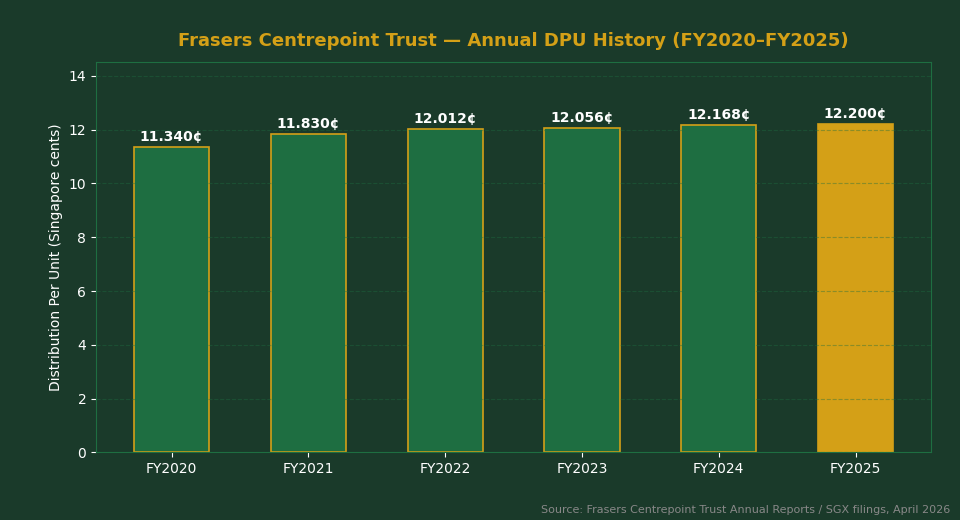
| Financial Year | DPU (Singapore cents) | YoY Change | Indicative Yield at S$2.12 |
|---|---|---|---|
| FY2020 | 11.340 | — | 5.35% |
| FY2021 | 11.830 | +4.3% | 5.58% |
| FY2022 | 12.012 | +1.5% | 5.66% |
| FY2023 | 12.056 | +0.4% | 5.69% |
| FY2024 | 12.168 | +0.9% | 5.74% |
| FY2025 (latest) | ~12.200 | +0.3% | ~5.75% |
Source: FCT Annual Reports, SGX filings, April 2026. Yield calculated at S$2.12 unit price. FY2025 DPU is approximate.
FCT distributes income semi-annually — investors receive two DPU payments per year, typically in March and September. This differs from some REITs that pay quarterly, so Singapore investors should factor this into their income planning calendar. If you are building a passive income Singapore portfolio, combining FCT with quarterly-paying REITs can smooth your monthly cash flow.
Yield on cost example: A Singapore investor who bought 20,000 FCT units at S$2.00 (the October 2023 low) paid S$40,000. At an FY2025 DPU of 12.20 cents, they collect S$2,440 per year — a yield on cost of 6.1%. Compare this to a new buyer at today’s S$2.12 who earns the same S$2,440 on a S$42,400 investment — yield on cost of 5.75%. The gap illustrates the compounding advantage of buying on weakness.
Portfolio: FCT’s 9 Suburban Malls
FCT’s portfolio is 100% Singapore-focused — a deliberate concentration strategy that gives it deep local market expertise and eliminates foreign currency and political risks that affect pan-Asian REITs. All nine malls are suburban community centres, strategically positioned at or adjacent to MRT stations, bus interchanges, and HDB estates.
| Mall | Location | NLA (sqft approx.) | Anchor Tenant |
|---|---|---|---|
| Causeway Point | Woodlands | ~567,000 | NTUC FairPrice Finest |
| Northpoint City North Wing | Yishun | ~230,000 | NTUC FairPrice Finest |
| Waterway Point | Punggol | ~371,000 | Don Don Donki, Golden Village |
| Changi City Point | Changi Business Park | ~218,000 | Sheng Siong, Cold Storage |
| Century Square | Tampines | ~218,000 | Shaw Theatres, NTUC FairPrice |
| Tiong Bahru Plaza | Tiong Bahru | ~237,000 | NTUC FairPrice |
| White Sands | Pasir Ris | ~217,000 | NTUC FairPrice |
| Hougang Mall | Hougang | ~236,000 | NTUC FairPrice |
| Tampines 1 | Tampines | ~246,000 | H&M, Don Don Donki |
Source: FCT Investor Presentation, April 2026. NLA figures are approximate and rounded.
The flagship property, Causeway Point, is the largest suburban mall in northern Singapore and a dominant catchment-area mall for Woodlands, Marsiling, and Admiralty. It consistently delivers over 30 million visitor footfalls per year and anchors FCT’s portfolio value. Waterway Point in Punggol is another growth engine — serving Singapore’s youngest town where HDB population density and consumer spending power continue to rise.
Portfolio occupancy has held near 99% consistently — among the highest in the SGX REIT universe — driven by the inelastic demand for necessity retail services within these catchment communities. This near-full occupancy provides FCT’s management with strong leverage in lease renewal negotiations, supporting positive rental reversions.
Financial Health: Gearing, ICR & Debt Maturity
FCT’s balance sheet is one of its most underappreciated strengths. With a gearing ratio of approximately 39% — well below the MAS regulatory cap of 50% — FCT has meaningful debt headroom to fund acquisitions without equity dilution. This headroom is a key competitive advantage in an environment where acquisition-driven DPU growth is the primary lever for S-REITs.
The interest coverage ratio (ICR) of approximately 2.3x — measured as net property income divided by interest expenses — sits comfortably above MAS’s minimum guidance threshold of 2.0x (below which MAS restricts borrowings above 45%). FCT’s suburban mall NPI is highly stable and predictable, making ICR management straightforward. You can model FCT’s gearing headroom using the S-REIT Gearing Ratio & ICR Calculator.
FCT proactively manages its debt maturity profile to avoid refinancing cliff risk. As at their most recent results, the weighted average debt maturity was approximately 2.6 years, with no single year representing an oversized debt maturity wall. The majority of FCT’s debt is on fixed rates or has been hedged via interest rate swaps — reducing its near-term sensitivity to short-term Singapore interbank rate (SORA) movements.
From a Singapore investor’s perspective, FCT’s conservative balance sheet makes it a suitable CPF investment strategy candidate for those using CPFIS to invest in S-REITs — the low gearing and high occupancy give it a more bond-like income profile than higher-geared peers.
FCT Yield vs Peers: Singapore Retail & Commercial REITs
How does FCT’s ~5.5% yield stack up against its S-REIT peers? The table below compares FCT against the major Singapore retail and commercial REITs as at April 2026. Note that higher yields often reflect higher risk, higher gearing, or portfolio concentration risk — not simply more attractive investment cases.
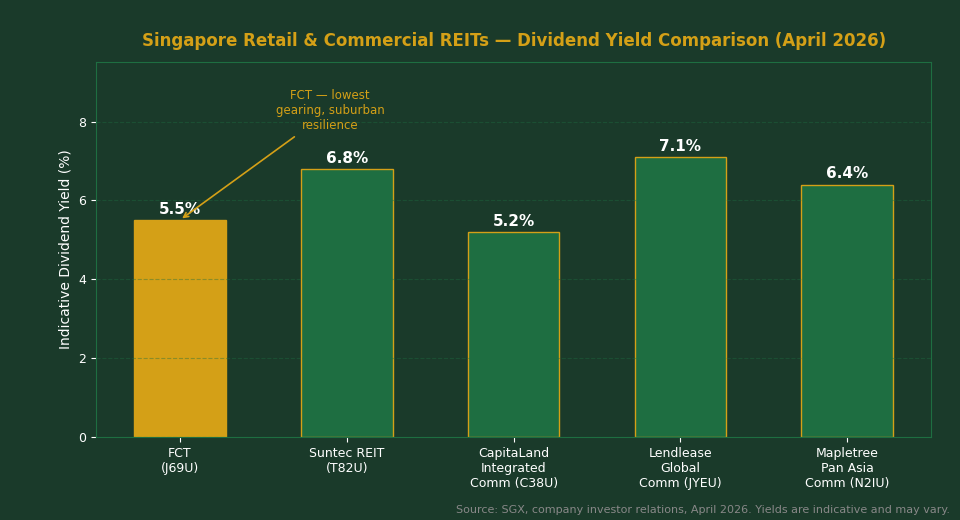
| REIT (Ticker) | Indicative Yield | Gearing | Focus |
|---|---|---|---|
| Frasers Centrepoint Trust (J69U) | ~5.5% | ~39% | Pure suburban SG retail |
| CapitaLand Integrated Comm (C38U) | ~5.2% | ~42% | Retail + office (mixed) |
| Suntec REIT (T82U) | ~6.8% | ~42% | Office + retail + overseas |
| Mapletree Pan Asia Comm (N2IU) | ~6.4% | ~40% | Pan-Asia office/retail |
| Lendlease Global Comm (JYEU) | ~7.1% | ~38% | Retail + office (SG + Italy) |
Source: SGX, company investor relations, April 2026. Yields and gearing are indicative and may change. Not investment advice.
FCT’s ~5.5% yield is at the lower end compared to peers offering 6–7%. However, this reflects its premium positioning: 100% Singapore exposure, near-full occupancy, lowest execution risk, and the strongest suburban footfall defensiveness. Investors who prioritise capital preservation and income reliability — over maximum yield — often prefer FCT to higher-yielding but more complex peers. For those seeking higher yield with more risk, compare FCT against the best S-REITs in Singapore 2026.
Why Singapore Investors Hold FCT in Their Portfolios
FCT consistently appears in the core holdings of Singapore income investors for several structural reasons that go beyond raw yield:
1. Necessity retail is recession-resistant. Unlike discretionary retailers (fashion, luxury, electronics), FCT’s anchor tenants — supermarkets, clinics, enrichment centres, and food courts — serve non-deferrable spending needs. During economic downturns, consumers trade down from malls to suburban shops, not away from them. This was demonstrated clearly during 2020 when FCT’s occupancy barely dipped while CBD retail saw sharp vacancy increases.
2. Singapore’s suburban population is growing. The Singapore government’s long-term urban planning continuously drives HDB population density to towns like Punggol, Woodlands, and Tampines — all served by FCT malls. The Waterway Point extension in Punggol and Northpoint’s proximity to Yishun New Town position FCT to benefit from demographic tailwinds for decades.
3. Strong sponsor pipeline. Frasers Property owns additional suburban retail assets not yet in the FCT portfolio — giving FCT a credible acquisition pipeline. Sponsor-backed REITs with clear right-of-first-refusal (ROFR) arrangements can grow DPU through acquisitions without the execution risk of acquiring third-party assets at competitive prices.
4. CPF-eligible investment. FCT is approved under the CPF Investment Scheme (CPFIS-OA), allowing Singapore investors to use their CPF Ordinary Account savings to buy units. This makes it particularly attractive for Singaporeans looking to generate returns above the CPF OA’s 2.5% floor rate. Use the CPF Investment Scheme (CPFIS) Calculator to model how adding FCT might affect your CPF portfolio.
5. Consistent semi-annual income stream. For retirees and near-retirement investors building a Singapore retirement plan, FCT’s semi-annual DPU payment (March and September) provides a reliable income anchor that complements CPF LIFE payouts and other investments.
Key Risks to Consider Before Investing in FCT
FCT is widely regarded as a defensive S-REIT, but no investment is without risk. Informed investors should weigh these factors:
Interest rate sensitivity. Like all REITs, FCT’s unit price is inversely sensitive to interest rate expectations. When bond yields rise, REITs become less attractive relative to fixed income alternatives. FCT’s ~39% gearing means rising SORA rates also increase interest expenses, compressing distributable income. During the 2022–2023 rate hike cycle, FCT’s unit price fell ~20% from its peak despite stable operational performance.
E-commerce and retail structural shift. While FCT’s necessity-retail anchor tenants are largely insulated from e-commerce disruption, ancillary tenants (fashion, electronics, lifestyle) face ongoing pressure from online competition. FCT’s management actively manages this through tenant remixing — replacing weaker retail tenants with F&B, services, and experiential concepts that cannot be replicated online. Investors should monitor the tenant mix annually.
Rental reversion risk. FCT’s leases typically have 2–3 year tenures. During lease renewals, if market rents soften — for example, during an economic downturn — FCT may face negative rental reversions that drag DPU growth. With portfolio WALE of ~1.8 years, a significant portion of the portfolio renews each year, exposing FCT to prevailing market rent conditions.
Concentration in Singapore. Being 100% Singapore-focused is both a strength and a limitation. Any Singapore-specific shock — a severe recession, major policy change, or a new HDB town requiring years of population build-up — affects FCT’s entire portfolio simultaneously. Unlike pan-Asian REITs, FCT has no geographic diversification buffer.
Acquisition execution risk. FCT’s future DPU growth depends heavily on executing accretive acquisitions. If Frasers Property does not inject pipeline assets on favourable terms, or if acquisition prices prove too high relative to the NPI yield, DPU growth could stall. Compare this risk profile against the broader S-REIT landscape using the Singapore REIT ETF guide for a diversified alternative approach.
How to Buy FCT (J69U) in Singapore
FCT is listed on the SGX Mainboard and can be purchased through any Singapore-licensed brokerage in board lots of 100 units. At a unit price of ~S$2.12, a single board lot costs approximately S$212 — making it accessible to retail investors. Here is a step-by-step overview:
Step 1 — Open a brokerage account. You need a CDP-linked brokerage or a custodian account. Brokerages commonly used by Singapore S-REIT investors include IBKR (Interactive Brokers), Syfe Trade, FSMOne, and MooMoo Singapore. Each has different fee structures — commission, platform fees, and FX spreads — that affect your effective yield. Use the Brokerage Fee Calculator to compare costs across platforms before committing.
Step 2 — Fund your account. Fund with SGD directly to avoid FX conversion fees, as FCT trades in Singapore dollars on SGX.
Step 3 — Search for J69U and place a limit order. Use the ticker J69U on your brokerage’s trading platform. Place a limit order at your target entry price rather than a market order to avoid slippage on lower-liquidity days. FCT typically trades 2–5 million units per day, so liquidity is adequate for retail investors.
Step 4 — DPU payment. Dividends are credited to your bank account (for CDP-linked accounts) or custodian account semi-annually, typically within 4–6 weeks after the ex-dividend date announcement. Keep an eye on FCT’s SGX announcements for the ex-date and payment date each cycle.
If you prefer a diversified approach rather than picking individual S-REITs, consider platforms like Syfe or Endowus, which offer managed S-REIT portfolios that include FCT alongside other REITs — suitable for investors who want S-REIT exposure without single-stock concentration risk. Alternatively, FSMOne offers a low-cost platform for direct SGX trading of FCT and other S-REITs.
FAQ — Frasers Centrepoint Trust (J69U)
What is Frasers Centrepoint Trust and what does it own?
What is FCT's current dividend yield in 2026?
Is FCT a safe investment for Singapore retirees?
How often does FCT pay dividends?
Can I use CPF to buy Frasers Centrepoint Trust?
What is FCT's gearing ratio and is it safe?
How does FCT compare to CapitaLand Integrated Commercial Trust (CICT)?
This article was researched with the help of AI. While we strive to keep all information accurate and up to date, there may be errors. If you notice any discrepancies, please contact us.