Keppel DC REIT and the AI Boom: What Surging Data Centre Demand Means for DPU (2026)
S-REITs Analysis • Updated October 2026 • SGX: AJBU
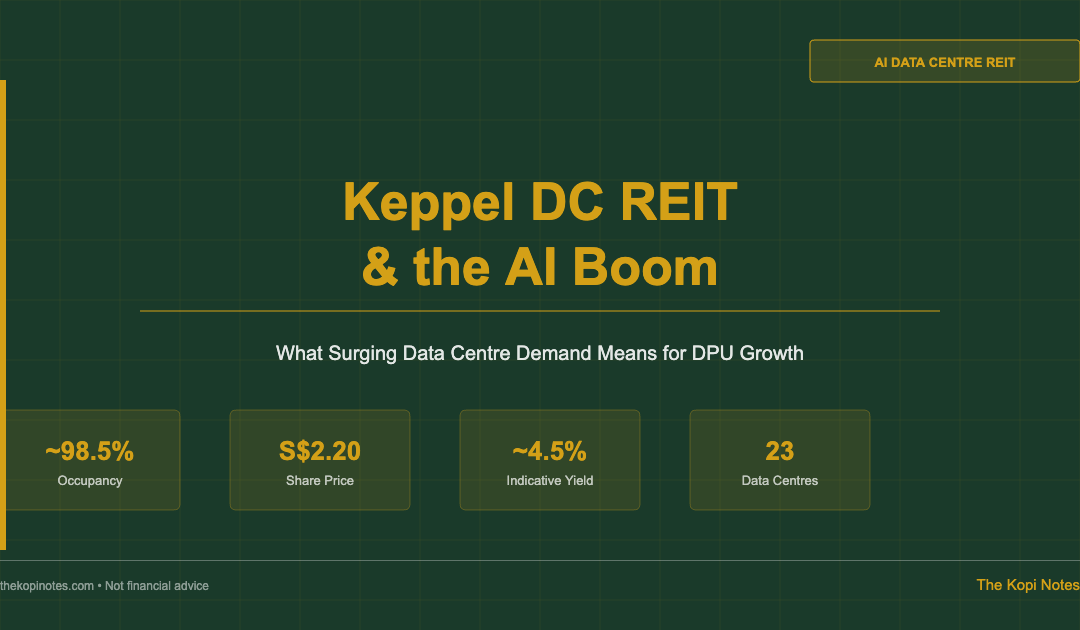
Keppel DC REIT (SGX: AJBU) is Singapore’s largest listed data centre REIT, owning 23 facilities across nine countries with a portfolio value of approximately S$3.8 billion. The AI boom — driven by hyperscalers like Microsoft, Alibaba, and Google racing to build GPU compute capacity — is creating structural demand for data centre space that directly benefits KDC’s occupancy, rental reversions, and DPU growth. At a share price of around S$2.20 and an indicative yield of ~4.5%, here is what the AI tailwind means for Singapore REIT investors.
Not financial advice. All figures are for educational reference only and based on publicly available data. Data as at October 2026 unless noted.
What Is the AI Boom and Why Do Data Centres Matter?
The artificial intelligence supercycle is reshaping global infrastructure spending at a pace not seen since the smartphone revolution. Training a single large language model like GPT-4 required roughly 25,000 specialised NVIDIA A100 GPUs running continuously for weeks. Inference — actually running that model to answer user queries at scale — demands even more sustained compute throughput. This GPU-intensive workload is dramatically different from traditional enterprise IT.
A standard enterprise server rack draws 3-8 kilowatts of power. An AI GPU rack draws 50-100 kilowatts — sometimes more. This tenfold increase in power density per rack means that even as the physical number of servers grows modestly, the electrical and cooling infrastructure requirements explode. Data centres must be entirely redesigned to handle liquid cooling, higher floor loading, and redundant power supply at scale.
According to the International Energy Agency’s Electricity 2024 report, global data centre electricity consumption is projected to double by 2028, reaching approximately 800 gigawatts. Goldman Sachs Research estimates AI data centre capacity requirements alone will consume 3-4 times more power per comparable workload versus legacy cloud. For landlords of data centre facilities — specifically REITs like Keppel DC REIT — this structural shift translates into three durable tailwinds: near-zero vacancy, positive rental reversion, and strengthening tenant credit quality.
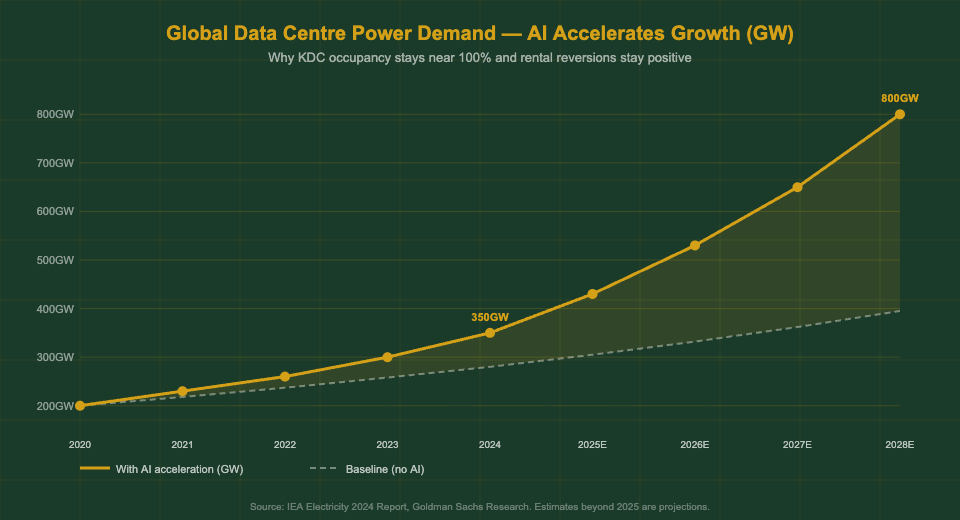
Source: IEA Electricity 2024 Report, Goldman Sachs Research. Estimates beyond 2025 are projections. Not financial advice.
Keppel DC REIT’s AI-Ready Portfolio
Keppel DC REIT listed on the SGX in December 2014 as Asia’s first pure-play data centre REIT. As at mid-2026, its portfolio comprises 23 data centres across nine countries — Singapore, Australia, Germany, Ireland, Netherlands, United Kingdom, Italy, Japan, and Malaysia — with a total lettable area of approximately 480,000 square metres.
What makes KDC particularly well-positioned for the AI boom is its tenant mix. Unlike retail or office REITs that depend on hundreds of small tenants, KDC’s key tenants are hyperscalers and large cloud providers — names like Microsoft, Alibaba Cloud, Google, and major European colocation operators. These tenants are actively expanding their AI compute capacity and typically sign long master leases of 10-20 years, providing KDC with exceptional income visibility.
| Metric | KDC (AJBU) | Peer Average | Significance |
|---|---|---|---|
| Portfolio Size | 23 assets, 9 countries | 8-15 assets | ✅ Diversified |
| Occupancy Rate | ~98.5% | 92-95% | ✅ Best-in-class |
| WALE (yrs) | ~7.6 years | 4-6 years | ✅ Long income visibility |
| Gearing Ratio | ~37.5% | 38-42% | ✅ Conservative leverage |
| Key Tenant Type | Hyperscalers / Cloud | Enterprise IT | ✅ AI-driven demand |
| Indicative Yield | ~4.5% | 3.5-5.0% | ⚠️ Mid-range for sector |
Source: Keppel DC REIT H1 2026 Results, TKN research (October 2026). Peer average is illustrative. Not financial advice.
Singapore remains KDC’s largest geography, contributing approximately 30% of total net property income. Singapore’s strategic position as Southeast Asia’s digital hub — underpinned by MAS-regulated financial infrastructure, excellent connectivity, and political stability — means hyperscalers continue to prefer Singapore as a regional AI hub. New greenfield data centre capacity in Singapore is strictly controlled by the government, reinforcing the scarcity premium on existing stock like KDC’s.
Occupancy, Rental Reversions, and DPU Impact
One of the most direct ways AI demand feeds into KDC’s DPU is through rental reversions at lease renewal. Because hyperscaler tenants are competing for scarce AI-grade data centre capacity, they are willing to pay meaningfully higher rents when leases roll. KDC has reported positive rental reversions consistently since FY2022 — a trend that should continue as AI workloads crowd out traditional cloud.
The mechanism is straightforward: when a 10-year lease signed in 2015 comes up for renewal in 2025, the new market rent reflects the AI-era power density premium. A facility that previously earned S$180-200 per square foot per annum may now renew at S$230-280, depending on location and power specification. Over a portfolio of 23 assets, even a mid-single-digit rental reversion on expiring leases adds a visible increment to DPU each year.
KDC’s 98.5% occupancy rate provides minimal scope for occupancy-driven upside — the portfolio is essentially full. This means DPU growth must come primarily from rental reversions (positive for AI-era tenants), asset enhancements (increasing power capacity and therefore rentable value per facility), and selective acquisitions in undersupplied AI data centre markets.
Singapore investors can access KDC’s income stream conveniently via Syfe referral code and sign-up bonus or FSMOne referral code, both of which offer REIT-focused portfolio products with KDC as a constituent. For broader S-REIT exposure, our best S-REITs in Singapore 2026 guide compares yields, gearing, and DPU trends across the sector.
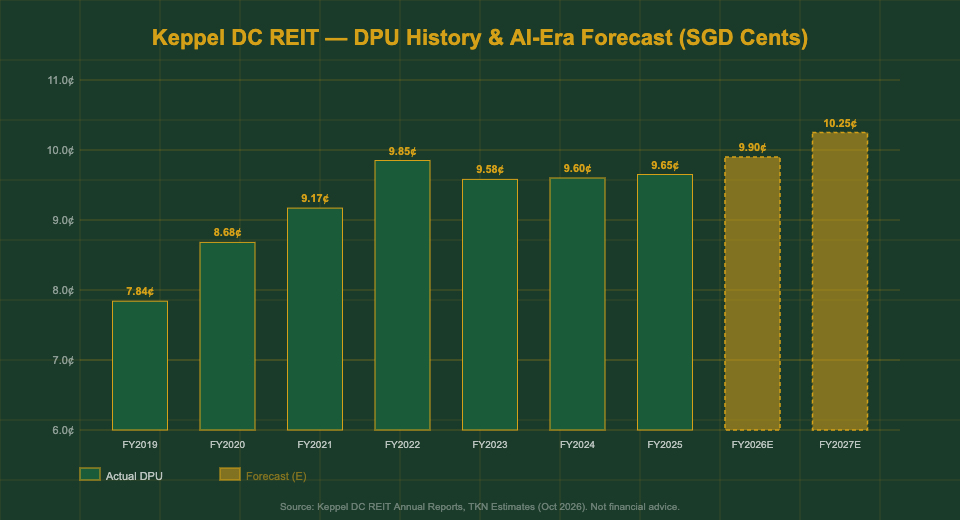
Source: Keppel DC REIT Annual Reports, TKN Estimates. FY2026E and FY2027E are analyst estimates and should not be relied upon. Not financial advice.
DPU History and AI-Era Forecast
Keppel DC REIT has delivered a broadly growing DPU since listing in 2014, though FY2023-FY2024 saw a temporary plateau as higher interest costs weighed on distributable income. With the US Federal Reserve’s rate-cutting cycle now underway, the interest cost headwind is receding — and the AI demand tailwind is providing a structural offset through rental reversion.
| Financial Year | DPU (SGD cents) | YoY Change | Key Driver |
|---|---|---|---|
| FY2019 | 7.84c | – | Portfolio expansion, Singapore anchor |
| FY2020 | 8.68c | +10.7% | COVID-19 digitalisation surge |
| FY2021 | 9.17c | +5.6% | Acquisitions in Europe, Australia |
| FY2022 | 9.85c | +7.4% | Peak pre-rate-hike earnings |
| FY2023 | 9.58c | -2.7% | Higher interest costs, FX headwinds |
| FY2024 | 9.60c | +0.2% | Stabilisation; first Fed cuts |
| FY2025 | 9.65c | +0.5% | AI reversion uplift beginning |
| FY2026E | ~9.90c | ~+2.6% | Rental reversion, lower hedging cost |
| FY2027E | ~10.25c | ~+3.5% | Full AI-driven reversion cycle |
FY2026E and FY2027E are TKN estimates based on consensus data and public disclosures. They are not guaranteed. Source: KDC Annual Reports, TKN research (October 2026).
The DPU plateau in FY2023-FY2024 was driven primarily by a sharp rise in financing costs — KDC’s all-in cost of debt rose from around 1.8% in FY2021 to approximately 3.8% by FY2023. With the US Fed having cut rates by 100 basis points since late 2024, and KDC progressively refinancing legacy high-cost debt, the interest headwind should gradually reverse. Meanwhile, AI-driven rental reversions provide a separate upward lift.
For investors building a passive income Singapore portfolio, KDC’s combination of near-full occupancy and a recovering DPU trajectory makes it a core holding in most data centre allocation frameworks. Pair it with our Singapore retirement calculator to see how KDC income compounds toward your retirement number.
Key Risks to Watch
No investment thesis is complete without acknowledging the risks. KDC’s AI data centre narrative is compelling, but several factors could impair the expected DPU recovery:
1. AI Capex Cycle Could Pause: If hyperscalers like Microsoft, Alphabet, or Alibaba pull back on AI infrastructure spend — due to delayed AI monetisation, regulatory headwinds, or a funding crunch — demand for new colocation leases could slow. KDC’s long WALE provides buffer, but new incremental demand drives the reversion story.
2. Singapore Electricity Cost Inflation: Singapore data centres face higher electricity tariffs than European peers. If energy costs rise sharply, tenant margins compress, potentially making lease renewal negotiations harder. KDC’s master-lease structure shifts some energy cost risk to tenants, but not universally.
3. Currency Headwinds: KDC earns in EUR, GBP, AUD, and JPY — none of which have been strong versus SGD in recent years. A prolonged strong-SGD environment reduces the SGD-reported DPU from overseas facilities.
4. Rising Competition: New data centre REITs and private infrastructure funds are entering Asia markets, potentially compressing cap rates or competing for the same tenants. Singapore’s moratorium on new greenfield data centres partially protects KDC, but competing supply in Australia, Germany, and Ireland is increasing.
5. Concentration Risk: KDC’s top 10 tenants account for a significant share of rental income. Loss of one major hyperscaler lease could create a material occupancy gap, even if temporarily.
For context, the Singapore T-bills 2026 guide shows the risk-free rate at ~1.95% for 6-month paper — KDC’s ~4.5% yield represents roughly 2.5 percentage points of risk premium over the risk-free rate, which is reasonable compensation for the above risks in the current environment.
Investment Outlook for 2026-2027
Keppel DC REIT occupies a rare structural sweet spot: it owns physical infrastructure essential to the AI economy, located in markets where new supply is constrained, leased to investment-grade tenants on long-term contracts, with a recovering distribution income trajectory as interest costs normalise.
For Singapore retail investors, the key decision variables are: Entry Price Discipline — at S$2.20 and a P/Book of approximately 1.5x, KDC is not cheap by historical standards, but the premium reflects the market’s recognition of AI data centre scarcity. Investors comfortable holding 3-5 years are better positioned to absorb short-term price volatility. Dividend Reinvestment — KDC does not offer a formal DRIP, so cash distributions must be manually reinvested; over a 10-year horizon the compounding effect is meaningful, particularly for investors supplementing CPF income. Our CPF investment strategy article discusses how KDC fits within the CPFIS-OA framework. Portfolio Weight — data centre REITs are higher-beta within the S-REIT universe; a 5-10% allocation within a diversified S-REIT portfolio is a sensible starting point.
Investors can access KDC through Endowus referral code (via CPF or SRS), or directly through brokers such as IBKR (referral code: jianxiong368). For managed exposure to the broader S-REIT universe including KDC, our Syfe referral code and sign-up bonus page covers the SREIT portfolio option.
Frequently Asked Questions About Keppel DC REIT and AI Demand
Does the AI boom directly benefit Keppel DC REIT DPU?
What is Keppel DC REIT current yield and is it attractive?
Can I buy Keppel DC REIT through CPF?
How does Keppel DC REIT compare to Mapletree Industrial Trust for AI exposure?
What is Keppel DC REIT gearing ratio and is there room to acquire?
What would cause Keppel DC REIT DPU to fall?
This article was researched with the help of AI. While we strive to keep all information accurate and up to date, there may be errors. If you notice any discrepancies, please contact us.