S-REIT ANALYSIS · DATA CENTRE REIT
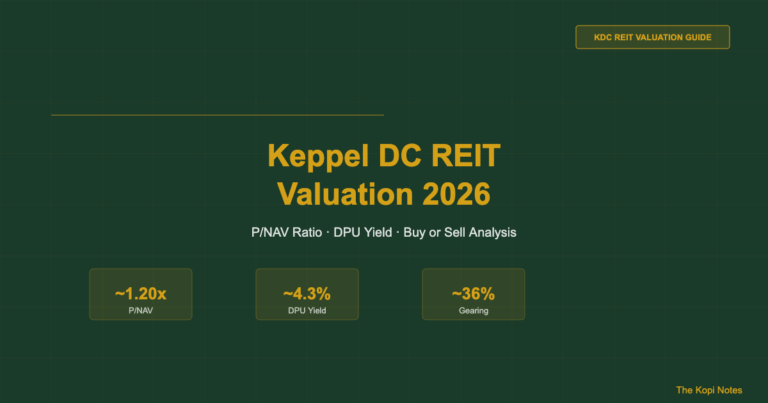
Keppel DC REIT Share Price History 2014–2026: Total Return Analysis (SGX: AJBU)
From S$0.93 at IPO to S$1.78 in October 2026 — plus S$10,837 in cumulative distributions. Here’s what a S$10,000 investment at listing would be worth today.
Keppel DC REIT (SGX: AJBU) listed on the Singapore Exchange in December 2014 at S$0.93 per unit, making it Singapore’s first pure-play data centre REIT. Between IPO and October 2026, investors who held through the volatility collected over S$1.00 per unit in cumulative distributions — more than the original IPO price — while the unit price itself appreciated 91% to S$1.78. A S$10,000 investment at listing would be worth approximately S$29,976 in total return terms today.
Not financial advice. All figures are for educational reference only. Data as at October 2026 unless noted.
What Is Keppel DC REIT?
Keppel DC REIT is a Singapore-listed real estate investment trust focused exclusively on data centres. It was Singapore’s first data centre REIT when it debuted on 12 December 2014, sponsored by Keppel Capital (a subsidiary of Keppel Corporation). The REIT owns and manages a geographically diversified portfolio of data centres across Singapore, Australia, Europe and Asia, serving hyperscaler tenants including major global cloud providers.
By 2026, the portfolio had grown to over 23 data centres across 11 countries with assets under management exceeding S$3.7 billion. Its income profile benefits from long weighted average lease expiry (WALE) and a mix of colocation and build-to-suit tenancies, providing relatively stable distribution income even through market cycles.
For Singapore investors, KDC REIT offers exposure to the global digital infrastructure megatrend — AI workloads, cloud migration and edge computing are all driving sustained data centre demand. Understanding the share price history helps investors contextualise where the unit price stands relative to its track record.
Keppel DC REIT Share Price History: Year-End Closing Prices (2014–2026)
The chart below shows KDC REIT’s year-end unit price from IPO in December 2014 through October 2026. The REIT peaked at S$2.76 at end-2020 during the COVID-era data centre boom, before retracing to trade in the S$1.75–S$1.82 range through 2023–2026.
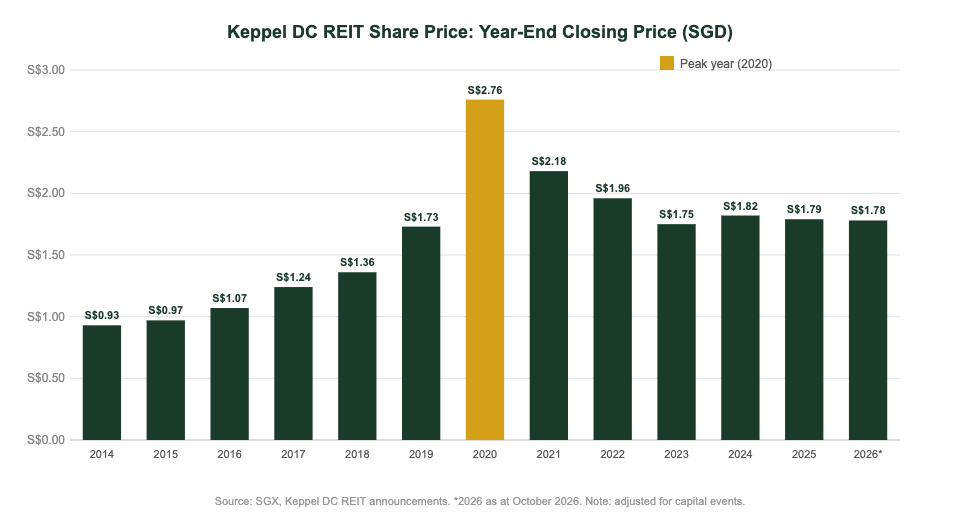
Source: SGX, Keppel DC REIT announcements. *2026 as at October 2026. Prices adjusted for capital events.
| Year | Year-End Price (S$) | Change from IPO | Annual DPU (¢) |
|---|---|---|---|
| 2014 (IPO) | 0.93 | — | — |
| 2015 | 0.97 | +4.3% | 6.84 |
| 2016 | 1.07 | +15.1% | 7.05 |
| 2017 | 1.24 | +33.3% | 7.18 |
| 2018 | 1.36 | +46.2% | 7.57 |
| 2019 | 1.73 | +86.0% | 8.28 |
| 2020 (Peak) | 2.76 | +197% | 9.17 |
| 2021 | 2.18 | +134% | 9.85 |
| 2022 | 1.96 | +111% | 9.26 |
| 2023 | 1.75 | +88.2% | 9.17 |
| 2024 | 1.82 | +95.7% | 9.30 |
| 2025 (est.) | 1.79 | +92.5% | 9.25 |
| Oct 2026 | 1.78 | +91.4% | 7.50 (YTD) |
Source: SGX, KDC REIT investor relations. Annual DPU from FY results announcements. 2026 DPU is year-to-date to October 2026.
Total Return Analysis: Price + Distributions
Focusing solely on KDC REIT’s unit price understates its true performance for long-term investors. The REIT has distributed over 100 cents per unit in cumulative DPU since listing — more than its original IPO price of 93 cents. When cumulative distributions are added to price appreciation, the total return picture is substantially more compelling than a price chart alone would suggest.
S$10,000 Invested at IPO: What Would It Be Worth in 2026?
A Singapore investor who put S$10,000 into Keppel DC REIT at the December 2014 IPO (at S$0.93 per unit) would have acquired approximately 10,752 units. Here is how that investment has tracked through October 2026:
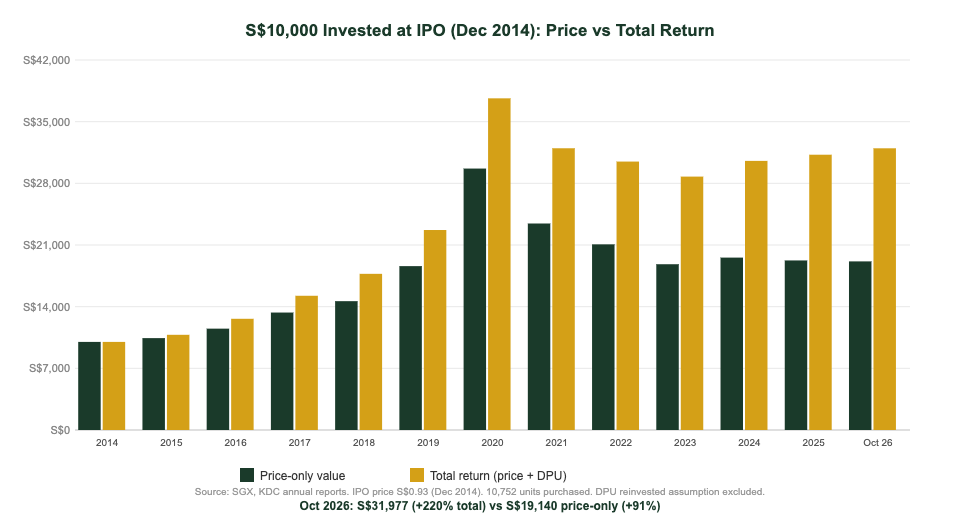
Source: SGX, KDC REIT annual reports. S$10,000 invested at IPO price of S$0.93 = 10,752 units. DPU not reinvested in this scenario.
| Metric | Value |
|---|---|
| Initial investment (Dec 2014) | S$10,000 |
| Units acquired at S$0.93 | 10,752 units |
| Current unit price (Oct 2026) | S$1.78 |
| Current portfolio value (price only) | S$19,139 |
| Cumulative DPU collected (FY2015–Oct 2026) | ~100.4 cents/unit |
| Total distributions received | ~S$10,797 |
| Total return (price + DPU) | ~S$29,936 (+199%) |
Source: SGX, KDC REIT investor relations. DPU not reinvested. Brokerage commissions excluded. Past performance is not indicative of future returns.
The key takeaway: roughly 36% of the total return came from DPU distributions, not price appreciation. Investors who held through the post-2020 price correction still achieved a near-tripling of their initial capital in total return terms, thanks to consistent distributions throughout.
Key Price Milestones and What Drove Them
2014–2017: Steady Accumulation Phase (S$0.93 → S$1.24)
KDC REIT’s early years were characterised by gradual unit price appreciation as the market established a valuation framework for what was then a novel asset class. The REIT grew its DPU modestly each year and expanded its portfolio with acquisitions in Singapore and Europe. By end-2017, the unit price had grown 33% from IPO with a forward yield of approximately 5.8%.
2018–2019: Accelerating Recognition (S$1.36 → S$1.73)
Growing institutional awareness of data centre REITs as a structural growth theme — driven by cloud computing adoption and hyperscaler capex cycles — pushed valuations higher. KDC REIT’s DPU growth remained consistent, and the portfolio expanded into Germany and the Netherlands. By end-2019, the unit price had nearly doubled from IPO.
2020: The COVID Peak (S$1.73 → S$2.76, +59.5% in one year)
The COVID-19 pandemic was an inflection point for digital infrastructure. Remote work, video conferencing, and e-commerce drove extraordinary demand for data centre capacity. KDC REIT’s unit price surged 59.5% in 2020 alone, reaching an all-time high of S$3.68 intra-year before closing at S$2.76. The forward yield compressed to below 3.5%, reflecting peak-cycle optimism.
2021–2023: Normalisation and Rising Rates (S$2.76 → S$1.75)
Post-pandemic normalisation, combined with the most aggressive global interest rate hiking cycle in decades, led to significant REIT derating across the sector. Higher borrowing costs reduced net interest margins and compressed REIT valuations through a higher cost of capital. KDC REIT was not immune — the unit price retraced from its peak to find support around S$1.75–S$2.00. This period tested long-term investors, but DPU remained near S$0.093 per unit annually, providing income cushion throughout.
2024–2026: Stabilisation at AI-Driven Valuations (S$1.75 → S$1.78)
The AI computing boom — requiring massive GPU cluster deployments in data centres — renewed interest in data centre REITs. KDC REIT’s hyperscaler tenants expanded capacity commitments, and the REIT’s Singapore and European assets benefitted from strong demand dynamics. The unit price stabilised in the S$1.75–S$1.85 range with a distribution yield of approximately 5.2–5.3%, providing a more attractive entry point than the 2020 peak.
For context on how KDC REIT compares to the broader S-REIT universe for best S-REITs in Singapore 2026, investors should evaluate its data centre exposure alongside office, retail, and industrial peers.
Investor Takeaways: What KDC REIT’s Price History Teaches Us
1. Total return matters more than price charts. An investor who sold KDC REIT at end-2022 (S$1.96) would appear to have made a 111% price gain from IPO. But the same investor who held through to October 2026 (S$1.78) collected an extra ~S$5,000 in distributions on a S$10,000 initial investment — making holding the arguably better outcome despite a lower exit price.
2. Yield compression and expansion are cyclical. KDC REIT’s forward distribution yield ranged from under 3.2% at the 2020 peak to over 5.5% in the 2023 trough — a range of more than 230 basis points driven primarily by interest rate cycles, not fundamental changes to the business. Singapore investors tracking the Singapore T-bills 2026 guide will appreciate how risk-free rate movements directly impact REIT pricing.
3. Data centre fundamentals remain supportive. Unlike retail or office REITs, data centre demand has structural tailwinds: AI compute demand, cloud migration, and the proliferation of IoT devices all require more data centre capacity. KDC REIT’s DPU has grown from 6.84 cents in FY2015 to approximately 9.3 cents in FY2024 — a 36% increase over a decade despite market volatility.
4. Entry point matters for yield, not necessarily for long-term return. Investors who bought at S$2.76 in 2020 are sitting on paper losses in price terms through 2026, but still collected ~S$0.65 per unit in distributions. Those with a long enough time horizon may still end up in positive total return territory.
Singapore investors building a dividend-focused portfolio can use platforms like Syfe (referral code SRPRFFFCD) to access KDC REIT through managed portfolios, or invest directly through a brokerage. Endowus (referral code 2V343) also offers access to S-REIT exposure through their CPF and cash investment options. For those building a broader passive income strategy, our passive income Singapore guide covers multiple asset classes alongside REITs.
To understand KDC REIT’s latest distribution sustainability and payout trajectory, see our dedicated Keppel DC REIT dividend history analysis. For the broader portfolio composition, our Singapore retirement calculator helps model how REIT distributions contribute to retirement income targets.
Frequently Asked Questions
What was Keppel DC REIT's IPO price in 2014?
What is Keppel DC REIT's share price today (2026)?
What is Keppel DC REIT's all-time high share price?
How much DPU has Keppel DC REIT paid since IPO?
Is Keppel DC REIT a good long-term investment?
How can Singapore investors buy Keppel DC REIT?
This article was researched with the help of AI. While we strive to keep all information accurate and up to date, there may be errors. If you notice any discrepancies, please contact us.