Keppel DC REIT Valuation 2026: P/NAV Ratio, DPU Yield & Is It Worth Buying?
Updated: October 2026 | Category: S-REITs | Est. read: 9 min
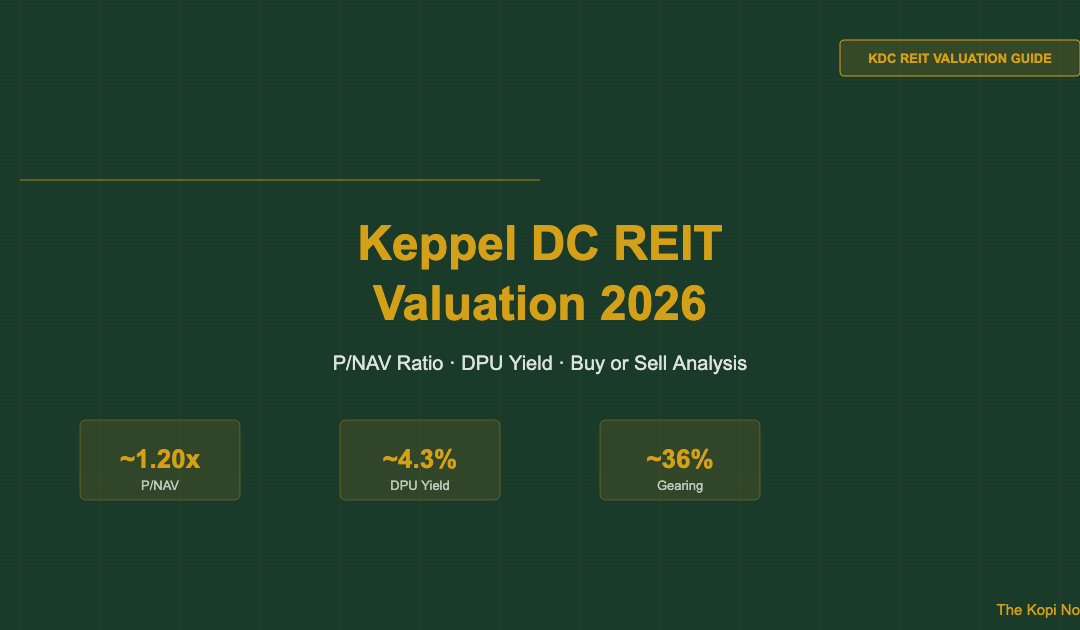
Keppel DC REIT (SGX: AJBU) is Singapore’s largest pure-play data centre REIT, owning 23 data centres across 8 countries with a total assets under management of approximately SGD 3.7 billion. As at October 2026, it trades at around 1.20x book value (P/NAV) with a forward DPU yield of approximately 4.3%. While the AI-driven data centre demand tailwind justifies a premium valuation, investors need to weigh the lower yield against peers. Here is our complete 2026 valuation breakdown.
Not financial advice. All figures are for educational reference only. Data as at October 2026 unless noted.
What is Keppel DC REIT?
Keppel DC REIT (KDC REIT) was listed on the Singapore Exchange (SGX) in December 2014 as Asia’s first listed data centre REIT. It is managed by Keppel DC REIT Management Pte. Ltd., a wholly-owned subsidiary of Keppel Corporation.
The REIT’s portfolio spans 23 data centres across 8 countries including Singapore, Australia, Germany, the Netherlands, the United Kingdom, Italy, Ireland, and Malaysia. With colocation, fully-fitted, and shell-and-core lease structures, KDC REIT serves hyperscalers, cloud providers, and enterprise clients — tenant types with long weighted-average lease expiries (WALEs) that provide income stability.
The thesis behind KDC REIT is straightforward: as AI workloads, cloud adoption, and digital infrastructure demand accelerate globally, data centres become mission-critical infrastructure. Occupancy rates have remained exceptionally high — above 98% — because building new data centres requires power supply agreements, planning approvals, and technical expertise that take years to secure.
For Singapore investors, KDC REIT sits in a unique niche: it offers exposure to global digital infrastructure via a SGX-listed S-REIT with distributions paid in SGD, making it tax-efficient under Singapore’s REIT distribution framework (distributions from a listed Singapore REIT are exempt from tax at the investor level).
You can learn more about the broader S-REIT landscape in our guide to the best S-REITs in Singapore 2026 and our passive income Singapore framework.
Key Valuation Metrics at a Glance (October 2026)
Before diving into each metric, here is a snapshot of KDC REIT’s valuation dashboard as at October 2026:
| Metric | Value | Interpretation |
|---|---|---|
| Share Price (SGD) | ~2.28 | Near 52-week midrange |
| NAV per Unit (SGD) | ~1.90 | Based on latest portfolio appraisal |
| P/NAV Ratio | ~1.20x | Premium to book value |
| Forward DPU (FY2026, SGD) | ~0.099 | Estimated full-year DPU |
| DPU Yield | ~4.3% | Below S-REIT sector average |
| Gearing | ~36.2% | Below 45% MAS regulatory cap |
| Interest Coverage Ratio | ~5.2x | Healthy — above 2.5x minimum |
| Portfolio Occupancy | ~98.5% | Near-full utilisation |
| Market Capitalisation | ~SGD 4.9B | Large-cap S-REIT |
Source: SGX filings, Keppel DC REIT quarterly updates, The Kopi Notes Research (October 2026). Estimates — always verify with latest announcements.
P/NAV Analysis: Is the Premium Justified?
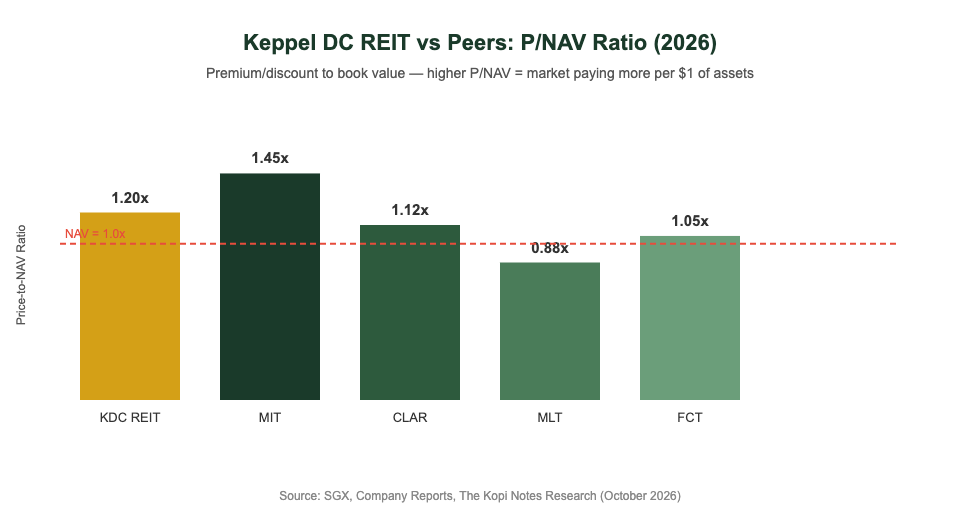
The Price-to-NAV (P/NAV) ratio is the most important valuation metric for REITs. It tells you how much the market is willing to pay per SGD 1.00 of net assets. A P/NAV of 1.20x means investors are paying SGD 1.20 for every SGD 1.00 of book value — a 20% premium.
Is a 1.20x P/NAV reasonable for KDC REIT?
For context, the broader S-REIT sector tends to trade at 0.85x–1.20x P/NAV, with higher-quality REITs (strong sponsors, long WALEs, essential infrastructure) commanding premiums. KDC REIT falls in the upper tier because:
- Irreplaceable assets: Data centres cannot be easily replaced — power supply constraints, cooling requirements, and fibre connectivity make each facility highly location-specific.
- AI demand tailwind: Hyperscalers (Amazon AWS, Microsoft Azure, Google Cloud) are signing long-term leases, anchoring occupancy and DPU visibility.
- Keppel Corporation sponsorship: Strong pipeline of deal-sourcing from Keppel’s global real estate platform.
- Near-perfect occupancy: At 98.5%, there is virtually no vacancy drag on distributable income.
However, a 1.20x P/NAV leaves limited margin of safety. If interest rates move higher or valuations are revised downward, unitholders could see capital erosion even if DPU remains stable. For income-focused investors using a Singapore retirement calculator, this downside risk matters.
Source: SGX, Company Reports, The Kopi Notes Research (October 2026)
Historical P/NAV context: KDC REIT has historically traded at a 1.1x–1.6x P/NAV premium since listing. At current levels of ~1.20x, the REIT is trading near the low end of its historical premium range — suggesting the market has already repriced some of the AI enthusiasm. This arguably provides a more attractive entry point than the 1.4x–1.5x premiums seen in 2021–2022.
DPU Yield Analysis: What Income Can You Expect?
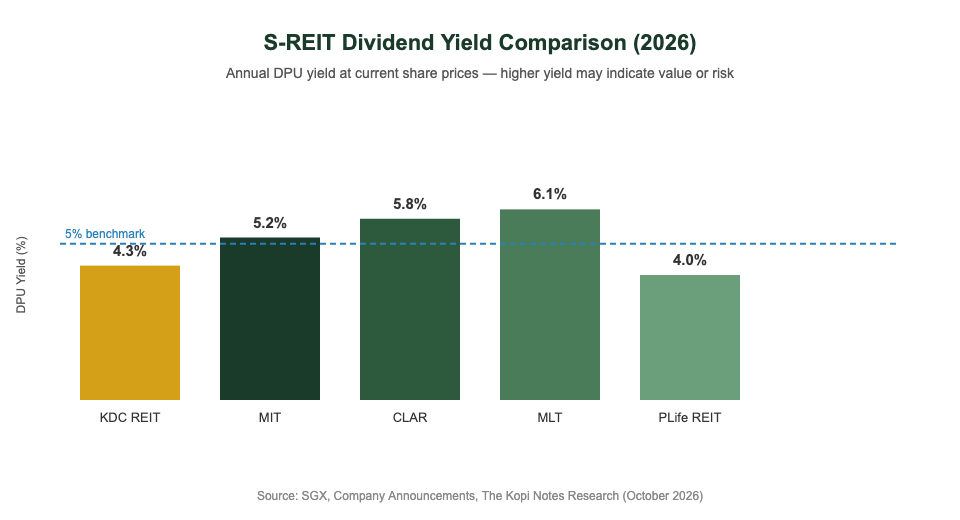
At a forward DPU of approximately SGD 0.099 and a share price of SGD 2.28, KDC REIT’s DPU yield works out to roughly 4.34% before any personal tax consideration (Singapore resident investors receive REIT distributions tax-free).
This is below the S-REIT sector average yield of approximately 5.5%–6.0%, reflecting the premium valuation the market places on data centre infrastructure.
What this means in SGD terms:
| Portfolio Size (SGD) | Units Held (approx.) | Est. Annual DPU (SGD) | Semi-Annual Payout |
|---|---|---|---|
| 10,000 | ~4,386 | ~434 | ~217 |
| 50,000 | ~21,930 | ~2,171 | ~1,086 |
| 100,000 | ~43,860 | ~4,342 | ~2,171 |
Source: Calculated at SGD 2.28/unit, SGD 0.099 DPU. For illustration only — actual DPU subject to quarterly announcements. Verify with the latest Keppel DC REIT investor relations disclosures.
KDC REIT pays distributions semi-annually, typically in March and September. For investors building a passive income stream in Singapore, this frequency is adequate but less regular than quarterly-paying REITs.
If maximising yield is your priority, consider supplementing KDC REIT with higher-yielding S-REITs — you can explore options via a Syfe referral code (use SRPRFFFCD) to access Syfe’s S-REIT-focused Income+ portfolio, or via FSMOne referral code (P0544985) for direct market access.
Source: SGX, Company Announcements, The Kopi Notes Research (October 2026)
Gearing & Financial Health
Gearing — the proportion of the REIT’s total assets financed by debt — is a critical risk metric. Under MAS regulations, Singapore REITs must maintain gearing below 45% (or 50% if interest coverage ratio exceeds 2.5x).
KDC REIT’s gearing of approximately 36.2% is comfortably below regulatory limits, and its interest coverage ratio of approximately 5.2x is well above the 2.5x threshold. This gives the REIT meaningful headroom for acquisitions without requiring a dilutive equity fundraising — an important consideration given the AI-driven acquisition pipeline Keppel has signalled.
Interest rate sensitivity: KDC REIT has actively hedged a significant portion of its debt into fixed-rate instruments. Approximately 75% of its borrowings are on fixed rates or swapped to fixed, limiting the DPU impact of near-term interest rate movements. For every 25 basis point increase in floating rates, the estimated DPU impact is approximately SGD 0.001–0.002 per unit per year — manageable but worth monitoring if rates remain elevated.
The REIT’s debt maturity profile is well-laddered, with no single year representing more than 25–30% of total borrowings, reducing refinancing concentration risk.
For investors using Endowus (referral code 2V343) to gain REIT exposure via CPF or SRS funds, note that KDC REIT is a permissible CPF investment under the CPF Investment Scheme (CPFIS) — align this with your CPF investment strategy.
Peer Comparison: KDC REIT vs Other S-REITs
No REIT valuation analysis is complete without a peer comparison. Below we compare KDC REIT against four frequently benchmarked S-REITs across the key valuation and income metrics:
| REIT | P/NAV | DPU Yield | Gearing | Occupancy | Sector |
|---|---|---|---|---|---|
| KDC REIT (AJBU) | 1.20x | 4.3% | 36.2% | 98.5% | Data Centre |
| MIT (ME8U) | 1.45x | 5.2% | 38.1% | 95.8% | Industrial/DC |
| CLAR (A17U) | 1.12x | 5.8% | 35.7% | 93.4% | Diversified Ind. |
| MLT (M44U) | 0.88x | 6.1% | 39.2% | 96.2% | Logistics |
| PLife REIT (C2PU) | 2.05x | 4.0% | 34.8% | 99.9% | Healthcare |
Source: SGX, Company Filings, Bloomberg, The Kopi Notes Research (October 2026). All estimates — cross-check with latest filings.
Key observations: KDC REIT’s 1.20x P/NAV is notably lower than Mapletree Industrial Trust’s 1.45x, despite both having significant data centre exposure. This relative discount could be a valuation opportunity — or it may reflect the market’s differentiation of MIT’s more diversified industrial portfolio versus KDC’s pure-play data centre concentration (which cuts both ways). ParkwayLife REIT commands the steepest premium (2.05x) given its healthcare-essential nature, confirming that “irreplaceable infrastructure” characteristics justify sustained premiums.
For investors looking at Syfe’s S-REIT portfolio, you can access a curated basket that includes KDC REIT using the Syfe referral code SRPRFFFCD.
Risks to the Valuation Thesis
No investment is without risk. KDC REIT’s bullish valuation rests on several key assumptions that, if disrupted, could lead to meaningful share price and DPU pressure:
1. Interest rate risk: While KDC REIT has hedged a significant portion of borrowings, the remaining floating-rate exposure creates sensitivity to policy rate movements. If rates stay “higher for longer”, refinancing costs on maturing debt could compress distributable income from 2027 onwards.
2. Customer concentration: A small number of hyperscale clients — likely representing 20–30% of total revenue — represent concentration risk. Non-renewal of a major lease or renegotiation at lower rates would materially impact DPU.
3. AI demand deceleration: Much of the current P/NAV premium is justified by AI-driven data centre demand. Any slowdown in AI capex spending by large technology companies (Meta, Google, Microsoft) could reduce demand for new colocation space, softening rental reversions.
4. Power and regulatory constraints: Data centres are energy-intensive. Singapore’s moratorium on new data centre builds (partially lifted in recent years) and grid capacity constraints in European markets could limit KDC REIT’s ability to expand its portfolio inorganically.
5. Currency risk: With assets spread across multiple currencies (AUD, EUR, GBP, MYR), KDC REIT’s SGD-reported DPU is subject to foreign exchange translation risk. A strengthening SGD would reduce the SGD equivalent of overseas earnings.
These risks are manageable but real. Investors should not treat the premium P/NAV as a guarantee of safety — rather, it reflects the market’s expectation of above-average earnings quality. If any of the above risks materialise, a de-rating towards 1.0x–1.1x P/NAV is plausible, representing 8–17% downside to current prices.
For a comparison with safer fixed-income alternatives, see our guide to Singapore T-bills 2026 and Singapore Savings Bonds 2026.
Buy, Sell or Hold? Our 2026 Verdict
After weighing the P/NAV, DPU yield, gearing, peer comparison, and key risks, here is our structured assessment for long-term Singapore investors:
| Investor Profile | Verdict | Reasoning |
|---|---|---|
| Growth-oriented, long horizon (10+ yrs) | BUY / ACCUMULATE | AI/cloud demand long-term structural trend; 1.20x P/NAV is near historical low |
| Income-focused, yield priority | HOLD / TRIM | 4.3% yield is below sector average; better yield available in MLT or CLAR |
| Existing holders (acquired below SGD 2.00) | HOLD | Capital gain already locked in; no reason to exit a quality franchise |
Source: The Kopi Notes analysis framework. Not financial advice. Please consult a licensed financial adviser before making investment decisions.
The bottom line: KDC REIT is a high-quality data centre REIT with an exceptional operational track record. The current 1.20x P/NAV is neither a screaming buy nor a clear sell — it sits at a valuation level that rewards patient investors who believe in the multi-year AI infrastructure buildout thesis.
For those wanting diversified S-REIT exposure rather than a single-name position, consider investing through a robo-advisor that includes KDC REIT in a balanced S-REIT portfolio. Our moomoo Singapore review 2026 covers direct brokerage options, while our Endowus referral code (2V343) gives access to fund-based S-REIT strategies via CPF and SRS.
Frequently Asked Questions: Keppel DC REIT Valuation
What is the current P/NAV ratio of Keppel DC REIT?
Is Keppel DC REIT's 4.3% yield good for Singapore investors?
How does KDC REIT's gearing compare to other S-REITs?
Can I buy Keppel DC REIT using CPF or SRS?
What is KDC REIT's dividend payment schedule?
Should I buy KDC REIT now or wait for a lower price?
Start Investing in S-REITs Today
Use our exclusive referral codes for sign-up bonuses on Singapore’s top investment platforms.
This article was researched with the help of AI. While we strive to keep all information accurate and up to date, there may be errors. If you notice any discrepancies, please contact us.