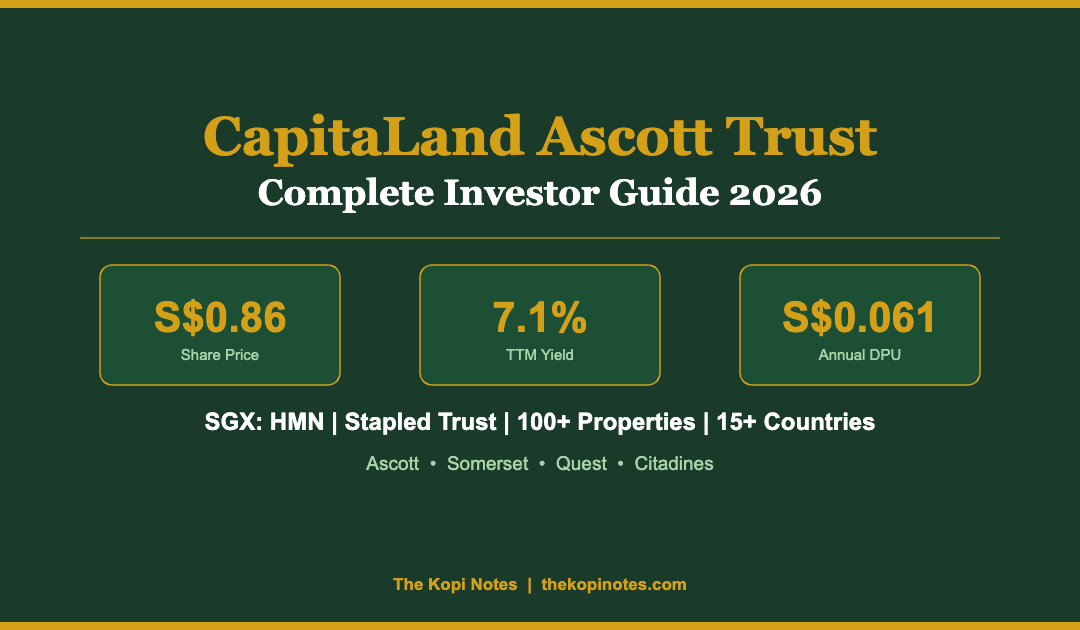
If you are looking for a Singapore-listed trust that offers consistent income from international hospitality assets, CapitaLand Ascott Trust (CLAS) deserves a close look. Trading at S$0.86 on the SGX under ticker HMN, CLAS delivers a trailing twelve-month dividend yield of 7.1% — among the highest in the S-REIT universe — backed by a global portfolio spanning serviced residences, student accommodation, and coliving properties across 15+ countries.
This guide covers everything you need to know: the DPU history from 2022 to 2026, how falling interest rates could further boost distributions, how CLAS compares with other hospitality trusts on the SGX, and whether the ~7% yield is sustainable for long-term investors.
CLAS Quick Stats (August 2026)
| Metric | Value |
|---|---|
| Share Price (SGX: HMN) | S$0.86 |
| TTM Dividend Yield | 7.10% |
| 2026 Annual DPU | S$0.061/unit |
| Portfolio Size | 100+ Properties | 15+ Countries |
| Structure | Stapled Trust (REIT + BT) |
| Listing Date | 31 March 2006 (Mainboard) |
| Sponsor | CapitaLand Investment Limited |
Table of Contents
Contents
- What Is CapitaLand Ascott Trust?
- DPU History 2022-2026
- Portfolio Overview: Global Footprint
- Rate-Cut Tailwinds for CLAS
- CLAS vs Peers: FEHT and CDL-HT
- Bull and Bear Case for 2H2026
- How to Start Investing in CLAS
- Frequently Asked Questions
What Is CapitaLand Ascott Trust (CLAS)?
CapitaLand Ascott Trust (SGX: HMN) is Asia-Pacific’s largest listed hospitality trust by asset value, and one of the longest-standing trusts on the Singapore Exchange — listed since March 2006 under its original name Ascott Residence Trust.
CLAS is structured as a stapled security combining two entities: CapitaLand Ascott REIT and CapitaLand Ascott Business Trust. This dual structure allows it to hold both income-producing real estate (as a REIT) and development or hospitality-management properties (as a Business Trust) — giving it far greater investment flexibility than a standard S-REIT.
The trust is sponsored by CapitaLand Investment Limited (CLI), Singapore’s largest real estate investment manager, which provides CLAS with access to a deep global pipeline and institutional credibility that many smaller trusts cannot match.
CLAS invests across four hospitality segments:
- Serviced residences — Ascott and Somerset branded long-stay apartments for corporate and leisure travellers
- Rental housing — Quest apartments in Australia serving domestic business travellers
- Student accommodation — purpose-built student housing in Europe and the UK offering near-100% occupancy during academic terms
- Coliving — Lyf and Coliwoo-branded urban living in Singapore, catering to young professionals priced out of private housing
This diversity across segments and geographies is a structural advantage. When a hotel-centric trust sees occupancy collapse during a travel shock, CLAS’s student housing and long-stay serviced residences continue to generate stable income. For more background, see our CLAS complete investor guide.
CLAS DPU History 2022-2026: Post-COVID Recovery in Full Swing
CLAS’s distribution-per-unit (DPU) history tells a compelling recovery story. After COVID-19 devastated global travel and hammered occupancy rates in 2020-2021, the trust has delivered a strong rebound in distributions — almost doubling its annual DPU from 2022 to 2026.
| Year | Total DPU | Yield (Approx.) | YoY Change |
|---|---|---|---|
| 2022 | S$0.034 | 3.97% | — |
| 2023 | S$0.057 | 6.67% | +67.6% |
| 2024 | S$0.056 | 6.56% | -1.8% |
| 2025 | S$0.061 | 7.07% | +8.9% |
| 2026 (Annualised) | S$0.061 | 7.10% | ~Flat |
Source: dividends.sg. Yield is approximate, based on prevailing share price. 2026 data as at August 2026.
Key takeaways from this DPU trajectory:
- The +67.6% DPU jump in 2023 reflects the full normalisation of global travel post-COVID lockdowns
- The slight 2024 dip (-1.8%) reflects higher interest expenses from the global rate-hike cycle
- The +8.9% recovery in 2025 shows CLAS’s resilience and the benefit of portfolio repositioning
- Stabilisation at S$0.061 in 2026 signals management confidence in sustaining the current distribution
Over the full 2022-2026 cycle, CLAS grew DPU by 79% from S$0.034 to S$0.061 — a remarkable recovery that demonstrates the operating leverage of the global serviced residence model when travel volumes normalise.
Portfolio Overview: A Truly Global Hospitality Trust
CLAS operates across 15+ countries and 44+ cities, with deliberate diversification across developed and emerging markets. Key geographic clusters include:
- Singapore — Lyf one-north, Citadines Mount Sophia, Somerset Orchard, Coliwoo coliving assets; strong domestic corporate and leisure demand
- Japan — Multiple Somerset properties in Tokyo, Osaka, and Fukuoka; benefits from record inbound tourism driven by weaker yen
- Australia — Quest serviced apartments in major cities; anchored by domestic corporate travel and long-stay demand
- Europe — Citadines properties and student accommodation in Paris, London, Berlin, Barcelona, Brussels; student housing provides near-100% occupancy during academic year
- Southeast Asia — Somerset Vietnam (Hanoi, Ho Chi Minh City), Manila, Jakarta, Kuala Lumpur; captures rising middle-class corporate travel
- United States — Element Times Square West and other assets in New York
This diversified footprint means CLAS is rarely fully exposed to any single market shock. When Singapore hotels slow during a domestic event (like early 2024 occupancy softness), Japan and Europe may be running at full capacity. When Europe faces macroeconomic headwinds, Australia’s resilient corporate travel market provides ballast.
CLAS has also been actively growing its Singapore coliving exposure, a segment with structural demand tailwinds: Singapore’s private property prices remain elevated, pushing younger professionals toward flexible coliving arrangements. The S$134M Coliwoo Midtown acquisition exemplifies this strategy, which management views as a long-term secular growth driver distinct from cyclical hotel demand.
For income investors assessing CLAS as part of a broader Singapore REIT portfolio, the trust pairs well with industrial or commercial REITs to create a diversified income stream across sectors. See our Singapore REIT ETF guide for a passive approach to S-REIT exposure.
Rate-Cut Tailwinds: Why CLAS Could Re-Rate Higher in 2H2026
With the US Federal Reserve on an easing path and the Jackson Hole Symposium (August 27-29, 2026) expected to signal further rate cuts, interest rate-sensitive assets like CLAS are positioned to benefit from multiple channels.
1. Lower cost of debt directly boosts DPU
CLAS carries a mix of fixed and floating-rate debt across its global portfolio. As floating-rate portions reprice lower and maturing fixed-rate debt gets refinanced at more favourable rates, the trust’s interest expense falls — freeing up more distributable income per unit. Even a 50bps reduction in average borrowing cost on a multi-billion dollar debt portfolio can translate into meaningful additional DPU.
2. Cap rate compression re-rates asset values
Lower interest rates compress cap rates, which generally causes real asset valuations (and hence REIT NAVs) to rise. If CLAS’s portfolio is revalued upward, the trust’s gearing ratio falls, creating headroom for further acquisitions or distribution increases without additional equity fundraising.
3. Weaker USD supports emerging market travel
Rate cuts typically soften the US dollar, which makes travel to Southeast Asia and other emerging markets more affordable for Western visitors. This can translate into higher RevPAU at CLAS’s Vietnam, Indonesia, and Philippines properties — a secondary but real benefit of the rate-cut cycle.
4. Share price re-rating potential
Many S-REITs trade at a discount to NAV when interest rates are high (because REIT yields must compete with risk-free rates). As rates fall, the required yield premium compresses and REIT share prices tend to re-rate upward. At S$0.86 per unit, if CLAS re-rates toward its pre-hike trading levels, early investors capture both income and capital appreciation.
This is not a guarantee — rate cuts may be slower than expected, and CLAS has its own operating risks to manage. But for income investors comfortable with hospitality sector exposure, CLAS at ~7% yield offers a genuinely attractive entry point in a falling-rate environment.
CLAS vs Peers: Hospitality REIT Comparison (2026)
Singapore has three main listed hospitality trusts. Here is how they compare:
| Trust | Ticker | Approx. Yield | Asset Focus | Markets |
|---|---|---|---|---|
| CapitaLand Ascott Trust | HMN | ~7.1% | Serviced residences, student accom, coliving | 15+ countries |
| Far East Hospitality Trust | Q5T | ~6.1% | Hotels and serviced residences | Singapore + Japan |
| CDL Hospitality Trusts | J85 | ~6-7% | Hotels (Singapore, UK, Europe) | 9 countries |
Approximate yields only. Verify current data before investing.
CLAS advantages over its peers:
- Broadest geographic diversification — 15+ countries vs FEHT’s 2 and CDL-HT’s 9
- Widest asset class coverage — student accommodation and coliving alongside traditional serviced residences
- Largest portfolio scale — 100+ properties and 17,000+ units provides operational leverage and refinancing flexibility
- Strong CLI sponsorship — access to a global real estate pipeline that smaller trusts cannot match
FEHT is the right choice for investors wanting concentrated Singapore and Japan hotel exposure with simpler FX dynamics. CDL-HT suits those comfortable with UK and European hotel cycles. CLAS is the choice for investors wanting maximum global diversification within a single hospitality trust.
Further reading: Far East Hospitality Trust Investor Guide | CDL Hospitality Trusts 1H2026 Results Review
Bull Case vs Bear Case: Should You Buy CLAS in 2H2026?
Bull Case
- 7.1% yield is genuinely compelling — outpacing most Singapore savings accounts, Singapore Savings Bonds, and fixed deposits
- Rate cuts reduce borrowing costs — floating-rate debt reprices lower, potentially pushing DPU toward S$0.065 or above
- Japan tailwind continues — strong inbound tourism and corporate demand support Tokyo and Osaka serviced residences
- Sponsor pipeline — CapitaLand Investment’s global real estate network gives CLAS ongoing deal flow
- Coliving secular growth — Singapore housing affordability drives demand for Lyf and Coliwoo assets structurally
- Distribution stability — two consecutive years of S$0.061 DPU signals management confidence
Bear Case
- Global travel slowdown risk — a US recession or geopolitical shock reduces RevPAU across the portfolio
- FX headwinds — a stronger SGD erodes the value of distributions from Japan, Australia, and Europe
- Rates higher for longer — if rate cuts are delayed, debt costs stay elevated and DPU growth stalls
- Equity fundraising dilution — CLAS has a history of issuing new units for acquisitions, diluting per-unit metrics
- Competition — at 7.1% yield, investors must weigh CLAS against industrial S-REITs or higher-rated credits
Investment verdict: For long-term income investors comfortable with global hospitality exposure, CLAS at ~7% yield offers a compelling risk-reward in a rate-easing cycle. The distribution history is strong, the sponsor is credible, and the asset diversification is unmatched in the Singapore hospitality REIT space. Position sizing matters: given FX and gearing risks, CLAS works best as one component of a diversified S-REIT portfolio rather than an outright concentration bet.
For portfolio ideas, see our Best S-REITs Singapore 2026 guide and our CLAS share price detailed analysis.
How to Start Investing in CLAS (SGX: HMN)
To buy CLAS units on the SGX, open a brokerage account with an SGX-linked platform. Our picks for Singapore retail investors:
Disclosure: These are referral links. The Kopi Notes may receive a benefit if you sign up. Always conduct your own due diligence before investing. This article is not financial advice.
Frequently Asked Questions About CLAS
What is CapitaLand Ascott Trust and its SGX ticker?
What is the current dividend yield of CLAS?
How often does CLAS pay distributions?
Is CapitaLand Ascott Trust a REIT or a Business Trust?
How does CLAS compare to Far East Hospitality Trust and CDL Hospitality Trusts?
Will CLAS benefit from Fed rate cuts in 2H2026?
Where can I buy CLAS units on the SGX?
This article was researched with the help of AI. While we strive to keep all information accurate and up to date, there may be errors. If you notice any discrepancies, please contact us.