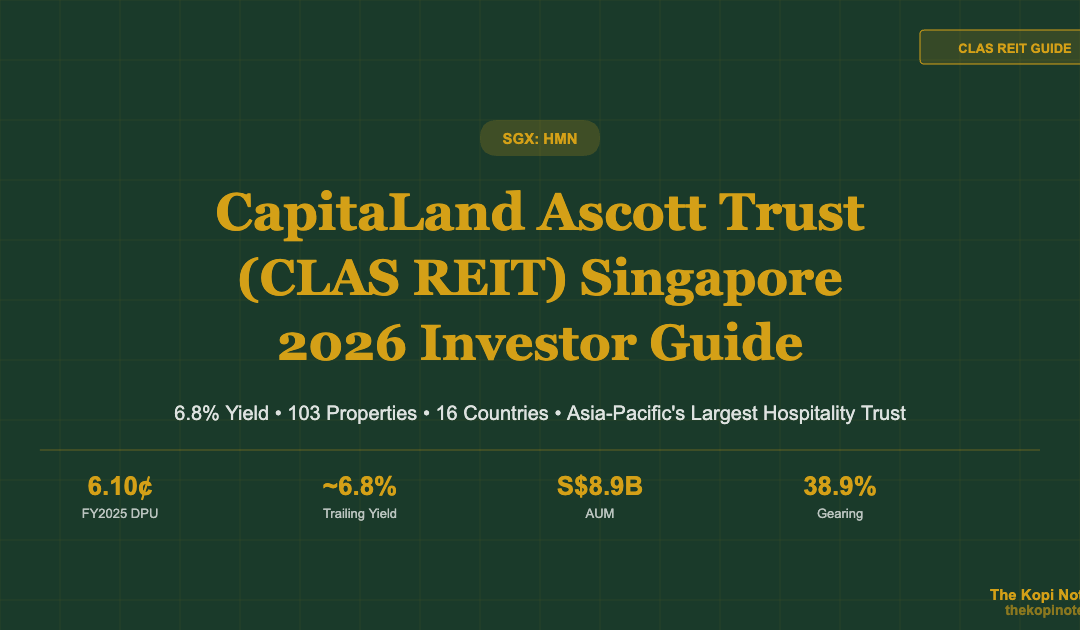
CLAS REIT Singapore 2026: Complete Investor Guide to CapitaLand Ascott Trust
Asia-Pacific’s largest hospitality trust • 6.8% yield • 103 properties across 16 countries
CLAS REIT (CapitaLand Ascott Trust, SGX: HMN) is Singapore’s only listed hospitality trust with truly global reach — 103 properties across 45 cities in 16 countries. For FY2025, it paid a Distribution Per Unit (DPU) of 6.10¢, delivering a trailing yield of approximately 6.8% at the current share price of ~S$0.895. With S$8.9 billion in assets under management and a gearing ratio of 38.9%, CLAS stands out as the dominant hospitality REIT on SGX for Singapore investors seeking income plus global diversification.
Not financial advice. All figures are for educational reference only. Data as at June 2026 unless noted.
- CLAS (SGX: HMN) pays 6.10¢ DPU for FY2025 — ~6.8% yield at S$0.895, paid semi-annually in February and August
- Unlike most S-REITs, CLAS spans 16 countries — built-in geographic diversification in a single SGX unit
- Analyst consensus is BUY with target S$1.05–S$1.08, implying 17–21% upside; AEI renovations are a temporary headwind resolving by 2027
Table of Contents — Click to expand
- What Is CLAS REIT?
- Key Financial Metrics 2026
- DPU & Distribution History FY2020–FY2025
- Portfolio: 103 Properties, 16 Countries
- How CLAS Makes Money: The Business Model
- 1Q2026 Update: RevPAU & Occupancy
- Is the 6.8% Yield Sustainable?
- Peer Comparison: CLAS vs Other S-REITs
- Risks of Investing in CLAS
- How to Buy CLAS (CPF, SRS & Cash)
- Frequently Asked Questions
What Is CLAS REIT (CapitaLand Ascott Trust)?
CapitaLand Ascott Trust (CLAS) is a stapled group listed on the Singapore Exchange (SGX) under ticker HMN. It comprises two entities: CapitaLand Ascott Real Estate Investment Trust and CapitaLand Ascott Business Trust. Together, they invest in income-producing hospitality real estate globally.
The trust was originally listed as Ascott Residence Trust (ART) back in 2006 — one of the earliest hospitality trusts in Asia. It rebranded to CapitaLand Ascott Trust after CapitaLand’s corporate restructuring. Its sponsor is CapitaLand Investment Limited, one of Asia’s largest diversified real estate managers.
CLAS is not a typical hotel REIT. It focuses on serviced residences, rental housing, and student accommodation — asset types with longer lease structures and more stable income than pure hotel REITs. Think of it as a “stay longer” play on global mobility: corporate travellers, expatriates, and long-stay guests who need more than a standard hotel room.
S$8.9B AUM | 103 Properties | 45 Cities | 16 Countries
Key brands under the CLAS umbrella include Ascott, Somerset, Quest, and Citadines — each targeting a different guest segment from luxury extended-stay to affordable corporate serviced apartments. This brand diversification helps CLAS maintain high occupancy across different market conditions.
CLAS REIT Key Financial Metrics 2026
Here’s a snapshot of CLAS’ most important numbers as at June 2026. These are the figures serious REIT investors check before adding to a position.
| Metric | Value | Context |
|---|---|---|
| SGX Ticker | HMN | Formerly ART (Ascott Residence Trust) |
| Share Price (Jun 2026) | ~S$0.895 | 52-week range: S$0.85–S$0.99 |
| FY2025 DPU | 6.10¢ | Stable vs FY2024; paid semi-annually |
| Trailing Yield | ~6.8% | At S$0.895 share price |
| AUM | S$8.9 billion | As at 31 March 2026 |
| Gearing Ratio | 38.9% | MAS limit: 50%; ~S$1.9B headroom |
| Properties | 103 | 45 cities, 16 countries |
| Analyst Consensus | BUY | TP S$1.05–S$1.08; 6 of 8 analysts BUY |
Source: CapitaLand Ascott Trust investor relations, SGX, analyst reports. Data as at June 2026.
The ~6.8% yield sits in the middle of the S-REIT yield spectrum — higher than defensive healthcare and data centre REITs, comparable to commercial REITs, and slightly below some smaller or higher-risk retail REITs. For a yield at this level, CLAS’ geographic diversification and AUM scale make it unusually robust.
CLAS DPU & Distribution History FY2020–FY2025
DPU (Distribution Per Unit) is the cash paid to each unit you own. For CLAS, it’s paid semi-annually — once in February (for the second half of the prior year) and once in August (for the first half). This means you collect income twice a year.
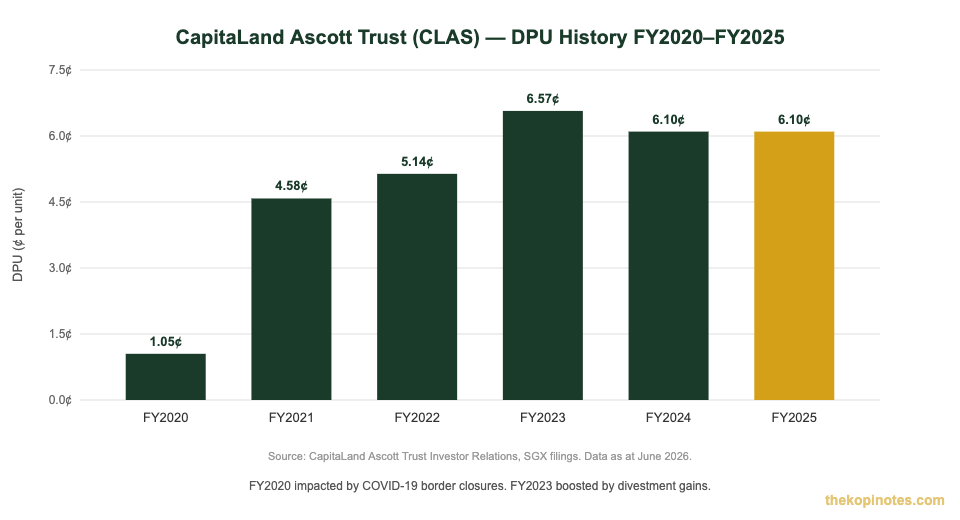
| Fiscal Year | Annual DPU (¢) | YoY Change | Key Driver |
|---|---|---|---|
| FY2020 | 1.05¢ | –84% | COVID-19; global travel shutdowns |
| FY2021 | 4.58¢ | +336% | Travel reopening; vaccination rollouts |
| FY2022 | 5.14¢ | +12.2% | Post-COVID travel boom; RevPAU surged |
| FY2023 | 6.57¢ | +27.8% | Peak year; boosted by divestment gains |
| FY2024 | 6.10¢ | –7.2% | Normalised post-divestment; rates headwind |
| FY2025 | 6.10¢ | 0% | Stable; S$23.2M retained for AEIs |
Source: CapitaLand Ascott Trust investor relations, SGX filings. Data as at June 2026.
The 6.10¢ DPU in FY2025 is not because the business is shrinking. Income available for distribution actually rose 11% to S$256.7 million. Management chose to retain S$23.2 million to fund Asset Enhancement Initiatives (AEIs) — renovations that will lift RevPAU when complete. The 6.10¢ represents a deliberate floor, not a ceiling.
CLAS Portfolio: 103 Properties Across 16 Countries
CLAS’ portfolio is what sets it apart from every other S-REIT. Most Singapore REITs concentrate in one or two countries — CLAS spans 45 cities in 16 countries. If one market stumbles, others can pick up the slack.
| Region | Key Markets | 1Q2026 RevPAU Trend | Income Type |
|---|---|---|---|
| Singapore | Singapore | +2% YoY | Master lease + management contract |
| Australia | Sydney, Melbourne, Perth | +7% YoY (AUD 188) | Management contract |
| Japan | Tokyo, Osaka, Hiratsuka | +3% YoY same-store | Rental housing (long leases) |
| Europe | London, Paris, Hamburg | AEI drag (temporary) | Master lease + direct ownership |
| USA | New York | AEI drag (temporary) | Direct ownership |
| Rest of Asia | Vietnam, Philippines, China | Steady recovery | Management contract + master lease |
Source: CapitaLand Ascott Trust 1Q2026 Business Update, April 2026.
In 2026, CLAS added three Japan rental housing properties near Greater Tokyo for approximately ¥4.6 billion (~S$42 million). Japan rental housing offers long leases in yen — a defensive income stream that buffers the more volatile hotel income from other markets. Properties operate under four brand tiers: Ascott (premium), Somerset (mid-upper), Quest (Australia/New Zealand corporate), and Citadines (mid-scale).
How CLAS Makes Money: The Business Model
CLAS generates income through three structures — and understanding the blend is crucial for forecasting DPU stability.
1. Master Leases — CLAS owns the property and leases it to an operator for fixed or variable rent. Fixed rent = guaranteed income regardless of occupancy. Roughly 30–40% of CLAS’ gross profit comes from master lease properties. This is your income floor.
2. Management Contracts — CLAS owns the property and appoints an operator who pays CLAS a share of gross profit. Income rises and falls with occupancy and room rates. Higher upside but more volatility. Most of CLAS’ portfolio by AUM sits here.
3. Rental Housing — Particularly in Japan, CLAS owns residential apartments rented on medium-to-long leases. The most stable income type, but with lower RevPAU potential. The Japan expansion is deliberately building this pillar to stabilise the overall DPU base.
The mix gives CLAS a base of stable master lease income topped up by variable management contract income. As a Singapore investor, CLAS’ DPU won’t collapse overnight — but it also won’t spike as dramatically as a pure-variable structure might in a great travel year. For building a passive income Singapore portfolio, CLAS works best alongside more defensive REITs.
1Q2026 Business Update: RevPAU, Occupancy & AEI Progress
CLAS released its 1Q2026 business update in April 2026. The headline numbers looked soft — but context matters enormously here.
Portfolio RevPAU dipped to S$137 with overall occupancy at 77%. Strip out the properties under AEI renovation in London, Hamburg, New York, and Paris, and same-store RevPAU rose 1% year-on-year. The underlying portfolio is healthy. The noise is coming from temporarily closed or restricted rooms during renovation.
| Market | 1Q2026 RevPAU | YoY Change | Note |
|---|---|---|---|
| Portfolio (all) | S$137 | – | AEI drag included |
| Same-store (ex-AEI) | — | +1% YoY | Underlying portfolio growing |
| Australia | AUD 188 | +7% YoY | Strong corporate travel demand |
| Japan (same-store) | — | +3% YoY | Tourism + weaker yen driving inbound |
| Singapore | — | +2% YoY | MICE events; corporate demand steady |
Source: CapitaLand Ascott Trust 1Q2026 Business Update, April 2026.
The Cavendish London AEI is the most significant ongoing project. London is one of the world’s premium hospitality markets — when this renovation completes in 2027, it should contribute materially higher RevPAU. Overall occupancy at 77% remains ~5 percentage points below pre-COVID norms. This gap is latent upside — not structural decline.
Is the 6.8% Yield Sustainable?
This is the question every REIT investor asks. Here’s the honest answer: the 6.10¢ DPU looks defensible at current operating conditions — but it’s not risk-free.
What supports sustainability: Gearing of 38.9% leaves S$1.9 billion of debt headroom before hitting MAS’ 50% limit. Income available for distribution rose 11% in FY2025 to S$256.7 million — the business generates more cash than the DPU requires. The master lease component provides a guaranteed income floor. And CLAS’ 16-country portfolio means no single market can crater the whole distribution.
What could pressure the yield: Currency risk is CLAS’ biggest ongoing challenge — a strong SGD erodes foreign-currency distributions. Interest rate risk reduces distributable income. AEI overruns could push renovation timelines later. And occupancy recovery in Europe/USA is not guaranteed if business travel softens.
| Scenario | Annual DPU (¢) | Yield at S$0.895 | Key Assumption |
|---|---|---|---|
| Bear Case | 5.50¢ | 6.1% | FX drag; AEI extends; occupancy flat |
| Base Case | 6.00–6.10¢ | 6.7–6.8% | Stable distributions; AEI completes 2027 |
| Bull Case | 6.60¢ | 7.4% | Occupancy normalises; AEI uplifts RevPAU; FX stable |
Source: TKN estimates based on FY2025 reported data. Not financial advice. Past distributions do not guarantee future distributions.
The base case 6.0–6.1¢ DPU is well-supported by current financials. Even the bear case at 5.5¢ still delivers a 6.1% yield — respectable for a globally diversified trust. To build a passive income portfolio using REITs like CLAS alongside other assets, use our Singapore retirement calculator to model different income scenarios.
Peer Comparison: CLAS vs Other Singapore REITs
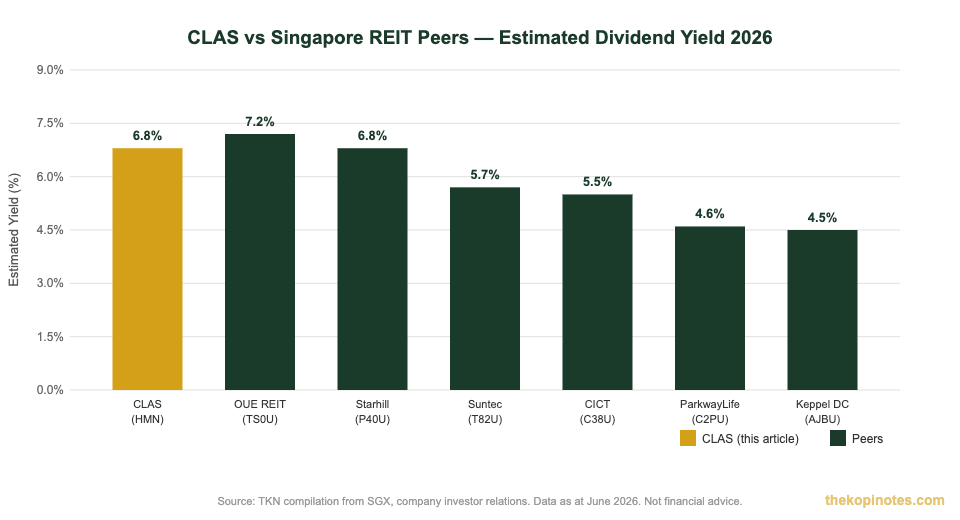
| REIT | SGX Ticker | Sector | Est. Yield | Gearing |
|---|---|---|---|---|
| CapitaLand Ascott Trust | HMN | Hospitality | ~6.8% | 38.9% |
| OUE REIT | TS0U | Diversified | ~7.2% | 35.5% |
| Starhill Global REIT | P40U | Retail/Office | ~6.8% | 35.5% |
| Suntec REIT | T82U | Office/Retail | ~5.7% | 43.0% |
| CICT | C38U | Commercial | ~5.5% | 39.6% |
| ParkwayLife REIT | C2PU | Healthcare | ~4.6% | 33.4% |
| Keppel DC REIT | AJBU | Data Centre | ~4.5% | 36.0% |
Source: TKN compilation from SGX, company investor relations, analyst estimates. Data as at June 2026. Not a recommendation.
CLAS at ~6.8% sits in a competitive band — higher yield than defensive REITs, similar to Starhill. The key differentiator is scale and geographic spread. No other S-REIT gives you 16-country exposure in a single S$0.895 unit. For broader S-REIT comparison, see our best S-REITs Singapore 2026 guide or the Singapore REIT ETF guide for diversified exposure.
Key Risks of Investing in CLAS REIT
Currency Risk: Income flows from 16 countries in multiple currencies. A strengthening SGD erodes the value of foreign-currency distributions. CLAS partially hedges FX exposure, but currency drag is a persistent headwind in strong-SGD environments.
Hospitality Cycle Risk: Hotels and serviced residences are more cyclical than industrial or healthcare assets. COVID demonstrated this viscerally — CLAS’ DPU dropped from 6+ cents to 1.05¢ in FY2020. Master leases cushion the floor but cannot fully eliminate this cyclicality.
AEI Execution Risk: If renovations overrun in time or cost, it delays the RevPAU uplift. The Cavendish London project is the largest current AEI — any delay to its 2027 completion would be a negative catalyst for near-term DPU.
Interest Rate Risk: Like all leveraged REITs, CLAS’ distributable income is sensitive to changes in borrowing costs. Management has partially hedged this with fixed-rate debt, but the floating-rate portion remains exposed.
Gearing & Acquisition Risk: At 38.9%, CLAS’ gearing is comfortable but not low. Any large acquisition financed by debt could push gearing higher and pressure the DPU. Use our Singapore retirement calculator to model income scenarios against different REIT weightings.
How to Buy CLAS REIT in Singapore (CPF, SRS & Cash)
CLAS trades on SGX under ticker HMN. You can purchase it through any SGX-connected brokerage using cash, your CPF Ordinary Account (via CPFIS), or your SRS account. Always verify current CPFIS eligibility on the CPF Board’s approved investment list before using CPF funds.
| Broker | CPF (CPFIS-OA)? | SRS? | Min. Commission | Best For |
|---|---|---|---|---|
| FSMOne | ✓ | ✓ | 0.08% (min S$8.80) | Best low-cost for CPF/SRS |
| DBS Vickers | ✓ | ✓ | 0.12% (min S$25) | DBS banking customers |
| IBKR | ✗ | ✗ | ~S$1.70 flat | Active traders; low commission |
| Syfe Trade | ✗ | ✗ | S$0 (first 3 free/mo) | Beginners; commission-free |
Source: Broker websites. Data as at June 2026. Commission rates may change — always verify on broker’s official site before trading.
For CPF investors: Use FSMOne (FSMOne referral code P0544985) for the lowest commission on CPFIS trades. Our CPF investment strategy guide covers how to structure REIT investments alongside CPF-SA topping up.
For robo-advisor investors: Endowus referral code 2V343 offers REIT-focused portfolios using CPF, SRS, and cash. Syfe referral code and sign-up bonus SRPRFFFCD offers a REIT+ portfolio with active S-REIT weighting. Both are strong options if you’d rather not pick individual REITs.
Frequently Asked Questions: CLAS REIT Singapore
What is CLAS REIT and what does it invest in?
What is CLAS REIT's current dividend yield?
What SGX ticker does CLAS REIT trade under?
Can I buy CLAS REIT using my CPF?
How many properties does CLAS own and where?
What is CLAS' gearing ratio and is it safe?
Why did CLAS DPU hold at 6.10¢ despite higher income?
What is RevPAU and why does it matter for CLAS?
What are the main risks of investing in CLAS?
What is the analyst consensus on CLAS REIT in 2026?
How does CLAS compare to the Lion-Phillip S-REIT ETF?
Disclaimer: This article is for educational and informational purposes only and does not constitute financial advice. All data as at June 2026. Past distributions are not a guarantee of future distributions. Always conduct your own research and consider consulting a licensed financial advisor before making investment decisions. The Kopi Notes may earn referral fees from links on this page.
This article was researched with the help of AI. While we strive to keep all information accurate and up to date, there may be errors. If you notice any discrepancies, please contact us.