CapitaLand Ascott Trust Share Price: The S$134M Coliwoo Midtown Deal Explained
How CLAS’s biggest co-living bet of 2026 could move your dividend — yield math, DPS impact, and the risks, broken down for Singapore investors.
CapitaLand Ascott Trust (SGX: HMN) is buying Coliwoo Midtown, a 212-unit co-living property, for S$134 million — its first major living-sector move since its 1H2026 results. The deal is priced at a 4.1% EBITDA yield, 180 basis points above the 2.3% yield CLAS booked selling The Robertson House. Management expects it to lift distributions by 2.4% once completed in Q4 2026.
Not financial advice. All figures are for educational reference only. Data as at August 2026 unless noted.
- CLAS is buying Coliwoo Midtown (212 co-living units) for S$134 million, partly funded by proceeds from selling The Robertson House.
- The deal pencils out to +2.4% pro forma DPS accretion and lifts CLAS’s living-sector exposure to 19.5% of portfolio value.
- At today’s S$0.86 share price and roughly 7.1% trailing yield, this is a genuine but modest dividend tailwind — not a game-changer on its own.
Table of Contents
The Coliwoo Midtown Deal at a Glance
CapitaLand Ascott Trust (CLAS) has agreed to buy Coliwoo Midtown from Coliwoo Holdings (SGX: W8W) at an agreed property value of S$134.0 million. The six-storey building has 212 keys across eight room types, from two- to five-bedroom units. It’s a co-living asset — think shared common spaces with private bedrooms, aimed at young professionals and expats who want a longer stay than a hotel but more flexibility than a lease.
Coliwoo Midtown reopened in March 2026 after a major refurbishment and hit almost 90% occupancy by July. CLAS will lease the property back to Coliwoo for 10 years, with annual rent indexation built in. That structure gives CLAS predictable, hotel-independent income — no room-by-room revenue management, just a fixed lease with built-in rent escalation.
| Deal Term | Detail |
|---|---|
| Property | Coliwoo Midtown, Singapore |
| Seller | Coliwoo Holdings (SGX: W8W) |
| Agreed Property Value | S$134.0 million |
| Acquisition Yield | 4.1% (FY2025 pro forma EBITDA basis) |
| Units | 212 keys, 8 room types (2- to 5-bedroom) |
| Lease Structure | 10-year leaseback to Coliwoo, annual rent indexation |
| July 2026 Occupancy | ~90% |
| Completion Target | Q4 2026 |
| Pro Forma DPS Impact | +2.4% |
Source: CapitaLand Ascott Trust press release, August 2026
For the full picture on CLAS’s portfolio, dividend history, and how it fits a Singapore income portfolio, see our CapitaLand Ascott Trust investor guide.
Why CLAS Is Betting on Co-Living
CLAS calls this its “living sector” — a bucket that includes co-living, rental housing, and student accommodation. Unlike a hotel room, these assets earn income from tenants who stay weeks or months, not nights. That means steadier occupancy and less exposure to swings in tourist arrivals or corporate travel budgets.
This deal is really a capital recycling move. CLAS sold The Robertson House — an older serviced residence — at a 2.3% exit yield, then redeployed the proceeds into Coliwoo Midtown at a 4.1% yield. In plain English: it swapped a lower-yielding, more hotel-like asset for a higher-yielding, longer-stay one, without raising fresh equity. That’s the kind of accretive recycling S-REIT investors should watch for, because it grows distributions without diluting existing unitholders.
Management has a medium-term target of pushing the living sector to 25% to 30% of portfolio value. Post-deal, it sits at 19.5% — so there’s more runway, and likely more living-sector acquisitions ahead. For context on how CLAS’s sector mix compares with other trusts, our S-REIT sectors guide breaks down industrial, retail, office, and hospitality trusts side by side.
The Yield Math: 4.1% In, 2.3% Out
Here’s the actual arithmetic. A S$134.0 million purchase at a 4.1% EBITDA yield works out to roughly S$5.49 million of annual income (S$134.0m × 4.1%). That’s the fresh income CLAS gains from the leaseback rent.
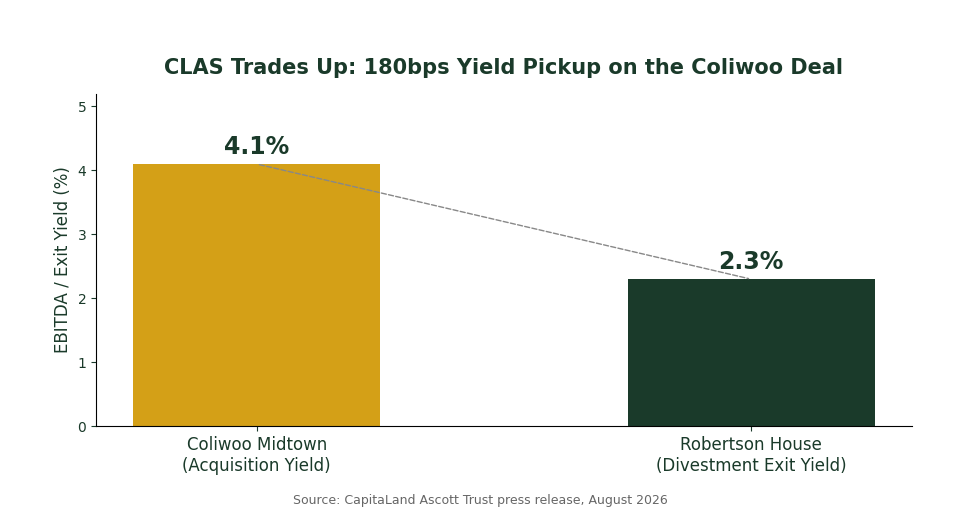
Compare that with what CLAS gave up: The Robertson House sold at a 2.3% exit yield, meaning the sale proceeds were earning less income per dollar of asset value than Coliwoo Midtown will. The 180 basis point spread between the two yields is the source of the deal’s accretion — CLAS didn’t need to raise new equity or take on much extra debt to grow income, it just swapped a lower-yielding asset for a higher-yielding one. This is a common playbook among S-REITs looking to lift DPU without diluting unitholders, and it works best when management can consistently find replacement assets at a meaningful yield premium.
What It Means for Your CLAS Dividend
As at 9 August 2026, CLAS traded at S$0.86 with a trailing dividend yield of roughly 7.1%. For 1H2026, distribution per stapled security (DPS) held steady at 2.53 cents, unchanged year-on-year. Core DPS — stripping out one-off items — actually fell 10% to 2.16 cents, and the flat headline number was propped up by S$9.6 million retained from non-periodic items. Gearing stood at 37.7% as at 30 June 2026.
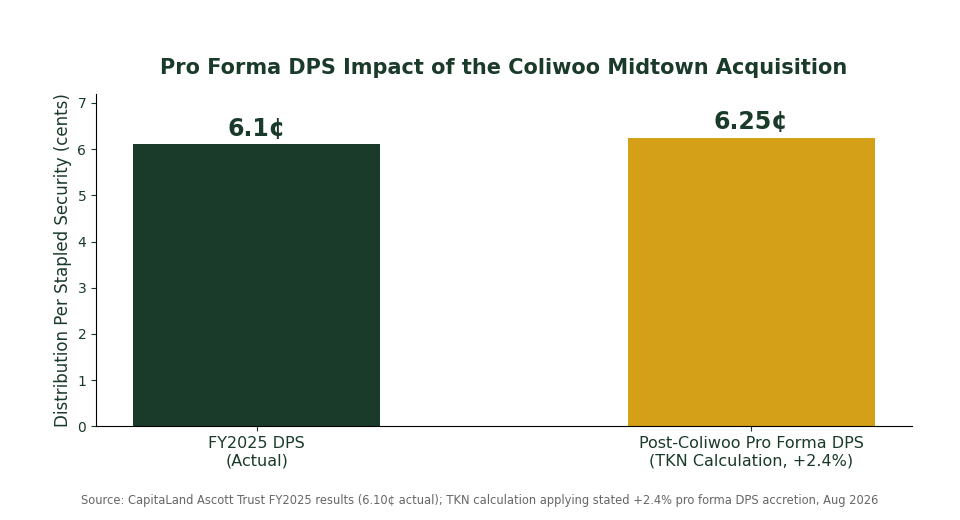
So where does the Coliwoo deal fit in? Management guided a +2.4% pro forma DPS accretion from this acquisition alone. Using CLAS’s actual FY2025 DPS of 6.10 cents as the base, that works out to about 6.25 cents on a pro forma basis (6.10 × 1.024). At the current S$0.86 share price, that’s a yield uplift from roughly 7.09% to 7.27% — an incremental 17 basis points of yield, from this single deal alone. It won’t offset a 10% core DPS decline by itself, but it’s a real, quantifiable contributor once the deal completes in Q4 2026.
| Metric | Value |
|---|---|
| Share Price | S$0.86 (9 Aug 2026) |
| Trailing Dividend Yield | ~7.1% |
| 1H2026 DPS | 2.53 cents (unchanged YoY) |
| 1H2026 Core DPS | 2.16 cents (-10% YoY) |
| FY2025 DPS | 6.10 cents |
| Gearing | 37.7% (30 Jun 2026) |
| Portfolio Value | S$8.8 billion (30 Jun 2026) |
Source: CapitaLand Ascott Trust 1H2026 and FY2025 results; EdgeProp, August 2026
Retail investors chasing passive income should read this DPS trend alongside the broader picture — check out our passive income Singapore guide for how S-REIT distributions fit into a diversified income portfolio.
CLAS’s Living-Sector Pivot in Context
With Coliwoo Midtown added, CLAS’s living sector rises to 19.5% of its S$8.8 billion portfolio — roughly S$1.7 billion of assets. That’s still short of management’s 25% to 30% medium-term target, which tells you this probably won’t be the last living-sector deal from CLAS in 2026.
This pivot matters because CLAS’s peer set — hospitality-heavy trusts like Far East Hospitality Trust and CDL Hospitality Trusts — remain more exposed to swings in tourist arrivals and room rates. CLAS is deliberately diversifying away from that cyclicality. If you’re deciding between CLAS and a pure hospitality REIT, the living-sector exposure is now a real point of differentiation, not just a strategy slide.
You can check exactly how much CLAS trades below or above its net asset value using our S-REIT P/NAV discount calculator before deciding whether the current price already reflects this pivot.
Risks to Watch
No acquisition is risk-free, and this one has a few worth flagging. First, the 10-year leaseback means CLAS’s income from Coliwoo Midtown depends on Coliwoo Holdings staying financially healthy as a tenant. Coliwoo is a smaller, newer operator than the hotel chains CLAS typically deals with, so this is a real counterparty risk, not a formality.
Second, co-living is a young asset class in Singapore. There’s less transaction history to benchmark whether 4.1% is genuinely attractive, or just attractive relative to a soft hospitality exit. Third, gearing at 37.7% is already mid-pack among S-REITs. It leaves headroom for now, but not unlimited room — further living-sector deals may need equity fundraising or perpetual bonds rather than pure debt, which could dilute or add refinancing risk down the line.
Is CapitaLand Ascott Trust a Buy After This Deal?
The bull case: this is accretive, self-funded capital recycling that diversifies CLAS away from hospitality’s cyclicality and toward stickier, longer-stay residential-style income. A ~7.1% trailing yield with a headline DPS that held flat despite softer hospitality performance is not a bad starting point for income investors.
The bear case: core DPS actually fell 10% in 1H2026, and one 2.4%-accretive deal doesn’t undo that on its own. Gearing isn’t alarming, but it’s not cheap either, and the living-sector pivot is still a multi-year story, not a done deal.
Where CLAS sits among other best S-REITs in Singapore 2026 depends on whether you want a REIT mid-transition, or one with a settled, predictable portfolio. If you’re comfortable holding through the pivot, this deal is a reasonable, quantifiable reason for cautious optimism — not a reason to chase the stock.
Not financial advice. This article is for educational reference only and does not constitute a recommendation to buy or sell any security. Data as at August 2026.
Frequently Asked Questions
What is CapitaLand Ascott Trust's Coliwoo Midtown acquisition?
CapitaLand Ascott Trust (CLAS) has agreed to buy Coliwoo Midtown, a 212-unit co-living property in Singapore, for S$134 million from Coliwoo Holdings (SGX: W8W). CLAS will lease the property back to Coliwoo for 10 years with annual rent indexation. Completion is targeted for Q4 2026.
How much did CLAS pay for Coliwoo Midtown, and is it a good price?
CLAS is paying S$134.0 million, priced at a 4.1% EBITDA yield on a FY2025 pro forma basis. That’s 180 basis points above the 2.3% exit yield CLAS achieved selling The Robertson House, which means CLAS is trading a lower-yielding asset for a higher-yielding one — a genuinely accretive swap on paper.
Will the Coliwoo Midtown deal increase my CLAS dividend?
Management expects the deal to lift pro forma distribution per stapled security (DPS) by 2.4% once it completes. Applied to CLAS’s FY2025 DPS of 6.10 cents, that works out to roughly 6.25 cents on a pro forma basis — a modest but real dividend tailwind, not a dramatic re-rating.
What is CapitaLand Ascott Trust's dividend yield in 2026?
As at 9 August 2026, CLAS traded at S$0.86 with a trailing dividend yield of roughly 7.1%. Its 1H2026 DPS held steady at 2.53 cents year-on-year, though core DPS (excluding one-off items) fell 10% to 2.16 cents.
Is CapitaLand Ascott Trust a buy after this acquisition?
It depends on your view of the living-sector pivot. The deal is accretive and diversifies CLAS away from hospitality cyclicality, supporting a ~7.1% yield. But core DPS fell 10% in 1H2026, so this single deal doesn’t offset that on its own. This is not financial advice — assess your own risk tolerance and portfolio needs.
Can I buy CapitaLand Ascott Trust using my CPF or SRS?
CLAS is listed on the SGX mainboard, so it’s eligible for both CPF Investment Scheme (CPFIS-OA, subject to your bank’s fund list) and SRS funds through most Singapore brokers. Check your specific brokerage’s supported instruments before placing an order, as CPFIS access can vary by platform.
Ready to Build Your S-REIT Income Portfolio?
Open a brokerage account and start buying Singapore REITs like CLAS today. Use our referral links for exclusive sign-up bonuses.
This article was researched with the help of AI. While we strive to keep all information accurate and up to date, there may be errors. If you notice any discrepancies, please contact us.