iREIT Global Share Price 2026 (SGX: UD1U): DPU History, Yield & Investor Guide
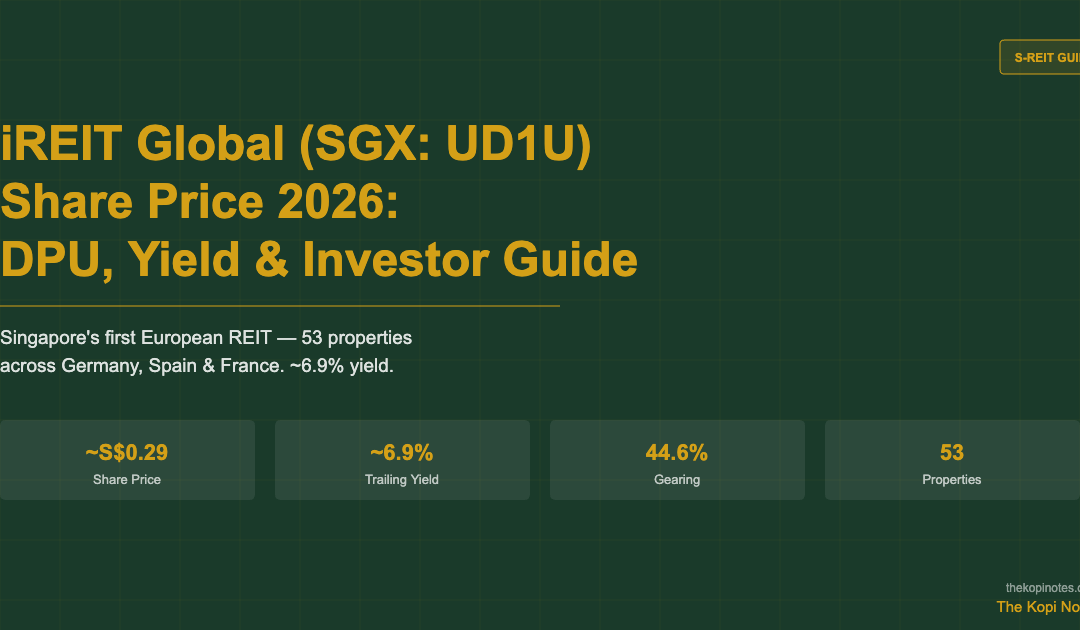
Singapore’s first Europe-focused REIT — 53 properties across Germany, Spain and France, trading at ~S$0.29 with a ~7% dividend yield in 2026.
iREIT Global (SGX: UD1U) is Singapore’s first pure-play European real estate investment trust, owning 53 income-producing properties — five freehold office buildings in Germany, four freehold offices in Spain, and 44 retail properties in France. Listed on SGX since August 2014 and co-sponsored by Tikehau Capital and City Developments Limited (CDL), it gives Singapore retail investors direct exposure to European commercial real estate without currency conversion or foreign brokerage accounts. At its June 2026 price of around S$0.29, the trailing yield is approximately 6.9–7.0%.
Not financial advice. All figures are for educational reference only. Data as at June 2026 unless noted.
Table of Contents
Contents — Click to expand
- What Is iREIT Global?
- Key Facts at a Glance
- iREIT Global Share Price History 2019–2026
- DPU History & Dividend Yield
- Portfolio Overview: Germany, Spain & France
- Financial Health: Gearing, ICR & Balance Sheet
- Key Risks for Singapore Investors
- How to Buy iREIT Global in Singapore (CPF & SRS)
- Peer Yield Comparison 2026
- Analyst Verdict & Our View
- Frequently Asked Questions
What Is iREIT Global?
iREIT Global is a Singapore real estate investment trust (S-REIT) with a unique mandate: investing exclusively in income-producing commercial real estate across Europe. It was listed on the Singapore Exchange (SGX) on 13 August 2014 under the ticker UD1U, making it the first S-REIT to focus entirely on European markets.
The REIT is co-sponsored by two major institutions: Tikehau Capital, a leading European alternative asset manager with over €45 billion AUM, and City Developments Limited (CDL), one of Singapore’s largest property developers. This dual-sponsor structure gives iREIT Global access to institutional-grade deal flow in Europe while maintaining strong Singapore corporate governance oversight.
As at December 2025, the portfolio spans 53 properties across three countries: five freehold Grade-A office buildings in Germany (Berlin, Darmstadt, Münster, Bonn), four freehold offices in Spain (Madrid and Barcelona submarkets), and 44 retail properties across France held via its stake in Tikehau Real Estate France. The French retail portfolio consists of supermarket-anchored neighbourhood centres, providing defensive, necessity-driven income.
iREIT Global distributes income semi-annually — typically in August (for 1H) and February (for 2H). Distributions are declared in euros (EUR) and paid in Singapore dollars at the prevailing SGD/EUR exchange rate, meaning unitholders are exposed to EUR/SGD currency movements. For a Singapore resident holding units, this introduces foreign exchange risk that pure SGX-listed S-REITs do not carry.
Despite this, the REIT has attracted a loyal following among Singapore yield investors seeking geographic diversification beyond Asia-Pacific REITs. Its European office and French retail mix offers a different demand cycle to Singapore’s office or industrial sectors.
Key Facts at a Glance
| Metric | Detail |
|---|---|
| SGX Ticker | UD1U |
| Listed | 13 August 2014 (SGX Mainboard) |
| Sponsors | Tikehau Capital & City Developments Limited (CDL) |
| Share Price (June 2026) | ~S$0.29 |
| FY2025 DPU | €1.09 cents (paid in SGD equivalent) |
| Trailing Dividend Yield | ~6.9% (as at June 2026) |
| Aggregate Leverage | 44.6% (as at Dec 2025) |
| Portfolio Occupancy | 89.4% (excl. Berlin Campus; as at Dec 2025) |
| Number of Properties | 53 (5 Germany + 4 Spain + 44 France) |
| Distribution Frequency | Semi-annual (1H + 2H) |
| Distribution Currency | EUR (paid in SGD equivalent) |
Source: iREIT Global FY2025 Results Presentation, February 2026; SGX filings
iREIT Global Share Price History 2019–2026
iREIT Global’s share price has been on a multi-year downtrend from its peak above S$0.80 in 2019, driven by the COVID-19 pandemic’s impact on European office markets, rising European interest rates from 2022 through 2024, and more recently the Berlin Campus vacancy issue. By June 2026, the share price has stabilised around S$0.29–S$0.31, and analyst RHB has flagged it as a “potential privatisation candidate” given what it describes as a “sharp dislocation” between trading price and underlying asset value.
The table below shows approximate share price milestones over the past seven years:
| Period | Approx. Share Price (S$) | Key Event |
|---|---|---|
| Dec 2019 | ~0.83 | Pre-COVID peak; stable German office rents |
| Mar 2020 | ~0.44 | COVID selldown; European office concerns |
| Dec 2021 | ~0.65 | Recovery; French retail portfolio acquisition |
| Dec 2022 | ~0.45 | ECB rate hikes begin; EUR/SGD softens |
| Dec 2023 | ~0.35 | Continued rate pressure; Berlin Campus vacancy |
| Dec 2024 | ~0.28 | DPU cuts; Berlin refurbishment commences |
| June 2026 | ~0.29 | Darmstadt 10-yr federal lease; stabilisation signs |
Source: SGX filings, iREIT Global announcements, The Edge Singapore. Share prices are approximate mid-market figures; do not constitute investment advice.
One important context: iREIT Global’s distributions are declared in euros and converted to SGD at the prevailing rate before payout. The EUR/SGD rate has fluctuated between 1.40 and 1.55 in recent years, meaning a SGD investor’s effective yield can differ meaningfully from the EUR-denominated DPU figure.
DPU History & Dividend Yield
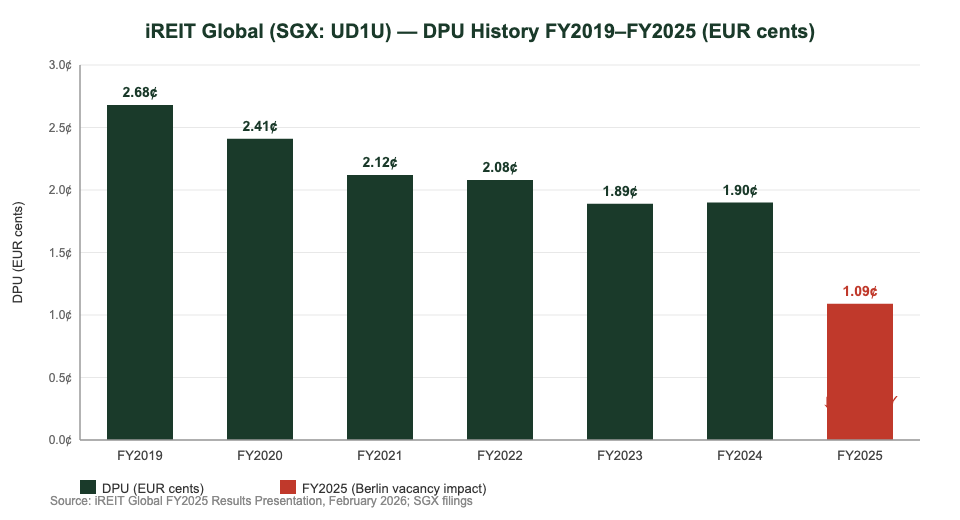
iREIT Global’s DPU history tells the story of European office market headwinds. After a period of relative stability, the REIT faced a sharp DPU compression starting from 1H FY2025, primarily due to the Berlin Campus vacancy. The Berlin Campus — a large office complex in Berlin — saw tenants vacate, and the manager commenced a full repositioning and refurbishment programme. This removed a meaningful chunk of net property income (NPI) from the income stream.
For FY2025 (financial year ending December 2025), iREIT Global reported a full-year DPU of approximately €1.09 cents, a decline of 42.6% year-on-year. The 2H FY2025 DPU alone was down nearly 60% year-on-year as the Berlin vacancy impact was felt in full. This DPU level is the lowest the REIT has distributed since listing, and reflects the transitional nature of the portfolio as it works through the Berlin repositioning.
On the positive side, management secured a 10-year lease with a federal government tenant at Darmstadt Campus in Q1 2026, which is expected to increase occupancy there from 41.3% to approximately 60%. This is a significant development — federal tenants are extremely stable, creditworthy lessees with long lease terms, and a 10-year commitment provides strong visibility on NPI from that asset.
| Financial Year | DPU (EUR cents) | YoY Change | Note |
|---|---|---|---|
| FY2019 | 2.68¢ | — | Pre-COVID; German portfolio full occupancy |
| FY2020 | 2.41¢ | -10.1% | COVID impact; partial income waiver |
| FY2021 | 2.12¢ | -12.0% | Recovery; French retail acquisition completed |
| FY2022 | 2.08¢ | -1.9% | ECB rate hike cycle begins |
| FY2023 | 1.89¢ | -9.1% | Berlin tenant departure; rate pressure |
| FY2024 | 1.90¢ | +0.5% | Temporary stabilisation; one-off income |
| FY2025 | 1.09¢ | -42.6% | Berlin Campus vacancy bites; refurb in progress |
Source: iREIT Global FY2025 Results Presentation, SGX, February 2026; REITSWEEK, The Edge Singapore
For a Singapore investor holding S$50,000 worth of iREIT Global at S$0.29 per unit (approximately 172,414 units), the FY2025 DPU of €1.09 cents — converted at approximately EUR/SGD 1.48 — translates to roughly S$1,614 in annual distributions, or a 3.2% effective SGD yield at that DPU level. However, the trailing 12-month yield based on the current share price is quoted at approximately 6.9–7.0%, which reflects trailing distributions prior to the deep FY2025 cut. Investors evaluating iREIT Global in 2026 should note that the DPU is at a cyclical trough and forward yield will depend heavily on the pace of Berlin Campus repositioning and new leasing at Darmstadt.
Portfolio Overview: Germany, Spain & France
iREIT Global’s 53-property portfolio is geographically diversified across three European markets, each contributing a different risk-return profile to the overall trust.
Germany (5 Properties)
The German portfolio is the backbone of iREIT Global’s original investment thesis. It comprises five freehold Grade-A or near-Grade-A office buildings located in major German cities and suburban business districts: Berlin (Berlin Campus — currently under repositioning), Darmstadt, Münster, and Bonn. Germany’s commercial real estate market is characterised by long lease terms (often 5–10 years), triple-net lease structures where tenants pay operating costs, and historically low vacancy rates in prime office submarkets.
The Berlin Campus repositioning is the single most important near-term catalyst — or risk — for the REIT’s DPU. The property suffered meaningful tenant departures, and the manager commenced full refurbishment works in 1H 2025. Completion is expected in late 2026 or 2027, after which the repositioned Berlin Campus should command materially higher rents. The Darmstadt 10-year federal lease secured in Q1 2026 (raising occupancy from 41.3% to ~60%) is an early indication that the German leasing pipeline is moving.
Spain (4 Properties)
The four Spanish office properties are located in established business districts in Madrid and Barcelona. Spain’s office market has recovered more strongly post-COVID than Germany’s, with occupancy levels and rents returning to pre-pandemic levels in prime locations. These assets provide stable income while the German portfolio is in transition. Spanish commercial real estate typically has shorter lease terms (3–5 years) versus Germany, but rents tend to index to inflation (CPI-linked), providing a natural hedge.
France (44 Properties)
The French portfolio — acquired through iREIT Global’s stake in Tikehau Real Estate France — consists of 44 neighbourhood retail centres anchored by everyday-necessity retailers such as supermarkets and service-sector tenants. This is the most defensive segment: French neighbourhood retail was largely immune to the structural decline that affected large shopping malls, as tenants sell essential goods that resist e-commerce substitution. Lease terms in the French retail portfolio are typically 9-year commercial leases (known as “baux commerciaux” under French law), providing strong income visibility.
Financial Health: Gearing, ICR & Balance Sheet
iREIT Global’s aggregate leverage stood at 44.6% as at December 2025, which is elevated relative to the S-REIT sector average (typically 35–40%) and sits close to the MAS regulatory limit of 50%. This is the primary balance sheet risk for the REIT: at 44.6% gearing, there is limited headroom to take on new debt for acquisitions, and any portfolio devaluation — for example, from rising European capitalisation rates — could further compress this buffer.
The REIT’s interest cover ratio (ICR) is also under pressure due to the combination of elevated European interest rates (European Central Bank’s tightening cycle from 2022 to 2024 pushed Euro interest rates to multi-decade highs) and reduced NPI from the Berlin Campus vacancy. The ECB began cutting rates in 2024 and continued into 2025, which should provide some relief on refinancing costs as existing debt facilities roll over.
| Balance Sheet Metric | FY2025 (Dec 2025) | Assessment |
|---|---|---|
| Aggregate Leverage | 44.6% | Elevated — limited headroom to 50% MAS cap |
| Portfolio Occupancy | 89.4% (excl. Berlin Campus) | Satisfactory ex-Berlin |
| Distribution Currency | EUR (paid in SGD) | FX risk: EUR/SGD fluctuation |
| Berlin Campus Occupancy | ~0% (under repositioning) | Key DPU drag; recovery expected post-2026 |
| ECB Rate Environment | Easing (rate cuts 2024–2025) | Positive for refinancing costs |
Source: iREIT Global FY2025 Results Presentation, February 2026; MAS S-REIT leverage rules
Key Risks for Singapore Investors
iREIT Global carries a distinct risk profile compared to a typical Singapore-focused REIT. Singapore investors evaluating the REIT should be aware of the following:
1. EUR/SGD Currency Risk. Distributions are declared in euros and converted to SGD before payment. If the euro weakens against the Singapore dollar — as it did during parts of 2022–2023 — a Singapore investor receives fewer SGD per euro of DPU even if the underlying euro DPU is stable. There is no hedging mechanism at the unitholder level; the manager may hedge at the REIT level but SGD-denominated returns remain exposed.
2. Berlin Campus Vacancy. This is the largest near-term DPU risk. Berlin Campus is iREIT Global’s largest individual German asset, and its current zero occupancy (under full repositioning) has been the primary driver of the 42.6% DPU decline in FY2025. Until new anchor tenants are secured and income resumes, DPU will remain at or near current depressed levels.
3. Elevated Gearing at 44.6%. With aggregate leverage near 45%, the REIT has little room to issue new debt for acquisitions. Any further portfolio devaluation (e.g. from European cap rate expansion) could breach the 50% MAS limit, triggering forced asset sales. This constrains the manager’s ability to grow distributions through acquisitions.
4. European Commercial Real Estate Headwinds. Work-from-home adoption has structurally reduced European office demand, particularly in Germany where many companies have adopted hybrid work policies. While prime CBD offices remain well-let, suburban or secondary offices face structural vacancy risk — which is partly what happened with Berlin Campus.
5. Small-Cap Liquidity. iREIT Global is a small-to-mid cap S-REIT by market capitalisation. Trading volumes can be thin, meaning bid-ask spreads are wider than large-cap REITs. A Singapore investor seeking to exit a large position may find it difficult to do so at the quoted price.
These risks are not reasons to automatically avoid iREIT Global — but they are reasons to size the position prudently. For diversified S-REIT portfolios, comparing iREIT Global alongside the best S-REITs in Singapore 2026 by sector, yield, and risk profile is a useful exercise before committing capital.
How to Buy iREIT Global in Singapore (CPF & SRS)
iREIT Global units (SGX: UD1U) are listed on the SGX Mainboard and can be purchased through any Singapore-licensed brokerage in board lots of 100 units. At S$0.29 per unit, one board lot costs approximately S$29, making it one of the most affordable S-REITs by unit price.
CDP-Linked Brokers (Shares held in your name)
Using a FSMOne referral code gives you access to FSMOne’s platform, which is one of Singapore’s most cost-effective CDP-linked brokers (0.08% commission, minimum S$10). Shares bought via CDP-linked brokers are registered in your name with the Central Depository, so you receive corporate communications directly and can participate in rights issues.
Custodian Brokers
Brokers like moomoo Singapore offer competitive commissions and a user-friendly app, though shares are held in a custodian account (not your CDP account). This is fine for most retail investors but does mean you need to manually update your SGX CDP if you ever want to transfer shares.
CPF Investment Scheme (CPFIS)
iREIT Global is eligible under the CPF Investment Scheme (CPFIS-OA), meaning Singapore residents can use their CPF Ordinary Account savings to buy units through an approved CPFIS bank account (DBS, OCBC, or UOB). To invest CPF funds in iREIT Global: (1) Open a CPFIS investment account with DBS, OCBC, or UOB if you don’t already have one. (2) Link your CPF OA to the brokerage. (3) Search for SGX: UD1U and place your order. Note: CPF OA funds earn a guaranteed 2.5% p.a. — only invest CPF in equities if you are comfortable with the risk that returns may underperform the risk-free CPF rate. For CPF strategy context, our guide to CPF investment strategy Singapore covers the CPFIS rules in detail.
SRS (Supplementary Retirement Scheme)
iREIT Global units can also be purchased using SRS funds through any SRS-linked brokerage (DBS Vickers, OCBC Securities, UOB Kay Hian, or Syfe Brokerage). SRS investing in iREIT Global is attractive because: (a) SRS contributions receive tax relief upfront, reducing your chargeable income, and (b) SRS withdrawals at retirement are 50% exempt from income tax. Using Syfe referral code SRPRFFFCD unlocks Syfe’s SRS brokerage service with no minimum investment.
Peer Yield Comparison 2026
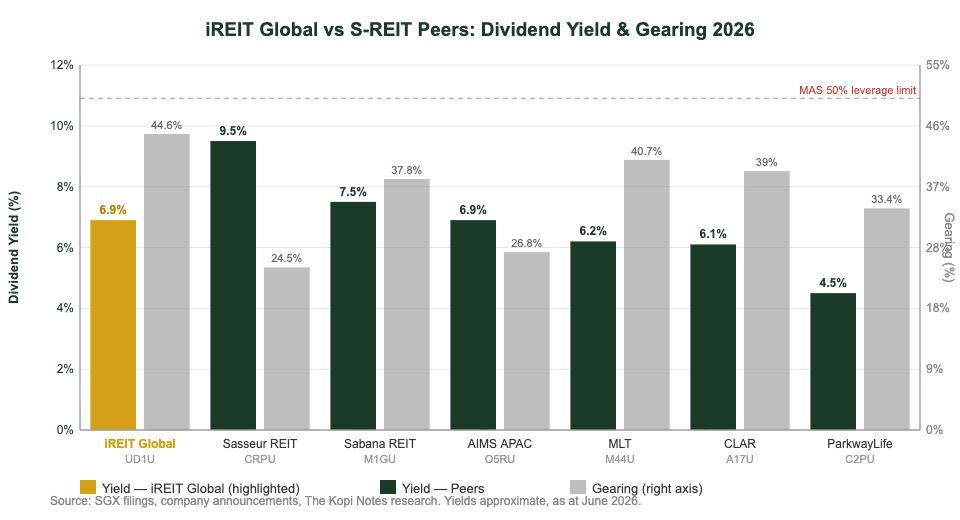
To contextualise iREIT Global’s yield against other S-REITs, the table below compares trailing dividend yields across a selection of peers as at June 2026. Note that iREIT Global’s elevated yield partly reflects its DPU risk (deep FY2025 cut) and elevated gearing — higher yield often signals higher risk in the S-REIT market.
| REIT | SGX Ticker | Approx. Yield | Gearing | Geography |
|---|---|---|---|---|
| iREIT Global | UD1U | ~6.9% | 44.6% | Europe (DE/ES/FR) |
| Sasseur REIT | CRPU | ~9.5% | 24.5% | China (Retail) |
| Sabana REIT | M1GU | ~7.5% | 37.8% | Singapore (Industrial) |
| AIMS APAC REIT | O5RU | ~6.9% | 26.8% | SG + Australia |
| Mapletree Logistics Trust | M44U | ~6.2% | 40.7% | Asia-Pacific |
| CapitaLand Ascendas REIT | A17U | ~6.1% | 39.0% | Global (Industrial) |
| ParkwayLife REIT | C2PU | ~4.5% | 33.4% | SG + JP + FR (Healthcare) |
Source: SGX, company announcements, The Kopi Notes research. Yields are approximate trailing figures as at June 2026 and may differ from forward yields. Not a buy recommendation.
Compared to peers, iREIT Global’s yield sits in the mid-range of the S-REIT universe — but its gearing at 44.6% is the highest in this comparison table. For a Singapore investor already holding passive income Singapore-focused assets like industrial or healthcare REITs, iREIT Global offers genuine geographic diversification into European commercial real estate, which may be its strongest portfolio argument.
Analyst Verdict & Our View
RHB Bank has described iREIT Global as a “potential privatisation candidate” with a “sharp dislocation” in trading price relative to net asset value — suggesting the market may be pricing in more distress than the underlying asset portfolio warrants. This is a contrarian thesis: if the Berlin Campus repositioning succeeds, DPU recovers toward historical levels, and/or a sponsor-backed privatisation occurs, current unitholders could benefit from significant price re-rating.
However, the bear case is equally clear: elevated gearing (44.6%), continued Berlin vacancy drag, EUR/SGD currency headwinds, and European office structural demand shifts could keep DPU depressed for longer than expected. The REIT has limited capital management levers at current leverage levels.
For a Singapore retirement portfolio, iREIT Global is best treated as a small, speculative satellite position — not a core income holding. The Berlin repositioning timeline remains uncertain, and the dividend cut has already shown that income investors cannot rely on stable DPU here in the near term. That said, at S$0.29 and a nominal 7% yield, the risk-reward may appeal to value-oriented investors willing to wait for a DPU recovery through 2026–2027.
To build a more resilient, higher-conviction passive income strategy, our Singapore retirement calculator can help you model how much yield you need from your REIT portfolio to reach your retirement income target — and whether iREIT Global’s current yield level justifies the risk.
You can also explore the Singapore REIT ETF guide for diversified exposure to S-REITs without single-REIT concentration risk, or use the Endowus referral code 2V343 to invest in REITs through Endowus’s CPF and SRS-eligible portfolios.
Disclaimer: This article is for educational purposes only and does not constitute financial advice. Past DPU and share price performance are not indicative of future results. Always conduct your own due diligence before investing.
Frequently Asked Questions
What is iREIT Global's current share price in 2026?
As at June 2026, iREIT Global (SGX: UD1U) is trading at approximately S$0.29–S$0.31 per unit. The share price has been on a multi-year downtrend from its 2019 peak of around S$0.83, driven by COVID-19 impacts, European interest rate hikes, and more recently the Berlin Campus vacancy that has significantly reduced net property income. The current price implies a trailing yield of approximately 6.9–7.0% based on FY2025 DPU, though investors should note the DPU was cut sharply in FY2025 and the forward yield may differ.
Why did iREIT Global's DPU fall so sharply in FY2025?
iREIT Global’s FY2025 DPU fell 42.6% year-on-year to €1.09 cents, primarily due to the Berlin Campus vacancy. Berlin Campus — the REIT’s largest German property — underwent a full repositioning and refurbishment programme after tenants vacated, removing a significant chunk of net property income from the income stream. The 2H FY2025 DPU was down nearly 60% year-on-year as the full impact hit. The manager has since secured a 10-year federal government lease at Darmstadt Campus in Q1 2026, which is a positive signal for the German portfolio’s recovery trajectory.
Can I buy iREIT Global using my CPF or SRS funds?
Yes. iREIT Global (SGX: UD1U) is eligible under both the CPF Investment Scheme (CPFIS-OA) and the Supplementary Retirement Scheme (SRS). To invest CPF OA funds, you need a CPFIS investment account with DBS, OCBC, or UOB. For SRS investment, you can use DBS Vickers, OCBC Securities, UOB Kay Hian, or Syfe Brokerage. Do note that CPF OA funds earn a guaranteed 2.5% p.a. interest, so investing CPF in any equity (including REITs) is only worthwhile if you expect returns above 2.5% — which is not guaranteed given iREIT Global’s current DPU trajectory.
What is the dividend yield of iREIT Global in 2026?
The trailing dividend yield for iREIT Global as at June 2026 is approximately 6.9–7.0%, based on FY2025 full-year DPU of €1.09 cents converted to SGD at prevailing exchange rates. However, this trailing yield is based on the deeply depressed FY2025 DPU following the Berlin Campus vacancy impact. If Berlin Campus is successfully repositioned and new leases are secured, forward DPU — and therefore forward yield — could be materially higher. Conversely, if the repositioning takes longer than expected, DPU could remain at or near current levels through 2027.
Is iREIT Global a good REIT to buy in 2026?
iREIT Global is a higher-risk, higher-potential-reward S-REIT in 2026. Analyst RHB has flagged it as a “potential privatisation candidate” given the perceived dislocation between its trading price and net asset value. The bull case involves a successful Berlin Campus repositioning, DPU recovery, and possible privatisation by its sponsors (Tikehau Capital and CDL). The bear case involves prolonged vacancy, elevated gearing at 44.6% constraining growth, and continued EUR/SGD currency headwinds. It is best treated as a small satellite position in a diversified REIT portfolio — not a core income holding for retirement planning purposes.
What is the gearing level of iREIT Global, and why does it matter?
iREIT Global’s aggregate leverage (gearing) stood at 44.6% as at December 2025. This is elevated relative to the S-REIT sector average of 35–40% and is approaching the MAS regulatory limit of 50%. High gearing matters for two reasons: first, if portfolio valuations fall (e.g. from rising European capitalisation rates), the gearing ratio could breach the 50% MAS cap, potentially forcing asset sales. Second, high gearing limits the manager’s ability to issue new debt for acquisitions, constraining distribution growth. Singapore investors comparing iREIT Global against peers like AIMS APAC REIT (26.8% gearing) or Sabana REIT (37.8%) are taking on meaningfully more balance sheet risk.
How does iREIT Global pay dividends to Singapore investors?
iREIT Global distributes income semi-annually — once for the first half of the financial year (1H, typically paid in August) and once for the second half (2H, typically paid in February). Distributions are declared in euros (EUR) and converted to Singapore dollars at the prevailing EUR/SGD exchange rate before payment. This means Singapore investors are exposed to EUR/SGD currency fluctuations: if the euro weakens against the SGD between declaration and payment, you receive fewer Singapore dollars. There is no hedging mechanism at the unitholder level, though the manager may hedge currency exposure at the trust level.
Start Building Your S-REIT Portfolio Today
Compare S-REITs, run your numbers, and invest smarter with these Singapore platforms and tools.
This article was researched with the help of AI. While we strive to keep all information accurate and up to date, there may be errors. If you notice any discrepancies, please contact us.