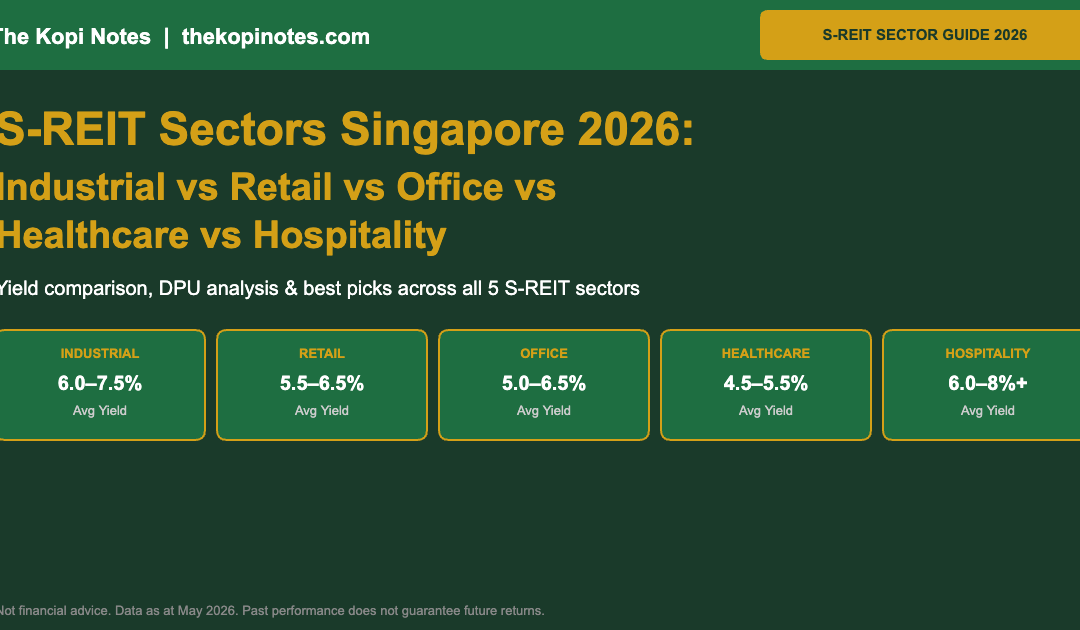
S-REIT Sectors Singapore 2026: Industrial vs Retail vs Office vs Healthcare vs Hospitality
A complete sector-by-sector breakdown of Singapore REITs — yield comparison, DPU analysis, gearing ratios, and our best picks across all five S-REIT sectors. Not financial advice. Data as at May 2026.
Singapore REITs (S-REITs) span five distinct property sectors — each with its own yield profile, DPU drivers, gearing constraints, and macro sensitivities. Whether you are building a dividend income portfolio or seeking total returns via CPF or SRS, understanding which S-REIT sector fits your goals is the first step.
As at May 2026, SORA has settled near 1.1%, providing meaningful DPU relief for floating-rate borrowers, and occupancy rates across industrial and retail sectors remain resilient above 95%. This guide compares all five sectors head-to-head with data tables, gearing analysis, and sector verdicts.
S-REIT Sector Overview 2026
There are over 40 S-REITs listed on SGX, collectively managing more than S$120 billion in assets. The Singapore REIT market is one of the most mature in Asia, with a tax-transparent structure that passes at least 90% of distributable income to unitholders each quarter or semi-annually. S-REITs are subject to the MAS 50% aggregate leverage limit. As at May 2026, average sector gearing sits at 37–40%, leaving a reasonable buffer before forced deleveraging.
The five main sectors are: Industrial (logistics, data centres, business parks), Retail (suburban malls, integrated developments), Office (Grade A CBD), Healthcare (hospitals, nursing homes), and Hospitality (hotels, serviced residences). A smaller group of Overseas REITs targets European and US commercial property at higher yields with added currency risk.
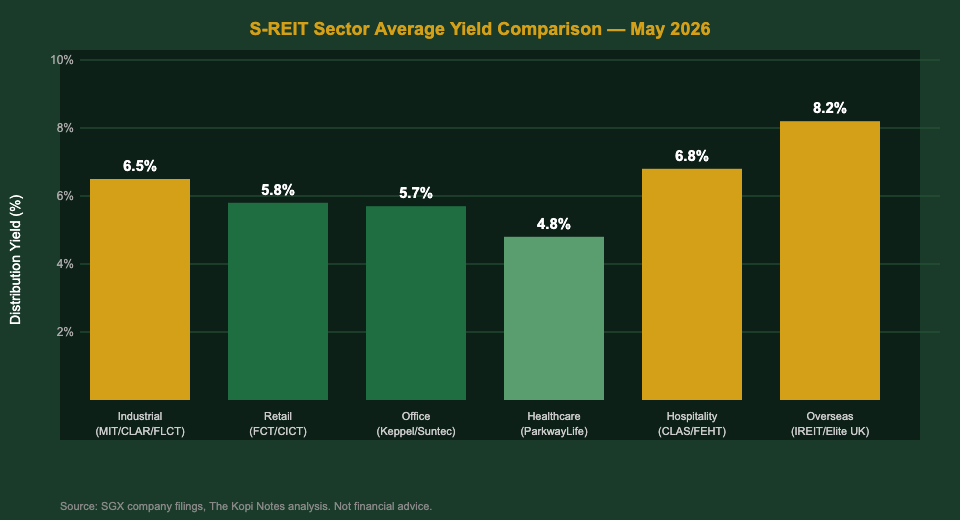
Sector Yield Comparison Table — May 2026
Yields based on trailing 12-month DPU and share prices as at May 2026. All data from latest SGX company filings.
| REIT (Ticker) | Sector | DPU (¢) | Yield | Gearing | ICR |
|---|---|---|---|---|---|
| Mapletree Industrial Trust (ME8U) | Industrial | 12.71 | 6.5% | 37.5% | 4.8× |
| CapitaLand Ascendas REIT (A17U) | Industrial | 15.005 | 6.1% | 39.0% | 4.1× |
| AIMS APAC REIT (O5RU) | Industrial | 9.850 | 6.9% | 26.8% | 5.2× |
| Frasers Centrepoint Trust (J69U) | Retail | 12.056 | 6.0% | 33.5% | 4.7× |
| CapitaLand Integrated Commercial Trust (C38U) | Retail/Office | 10.66 | 4.8% | 40.2% | 3.6× |
| Keppel REIT (K71U) | Office | 5.23 | 5.4% | 40.2% | 3.4× |
| Suntec REIT (T82U) | Office/Retail | 6.404 | 6.0% | 42.5% | 3.1× |
| ParkwayLife REIT (C2PU) | Healthcare | 15.29 | 4.8% | 33.4% | 8.2× |
| CapitaLand Ascott Trust (HMN) | Hospitality | 6.10 | 6.9% | 38.9% | 3.2× |
| Far East Hospitality Trust (Q5T) | Hospitality | 3.70 | 6.4% | 30.4% | 4.2× |
| IREIT Global (UD1U) | Overseas | 2.80 | 7.0% | 34.2% | 3.8× |
| Elite UK REIT (MXNU) | Overseas | 3.03p | 8.4% | 38.5% | 3.6× |
Source: SGX company filings. Yields = trailing DPU ÷ May 2026 share price. Not financial advice.
Industrial REITs: The Backbone of Singapore’s Logistics and Data Economy
Industrial S-REITs are the largest sub-sector by market cap, anchored by three large-cap names and several mid-cap specialists. Properties include logistics warehouses, data centres, hi-tech industrial buildings, business parks, and flatted factories. Three structural tailwinds support the sector in 2026: Changi Airport expansion and Tuas Megaport Phase 1 driving warehouse demand; power-constrained data centre supply keeping rents elevated; and positive rental reversions of 8–15% across most portfolios.
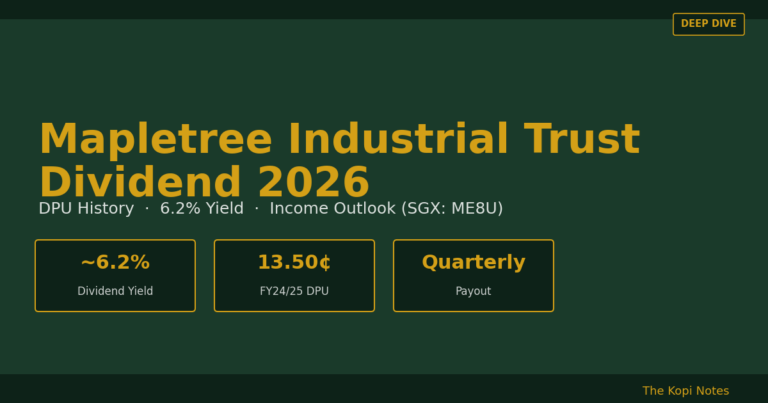
Mapletree Industrial Trust (MIT, ME8U) — FY2026 DPU 12.71¢, yield ~6.5%, gearing 37.5%, ICR 4.8×. Data centres make up ~57% of AUM. Read our full MIT investor guide.
CapitaLand Ascendas REIT (CLAR, A17U) — FY2025 DPU 15.005¢, yield ~6.1%, 222 properties across SG/AU/UK/US. Rental reversion +13.6% in 1H FY2025. See our CLAR deep-dive.
AIMS APAC REIT (O5RU) — FY2026 DPU 9.850¢, yield ~6.9%, gearing only 26.8% — the standout mid-cap pick with lowest gearing in the peer group. Full review: AIMS APAC REIT guide.
Verdict: Best risk-reward sector for 2026. Positive rent reversions, manageable gearing, and structural demand from data centres and e-commerce make industrial the core holding for Singapore dividend investors.
Retail REITs: Singapore Mall Resilience in a Digital Age
Singapore’s retail S-REITs benefit from dense population, strong domestic consumption, and the structural moat of suburban malls — a format that has proven more resilient than CBD retail against e-commerce headwinds.
Frasers Centrepoint Trust (FCT, J69U) — FY2025 DPU 12.056¢, yield ~6.0%, gearing 33.5%. Nine suburban malls including Causeway Point, Northpoint City, and Waterway Point, all with 99.5%+ occupancy. See FCT share price guide.
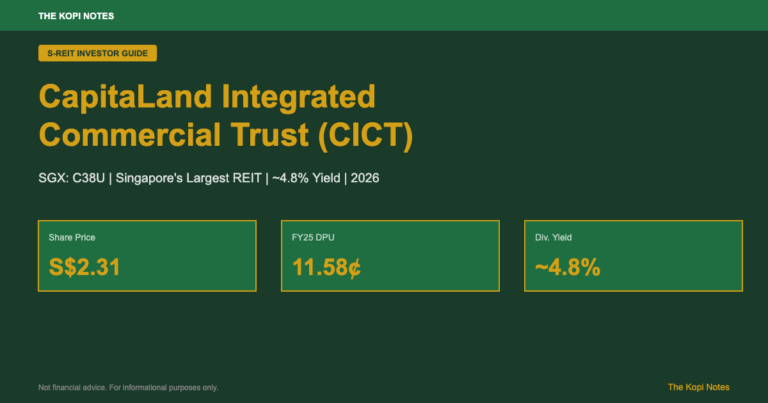
CapitaLand Integrated Commercial Trust (CICT, C38U) — FY2024 DPU 10.66¢, yield ~4.8%, gearing 40.2%. The largest REIT in Singapore by market cap (~S$14B), owning 21 properties including ION Orchard, Raffles City Singapore, and Capitol Singapore post-Paragon acquisition.
Verdict: FCT offers better yield and lower gearing than CICT, making it preferred for income investors. CICT suits total-return investors wanting exposure to Singapore’s prime retail and office assets.
Office REITs: Grade A CBD Recovery and AI-Driven Demand
Singapore office S-REITs own some of Asia’s most prestigious commercial real estate. In 2026, Grade A CBD office rents have stabilised at S$10.50–S$11.00 psf/month, supported by financial services and technology sector demand. Both major office REITs carry gearing near 40–42%, making them the most interest-rate sensitive S-REIT sub-sector.
Keppel REIT (K71U) — FY2025 DPU 5.23¢, yield ~5.4%, gearing 40.2%, ICR 3.4×. S$11.7B portfolio across SG, AU, KR, JP. 1Q2026 NPI +9.7% YoY, occupancy 97.1%. Full deep-dive: Keppel REIT guide.
Suntec REIT (T82U) — FY2024 DPU 6.404¢, yield ~6.0%, gearing ~42.5%. Mixed-use REIT combining Suntec City Mall, office towers, and convention centre with Australian properties. Higher yield comes with higher gearing risk. Full analysis: Suntec REIT investor guide.
Verdict: Keppel REIT preferred for its superior balance sheet; Suntec for higher headline yield. Office carries more interest rate risk than industrial or retail — size this sector carefully in a rising-rate environment.
Healthcare REITs: Defensive Dividends with 18 Consecutive Years of DPU Growth
Healthcare S-REITs represent the most defensive sub-sector on SGX. Properties — hospitals, specialist medical centres, nursing homes — are leased on long-term triple-net or CPI-linked leases, providing highly predictable DPU that is largely insulated from economic cycles.
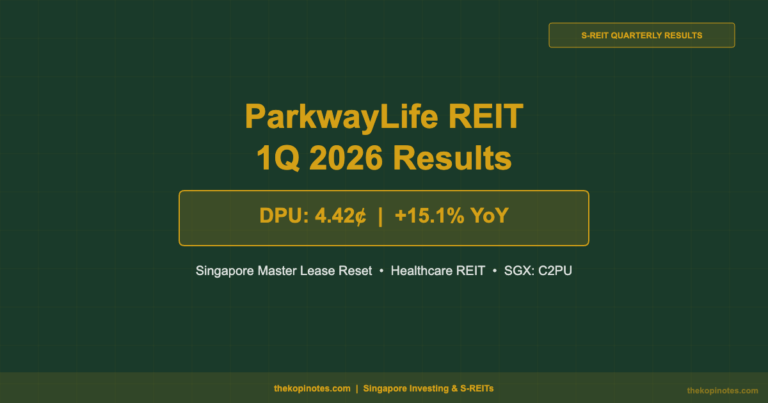
ParkwayLife REIT (C2PU) is Singapore’s only pure-play healthcare REIT with an unbroken 18-year DPU growth record. FY2025 DPU was 15.29¢, with 1Q2026 DPU of 4.42¢ (+15.1% YoY boosted by Singapore CPI rent revision). Portfolio spans 75 properties across Singapore, Japan, and France. Gearing 33.4%, ICR 8.2× — the highest ICR of any major S-REIT. The trade-off: yield of only ~4.8%, reflecting a premium defensive valuation. Full analysis: ParkwayLife REIT guide.
Verdict: Best for capital-preservation investors and CPF/SRS income drawdown strategies. Not the right sector if you need maximum income from day one — but an excellent anchor for long-term DPU compounding.
Hospitality REITs: Tourism Recovery and RevPAU Tailwinds
Hospitality S-REITs own hotels, serviced residences, and student accommodation globally. Singapore’s tourism recovery is strong — Changi Airport handled a record 68.3 million passengers in FY2025, and hotel occupancy sits at 85–88%. RevPAU (Revenue Per Available Unit) is the key performance metric.
CapitaLand Ascott Trust (CLAS, HMN) — FY2025 DPU 6.10¢, yield ~6.9%, gearing 38.9%. Largest hospitality REIT in Asia Pacific: 99 properties across 46 cities. 1Q2026 RevPAU S$137 (+1% YoY). Ongoing AEI pipeline S$180M. Full guide: CLAS investor guide.
Far East Hospitality Trust (FEHT, Q5T) — FY2025 DPS 3.70¢, yield ~6.4%, gearing only 30.4%. Pure-play Singapore hotel and serviced residence REIT with 13 properties plus Japan’s Four Points by Sheraton Nagoya providing income diversification.
Verdict: Highest yield potential but highest DPU volatility. CLAS for scale and global diversification; FEHT for Singapore purity and conservative gearing. Both suit investors comfortable with quarterly income variability.
Overseas-Focused REITs: Higher Yield, Higher Risk
A distinct group of S-REITs focuses exclusively on properties outside Singapore — primarily European and US commercial real estate. These offer the highest yields on SGX but carry currency risk (EUR, GBP, USD vs SGD), geopolitical risk, and government tenant concentration risk.
IREIT Global (UD1U) — yield ~7.0%, gearing 34.2%. Office and retail properties in Germany, Spain, Netherlands, France, and Poland. Berlin Campus repositioning (office to mixed-use residential/retail) is the key medium-term catalyst. Full IREIT analysis.
Elite UK REIT (MXNU) — DPU 3.03p, yield ~8.4%. 155 UK government-leased office properties, 7.2-year WALE, 99% UK government tenant — among the most stable tenant profiles of any S-REIT. GBP depreciation risk is the main watch point. Elite UK REIT guide.
Verdict: Suitable as a satellite allocation (5–10% of REIT portfolio) for yield enhancement. Not recommended as a core holding due to currency and geographic risks.
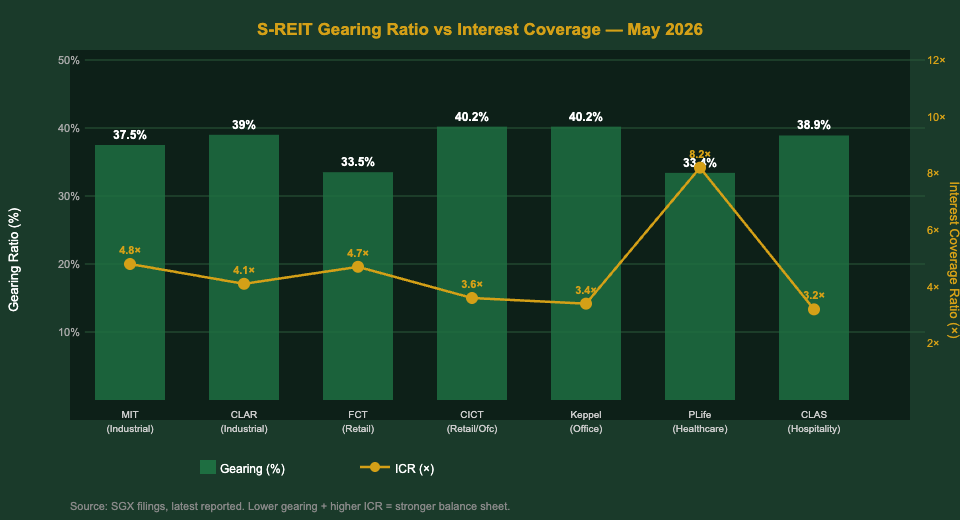
Gearing and Balance Sheet Comparison
Under MAS regulations, S-REITs face a 50% aggregate leverage cap (or 60% with investment-grade credit rating and ICR ≥ 2.5×). Lower gearing and higher ICR indicate a more resilient balance sheet capable of weathering interest rate volatility and executing yield-accretive acquisitions.
| REIT | Gearing | ICR | Balance Sheet |
|---|---|---|---|
| AIMS APAC REIT | 26.8% | 5.2× | ★★★★★ Excellent |
| ParkwayLife REIT | 33.4% | 8.2× | ★★★★★ Excellent |
| Far East Hospitality Trust | 30.4% | 4.2× | ★★★★ Very Good |
| Frasers Centrepoint Trust | 33.5% | 4.7× | ★★★★ Very Good |
| Mapletree Industrial Trust | 37.5% | 4.8× | ★★★★ Very Good |
| CapitaLand Ascendas REIT | 39.0% | 4.1× | ★★★★ Good |
| CapitaLand Ascott Trust | 38.9% | 3.2× | ★★★ Adequate |
| Keppel REIT | 40.2% | 3.4× | ★★★ Adequate |
| CICT | 40.2% | 3.6× | ★★★ Adequate |
| Suntec REIT | 42.5% | 3.1× | ★★ Watch |
Source: Latest SGX company filings. Not financial advice.
How to Buy S-REITs with CPF or SRS
Most SGX Main Board S-REITs are eligible for purchase using CPF Investment Scheme (CPFIS-OA) funds. You can check eligibility on the CPF Board website. CPF OA funds used for investment no longer earn the guaranteed 2.5% p.a. interest — compare opportunity costs carefully using our CPF investment strategy guide.
SRS (Supplementary Retirement Scheme) funds can be used to buy any SGX-listed S-REIT via a SRS-linked brokerage account, reducing your taxable income dollar-for-dollar. Use our SRS Tax Savings Calculator to estimate your savings.
To invest efficiently, consider Endowus (CPF and SRS compatible, institutional fund access), Syfe REIT+ (targets 5–7% yield), or buy directly on SGX via FSMOne at 0.08% brokerage. You can also use our S-REIT Dividend Yield Calculator to model your portfolio income.
Which S-REIT Sector Is Best for 2026?
| Sector | Yield | DPU Stability | Growth | Our Rating |
|---|---|---|---|---|
| Industrial | ★★★★ | ★★★★ | ★★★★★ | BUY |
| Retail | ★★★★ | ★★★★ | ★★★ | BUY |
| Office | ★★★ | ★★★ | ★★★ | HOLD |
| Healthcare | ★★ | ★★★★★ | ★★★ | BUY (Defensive) |
| Hospitality | ★★★★★ | ★★★ | ★★★★ | BUY (High Income) |
| Overseas | ★★★★★ | ★★★ | ★★ | SATELLITE |
Our suggested portfolio allocation for 2026: 40–50% Industrial (MIT/CLAR/AIMS APAC) + 20–25% Retail (FCT) + 15–20% Healthcare (ParkwayLife) + 10–15% Hospitality (CLAS/FEHT). This targets a blended yield of ~5.8–6.2% with above-average balance sheet quality. Compare our full picks at Best S-REITs Singapore 2026, or explore the Singapore REIT ETF guide for a single-fund approach.
Frequently Asked Questions
Which S-REIT sector has the highest yield in Singapore 2026?
Are Singapore REITs safe investments?
Can I buy S-REITs with CPF?
What is a good gearing ratio for a Singapore REIT?
Which S-REIT has the best DPU growth record?
How do interest rates affect S-REITs?
Is it better to buy individual S-REITs or a REIT ETF?
Do Singapore REIT investors pay tax on distributions?
This article was researched with the help of AI. While we strive to keep all information accurate and up to date, there may be errors. If you notice any discrepancies, please contact us.