SRS Tax Savings 2026: How Much Tax Do You Actually Save?
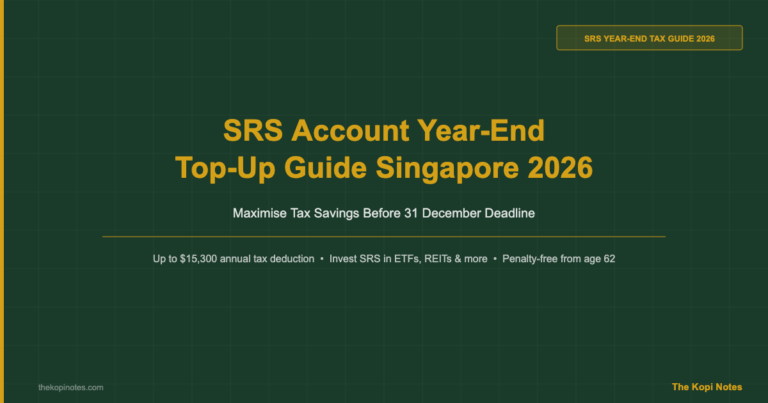
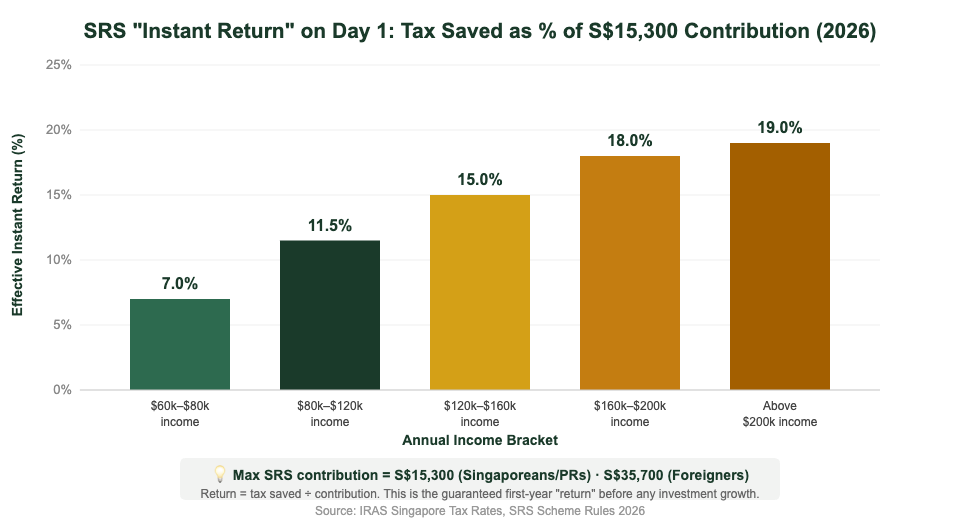
The Supplementary Retirement Scheme (SRS) is one of the most overlooked tax-saving tools in Singapore. Contributing to your SRS account reduces your chargeable income by up to S$15,300 (Singaporeans and PRs) or S$35,700 (foreigners) each year — delivering an instant, guaranteed first-year return of 7% to 22% depending on your income tax bracket. This guide shows you exactly how much tax you save at every income level in 2026.
Not financial advice. All figures are for educational reference only. Tax rates and SRS limits are based on IRAS Singapore and MAS data as at 2026.
Table of Contents
Click to expand — Table of Contents
What Is the SRS and How Does It Save Tax?
The Supplementary Retirement Scheme (SRS) is a voluntary government scheme that lets Singapore residents contribute money into a dedicated account — and deduct that contribution from their chargeable income before income tax is calculated.
Here’s the simple mechanism:
- You earn S$100,000 in 2026 and contribute S$15,300 to your SRS account.
- IRAS calculates your income tax on S$84,700 (S$100,000 − S$15,300) instead of the full S$100,000.
- You pay significantly less tax this year — money that stays in your SRS account and can be invested.
- When you withdraw from SRS at or after the statutory retirement age (currently 63), only 50% of withdrawals are taxable — and spread over 10 years, this typically means you pay little or no tax at all.
This double tax advantage — less tax going in, minimal tax coming out — makes SRS one of the most powerful retirement savings tools available to Singapore residents.
Who Can Open an SRS Account?
Any Singapore Citizen, Permanent Resident, or Employment Pass/S-Pass/work permit holder who pays income tax in Singapore can open an SRS account. You can open one with DBS, OCBC, or UOB. Once open, you have until 31 December each year to make your annual contribution and claim the deduction for that Year of Assessment (YA).
SRS Contribution Limits 2026
SRS has different annual contribution caps depending on your residency status:
| Resident Status | Annual SRS Cap | Maximum Tax Deduction |
|---|---|---|
| Singapore Citizen | S$15,300 | S$15,300 off chargeable income |
| Singapore Permanent Resident | S$15,300 | S$15,300 off chargeable income |
| Foreigner (EP/S-Pass holder) | S$35,700 | S$35,700 off chargeable income |
Source: Ministry of Finance (MOF) Singapore, SRS Scheme Guidelines, 2026.
You do not have to contribute the full cap — any amount works and gets you a proportional deduction. For example, if you can only spare S$5,000, you’ll reduce your chargeable income by S$5,000 and save the corresponding tax. Partial contributions are perfectly valid and still worthwhile.
One important note: the SRS contribution limit is separate from your CPF investment strategy — you cannot use CPF funds to top up your SRS account. SRS is funded exclusively from your take-home (post-CPF) cash.
Singapore Income Tax Brackets 2026
To understand how SRS saves tax, you first need to know which tax bracket your income falls into. Singapore uses a progressive tax system — higher income is taxed at higher marginal rates, but only the income within each band is taxed at that band’s rate.
| Chargeable Income | Tax Rate | Tax on This Band | Cumulative Tax |
|---|---|---|---|
| First S$20,000 | 0% | S$0 | S$0 |
| Next S$10,000 ($20k–$30k) | 2% | S$200 | S$200 |
| Next S$10,000 ($30k–$40k) | 3.5% | S$350 | S$550 |
| Next S$40,000 ($40k–$80k) | 7% | S$2,800 | S$3,350 |
| Next S$40,000 ($80k–$120k) | 11.5% | S$4,600 | S$7,950 |
| Next S$40,000 ($120k–$160k) | 15% | S$6,000 | S$13,950 |
| Next S$40,000 ($160k–$200k) | 18% | S$7,200 | S$21,150 |
| Next S$40,000 ($200k–$240k) | 19% | S$7,600 | S$28,750 |
Source: IRAS Singapore, Personal Income Tax Rates, YA2026.
The key takeaway: the higher your income, the higher your marginal tax rate, and the more money SRS saves you per dollar contributed.
SRS Tax Savings by Income Level: The Full Breakdown
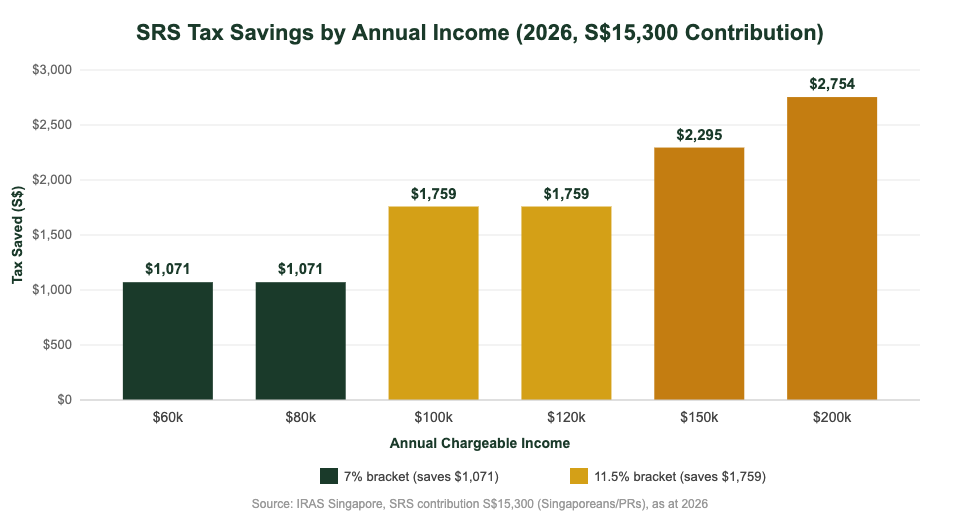
Here is the complete picture of how much tax a maximum S$15,300 SRS contribution saves you at different annual income levels. All calculations assume no other tax reliefs and standard personal income tax rates for YA2026.
| Annual Income | Tax Without SRS | Tax With SRS (–S$15,300) | Tax Saved | Effective Return |
|---|---|---|---|---|
| S$60,000 | S$1,950 | S$879 | S$1,071 | 7.0% |
| S$80,000 | S$3,350 | S$2,279 | S$1,071 | 7.0% |
| S$100,000 | S$5,650 | S$3,891 | S$1,759 | 11.5% |
| S$120,000 | S$7,950 | S$6,191 | S$1,759 | 11.5% |
| S$150,000 | S$12,450 | S$10,155 | S$2,295 | 15.0% |
| S$200,000 | S$21,150 | S$18,396 | S$2,754 | 18.0% |
Source: IRAS Singapore personal income tax rates, SRS contribution limit S$15,300 for Singaporeans/PRs. Calculations assume no other reliefs applied. Tax savings = annual guaranteed return before any investment returns.
The “Effective Return” column shows the guaranteed, risk-free return on your SRS contribution before your money even earns a single cent of investment returns. A S$100,000 income earner contributes S$15,300 today and immediately saves S$1,759 in taxes — that’s an 11.5% return in year 1, guaranteed.
Who Benefits Most from Maxing Out SRS?
SRS is technically available to any Singapore taxpayer, but the value varies significantly based on your situation:
High-Income Earners (S$80,000+ per year)
The marginal tax rate jumps from 7% to 11.5% at the S$80,001 mark. A salaried professional earning S$100,000 saves S$1,759 per year — that’s almost S$150 per month returned to you through lower taxes. At S$150,000, the savings jump to S$2,295 annually. If you’re in this bracket and not contributing to SRS, you are leaving significant money on the table every year.
Salaried Employees in the $60k–$80k Range
Even at the 7% marginal rate, S$1,071 in annual tax savings is meaningful — especially if you invest those SRS funds into a diversified portfolio via Endowus referral code (code: 2V343, for SRS investing) and let compound growth work over decades. The immediate tax saving is guaranteed; the investment returns on top are a bonus.
Foreigners on Employment Passes
Foreign EP holders can contribute up to S$35,700 annually — more than double the Singaporean cap. At a 17%–22% marginal rate, this can translate to S$6,000–S$7,854 in annual tax savings. SRS is arguably even more powerful for high-income foreign professionals than for Singaporeans.
Who Should NOT Prioritise SRS?
- Low-income earners below S$40,000: At 0%–3.5% marginal rates, the tax savings are small (S$535 or less on a full S$15,300 contribution). You’d be better off building an emergency fund first.
- Those with limited cash flow: SRS money is locked in until the statutory retirement age. Early withdrawal before age 63 triggers 100% of the withdrawn amount being taxable (vs 50% for on-time withdrawals) plus a 5% penalty. Only contribute what you can genuinely set aside long-term.
- Retirees already past retirement age: The tax arbitrage works best while you’re in a high-income-earning phase. Once you’ve retired, the calculus changes.
How to Invest Your SRS Money in 2026
Simply leaving your SRS funds in the bank account earns a negligible interest rate (typically 0.05%). The real power of SRS comes from investing the funds. Your SRS account balance can be invested into:
- Unit trusts and managed portfolios
- Singapore Exchange (SGX) listed stocks and ETFs
- Fixed deposits (for conservative investors)
- Singapore Savings Bonds (SSB) and T-bills
- Insurance products
For most investors, the simplest and most effective approach is a low-cost, globally diversified portfolio through a robo-advisor that accepts SRS:
Endowus (Best for SRS Managed Portfolios)
Endowus is the only platform in Singapore specifically designed with SRS in mind. You connect your SRS account directly, choose a model portfolio (100% equities for long-term growth, or blended with bonds for a balanced approach), and Endowus handles everything. Use Endowus referral code 2V343 for a sign-up bonus on first investment. Fees start from 0.25% p.a. for funds.
Syfe (Best for SRS ETF-Based Portfolios)
Syfe’s REIT+, Core, and Income+ portfolios are all available for SRS. The Syfe referral code and sign-up bonus SRPRFFFCD gets you a fee-free first months. Syfe is particularly popular for its Core Equity100 portfolio (100% equities, globally diversified).
FSMOne (Best for SRS Self-Directed Investing)
If you prefer to pick your own ETFs or unit trusts, FSMOne supports SRS investing with access to a wide range of funds. Use FSMOne referral code P0544985 when signing up. Commission-free regular savings plans make it excellent for disciplined monthly SRS investing.
SRS vs CPF Cash Top-Up: Which Saves More Tax in 2026?
Both SRS and CPF Cash Top-Up (under the Retirement Sum Topping-Up Scheme) reduce your chargeable income, but they work differently:
| Feature | SRS | CPF Cash Top-Up |
|---|---|---|
| Annual Cap (SC/PR) | S$15,300 | Up to S$8,000 (own SA/RA) + S$8,000 (family) |
| Investment Options | Wide (equities, ETFs, funds, SSB, FDs) | Limited (CPF Investment Scheme only) |
| Guaranteed Returns | None (depends on investments) | 4% p.a. (SA/RA) — risk-free |
| Withdrawal Flexibility | From age 63 (statutory retirement age) | From age 55 (SA)/CPF Life payout from 65 |
| Inheritance | Goes to estate (probate) | CPF nomination (direct, faster) |
Source: MAS, CPF Board 2026 guidelines.
For most Singaporeans, the optimal strategy is to use both: max out the CPF cash top-up first (for the guaranteed 4% return and the S$8,000 tax relief), then top up SRS for additional tax savings and investment flexibility. For a detailed comparison, read our guide on the SRS vs CPF Cash Top-Up comparison 2026.
For retirement planning tools, use our Singapore retirement calculator to see how SRS contributions accelerate your path to financial independence.
Frequently Asked Questions About SRS Tax Savings
How much tax do I save if I contribute S$15,300 to SRS at a S$100,000 income?
When is the SRS contribution deadline for YA2026 tax relief?
Does SRS interest income get taxed?
Can I withdraw from SRS before retirement age without penalty?
Is SRS tax savings worth it even at a S$60,000 salary?
Which SRS account should I open — DBS, OCBC or UOB?
This article was researched with the help of AI. While we strive to keep all information accurate and up to date, there may be errors. If you notice any discrepancies, please contact us.