How to Invest in Singapore: The Power of Compounding — Real Numbers and How to Maximise It (2026)
Why starting early — even with a small amount — beats starting late with a large amount. The numbers will surprise you.
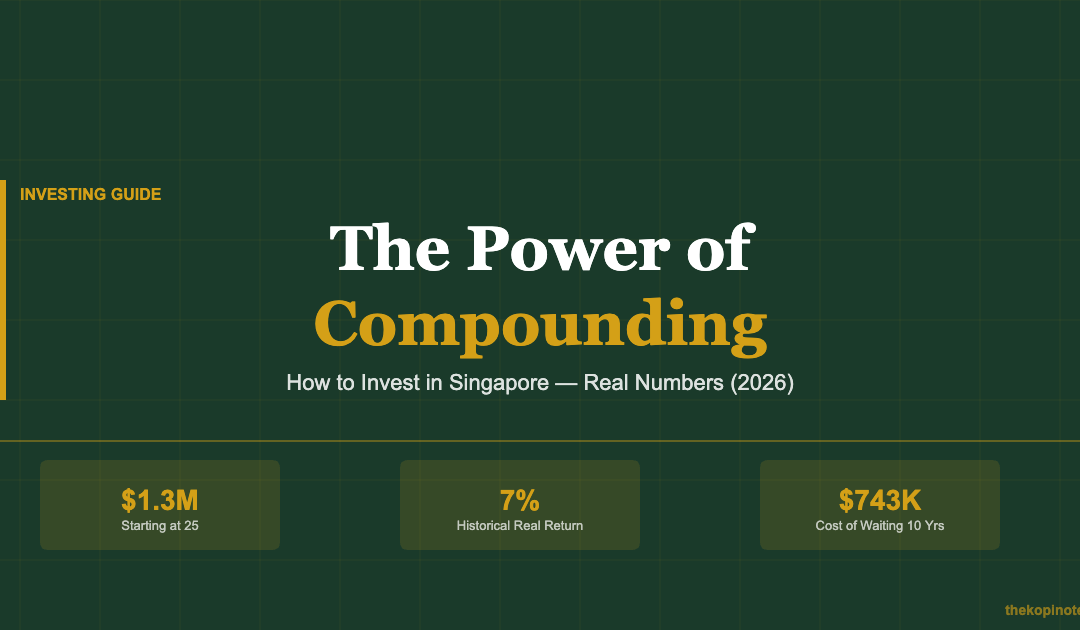
Compounding is what happens when your investment returns earn their own returns — turning time into your biggest financial asset. A Singapore investor who puts $500 a month into a low-cost global ETF from age 25 will, at 7% annual returns, have roughly $1.3 million by age 65. Someone who starts at 35 with the same amount reaches only about $567,000. Same contribution, same return — but a ten-year head start makes the difference of over $700,000.
Not financial advice. All figures are for educational reference only. Data verified as at 19 September 2026 unless noted.
- Compounding works by reinvesting returns — your money grows on itself, not just on your original capital.
- The single most powerful lever is time. Starting 10 years earlier can more than double your final portfolio.
- High fees are compounding in reverse — a 1.5% annual fee quietly destroys $86,000 of a $100,000 investment over 20 years.
Table of Contents
Contents — Click to expand
- What Is Compounding?
- Real Numbers: What $500 a Month Actually Grows To
- How Singapore’s Investment Accounts Compound
- The Hidden Killer: How Fees Destroy Compounding
- Early vs Late Starter — The Real Cost of Waiting
- How to Maximise Compounding in Singapore
- Common Mistakes That Kill Your Compounding
- Frequently Asked Questions
What Is Compounding?
Compounding — often called “compound interest” — is the process where your investment earnings generate their own earnings over time. It’s different from simple interest, where you only earn on your original amount.
With simple interest: $10,000 at 7% earns $700 per year. After 20 years, you have $24,000.
With compound interest: in year one you earn $700. In year two, 7% on $10,700 — that’s $749. Year three: 7% on $11,449, which is $801. After 20 years, you have $38,697. That’s $14,697 more — and you did nothing extra.
The formula is: FV = PV × (1 + r)^n. But the formula isn’t what matters. What matters is what happens when n gets large.
You put in $10,000. Time did the rest.
In Singapore’s investing context, compounding works across ETFs, REITs, CPF interest, and robo-advisor portfolios. The rate of return matters. But the length of time matters even more. And fees can quietly eat decades of gains.
Real Numbers: What $500 a Month Actually Grows To
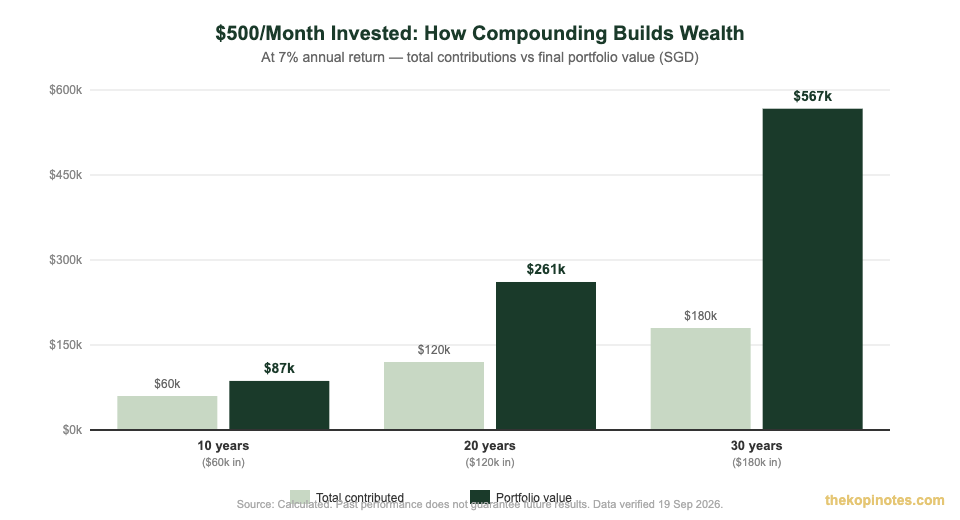
Let’s use a realistic Singapore scenario. You invest $500 a month — roughly what a young working adult might set aside after CPF contributions — into a low-cost global ETF like VWRA or CSPX. What do you get over time?
The table below uses CAGRs from conservative (4%) to optimistic (10%), and time horizons of 10, 20, and 30 years. All figures assume monthly contributions reinvested at the stated rate.
Table 1: $500/Month Invested — Final Portfolio Value
| Annual Return | 10 Years | 20 Years | 30 Years |
|---|---|---|---|
| 4% (conservative) | $73,600 | $183,200 | $347,200 |
| 6% (moderate) | $82,100 | $231,000 | $502,200 |
| 7% (S&P 500 real, historical) | $86,600 | $261,200 | $567,000 |
| 10% (nominal S&P 500 historical) | $102,400 | $382,800 | $1,130,000 |
Total contributions over 10/20/30 years = $60,000 / $120,000 / $180,000 respectively. Historical figures are illustrative — past performance does not guarantee future results.
At 7% over 40 years (age 25 to 65): that $500/month becomes approximately $1.3 million. Your total contributions: $240,000. The remaining $1,060,000 came from compounding alone.
How Singapore’s Investment Accounts Compound
CPF Ordinary Account (OA): 2.5% Floor
Your CPF OA earns at least 2.5% per annum — a guaranteed floor rate, extended to 31 December 2026. Interest is credited monthly and added to your balance, which then earns interest the following month. For the first $20,000 in your OA, you earn an extra 1% (extra interest up to $60,000 across all CPF accounts for those under 55, prioritised to SA then OA). For the CPF investment strategy discussion on OA vs CPFIS, this guaranteed compounding baseline matters.
CPF Special Account (SA): 4% Floor
Your SA earns at least 4% per annum, also extended to 31 December 2026. The SA benefits most from compounding — and its withdrawal restrictions are actually an advantage (less temptation to interrupt compounding).
SRS Account: Depends on What You Invest In
Your SRS account earns just 0.05% if left as cash. Inside SRS, you can buy approved stocks, ETFs, and unit trusts. The SRS tax benefit (contributions reduce your taxable income) also creates an immediate return boost on top of investment compounding.
ETF Portfolios: Market-Rate Compounding
For accumulating ETFs like CSPX (iShares S&P 500 UCITS ETF, LSE) and VWRA (Vanguard FTSE All-World UCITS ETF), dividends are automatically reinvested inside the fund — no manual action needed. This is pure automatic compounding. You can buy these through Syfe, IBKR, or FSMOne — see the Syfe referral code and FSMOne referral code for exclusive welcome bonuses.
Singapore REITs: Manual Reinvestment Required
S-REITs pay out at least 90% of their taxable income as distributions. You receive cash DPU every quarter and must manually reinvest it to compound. For which REITs offer the best yields, see the guide on best S-REITs in Singapore 2026.
The Hidden Killer: How Fees Destroy Compounding
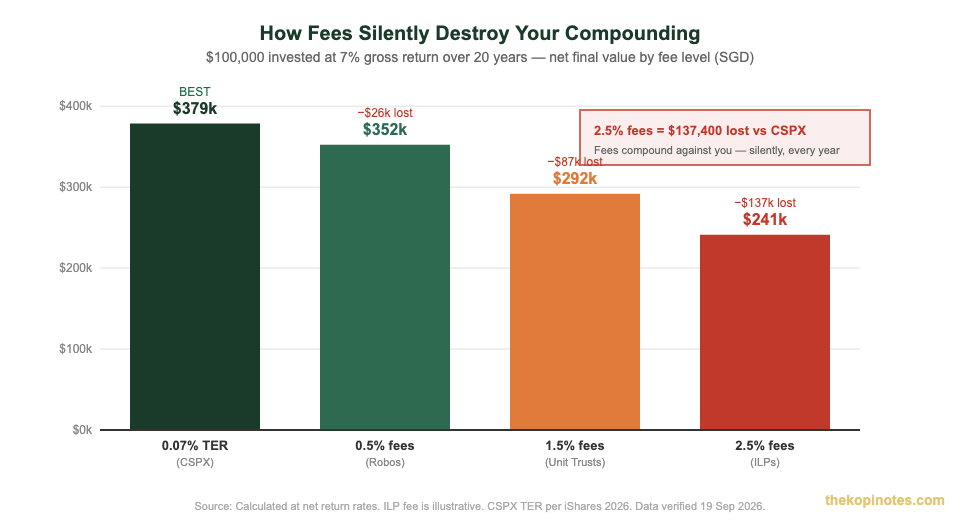
Here’s the cruel irony of fees: they compound too — in the wrong direction. Every percentage point you pay in annual fees is a percentage point your money doesn’t compound. Over decades, this destroys enormous wealth.
Table 2: Fee Drag on $100,000 Invested Over 20 Years (7% Gross Return)
| Annual Fee | Example Vehicle | Net Return | Final Value | Lost to Fees |
|---|---|---|---|---|
| 0.07% | CSPX (iShares S&P 500 UCITS ETF) | 6.93% | $378,600 | $8,400 |
| 0.5% | Robo-advisor (mid-tier) | 6.5% | $352,400 | $34,600 |
| 1.5% | Actively managed fund (typical) | 5.5% | $291,800 | $94,800 |
| 2.5% | Investment-linked policy (ILP) | 4.5% | $241,200 | $144,600 |
Source: Calculated at stated net return rates. CSPX TER per iShares fund factsheet, 2026. ILP total fee estimate is illustrative — actual ILP charges vary by insurer. Past performance does not guarantee future results.
Pay attention to the last column. At 2.5% annual fees — typical for some investment-linked policies — you lose $144,600 over 20 years. Not because the market performed badly. Because fees compounded against you.
This is why Singapore’s robo-advisors (Endowus, Syfe) have disrupted the market — charging 0.3–0.65% all-in versus 1.5–3% for traditional unit trusts. For Endowus, you can invest CPF and SRS funds too. See the Endowus referral code for a welcome bonus.
That’s fees compounding against you — silently, every year.
Early vs Late Starter — The Real Cost of Waiting
Meet two Singapore investors. Mei starts at age 25. She invests $500 a month at 7% annual return until age 65. Total contributions: $240,000 over 40 years.
Kai starts at age 35. Same $500 a month at 7%, retiring at 65. Total contributions: $180,000 over 30 years. Kai contributes $60,000 less. But the final difference isn’t $60,000.
| Investor | Start Age | Total Contributed | Final Value at 65 |
|---|---|---|---|
| Mei (starts at 25) | 25 | $240,000 | $1,310,000 |
| Kai (starts at 35) | 35 | $180,000 | $567,000 |
Assumes 7% CAGR, $500/month contributions, compounded monthly. Illustrative only.
Kai ends up with $743,000 less than Mei — despite contributing only $60,000 less. The missing $683,000 is pure compounding that Kai missed by waiting one decade. If Kai wanted to reach Mei’s $1.31 million, he would need to invest approximately $1,160 a month — more than double Mei’s $500.
Use the Singapore retirement calculator to plug in your own numbers and see your compounding trajectory.
How to Maximise Compounding in Singapore
1. Start as Early as Possible
Even $100 a month matters. Starting at 25 vs 35 produces twice the wealth by retirement. If you’re already past 35, don’t panic — just start now. Waiting one more year costs more than waiting five years did.
2. Choose Low-Fee Accumulating ETFs
Accumulating ETFs like CSPX (0.07% TER) and VWRA (0.22% TER) automatically reinvest dividends. Compounding happens inside the fund — you never have to manually reinvest. These are Ireland-domiciled UCITS ETFs listed on the London Stock Exchange (LSE), which means lower withholding tax on US dividends (15% vs 30% for US-domiciled funds).
3. Maximise Tax-Advantaged Accounts
Two accounts in Singapore let compounding run without being taxed along the way:
- CPF SA: 4% guaranteed per annum, no capital gains tax, and no withdrawal pressure until retirement. Voluntary top-ups to SA before the Enhanced Retirement Sum (ERS) cap let this compound at 4% for decades.
- SRS: Every dollar you contribute reduces your taxable income. Then invest those SRS dollars in ETFs or unit trusts where they compound further. Withdrawals after statutory retirement age (currently 63, moving to 64 from July 2026) are taxed at 50% of your personal rate — the biggest tax-sheltered wrapper available to Singapore residents.
4. Never Interrupt Compounding
Every time you sell and sit in cash, compounding pauses. Market downturns feel scary, but they’re temporary interruptions to compounding. Missing the 10 best trading days in a year dramatically reduces long-term returns. The evidence strongly supports staying invested through volatility rather than timing the market.
Common Mistakes That Kill Your Compounding
Panic selling during a crash. Those who sold in major market downturns locked in permanent losses. Those who held recovered — and then some.
Switching funds too often. Every fund switch may trigger transaction costs, bid-ask spreads, or realized gains. Frequent switching interrupts compounding.
Leaving SRS as cash. Your SRS account earns 0.05% if uninvested. With inflation at 2–4% annually, uninvested SRS money is shrinking in real terms — the opposite of compounding.
Paying too much in fees. A 1.5% fee gap doesn’t just cost 1.5% per year — it costs a compounding multiplier applied over decades.
Starting too late because you’re waiting for “the right time.” There is no right time. Markets at all-time highs are typically followed by more all-time highs. Time in the market beats timing the market.
Frequently Asked Questions
How does compounding work for Singapore investors?
Compounding means your investment returns earn their own returns over time. If you invest $10,000 at 7% annual return, you earn $700 in year one. In year two, you earn 7% on $10,700 — not just on your original $10,000. This snowball effect accelerates the longer you stay invested. In Singapore, compounding works across ETFs, CPF accounts (OA at 2.5%, SA at 4%), SRS investments, and REIT distributions that are reinvested.
What is the best account for compounding in Singapore?
For guaranteed compounding, your CPF Special Account (SA) earns 4% per annum — one of the best risk-free rates available. For market-rate compounding, accumulating ETFs like CSPX (0.07% TER) and VWRA (0.22% TER) automatically reinvest dividends. For tax-sheltered compounding, the SRS lets your money grow with a significant upfront tax benefit. The best approach: use all three — CPF SA top-ups, SRS investments in low-cost ETFs, and direct ETF purchases with cash savings.
How much does starting 10 years later cost me in compounding?
A lot more than you’d expect. Investing $500 a month from age 25 to 65 at 7% annual return yields approximately $1.31 million. Starting at 35 instead yields approximately $567,000 — a $743,000 difference, despite contributing only $60,000 less in total. To close that gap, a 35-year-old would need to invest over $1,150 a month to match a 25-year-old’s $500 a month. The earlier you start, the more compounding does the heavy lifting.
How much do fees really matter in compounding?
Fees matter enormously because they compound against you. A 1.5% annual fee on a $100,000 investment grown at 7% gross return for 20 years costs you approximately $86,800 compared to a 0.07% TER ETF. Always check the Total Expense Ratio (TER). Low-cost UCITS ETFs like CSPX (0.07%) and VWRA (0.22%) are dramatically cheaper than actively managed unit trusts (typically 1.5–2.5%) or investment-linked policies.
Does compounding work with CPF in Singapore?
Yes. Your CPF OA earns at least 2.5% per annum and the SA earns at least 4% — both compounded monthly. These floor rates are guaranteed and extended to 31 December 2026. The first $20,000 in your OA also earns an extra 1%, bringing the effective rate to 3.5% on that portion. The CPF SA is particularly powerful for compounding because it is locked away — you can’t easily withdraw it, which prevents accidentally interrupting compounding.
What is the difference between an accumulating and a distributing ETF for compounding?
An accumulating ETF (like CSPX or VWRA) automatically reinvests dividends back into the fund — you never receive a cash payout and compounding is automatic. A distributing ETF pays out dividends as cash, which you must manually reinvest to maintain compounding. If you forget to reinvest, that cash sits idle and you lose out on returns. For long-term compounding, accumulating ETFs are simpler and more efficient.
Ready to Put Compounding to Work?
Open a brokerage or robo-advisor account and start investing in low-cost ETFs today. Use our referral links for exclusive sign-up bonuses.
This article was researched with the help of AI. While we strive to keep all information accurate and up to date, there may be errors. If you notice any discrepancies, please contact us.