MediSave for Integrated Shield Plans: What Changed in 2026
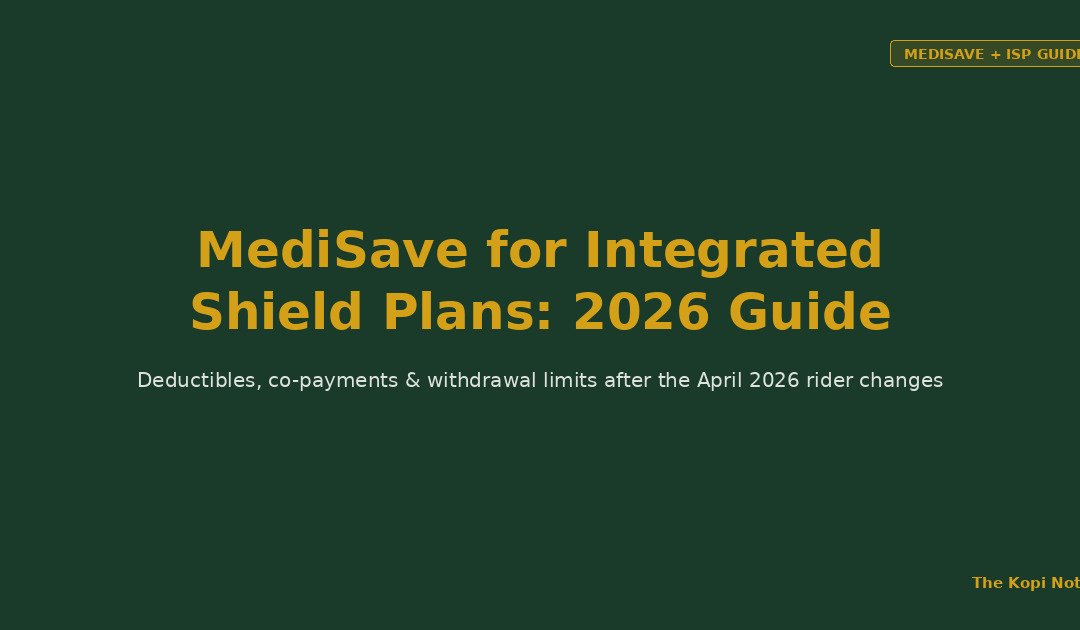
How much MediSave you’ll need for your ISP deductible, co-payment and premiums after the April 2026 rider changes.
You can use MediSave to pay your Integrated Shield Plan (ISP) premiums, deductible, and co-payment, subject to CPF Board withdrawal limits. From 1 April 2026, new ISP riders no longer cover the MOH-set minimum deductible ($1,500 to $3,500), and the co-payment cap rose to $6,000 a year. This means you’ll likely draw more MediSave per claim, even though rider premiums are about 30% cheaper.
Not financial advice. All figures are for educational reference only. Data verified as at 2 August 2026 against official CPF Board and MOH sources unless otherwise noted.
- From April 2026, MediSave has to cover a bigger slice of your hospital bill because new ISP riders can’t pay the deductible anymore.
- Your MediSave withdrawal is still capped — $1,130/day for the first 2 days of hospitalisation, then $400/day, plus a Table of Surgical Procedures (TOSP) limit of $240 to $5,290 per surgery.
- Check your Basic Healthcare Sum (BHS) — it’s $79,000 for 2026 — so you know how much MediSave headroom you actually have before you need cash.
Table of Contents
Contents — Click to expand
- What Changed for MediSave and ISP Riders in 2026
- How MediSave Actually Pays for Your Integrated Shield Plan
- MediSave Withdrawal Limits for Hospitalisation and Surgery (2026)
- Real Cost Example: MediSave Before vs After the Rider Changes
- Basic Healthcare Sum (BHS) 2026 and Why It Matters
- How to Budget Your MediSave for the New Rider Rules
- Frequently Asked Questions
What Changed for MediSave and ISP Riders in 2026
MOH announced on 26 November 2025 that Integrated Shield Plan riders would be redesigned. The goal: slow down premium increases by trimming how much of your bill the rider actually covers. From 1 April 2026, two things changed for every new rider sold.
First, new riders can no longer cover the minimum IP deductible that MOH sets for each ward class. That deductible ranges from $1,500 to $3,500 and now comes straight out of your own pocket — usually your MediSave — before your main ISP and rider kick in.
Second, the co-payment cap moved from $3,000 a year (set back in 2018) to a minimum of $6,000 a year. This cap excludes the deductible. The minimum 5% co-payment rule hasn’t changed. So you’re still protected against runaway bills, but the floor for what you pay yourself is now higher.
Here’s the part that matters most for your MediSave planning: MOH confirmed that both the deductible and co-payment can still be paid using MediSave, subject to the prevailing withdrawal limits covered in section 3. In practice, that means most Singaporeans will draw more from MediSave per hospital stay than they did under the old rider — even though they’re paying less in cash premiums.
| Ward Class / Targeted Coverage | Minimum IP Deductible (from Apr 2026) |
|---|---|
| Class A / Private | $3,500 |
| Class B1 | $2,500 |
| Class B2 | $2,000 |
| Class C | $1,500 |
| Day Surgery (non-subsidised / subsidised) | $2,000 / $1,500 |
Source: Ministry of Health, “New Requirements for Integrated Shield Plan Riders,” 26 November 2025 (Annex A). The deductible is the lower of the target coverage or the ward class you actually use.
How MediSave Actually Pays for Your Integrated Shield Plan
MediSave does three separate jobs when it comes to your ISP. It’s easy to mix these up, so let’s separate them clearly.
Paying your premiums. You can use MediSave to pay the annual premium for your main ISP and, in most cases, your rider too — subject to the annual Additional Withdrawal Limit (AWL) for older age bands. This hasn’t changed in 2026.
Paying your deductible. Once you’re hospitalised, the deductible is the first slice of the bill you pay. Since April 2026, new riders don’t cover this, so you’ll typically pay it from MediSave — again, capped by the hospitalisation withdrawal limits below.
Paying your co-payment. After the deductible, you still owe a minimum 5% co-payment, up to the new $6,000 annual cap. This too can be drawn from MediSave if you have the balance and haven’t hit your withdrawal limit for that admission.
For a deeper explainer on how MediSave, MediShield Life and your rider slot together, see our guide to the new ISP rider rules for 2026.
MediSave Withdrawal Limits for Hospitalisation and Surgery (2026)
Your MediSave isn’t a blank cheque. The CPF Board caps how much you can withdraw per day and per procedure, and these caps apply on top of anything MediShield Life or your ISP already pays. For a full breakdown by claim type, see our CPF MediSave withdrawal limits glossary entry.
| Claim Type | MediSave Withdrawal Limit |
|---|---|
| Hospitalisation — Day 1 & 2 | $1,130 per day |
| Hospitalisation — Day 3 onwards | $400 per day |
| Day surgery (ward charges) | $830 per day |
| Psychiatric treatment — Day 1 & 2 | $1,130 per day |
| Psychiatric treatment — Day 3 onwards | $230 per day |
| Surgery (Table of Surgical Procedures, Tables 1–7) | $240 to $5,290 per procedure |
Source: CPF Board, “Using MediSave for Hospitalisation,” cpf.gov.sg, updated 6 April 2026.
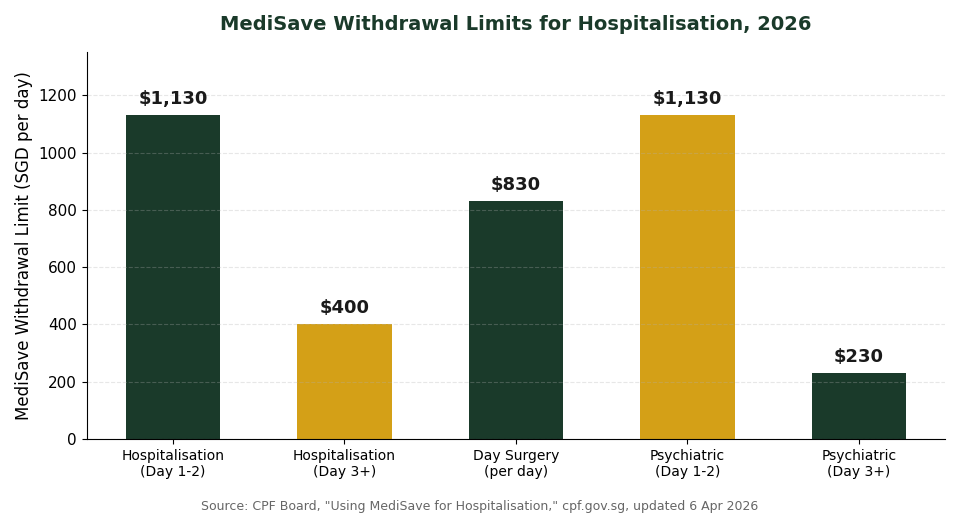
These limits are per admission, so a longer stay in a Class A or private ward can quickly eat through the $1,130-a-day allowance and drop to $400 a day from day three. That’s exactly why MOH built the deductible and co-payment structure the way it did — to keep you conscious of cost even when insurance is footing most of the bill.
Real Cost Example: MediSave Before vs After the Rider Changes
MOH published a worked example in its November 2025 announcement that shows exactly how this plays out. Here’s the case, simplified.
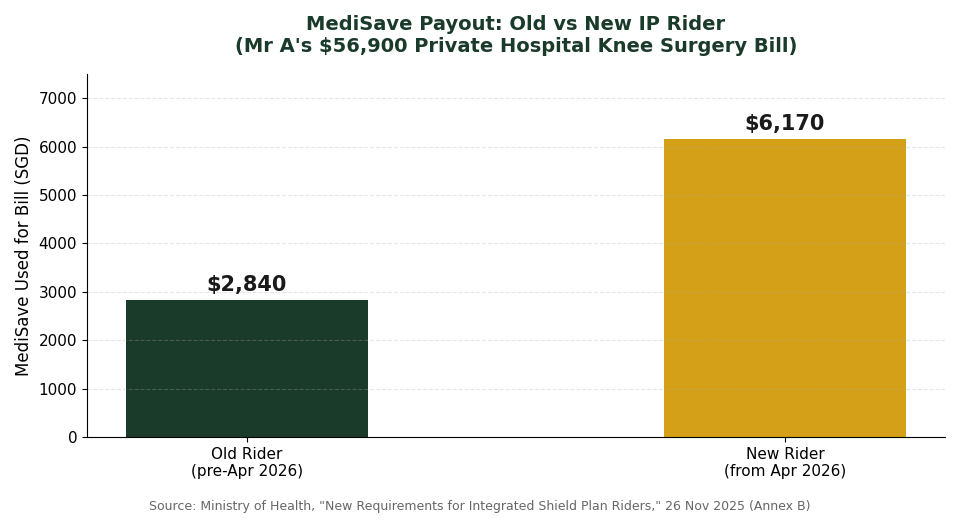
A 60-year-old Singaporean, “Mr A,” holds a private hospital ISP with a rider. He switches to the new rider in April 2026 and immediately saves 30% in cash premiums — about $1,600 that year. Three years later, he needs a knee joint replacement at a private hospital. The bill comes to $56,900.
Under his new rider, Mr A pays the $3,500 deductible plus 5% of the remaining bill, totalling $6,170 — and this is entirely covered by MediSave, based on the withdrawal limits above. Under his old rider, he would have paid only $2,840 from MediSave. That’s $3,330 more in MediSave usage with the new rider.
However, by switching, Mr A had already banked $4,800 in premium savings over those three years in cash. So even after the higher MediSave draw, he still comes out ahead — and his future annual savings keep compounding as premiums rise with age.
| Item | Old Rider (pre-Apr 2026) | New Rider (from Apr 2026) |
|---|---|---|
| Deductible covered by rider | Yes | No — you pay it |
| MediSave used for $56,900 bill | $2,840 | $6,170 |
| Annual rider premium (illustrative) | ~$5,330 | ~$3,730 (-30%) |
| 3-year cash premium savings | — | $4,800 |
Source: Ministry of Health, “New Requirements for Integrated Shield Plan Riders,” 26 November 2025 (Annex B, Case Example 1). Premium figures are illustrative based on the stated 30% average reduction and $1,600 annual saving disclosed by MOH.
Basic Healthcare Sum (BHS) 2026 and Why It Matters
Your Basic Healthcare Sum (BHS) — basically the ceiling on how much you can hold in your MediSave Account — was raised to $79,000 for members below 65 from 1 January 2026, up from $75,500 in 2025. If you turn 65 in 2026, your BHS is fixed at $79,000 for life. Anyone 66 or older in 2026 keeps their own cohort’s fixed BHS.
The BHS itself doesn’t limit how much you can withdraw for a single hospital stay — that’s governed by the per-day and per-procedure limits in section 3. But it does cap how much of a buffer you’re building up over time. If your MediSave balance is already at or near your BHS, any contributions above that automatically flow into your Ordinary or Special Account instead, so you’re not “topping up” extra protection against future ISP deductibles.
MediSave, Special and Retirement Account savings continue to earn a floor rate of 4% per annum (Q1 2026), so building a healthy buffer above your day-to-day needs isn’t wasted money — it compounds while it sits there. For a full walkthrough of limits, top-ups and interest, read our CPF MediSave cap 2026 guide.
How to Budget Your MediSave for the New Rider Rules
Here’s how to think about your MediSave position now that riders cover less of the bill.
Check your ward class deductible. If you’re on a Class A or private-hospital-targeted plan, budget for a $3,500 deductible per policy year — not the lower $1,500 to $2,000 that applied to lower ward classes.
Set aside a co-payment buffer. With the cap now at $6,000, a bad year with multiple admissions could mean $9,500 or more coming out of MediSave and cash combined (deductible plus cap). Keep at least this much in MediSave if you can.
Don’t assume “switching riders” is automatically better. As Mr A’s case shows, the new rider can mean paying more MediSave per claim even while your cash premium drops. Run your own numbers — or speak to a financial adviser — before switching, especially if you claim frequently.
Watch your MediSave balance relative to your BHS. If you’re regularly near the $79,000 cap, you have more headroom to absorb a bigger deductible than someone who keeps a thin MediSave balance.
If you haven’t reviewed how your ISP and rider stack up against competitors under the new rules, our Integrated Shield Plan comparison for 2026 breaks down deductibles, co-payment structure and premiums across all seven insurers.
Disclaimer: This article is for educational purposes only and does not constitute financial or insurance advice. Speak to a licensed financial adviser before making changes to your ISP or rider. Data verified as at 2 August 2026 against official CPF Board and MOH sources.
Frequently Asked Questions
Can I use MediSave to pay for my Integrated Shield Plan deductible in 2026?
Yes. MOH has confirmed that both the deductible and the co-payment under the new IP rider rules can be paid using MediSave, subject to the prevailing CPF Board withdrawal limits — for example, $1,130 per day for the first two days of hospitalisation. You just can’t rely on your rider to cover the deductible anymore, since new riders sold from 1 April 2026 don’t cover it.
How much MediSave can I use for hospitalisation in Singapore in 2026?
For hospitalisation, you can withdraw up to $1,130 per day for the first two days and $400 per day after that. Day surgery is capped at $830 per day. Surgical procedures follow the Table of Surgical Procedures, with limits ranging from $240 to $5,290 depending on complexity.
What is the new IP rider co-payment cap from April 2026?
The co-payment cap rose from a minimum of $3,000 a year (set in 2018) to a minimum of $6,000 a year. This cap applies to co-payments only, excluding the minimum IP deductible, and there’s no change to the minimum 5% co-payment requirement.
Will my existing ISP rider still be covered by MediSave after April 2026?
Existing riders remain valid contracts between you and your insurer. If you bought your rider before 27 November 2025, you can generally keep your current terms, though your insurer may reach out about transitioning options. If you bought a rider on or after 27 November 2025, you’ll transition to a compliant rider no later than your next policy renewal after 1 April 2028. MediSave rules for paying premiums, deductibles and co-payments apply the same way regardless of which rider generation you’re on.
What is the Basic Healthcare Sum (BHS) for 2026 and how does it affect my ISP premiums?
The BHS for 2026 is $79,000 for CPF members below 65, up from $75,500 in 2025. It’s the cap on how much you can hold in your MediSave Account — it doesn’t directly limit how much you can withdraw per hospital stay, but a higher BHS means more long-term headroom to pay ISP premiums, deductibles and co-payments from MediSave instead of cash.
Should I switch to the new IP rider to save on premiums?
It depends on how often you claim. If you rarely get hospitalised, the roughly 30% premium saving on the new rider usually outweighs the higher MediSave draw you’d face on the rare claim. If you claim frequently or have a chronic condition requiring regular private hospital treatment, the higher deductible and co-payment could cost you more overall — run the numbers for your own situation or speak to a financial adviser.
Planning Your Healthcare and Retirement Finances?
See how your MediSave, CPF and investments fit together for the years ahead.
Get Free Insurance Advice
Speak with a licensed insurance advisor. No obligation, no cost.
By submitting this form, you agree to our Privacy Policy.
This article was researched with the help of AI. While we strive to keep all information accurate and up to date, there may be errors. If you notice any discrepancies, please contact us.