Term Life Insurance Riders Singapore 2026
Which Add-Ons Are Actually Worth It?Term life insurance riders in Singapore are optional add-ons you attach to your base term life policy to expand your coverage. Common riders include the Critical Illness (CI) rider, Total and Permanent Disability (TPD) rider, Disability Income rider, Waiver of Premium rider, and Accidental Death rider. Whether they’re worth adding depends on your existing health coverage, income situation, and budget — and some riders are almost always a good idea, while others depend on your personal circumstances.
Not financial advice. All figures are for educational reference only. Data verified as at August 2026 unless noted.
- Riders expand your base term life policy — they don’t replace standalone plans.
- A CI rider is cheaper but offsets your death benefit. A standalone CI plan pays out fully and independently.
- The Waiver of Premium rider is low-cost and almost always worth adding.
- Most Singaporeans need at least S$300,000 in CI coverage — a rider alone usually won’t be enough.
What Are Term Life Insurance Riders?
A rider is an optional benefit you bolt on to your base term life insurance policy — for an additional premium — to broaden what your policy covers.
Your base term life policy does one thing: pays a death benefit if you die (or are terminally ill) within the policy term. That’s it. Riders fill the gaps. For example, a S$500,000 term life plan pays nothing if you survive a serious stroke but can’t work for two years. A CI rider or Disability Income rider covers exactly that gap.
In Singapore, all CI riders follow standardised definitions under the LIA CI Framework 2024, which took effect on 1 October 2025. This means the 37 severe-stage critical illness definitions are the same across all insurers — so you’re comparing price and features, not definitions, when you shop riders.
Key points before adding any rider:
- Riders lapse if you cancel your base policy
- Some riders reduce or terminate your death benefit upon payout
- Adding riders later may require fresh medical underwriting
- Riders reprice at each policy renewal
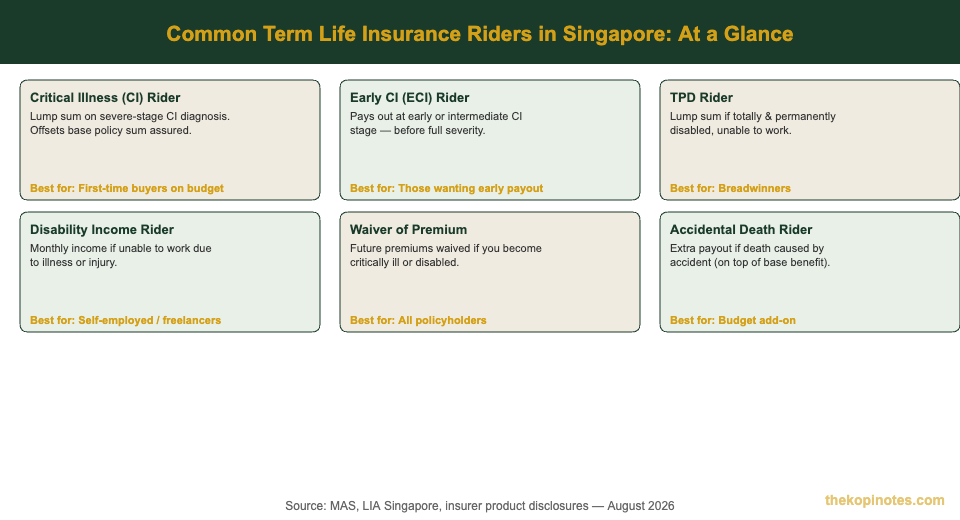
6 Types of Term Life Insurance Riders in Singapore
1. Critical Illness (CI) Rider
Pays a lump sum on diagnosis of one of the 37 LIA-standardised severe-stage critical illnesses — major cancer, heart attack, stroke with permanent neurological deficit, kidney failure, and more.
The catch: The CI payout reduces or terminates your base policy’s death benefit. If you claim S$200,000 from the CI rider on a S$500,000 policy, your remaining death benefit drops to S$300,000 (or the policy terminates — check your product terms).
The LIA reported a CI protection gap of S$579 billion in 2022 among working Singaporeans aged 20–69. A CI rider is a budget-friendly starting point, but for comprehensive cover, a dedicated standalone CI plan is usually the better choice.
2. Early Critical Illness (ECI) Rider
Pays out at early or intermediate stages of a critical illness — before the full severity threshold is reached. For example, Stage 1 breast cancer or a minor heart condition would trigger an ECI payout but not a standard CI payout.
Most real-world CI claims in Singapore happen at earlier stages, thanks to improved health screening. An ECI rider means you get cash at diagnosis — exactly when medical bills start mounting — rather than waiting for a condition to worsen.
ECI riders cost more than standard CI riders and come with sub-limits and waiting periods. They’re worth considering if you have a family history of cancer or heart disease.
3. Total and Permanent Disability (TPD) Rider
Pays a lump sum if you become totally and permanently disabled — typically defined as being unable to perform any occupation for 6 or more consecutive months due to injury or illness.
If you’re the sole breadwinner, TPD cover is critical. A disability doesn’t trigger a death benefit — so without TPD coverage, your family gets nothing from your life policy while you’re severely disabled but still alive.
Check your base policy first. Some term life plans bundle TPD coverage at no extra cost. If yours already includes TPD, don’t pay twice for a rider.
4. Disability Income Rider
Instead of a one-time lump sum, this rider replaces a monthly portion of your income when you’re unable to work due to illness or accident. Payout periods typically run 1, 2, or 5 years — or until you recover.
This is particularly valuable for self-employed Singaporeans. When you can’t work, your income stops immediately. A Disability Income rider bridges that financial gap while you recover. Pair it with your retirement planning calculator to stress-test your finances against a long-term disability scenario.
5. Waiver of Premium Rider
If you become critically ill or totally disabled, this rider waives all future premium payments — keeping your base policy in force at no further cost to you.
This is the most universally recommended rider. It’s inexpensive, and it means your life insurance stays active precisely when you’re least able to afford it. Almost every financial planner recommends adding this to any term life policy.
6. Accidental Death Rider
Pays an extra lump sum on top of your base death benefit if death is caused by an accident. A S$500,000 policy with a S$200,000 accidental death rider pays S$700,000 total in the event of accidental death.
This rider is very cheap — often under S$100 per year — and makes sense as a low-cost add-on, especially for younger policyholders who drive frequently or work in higher-risk environments.
CI Rider vs Standalone CI Policy: Which Should You Choose?
This is the most common question Singaporeans face when buying term life insurance. Here’s the honest answer: for most people, a standalone CI policy is the better choice for primary CI coverage — and a CI rider is useful only as a supplementary or budget top-up.
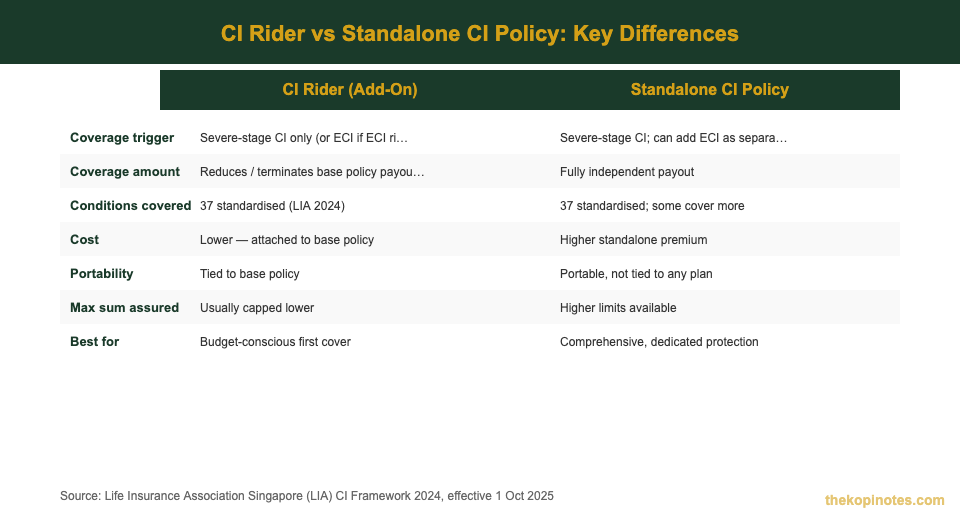
Here’s why a standalone CI plan usually wins:
- Independent payout: A standalone CI plan pays out in full — S$300,000 is S$300,000 — without touching your death benefit. Your family still gets the full life insurance payout when you die.
- Higher limits: Standalone CI plans let you insure up to S$500,000 or more. CI riders often have lower sum assured caps.
- Portability: A standalone CI plan exists on its own. Cancel your term life policy and your CI cover continues. With a rider, cancelling the base policy ends the rider too.
- More conditions: Some standalone CI plans cover more than the LIA-standardised 37 conditions, including additional female-specific cancers and multi-pay options.
When does a CI rider make sense? If you’re on a tight budget and can’t afford a standalone CI plan on top of your term life premiums, a CI rider gives you some CI protection for less money. Think of it as a first step — then upgrade to a standalone plan as your income grows.
If you’re still figuring out how much term life coverage you actually need, start there before deciding on riders.
How Much Do Riders Add to Your Premium?
Rider costs vary by age, health status, sum assured, and insurer. Here are rough indicative ranges for a healthy 35-year-old non-smoker:
| Rider Type | Indicative Annual Cost* | Notes |
|---|---|---|
| CI Rider (S$100k) | S$200–S$500/yr | Offsets base death benefit |
| ECI Rider (S$100k) | S$400–S$900/yr | Higher cost, early-stage coverage |
| TPD Rider (S$500k) | S$50–S$200/yr | Check if already bundled in base plan |
| Disability Income Rider | S$300–S$700/yr | Monthly payout, not lump sum |
| Waiver of Premium | S$30–S$80/yr | Almost always worth adding |
| Accidental Death Rider | S$50–S$120/yr | Very cheap for additional cover |
*Indicative ranges only. Actual premiums depend on age, health status, sum assured, and insurer. Always compare quotes. Data as at August 2026.
These costs are in addition to your base term life premium. If adding multiple riders pushes your total insurance spend above 10–15% of your monthly income, consider prioritising riders and spreading the rest across standalone plans as your income grows.
How to Decide Which Riders to Add
Use this decision framework before adding any rider to your term life policy:
- Check what you already have. Review your employer group insurance, MediShield Life, Integrated Shield Plan (IP), and any existing CI or disability coverage. Don’t double-pay for what’s already covered.
- Identify your biggest gap. Is it CI coverage? Income replacement if you can’t work? Disability protection? Each rider fills a specific gap — only add riders that plug real holes in your coverage.
- Check if CI is already in your base plan. Some term life policies automatically include TPD and terminal illness benefits. Don’t add a rider you’re already paying for.
- Prioritise the Waiver of Premium. At S$30–S$80 per year, it’s almost always worth adding. It keeps your policy active if you’re ever too ill to pay.
- Consider your dependants. If you’re supporting parents, a spouse, or young children, TPD and CI riders matter more than for single professionals without dependants.
- Compare quotes from multiple insurers. Use platforms like FSMOne or speak to a licensed financial adviser to compare rider costs across FWD, Singlife, AIA, Prudential, Manulife, and Great Eastern.
If you want a broader view of the right time to buy critical illness insurance in Singapore, read our separate guide on how age affects your premiums and coverage options.
Term Life Insurance Riders: Quick Comparison Table
| Rider | Payout Type | Trigger | Reduces Death Benefit? | Priority |
|---|---|---|---|---|
| CI Rider | Lump sum | Severe-stage CI diagnosis | Yes | Medium |
| ECI Rider | Lump sum | Early/intermediate CI diagnosis | Usually yes | Medium–High |
| TPD Rider | Lump sum | Total & permanent disability | Usually yes | High (if no bundled TPD) |
| Disability Income | Monthly income | Unable to work (illness/accident) | No | High (self-employed) |
| Waiver of Premium | Premium waiver | CI diagnosis or disability | No | Very High |
| Accidental Death | Extra lump sum | Death by accident | No — adds to it | Low–Medium |
Source: LIA Singapore, MAS, insurer product disclosures — August 2026. Always refer to your policy’s product summary for exact terms.
If you’re comparing insurers, our Endowus referral code guide covers how to use Endowus to invest any cash freed up from optimising your insurance spend.
Frequently Asked Questions
Can I add riders to my term life insurance after it's already in force?
Does a CI rider replace the need for a standalone critical illness plan?
Is the Waiver of Premium rider worth it?
What is the difference between a CI rider and an ECI rider?
How many critical illnesses does a Singapore CI rider cover?
Should I get a Disability Income rider or a standalone disability income policy?
Do I need riders if I already have a good Integrated Shield Plan (ISP)?
Get Free Insurance Advice
Speak with a licensed insurance advisor. No obligation, no cost.
By submitting this form, you agree to our Privacy Policy.
This article was researched with the help of AI. While we strive to keep all information accurate and up to date, there may be errors. If you notice any discrepancies, please contact us.