Critical Illness Insurance Waiting Period, Survival Period & Pre-Existing Conditions Explained
Singapore 2026 — the three fine-print rules that decide if your CI claim actually gets paid
Critical illness (CI) insurance in Singapore has three separate rules that decide if your claim gets paid: a waiting period after you buy the policy, a survival period after diagnosis, and pre-existing condition disclosure rules. Since November 2022, insurers set their own waiting periods — LIA no longer mandates a fixed 90 days. Here’s exactly how each rule works, and how to check them before you buy.
Not financial advice. All figures are for educational reference only, verified directly against official LIA circulars and insurer sources. Data verified as at 1 August 2026 unless otherwise noted.
- Waiting period = time from your policy’s start date before a claim is valid — e.g. Great Eastern currently applies 90 days for cancer, heart attack and related surgeries, but since Nov 2022, LIA lets each insurer set its own.
- Survival period = time from diagnosis you must stay alive before payout — commonly 7–30 days, entirely insurer-set. LIA doesn’t standardise this one at all.
- Undeclared pre-existing conditions can sink a claim, but only within the 1–2 year LIA “incontestability” window — after that, only fraud can void a genuine claim.
Table of Contents
Contents — Click to expand
- What Is a Waiting Period in CI Insurance?
- Why Waiting Periods Exist — and Why the Rules Changed in 2022
- Real Example: Great Eastern’s Current Waiting Period
- What Is a Survival Period? (And Why It’s Different)
- Waiting Period vs Survival Period at a Glance
- What Counts as a “Pre-Existing Condition”?
- Non-Disclosure: What Happens If You Don’t Declare It
- The Incontestability Clause: Your Protection After 1-2 Years
- Comparison: What Protects You, and What Doesn’t
- How to Choose a CI Policy With These Terms in Mind
- Where CI Premiums Fit Into Your Financial Plan
- FAQ
What Is a Waiting Period in Critical Illness Insurance?
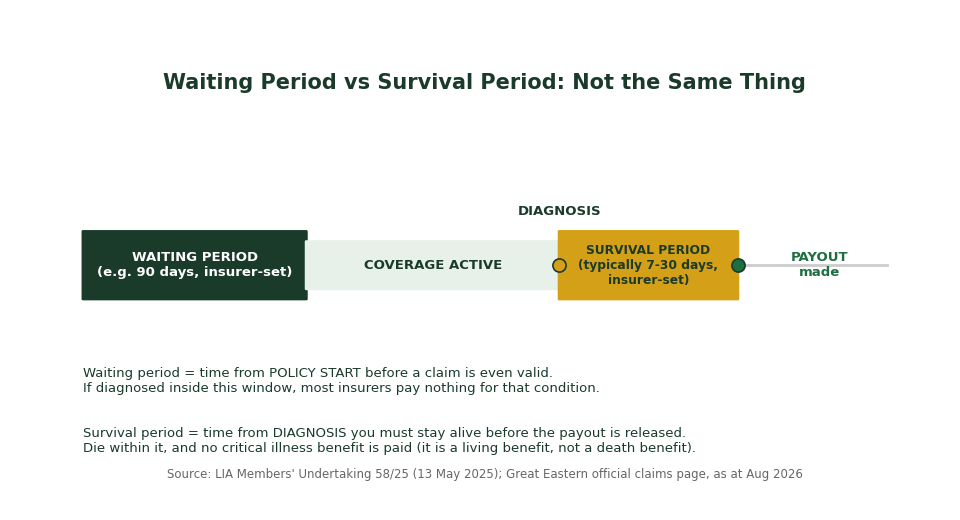
A waiting period is the time between your policy’s start date (or reinstatement date) and the date your CI cover actually kicks in for certain illnesses. If you’re diagnosed with a covered condition inside this window, most insurers won’t pay out for it.
Not every condition is affected. Insurers typically apply waiting periods to a short list of illnesses that are easy to develop symptoms for right before buying cover — usually cancer, heart attack, and related cardiac surgeries. Accidental conditions, like major burns from a car accident, are usually not subject to a waiting period at all.
Why Waiting Periods Exist — and Why the Rules Changed in 2022
Insurers use waiting periods to guard against anti-selection — someone who’s already unwell “shopping” for a CI plan right before diagnosis, then claiming almost immediately. Without this rule, honest policyholders would end up paying higher premiums to cover the gap.
Until November 2022, the industry followed one shared rule: every CI policy carried the same 90-day waiting period, set by the Life Insurance Association of Singapore (LIA) — the trade body every Singapore life insurer belongs to. That changed with LIA’s 2022 review.
That means there’s no longer one number to memorise. Each insurer — sometimes each plan — sets its own waiting period. Some kept 90 days, some shortened it, and some newer plans may not apply one at all for certain conditions. You have to check the product summary for the exact plan you’re buying — you can’t assume “90 days” applies everywhere anymore.
Real Example: Great Eastern’s Current Waiting Period
To show what this looks like in practice: Great Eastern’s official claims page (current as at August 2026) states a 90-day waiting period applies to new and reinstated policies, but only for four specific claim types — cancer and major cancers, heart attack, angioplasty and other invasive coronary treatments, and coronary artery bypass surgery. Other covered conditions under the same policy aren’t subject to this wait.
This shows two things. First, some insurers have kept the old 90-day figure voluntarily, even though it’s no longer compulsory industry-wide. Second, the waiting period doesn’t necessarily apply to your whole policy — it can be condition-specific. Always ask which conditions the waiting period covers, not just how long it lasts.
What Is a Survival Period? (And Why It’s Different)
A survival period is a completely different rule that trips up a lot of buyers who confuse it with the waiting period. It’s the length of time you must stay alive after diagnosis before your insurer releases the payout — commonly somewhere between 7 and 30 days, though the exact number is entirely up to each insurer.
Here’s the part that surprises people: if you pass away during the survival period, your family typically gets nothing from the CI benefit. That’s because CI insurance is a living benefit — designed to help you cope with treatment costs and lost income while you’re alive, not a substitute for life insurance. If you die during the survival window, your life insurance or DPS payout (if you have one) is what your family would rely on instead.
Unlike the waiting period, LIA’s Critical Illness Framework does not set any industry standard for the survival period at all — it’s purely a term each insurer writes into their own contract. That’s exactly why you need to check the product summary, not assume a “typical” number applies to you.
Waiting Period vs Survival Period at a Glance
| Feature | Waiting Period | Survival Period |
|---|---|---|
| Measured from | Policy issue / reinstatement date | Date of diagnosis |
| Typical length | Insurer-set (e.g. GE: 90 days for select conditions) | Commonly 7–30 days |
| Set by | Insurer (deregulated by LIA from Nov 2022) | Insurer (never standardised by LIA) |
| If it fails | Diagnosis inside the window = no payout for that condition | Death inside the window = no CI payout at all |
Source: LIA Members’ Undertaking 58/25 (13 May 2025); Great Eastern official claims page, as at Aug 2026
What Counts as a “Pre-Existing Condition”?
A pre-existing condition is any illness, injury, or symptom you had before your policy’s start date — whether or not you were formally diagnosed at the time. That last part matters: even something you noticed but never got checked can count, if it later turns out to be linked to a claim.
When you apply for CI insurance, you go through medical underwriting — usually a health declaration, sometimes followed by a medical exam for higher sums assured. What you declare (or don’t) at this stage determines what happens later if you make a claim tied to something you knew about beforehand.
Non-Disclosure: What Happens If You Don’t Declare It
If you don’t declare a pre-existing condition and later claim for something related to it, the insurer can investigate. If they find the non-disclosure was material — meaning it would have changed whether they accepted you, or on what terms — they can reject that specific claim, or in serious cases, void the entire policy from the start.
This is why the health declaration form matters more than people think. Be honest, even about things that feel minor. An undisclosed pre-existing condition is one of the most common reasons a genuine claim gets denied — and it’s usually preventable.
The Incontestability Clause: Your Protection After 1-2 Years
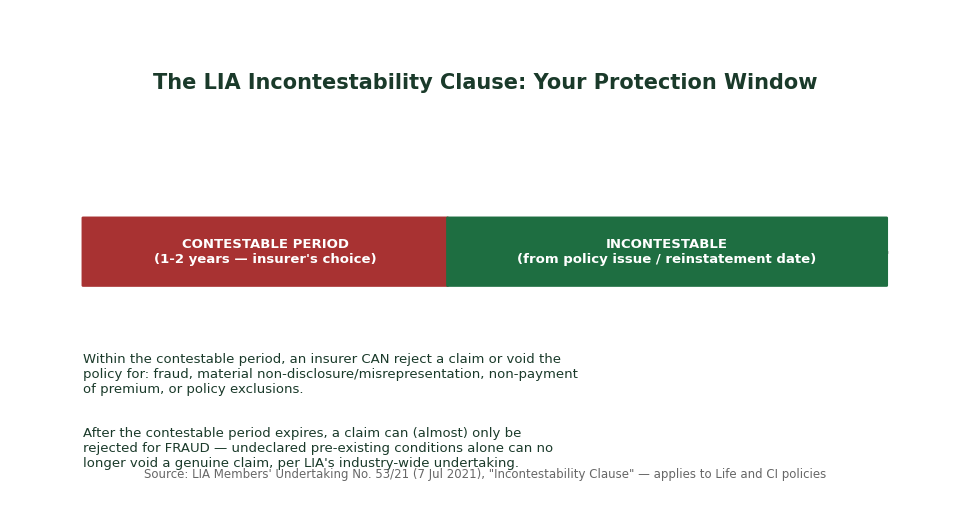
Here’s the good news: this exposure doesn’t last forever. Under an LIA industry-wide undertaking that’s applied since 1991 (most recently updated 7 July 2021), every Singapore life and CI policy must include an incontestability clause.
In practice, this means the riskiest window for an undisclosed pre-existing condition to sink your claim is the first one to two years you hold the policy. After that, honest mistakes on your original application generally can’t be used against you — deliberate lies still can.
Comparison: What Protects You, and What Doesn’t
| Situation | Within 1-2 Years of Policy Issue | After 1-2 Years (Incontestable) |
|---|---|---|
| Honest mistake on health declaration | Insurer can reject the claim or void the policy if material | Generally protected — insurer cannot use this to deny a claim |
| Deliberate fraud / lying on application | Insurer can reject the claim or void the policy | Still not protected — fraud voids a policy at any time |
| Named policy exclusion (e.g. specific illness excluded in writing) | Excluded — no claim possible | Still excluded — the incontestability clause does not override written exclusions |
| Non-payment of premium | Policy can lapse, cover stops | Same — premiums must always be kept current |
Source: LIA Members’ Undertaking No. 53/21, “Incontestability Clause” (7 July 2021)
How to Choose a CI Policy With These Terms in Mind
Once you understand what each term does, comparing plans becomes far more useful than just comparing premiums. Before you sign:
- Ask for the waiting period in writing, and which conditions it applies to. Don’t assume it’s 90 days — that’s no longer guaranteed.
- Ask for the survival period in days. This varies more than people expect and often isn’t disclosed prominently.
- Fill out the health declaration completely and honestly, even for conditions that feel resolved or minor.
- Note your policy’s issue date — that’s when your one-to-two-year incontestability clock starts running.
- If you’re switching CI insurers, remember a fresh policy resets both the waiting period and the incontestability clock. Don’t cancel your old policy until the new one’s waiting period has passed.
For a deeper look at coverage amounts and comparing plan structures, see our guides on how much critical illness insurance you need in Singapore and what critical illness insurance actually costs in Singapore. If you want the full picture on which conditions are covered, our complete critical illness insurance guide breaks down the LIA 37-condition framework in detail.
Where CI Premiums Fit Into Your Financial Plan
CI insurance is one piece of a broader financial plan, not a stand-alone decision. Once you know your premiums and coverage terms, it’s worth checking they fit your overall goals — including how much you’re setting aside for retirement, and whether your CPF and SRS savings are pulling their weight alongside your insurance.
Use the Singapore retirement calculator to see how your CI premiums interact with your long-term savings rate. If you’re also investing your SRS funds alongside your protection planning, the Endowus referral code gives you a starting point for a fee-based platform that handles both CPF and SRS investing. Our recent breakdown of what S$555 million in CI claims data tells you is also useful context for how often — and why — claims actually get paid out.
Frequently Asked Questions
What is the waiting period for critical illness insurance in Singapore?
There is no single fixed number anymore. Until November 2022, LIA mandated a uniform 90-day waiting period across the industry. Since then, each insurer sets its own. As an example, Great Eastern currently applies 90 days for cancer, heart attack, angioplasty and coronary artery bypass surgery on new or reinstated policies — but you should always confirm the exact figure in your own product summary before buying.
What is the survival period in critical illness insurance?
The survival period is the number of days you must survive after diagnosis before your insurer pays the claim. It commonly ranges from 7 to 30 days, but LIA does not standardise this figure at all — it is entirely set by each insurer in their own contract.
What happens if I die during the survival period?
No critical illness benefit is paid. CI insurance is a living benefit meant to help you cope with treatment costs and lost income while alive, not a death benefit. If you pass away during the survival period, your family would instead rely on any life insurance or Dependants’ Protection Scheme (DPS) coverage you hold.
Do all critical illness conditions have the same waiting period?
Not necessarily. Insurers often apply the waiting period only to specific conditions prone to anti-selection risk, such as cancer, heart attack, and related cardiac surgeries, while other covered conditions under the same policy may not carry a waiting period at all.
What counts as a pre-existing condition for CI insurance?
Any illness, injury, or symptom you had before your policy’s start date, whether or not you were formally diagnosed at the time. This is assessed against what you declared, or should have declared, on your health declaration during underwriting.
What happens if I don't declare a pre-existing condition?
If the insurer later finds the non-disclosure was material to their decision to accept you or set your terms, they can reject the related claim, or in serious cases void the entire policy from inception. This is one of the most common reasons genuine CI claims are denied.
How long can an insurer contest my CI claim over non-disclosure?
Under LIA’s incontestability clause (Members’ Undertaking No. 53/21), insurers have one or two years from your policy’s issue or reinstatement date to contest a claim on non-disclosure grounds. After that window closes, a claim can generally only be rejected for proven fraud, non-payment of premium, or a condition explicitly excluded in your policy.
Get Free Insurance Advice
Speak with a licensed insurance advisor. No obligation, no cost.
By submitting this form, you agree to our Privacy Policy.
This article was researched with the help of AI. While we strive to keep all information accurate and up to date, there may be errors. If you notice any discrepancies, please contact us.