Can MediSave Pay Your Integrated Shield Plan Deductible? (2026 Guide)
What changed on 1 April 2026, the deductible amounts by ward class, and exactly which MediSave limits apply to your claim.
MediSave can pay your Integrated Shield Plan (ISP) deductible and co-insurance, subject to standard MediSave withdrawal limits — separate from the $300–$900 Additional Withdrawal Limit (AWL) used for premiums. From 1 April 2026, new ISP riders can no longer cover the $1,500–$3,500 minimum deductible, so more of that first bill now comes out of your MediSave (or cash) directly.
Not financial advice. All figures are for educational reference only. Data verified as at 31 July 2026 against Ministry of Health (MOH) and CPF Board sources.
- Yes — MediSave can pay your ISP deductible and co-insurance, but under the normal hospitalisation withdrawal limits (up to $1,130/day for the first 2 days, $400/day after), not the smaller AWL used for premiums.
- From 1 April 2026, new ISP riders can no longer cover the minimum deductible ($1,500 to $3,500, depending on ward class) — you pay this portion yourself, via MediSave or cash.
- The co-payment cap (excluding the deductible) has risen from $3,000 to $6,000 a year, but average rider premiums are expected to fall about 30% in exchange.
Table of Contents
Contents — Click to expand
- Can You Use MediSave to Pay the Deductible?
- What Changed on 1 April 2026
- 2026 Minimum Deductibles by Ward Class
- MediSave for the Deductible vs the Premium AWL
- MediSave Withdrawal Limits That Apply
- Worked Example: A $56,900 Bill
- Does the Co-Payment Cap Include the Deductible?
- What This Means for You
- Frequently Asked Questions
Can You Use MediSave to Pay Your Integrated Shield Plan Deductible?
Yes. MOH’s own November 2025 announcement is explicit on this: “The deductible and co-payments can be paid using MediSave, subject to prevailing withdrawal limits.” This is a different pot of money from the one people usually ask about — the Additional Withdrawal Limit (AWL), which only applies to paying your Integrated Shield Plan premium.
Here’s the distinction that trips most people up. When you’re paying your yearly ISP premium, MediSave is capped by the AWL — $300, $600, or $900 a year depending on your age. But when you’re actually hospitalised and the bill comes in, MediSave draws from a completely different set of hospitalisation withdrawal limits to help cover your deductible and co-insurance. These limits are much larger, because they’re sized for real hospital bills, not annual premiums.
In practice, this means most Singaporeans won’t need to pay their ISP deductible entirely in cash. MediSave typically covers it, as long as you haven’t exhausted your MediSave balance or the applicable claim limit for that admission.
What Changed on 1 April 2026 — and Why It Matters
Until this year, most ISP riders let policyholders pay almost nothing out of pocket — the rider covered the deductible and most of the co-insurance, leaving a small fixed co-payment. MOH found this “near first-dollar” coverage was driving over-consumption: private hospital policyholders with riders were 1.4 times more likely to claim, with claims 1.4 times larger on average, than those without riders.
To fix this, MOH announced on 26 November 2025 that from 1 April 2026, newly sold ISP riders can no longer cover the minimum deductible MOH sets for each plan. You still get a rider to cap your co-insurance, but the deductible itself is now yours to pay upfront — either from MediSave or cash. For the full picture on how riders themselves changed, see our guide on MediSave for Integrated Shield Plan riders.
If you already held a rider bought before 27 November 2025, nothing changes immediately. Insurers must transition you to a compliant rider by your first policy renewal after 1 April 2028, so check your renewal notice rather than assuming you’re already affected.
2026 Minimum Integrated Shield Plan Deductibles by Ward Class
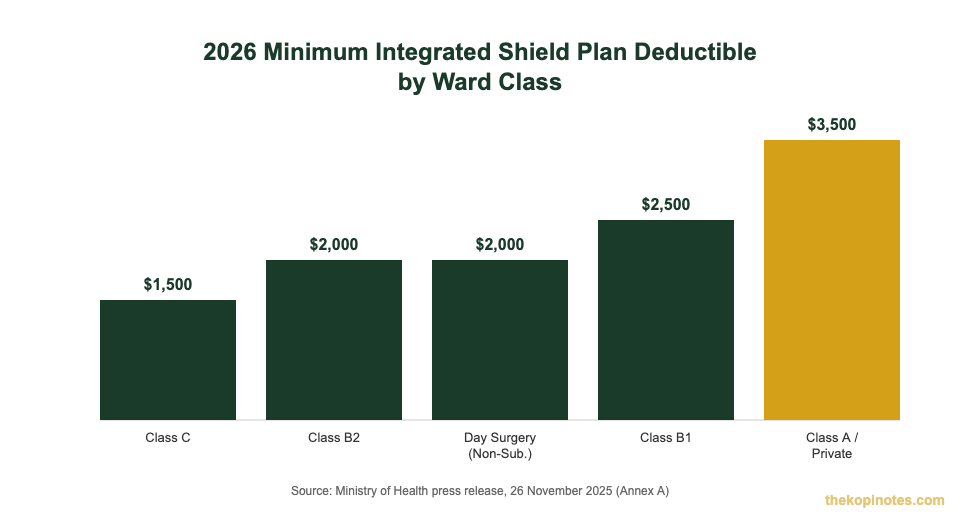
MOH sets a minimum deductible for every ISP, based on the ward class the plan targets and the ward class you actually use. If you’re admitted to a higher class than your plan targets, the higher deductible applies. Here’s the full 2026 schedule.
| Ward Class Utilised | Minimum Deductible |
|---|---|
| Class A / Private | $3,500 |
| Class B1 | $2,500 |
| Class B2 | $2,000 |
| Class C | $1,500 |
| Day Surgery / Short Stay — Non-Subsidised | $2,000 |
| Day Surgery / Short Stay — Subsidised | $1,500 |
Source: Ministry of Health, “New Requirements for Integrated Shield Plan Riders”, 26 November 2025 press release, Annex A.
The deductible is a once-a-year amount, not a once-per-bill amount. Multiple admissions in the same policy year count towards the same deductible, so once you’ve paid it in full, subsequent bills that year only attract the 5% minimum co-insurance.
MediSave for the Deductible vs the Premium AWL: Don’t Mix These Up
You should use MediSave to pay your ISP premium through the Additional Withdrawal Limit (AWL) — capped at $300 a year if you’re 40 or below, $600 if you’re 41 to 70, and $900 if you’re 71 or older. That’s a small, once-a-year allowance meant only for premiums.
The deductible and co-insurance are different. These are claim-time expenses, paid when you’re actually hospitalised, and they draw on your regular MediSave hospitalisation withdrawal limits — the same pot used for ward charges, treatment fees, and surgery. There’s no separate “deductible AWL.” If you’ve read that MediSave can only cover $300 to $900 towards your ISP costs, that figure applies to premiums only, not to what you owe when you make a claim.
This confusion is common because both use the word “MediSave” and both relate to Integrated Shield Plans. But treating them as the same limit means some people wrongly assume they’ll need thousands in cash for a deductible that MediSave can, in fact, largely absorb. For the full breakdown of your MediSave account and its other limits, see our complete guide to MediSave in 2026.
MediSave Withdrawal Limits That Apply to Your Deductible
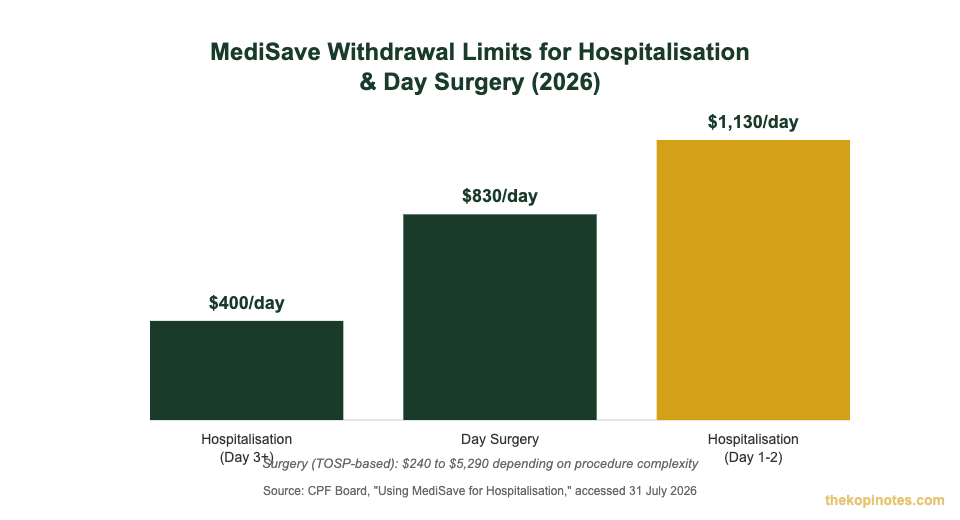
When your hospital bill (including the deductible and co-insurance portion) is settled, MediSave draws against these limits, as published by the CPF Board:
| Expense Type | MediSave Withdrawal Limit |
|---|---|
| Hospitalisation (first 2 days) | Up to $1,130 per day |
| Hospitalisation (day 3 onwards) | Up to $400 per day |
| Day surgery | Up to $830 per day |
| Surgery (Table of Surgical Procedures) | $240 to $5,290, by procedure complexity |
Source: CPF Board, “Using MediSave for Hospitalisation”, accessed 31 July 2026.
In plain terms: for most hospitalisations, these limits comfortably cover a $1,500–$3,500 deductible plus 5% co-insurance, especially once you stack the hospitalisation limit, the surgery (TOSP) limit, and MediShield Life’s own payout together. Where people run into trouble is with very short, low-cost admissions where the daily limits and the deductible land close to each other, or where their MediSave balance is already low from other claims that year.
Worked Example: A $56,900 Private Hospital Bill
MOH’s own illustration is useful here. Consider a 60-year-old Singaporean, holding a private hospital ISP with the new (post-April 2026) rider, who undergoes knee joint replacement surgery and receives a bill of $56,900.
- He pays the IP deductible of $3,500, then 5% co-insurance on the remaining bill.
- His total out-of-pocket component works out to $6,170.
- This entire $6,170 is covered by MediSave, based on the applicable withdrawal limits — no cash top-up needed.
Compare this to the old-style rider, where he would have paid only $2,840 through MediSave — $3,330 less. That gap is the direct cost of the deductible no longer being rider-covered. But MOH’s data also shows he would have saved around $1,600 a year in lower rider premiums by switching, and roughly $4,800 over three years before this claim even happened. For someone who is hospitalised only once or twice a decade, the maths often still favours the cheaper, leaner rider.
Does the Co-Payment Cap Cover the Deductible Too?
No — and this is worth being precise about, because it’s easy to assume your maximum yearly exposure is a single number. MOH raised the minimum co-payment cap from $3,000 to $6,000 a year from 1 April 2026, but that cap applies only to your 5% co-insurance payments, not the deductible. The deductible sits on top of the cap, as a separate, once-a-year amount.
So your realistic worst-case cash-and-MediSave exposure in a bad year is: your ward-class deductible (up to $3,500) plus up to $6,000 in co-insurance under the cap — a maximum of around $9,500, most of which MediSave can absorb under the withdrawal limits above. That’s a useful number to keep in mind when budgeting your MediSave balance, especially if you’re planning elective surgery. You can also compare plans on our best Integrated Shield Plan Singapore 2026 guide.
What This Means for You
If you’re due for a hospital admission or planning elective surgery after 1 April 2026, a few practical steps help:
Check your MediSave balance before admission. If you’ve made other claims that year, your remaining balance and withdrawal room may be lower than you expect. Your BHS cap and balance are covered in our BHS 2026 increase guide.
Ask your hospital’s billing office to run the numbers upfront. Most private hospitals can estimate your deductible, co-insurance, MediSave-payable amount, and cash balance before you’re admitted — ask for this in writing.
Don’t assume “no rider” means “no protection.” MediShield Life and your base ISP plan still cover the bulk of a large bill. The deductible only affects the first $1,500 to $3,500 of each policy year, not the whole claim. Use our MediShield Life premium calculator to estimate your annual cost by age band.
Review whether a rider still makes sense for you. With premiums expected to fall about 30% on average, some Singaporeans who skipped a rider before — because it was too costly — may find the new, leaner version worth adding for the co-insurance protection alone.
Disclaimer: This article is for educational purposes and is not financial or medical advice. Deductible, co-insurance, and withdrawal limit figures are accurate as at 31 July 2026 based on MOH and CPF Board publications, and may be revised by the authorities over time. Speak to your insurer or a licensed financial adviser about your specific policy.
Frequently Asked Questions
Can I use MediSave to pay my Integrated Shield Plan deductible?
Yes. MOH has confirmed that both the deductible and co-payment on an Integrated Shield Plan claim can be paid using MediSave, subject to the standard MediSave hospitalisation and surgery withdrawal limits. This is separate from the Additional Withdrawal Limit (AWL), which only covers your yearly premium.
How much is the Integrated Shield Plan deductible in 2026?
The minimum deductible ranges from $1,500 to $3,500 a year, depending on the ward class you use: $1,500 for Class C, $2,000 for Class B2, $2,500 for Class B1, and $3,500 for Class A or private wards. It’s paid once per policy year, not per bill.
Why can't my Integrated Shield Plan rider cover the deductible anymore?
From 1 April 2026, MOH no longer permits newly sold ISP riders to cover the minimum deductible. This follows MOH data showing rider holders claimed 1.4 times more often, with claims 1.4 times larger, than those without riders — a trend MOH wants to slow to keep premiums sustainable.
What's the difference between the AWL and the MediSave limits for the deductible?
The AWL ($300 to $900 a year, by age) only applies to paying your ISP premium. The deductible and co-insurance are paid separately, using your regular MediSave hospitalisation withdrawal limits — up to $1,130 a day for the first two days of a hospital stay, and up to $400 a day after that, plus surgery-specific limits.
Will I need to pay cash if my MediSave runs out?
Possibly. If your MediSave balance or the withdrawal limit for that admission is insufficient to cover the deductible and co-insurance, the shortfall must be paid in cash. This is more likely if you’ve made other MediSave claims earlier in the same year, so it’s worth checking your balance before a planned admission.
Does the co-payment cap include the deductible?
No. The $6,000 minimum co-payment cap that took effect on 1 April 2026 applies only to your 5% co-insurance payments. The deductible (up to $3,500) is a separate amount paid on top of the cap, once per policy year.
Working Out Your Own MediSave and Premium Numbers?
Use our calculator and guides to plan your Integrated Shield Plan costs before your next renewal or admission.
Get Free Insurance Advice
Speak with a licensed insurance advisor. No obligation, no cost.
By submitting this form, you agree to our Privacy Policy.
This article was researched with the help of AI. While we strive to keep all information accurate and up to date, there may be errors. If you notice any discrepancies, please contact us.