Endowment Plan Singapore Q4 2026: Which Tenor to Lock In After the Rate Hike
The Fed hiked +25bps on 17 September 2026. Here is how to choose between 1-year, 2-year, and 3-year endowment plans now.”Table
Endowment plans in Singapore are capital-guaranteed savings products issued by insurers. You pay a lump sum (single premium) or regular premiums, and the insurer guarantees a fixed return over a set tenor — typically 1, 2, or 3 years. After the Fed’s September 2026 rate hike of 25 basis points, new tranches launching in October and November 2026 are expected to offer better guaranteed yields than earlier this year, making Q4 an interesting window for locked-in savings.
Not financial advice. All figures are educational estimates for reference only. Data verified as at 21 September 2026 unless noted. Always check the latest tranche rates directly with insurers before committing.
- The Sep 17 Fed hike (+25bps) is pushing new endowment tranche yields higher — expect improvements in Oct-Nov 2026.
- A 3-year plan gives the highest guaranteed yield (~4.25% p.a. est.); a 1-year plan gives flexibility if rates move again.
- Choose your tenor based on when you need the money — not just the headline rate.
What Is an Endowment Plan?
An endowment plan is a type of insurance savings product. You put in a fixed sum of money, and the insurer guarantees to return it plus a fixed return at the end of the tenor.
The key feature is the guarantee. Unlike a unit trust or investment-linked policy (ILP), you know exactly what you will get back on day one. There is no market risk to your principal or your return.
Most short-term endowment plans in Singapore are single-premium products. You pay once, you wait, and you collect the guaranteed payout at maturity. Some also include a small death benefit, which is why they are classified as insurance products.
For a deeper comparison of endowment plans versus growth-oriented products, see our guide on ILP vs Endowment Plan Singapore 2026.
How the September 2026 Rate Hike Affects New Tranches
On 17 September 2026, the US Federal Reserve raised its benchmark rate by 25 basis points, bringing the Fed Funds Rate to 3.75%–4.00%. This was the first hike since 2023 and it has direct implications for new endowment plan tranches in Singapore.
Endowment plan yields are closely tied to Singapore interest rates and government bond yields. When US rates rise, Singapore rates tend to follow. Insurers price new tranches using the prevailing risk-free rate, so higher base rates generally translate into better guaranteed yields on new endowment products.
Historically, a 25bps Fed hike leads to a 15–30bps improvement in new endowment plan yields over the following one to three months. That means new tranches launching in October and November 2026 should offer materially better rates than what was available in August or early September.
Q4 endowment tranches expected to follow with higher yields
The article on new tranche yields for October 2026 covers specific insurer announcements as they emerge. This guide focuses on how to choose the right tenor once those tranches open.
1-Year vs 2-Year vs 3-Year: Which Tenor Makes Sense Now?
Choosing a tenor is not just about finding the highest headline rate. It is about matching the product to your actual financial timeline and your view on where rates are heading.
The 1-Year Endowment Plan
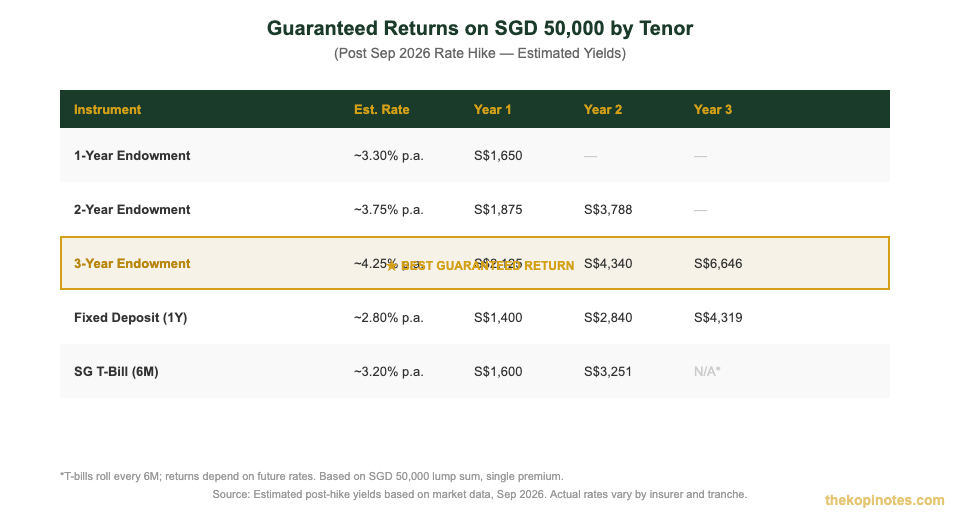
A 1-year plan gives you capital back in 12 months with a guaranteed return, currently estimated at around 3.0%–3.5% p.a. for new Q4 tranches. The upside is flexibility: if rates rise again, you can reinvest at a higher rate next year. The downside is a lower yield now for that optionality.
A 1-year plan makes sense if you believe the Fed is not done hiking, or if you have a specific expense coming in late 2027 that you are saving toward.
The 2-Year Endowment Plan
A 2-year plan sits in the middle. You lock in a higher rate than a 1-year plan, estimated around 3.5%–3.8% p.a. for Q4 2026 tranches, while only committing your money for 24 months. This is often the sweet spot for conservative savers who want a meaningful yield improvement over fixed deposits without giving up access for three years.
The 3-Year Endowment Plan
A 3-year plan offers the highest guaranteed yield, estimated up to 4.25% p.a. on new Q4 tranches. The trade-off is liquidity. Your money is locked up until late 2029. If rates fall in 2027 or 2028, you will be glad you locked in. But if you need the money early, you may face early termination penalties and loss of guaranteed returns.
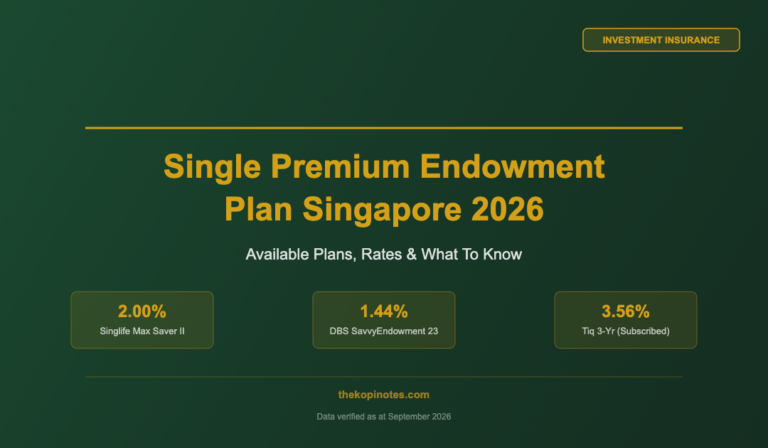
The Tiq 3-Year Endowment Plan was the standout product of 2026 at 3.56% p.a. guaranteed, but it is now fully subscribed. New equivalent tranches from AIA, Singlife, and Manulife are expected to open in October and November 2026 at potentially higher rates.
For a broader view on endowment plans in your savings strategy, see our Singapore endowment plan guide.
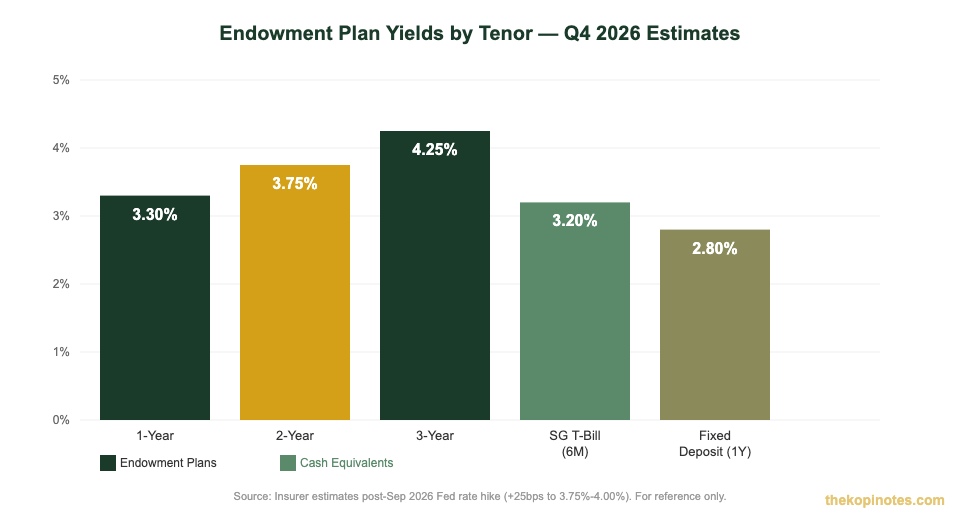
Estimated Q4 2026 Yields by Tenor
The table below shows estimated guaranteed yields for new endowment plan tranches opening in Q4 2026, compared against competing cash-equivalent products.
| Instrument | Tenor | Est. Yield (p.a.) | Liquidity |
|---|---|---|---|
| Endowment Plan | 1 Year | ~3.30% p.a. | Low (locked) |
| Endowment Plan | 2 Years | ~3.75% p.a. | Low (locked) |
| Endowment Plan ★ Best Yield | 3 Years | ~4.25% p.a. | Low (locked) |
| Singapore T-Bill | 6 Months | ~3.20% p.a. | Medium |
| Fixed Deposit (major bank) | 12 Months | ~2.80% p.a. | Low |
Source: Market estimates post-Sep 17, 2026 Fed rate hike (+25bps to 3.75%–4.00%). Actual tranche rates vary by insurer and subscription window. Check insurer websites for confirmed rates.
Who Should Buy an Endowment Plan Right Now?
Endowment plans suit a specific type of saver. You are a good fit if you have a lump sum you do not need for 1–3 years, you want a guaranteed return with no market risk, and you can leave the money untouched until maturity.
You are not a good fit if you need flexible access to funds, you are comfortable with equity market risk for potentially higher returns, or your investment horizon is 10 or more years (where equities or REITs have historically outperformed).
For those building a passive income portfolio, endowment plans can complement a dividend strategy. Platforms like Syfe and Endowus offer managed portfolios for the growth component, while endowment plans provide a guaranteed savings floor.
For more on how savings products fit into the rate-hike environment, read our guide on Singapore savings plans after the Fed rate hike.
Endowment Plans vs T-Bills vs Fixed Deposits
The September rate hike has improved yields across all short-term savings products. Here is a quick comparison of the three most popular guaranteed options for Singapore savers.
Singapore T-bills offer the highest liquidity. You can buy at MAS auctions and get your money back in 6 months. After the September hike, yields are estimated at around 3.20% p.a. However, you cannot lock in today’s rate for 3 years — your next T-bill rolls at whatever rate applies then.
Fixed deposits are the easiest to access through any major bank, but rates remain lower than endowment plans or T-bills, sitting around 2.80% p.a. on 12-month placements at major banks as at September 2026.
Endowment plans offer the highest guaranteed yield if you are willing to commit for 2–3 years. The trade-off is that early termination typically forfeits the guaranteed return and sometimes part of the principal.
| Factor | Endowment (3Y) | T-Bill (6M) | Fixed Deposit (1Y) |
|---|---|---|---|
| Est. Yield | ~4.25% p.a. | ~3.20% p.a. | ~2.80% p.a. |
| Rate Locked? | Yes (3 years) | No (resets) | Yes (1 year) |
| Capital Guaranteed? | Yes | Yes | Yes (SDIC) |
| Early Exit? | Penalty (severe) | Tradeable SGX | Usually penalty |
| Best For | Max yield, long lockup | Short term, flexible | Easy, low effort |
Source: Market estimates, September 2026. SDIC covers deposits up to SGD 100,000 per depositor per bank. Endowment plans covered under PPF up to SGD 500,000 per policyholder per insurer.
Frequently Asked Questions
”Should
”What
”Which
Get Free Insurance Advice
Speak with a licensed insurance advisor. No obligation, no cost.
By submitting this form, you agree to our Privacy Policy.
This article was researched with the help of AI. While we strive to keep all information accurate and up to date, there may be errors. If you notice any discrepancies, please contact us.