Mapletree Industrial Trust (ME8U):
Complete Investor Guide 2026
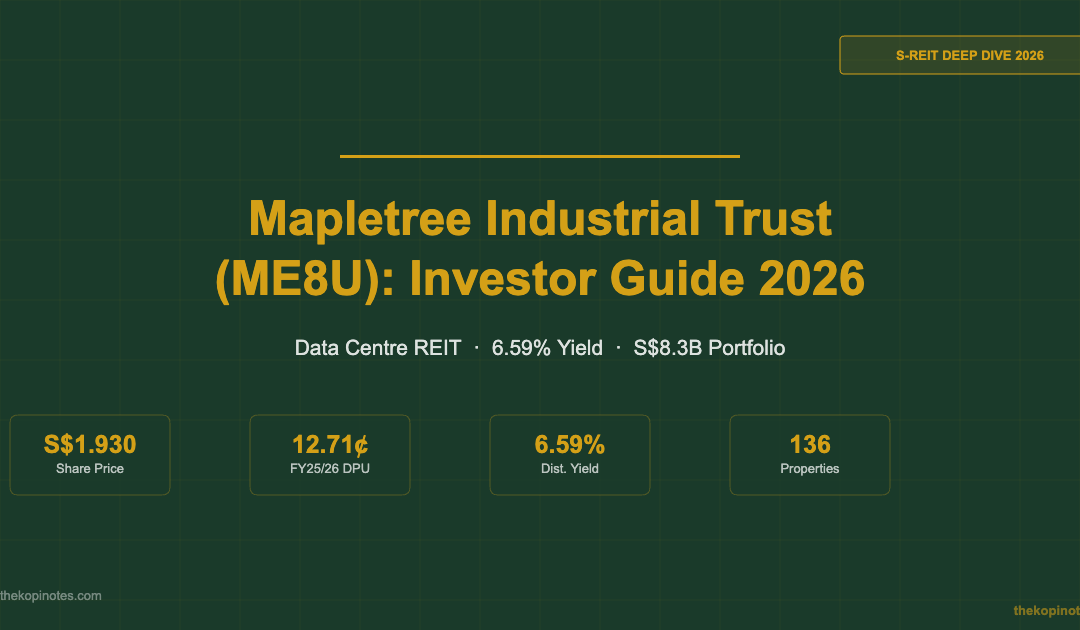
Data Centre REIT · 6.59% Yield · S$8.3B Portfolio · 136 Properties
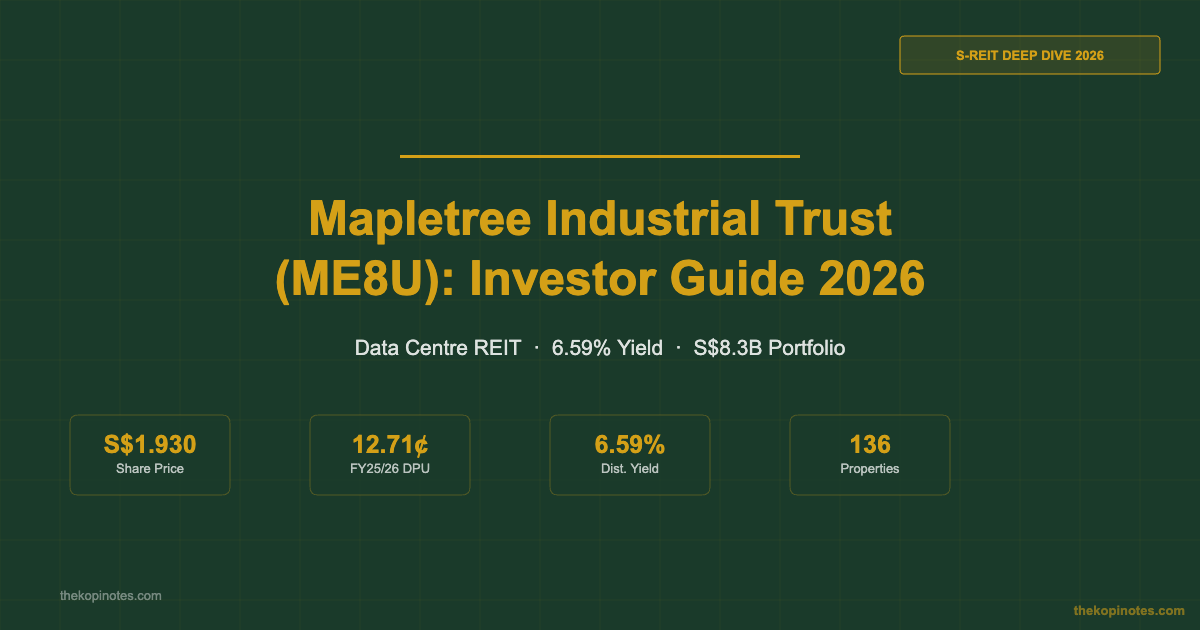
Mapletree Industrial Trust (SGX: ME8U) is Singapore’s largest industrial REIT by assets under management, with a S$8.3 billion portfolio spanning 136 properties across Singapore, North America, and Japan as at 31 March 2026. Roughly 57% of the portfolio by value is data centres, making MIT one of the few S-REITs with significant digital infrastructure exposure. At a share price of S$1.930 (July 2026), MIT offers a distribution yield of approximately 6.59% based on FY25/26 DPU of 12.71 Singapore cents.
Not financial advice. All figures are for educational reference only. Data as at July 2026 unless noted. Always verify with official MIT announcements before investing.
- MIT is a data centre-heavy industrial REIT listed on SGX (ME8U), with ~57% of its S$8.3B portfolio in data centres.
- FY25/26 DPU was 12.71 Singapore cents — a distribution yield of ~6.59% at the July 2026 price of S$1.930.
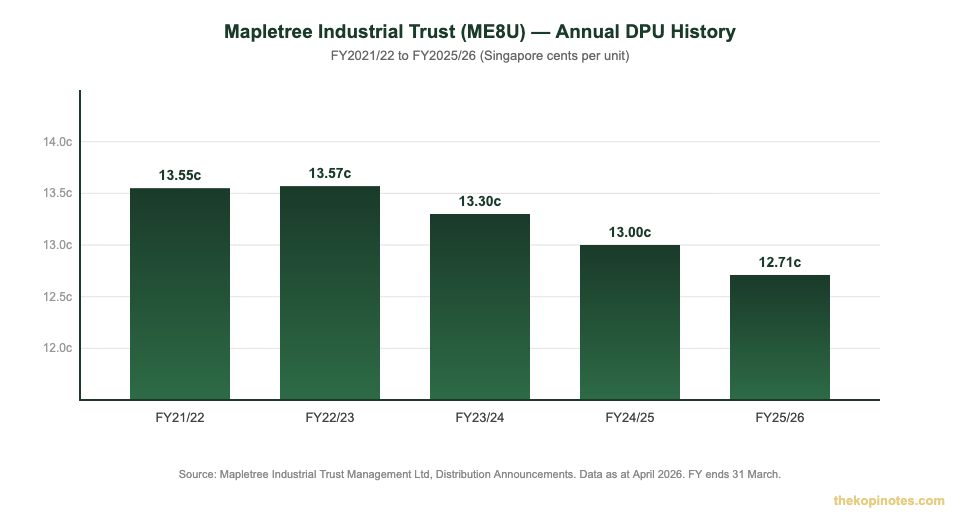
- DPU has gradually declined from a peak of 13.57¢ in FY22/23 due to higher borrowing costs — watch for interest rate stabilisation as a recovery catalyst.
Table of Contents
Show / Hide Contents
- What Is Mapletree Industrial Trust?
- MIT’s Portfolio: Three Geographies, One Vision
- Data Centre Exposure — MIT’s Key Differentiator
- DPU & Distribution Yield History
- Share Price & Valuation (July 2026)
- Balance Sheet & Gearing
- Key Risks to Watch
- How to Buy ME8U Shares in Singapore
- Frequently Asked Questions
What Is Mapletree Industrial Trust?
Mapletree Industrial Trust — ticker ME8U on the Singapore Exchange — is an industrial real estate investment trust (REIT) listed in October 2010. It is managed by Mapletree Industrial Trust Management Ltd, a wholly owned subsidiary of Mapletree Investments Pte Ltd. And Mapletree Investments is, in turn, wholly owned by Temasek Holdings — Singapore’s state investment company.
That Temasek backing matters. It signals institutional quality in asset management, access to capital markets, and a long-term investment horizon. When MIT needs to refinance debt or raise equity, the sponsor relationship gives it credibility and deal flow that smaller, independent REITs cannot easily match.
MIT’s mandate is to own and manage a portfolio of industrial and data centre properties. Over the years, it has transformed from a purely Singapore-focused flatted factory owner into a diversified, data centre-heavy REIT with assets in the US, Canada, and Japan. This evolution is the central story of MIT — and the main reason it commands a premium over more traditional industrial REITs.
MIT’s Portfolio: Three Geographies, One Vision
MIT’s portfolio spans Singapore, North America (United States and Canada), and Japan. Each geography plays a distinct role in the overall strategy.
Singapore (~60% of AUM) is the home base and the core of MIT’s income. The Singapore portfolio includes data centres, hi-tech buildings, and legacy industrial assets like flatted factories. Singapore properties generate stable, SGD-denominated income — important for a REIT that pays distributions in Singapore dollars.
North America (~34% of AUM) is where MIT has made its biggest offshore bet, primarily through US data centres (mainly in Northern Virginia — the world’s largest data centre hub) and industrial properties in Canada. These assets benefit from strong demand driven by cloud computing and AI workloads. However, they come with USD-denominated income, so currency movements affect distributions.
Japan (~6% of AUM) is a smaller but steady exposure, contributing JPY-denominated income and diversifying the portfolio away from the US rate cycle.
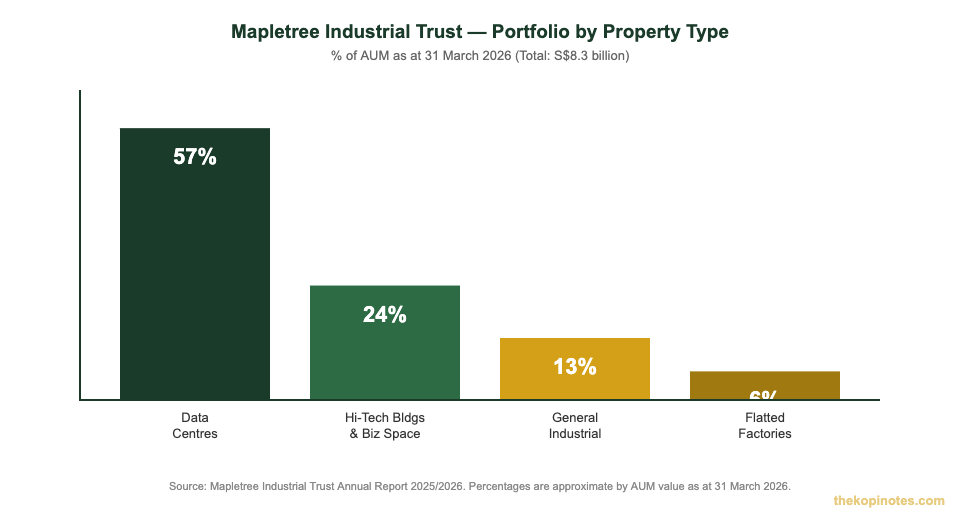
Portfolio Composition by Property Type
| Property Type | Est. % of AUM | Key Markets |
|---|---|---|
| Data Centres | ~57% | SG, US, Canada |
| Hi-Tech Buildings & Business Space | ~24% | Singapore |
| General Industrial Buildings | ~13% | Singapore, Japan |
| Flatted Factories & Other | ~6% | Singapore |
Source: Mapletree Industrial Trust Annual Report 2025/2026. Percentages are approximate by AUM value as at 31 March 2026.
Data Centre Exposure — MIT’s Key Differentiator
Not all industrial REITs are created equal. Most Singapore-listed industrial REITs own flatted factories, logistics warehouses, or business parks. MIT is different because data centres now make up roughly 57% of its total assets by value.
Why does this matter? Data centres are considered mission-critical infrastructure. Tenants — typically cloud providers, financial institutions, and telecommunications companies — sign long-term leases (often 10–20 years) and rarely leave. The cost and disruption of moving critical IT infrastructure is enormous. This means MIT’s data centre segment generates stable, long-duration income with very low vacancy risk.
MIT’s Singapore data centres include properties in Tai Seng, Toa Payoh, and Alexandra. In the US, MIT has a significant presence in Northern Virginia (Ashburn, VA) — the world’s highest-density data centre market — through 14 US data centres acquired as part of the Mapletree group’s expansion into North America.
The AI boom is a meaningful tailwind for data centre demand. Large language models require massive GPU clusters, and GPU clusters require data centres. Demand for colocation space in Singapore and Northern Virginia has remained strong through 2025–2026, with vacancy rates near record lows and rental rates rising.
That said, new data centre supply is also increasing — especially in the US. MIT’s portfolio is largely leased on long-term contracts, so near-term occupancy is not a major concern. But investors should monitor lease expiry profiles and rental reversion trends as long-term leases eventually roll.
DPU & Distribution Yield History
Distribution Per Unit (DPU) — basically how much cash each MIT unit pays you per quarter — is the core metric for REIT investors. MIT pays quarterly distributions, which is more frequent than many S-REITs that pay semi-annually.
For FY2025/26 (year ending 31 March 2026), MIT paid a total DPU of 12.71 Singapore cents, broken down as follows:
| Quarter | Period | DPU (S¢) |
|---|---|---|
| Q1 FY25/26 | Apr–Jun 2025 | 3.27 |
| Q2 FY25/26 | Jul–Sep 2025 | 3.18 |
| Q3 FY25/26 | Oct–Dec 2025 | 3.17 |
| Q4 FY25/26 | Jan–Mar 2026 | 3.09 |
| FY2025/26 Full Year Total | 12.71 | |
Source: Mapletree Industrial Trust Management Ltd, Distribution Announcements. Data verified July 2026.
At the current share price of S$1.930 (as at 6 July 2026), that translates to a distribution yield of approximately 6.59% — calculated as 12.71¢ ÷ S$1.930 × 100.
Zoom out and the trend is one of gradual DPU compression. MIT’s DPU peaked around FY22/23 and has been declining slowly since. The primary driver is higher borrowing costs: as fixed-rate debt expires, MIT refinances at current market rates, which are higher than the historically low rates of 2020–2022. This “interest rate drag” is a sector-wide issue for S-REITs, not just MIT.
The good news? Interest rates appear to have stabilised or are beginning to ease in 2025–2026. If borrowing costs trend down from here, MIT’s DPU compression should slow or reverse. That’s the bull case for MIT in 2026.
Share Price & Valuation (July 2026)
MIT’s share price was S$1.930 as at 6 July 2026 — meaningfully below the highs above S$3.00 seen in 2021, when interest rates were near zero and REIT valuations were elevated across the board.
At S$1.930, MIT trades at roughly 1.12x its net asset value (NAV) per unit of approximately S$1.73 as at 31 March 2026. Many institutional S-REIT investors use a P/NAV of 1.0–1.2x as a “fair value” benchmark for large-cap REITs with quality sponsors. MIT at ~1.12x P/NAV suggests it is fairly valued — not deeply discounted, but not stretched either.
For a Singapore retail investor holding S$50,000 worth of MIT units at S$1.930, you would receive approximately S$3,295 per year in distributions. That is roughly S$824 per quarter — a tangible passive income stream from a Temasek-backed REIT.
To compare MIT’s yield with other passive income options, see our guide on the best S-REITs in Singapore 2026 and use our Singapore retirement calculator to model long-term REIT income projections.
Balance Sheet & Gearing
MIT’s balance sheet is one of its strengths. As at 31 March 2026, the aggregate leverage (gearing) ratio was approximately 38.4% — well within MAS’s statutory limit of 50% and comfortably below the 45% threshold that triggers additional disclosure requirements.
A REIT with high gearing (say, 45%+) has limited headroom to take on new debt. If property values fall or interest rates rise, a highly geared REIT faces pressure. MIT’s ~38% gearing gives it meaningful buffer and capacity for acquisitions if the right deals present themselves.
Interest coverage ratio (ICR) — how many times MIT’s operating income covers its interest expense — stood at approximately 4.5x as at March 2026. MAS requires REITs with ICR below 2.5x to limit gearing to 45%. MIT’s ICR is well above that threshold, meaning no restrictions apply and the REIT has comfortable debt-servicing capacity even if interest rates remain elevated.
| Financial Metric | Value (FY25/26) | Comment |
|---|---|---|
| Aggregate Leverage | ~38.4% | MAS cap 50%; healthy buffer |
| Interest Coverage Ratio | ~4.5x | MAS min threshold is 2.5x |
| AUM | S$8.3 billion | As at 31 March 2026 |
| Portfolio Occupancy | ~94.6% | Healthy; data centres near full |
| NAV Per Unit | ~S$1.73 | P/NAV at S$1.930 ≈ 1.12x |
Source: MIT Annual Report 2025/2026 and Q4 FY25/26 financial results. NAV and ICR are approximate figures based on available disclosures as at 31 March 2026.
Key Risks to Watch
MIT is a quality REIT, but no investment is without risk. Here are the five key risks every potential investor should understand before buying ME8U.
1. Interest Rate Risk — The biggest near-term risk for MIT (and all REITs) is interest rates staying higher for longer. When MIT refinances existing debt at higher rates, additional interest expense reduces distributable income and flows through to a lower DPU. The decline from 13.57¢ in FY22/23 to 12.71¢ in FY25/26 is largely a story of rising financing costs.
2. Currency Risk — About 34% of MIT’s portfolio is in North America, generating USD income. About 6% is in Japan, generating JPY income. MIT hedges a portion of this exposure, but not all of it. A stronger SGD versus the USD would reduce the SGD equivalent of distributions from US properties.
3. US Data Centre Supply Risk — Northern Virginia is the world’s largest data centre market, but it is also attracting significant new supply. While MIT’s US data centres are on long-term leases with strong tenants, rental reversion upon lease renewal could be softer if new supply outpaces demand growth.
4. Singapore Industrial Land Leases — Many of MIT’s Singapore industrial properties sit on 30–60 year leasehold land. As land leases shorten over time, property valuations decline — a structural headwind for leasehold assets. This is a very long-term issue, but one worth factoring into a long-term hold thesis.
5. Acquisition Quality Risk — MIT has grown partly through acquisitions. Future deals that are overpriced or dilutive to DPU could harm unitholders. The quality of the manager’s capital allocation decisions matters enormously for long-term unitholder returns.
For a deeper understanding of how to evaluate S-REIT health, read our guide on DPU explained for Singapore REITs and our piece on passive income investing in Singapore.
How to Buy ME8U Shares in Singapore
ME8U is listed on the Singapore Exchange (SGX) and can be bought through any SGX-licensed brokerage. Here are the most popular options for Singapore retail investors in 2026.
Syfe — Syfe’s SGX trading platform offers competitive brokerage rates and no platform fees for Singapore stocks. You can also invest in Syfe’s managed REIT+ portfolio for a diversified, hands-off approach. Use the Syfe referral code (SRPRFFFCD) for a welcome bonus on your first deposit.
FSMOne (Fundsupermart) — A popular choice for dividend investors, with low brokerage fees (from 0.08%) and a Regular Savings Plan (RSP) feature that lets you auto-buy ME8U monthly. Use the FSMOne referral code (P0544985) when opening your account.
Interactive Brokers (IBKR) — For investors who want the lowest per-trade costs (as little as S$1.50 per SGX trade), IBKR is hard to beat. Best for experienced investors comfortable with a more complex platform interface.
moomoo — A popular choice among younger Singapore investors for its intuitive app, paper trading feature, and frequent sign-up promotions. See our moomoo Singapore review for a full breakdown of fees and features.
For CPF investors: MIT is not currently on the CPF Investment Scheme (CPFIS) approved list as of July 2026. If you want to use CPF-OA funds for REIT-like exposure, consider Endowus (referral code: 2V343) — which can manage your CPF funds into diversified income funds as an alternative.
Practical tip: at S$1.930 per unit with a minimum lot size of 100 units, the minimum purchase is approximately S$193 before brokerage. MIT is one of the more accessible large-cap S-REITs by entry cost.
Plan Your REIT Income
Model your MIT distributions and retirement income with TKN’s free tools.
Frequently Asked Questions
What is Mapletree Industrial Trust's DPU for FY2025/26?
How often does Mapletree Industrial Trust pay distributions?
Is Mapletree Industrial Trust a data centre REIT?
What is Mapletree Industrial Trust's gearing ratio?
How do I buy Mapletree Industrial Trust (ME8U) shares?
Why has MIT's DPU been declining since FY22/23?
Who manages Mapletree Industrial Trust?
Disclaimer: This article is for educational purposes only and does not constitute financial advice. Investing in REITs involves risks, including the possible loss of principal. Always conduct your own due diligence or consult a licensed financial adviser before making any investment decision. Data as at July 2026 unless otherwise stated. The Kopi Notes may earn referral commissions from links to brokerage platforms — this does not affect our editorial independence.
This article was researched with the help of AI. While we strive to keep all information accurate and up to date, there may be errors. If you notice any discrepancies, please contact us.