DBS vs OCBC vs UOB: Singapore Bank Stocks H2 2026 Dividend Comparison
Record earnings, rising dividends, and the July reporting season — which Singapore bank stock is right for your portfolio?
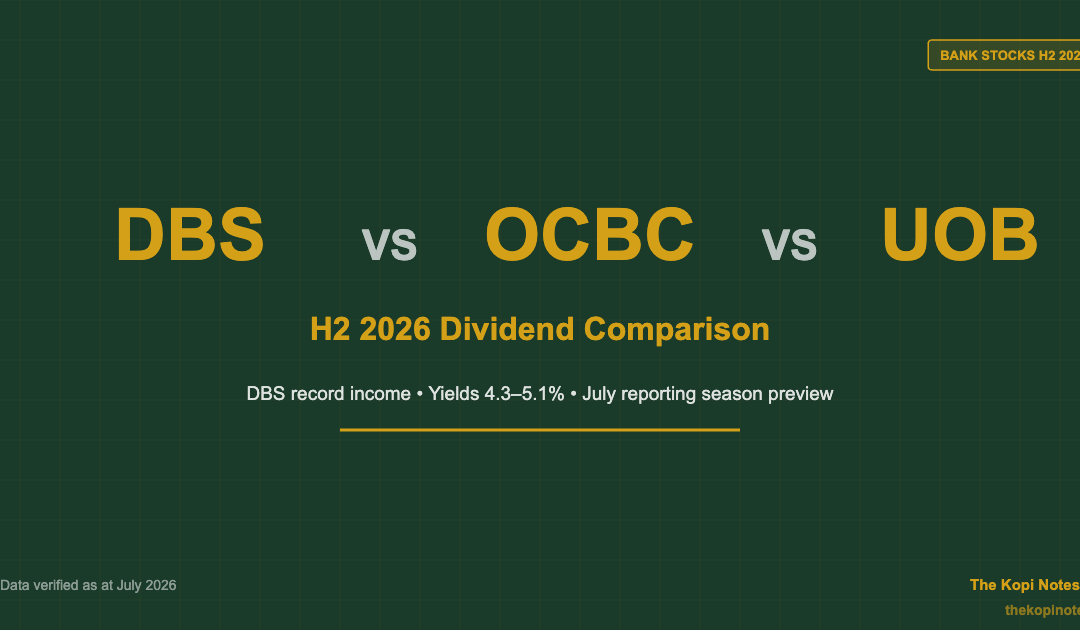
Singapore’s Big Three banks — DBS, OCBC, and UOB — are heading into H2 2026 with record earnings, fortress balance sheets, and dividend yields between 4.3% and 5.1%. DBS posted record total income of $5.95 billion in Q1 2026. OCBC delivered record non-interest income of $1.61 billion. All three maintain CET1 ratios above 15%, well above regulatory minimums. Here is a data-driven comparison to help you pick the right bank stock.
This is an editorial analysis. Not financial advice. All figures are for educational reference only. Data verified as at July 2026 unless noted.
- DBS = highest DPS growth (+117% since FY2022) and ROE (17%), but trades at a premium P/B of 2.39x
- OCBC = strongest earnings momentum in 2026, record non-interest income, most balanced risk-reward at 1.68x P/B
- UOB = cheapest valuation at 1.25x P/B and highest trailing yield (5.1%), but weakest earnings growth
Quick Comparison Table
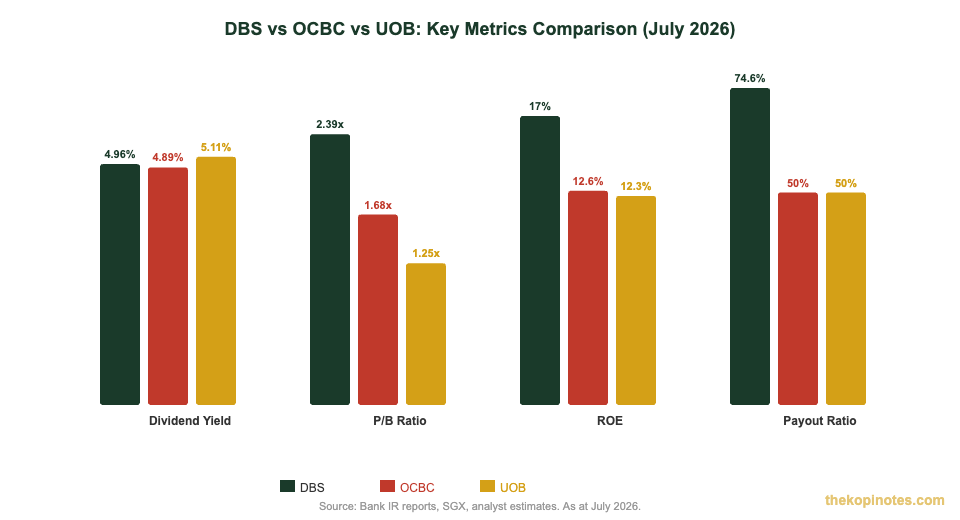
Let us start with the numbers. Here is a head-to-head comparison of all three Singapore banks as at July 2026.
| Metric | DBS | OCBC | UOB |
|---|---|---|---|
| Dividend Yield (TTM) | 4.96% | 4.89% | 5.11% |
| DPS (FY2025) | S$3.04 | S$1.01 | S$1.81 |
| DPS (FY2026E) | S$3.26 | S$1.10 | S$1.85 |
| Price-to-Book (P/B) | 2.39x | 1.68x | 1.25x |
| ROE | 17.0% | 12.6% | 12.3% |
| Payout Ratio | 74.6% | 50% | 50% |
| CET1 Ratio | >15% | >15% | >15% |
| Q1 2026 Highlight | Record $5.95B income | Record NII $1.61B | Softer YoY (high base) |
Source: StashAway, GrowBeansprout, bank IR reports. As at July 2026. E = analyst consensus estimate.
DBS: The Premium Growth Play
DBS Group Holdings (SGX: D05) is Southeast Asia’s largest bank and the undisputed dividend growth leader among the three. Its dividend per share has more than doubled from S$1.50 in FY2022 to an estimated S$3.26 for FY2026 — that is 117% growth in four years.
In Q1 2026, DBS delivered record total income of S$5.95 billion. Its ROE of 17% is the highest among the three banks, reflecting superior profitability. The bank’s wealth management franchise continues to grow, and its digital banking initiatives (including DBS digibank) are industry-leading.
The catch is valuation. DBS trades at 2.39x price-to-book, significantly above its historical average of 1.49x. At a 74.6% payout ratio, DBS is distributing a much larger share of earnings as dividends compared to OCBC and UOB. This makes the dividend generous, but leaves less room for error if earnings dip.
Best for: Investors who want the strongest DPS growth track record and are willing to pay a premium valuation for a best-in-class franchise.
OCBC: The Balanced Outperformer
OCBC (SGX: O39) has been the standout performer among the three banks in 2026. Its Q1 2026 net profit rose 5% YoY to S$1.97 billion, supported by record non-interest income of S$1.61 billion — up 23% year-on-year. The wealth management business has been the key growth driver.
OCBC’s cumulative EPS growth from 2022 to 2025 was 33.6% — actually stronger than DBS’s 21.3%. At 1.68x P/B, it trades at a discount to DBS while delivering comparable or better earnings growth. The 50% payout ratio gives it more room to increase dividends or retain earnings for growth.
OCBC’s share price has been near all-time highs in 2026, reflecting the market’s appreciation of its balanced growth profile. For investors looking to use our Singapore retirement calculator to model bank dividend income, OCBC offers an attractive combination of yield, growth, and safety.
Best for: Investors seeking a balanced blend of income, growth, and reasonable valuation. The “Goldilocks” pick among the three.
UOB: The Value Play
UOB (SGX: U11) is the cheapest of the three banks at 1.25x P/B. It also offers the highest trailing 12-month dividend yield at 5.11%. For pure income investors focused on current yield, UOB is the obvious pick.
However, UOB’s Q1 2026 earnings were softer year-on-year compared to the other two, partly due to a high comparison base from 2025. Its ROE of 12.3% is the lowest of the three. DPS has been flat at S$1.81 for two consecutive years, though analysts expect a modest increase to S$1.85 for FY2026.
UOB’s strength lies in its ASEAN franchise. The Citigroup consumer banking acquisition has expanded its Southeast Asian footprint significantly. If you believe in the long-term ASEAN growth story, UOB offers the most direct exposure at the cheapest price.
Best for: Value investors who want the cheapest P/B among the three banks and the highest current yield. Also a play on ASEAN consumer banking growth.
Dividend History and Sustainability
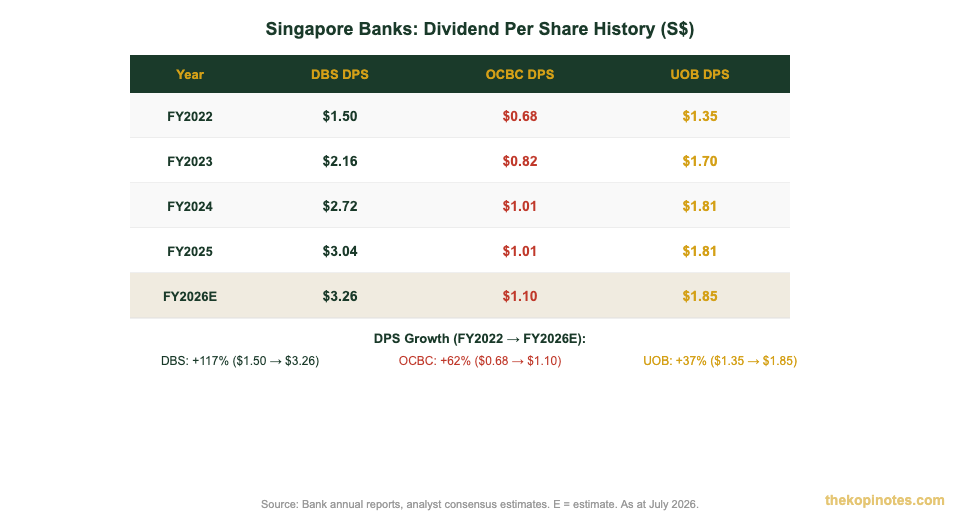
Here is the dividend per share trajectory for all three banks over the past five years.
| Year | DBS DPS | OCBC DPS | UOB DPS |
|---|---|---|---|
| FY2022 | S$1.50 | S$0.68 | S$1.35 |
| FY2023 | S$2.16 | S$0.82 | S$1.70 |
| FY2024 | S$2.72 | S$1.01 | S$1.81 |
| FY2025 | S$3.04 | S$1.01 | S$1.81 |
| FY2026E | S$3.26 | S$1.10 | S$1.85 |
Source: Bank annual reports, analyst consensus estimates. E = estimate. As at July 2026.
DBS has been the clear DPS growth leader, but its higher payout ratio (74.6%) means the dividend is more dependent on earnings holding up. OCBC and UOB’s 50% payout ratios give them more buffer to maintain or grow dividends even if earnings soften.
All three banks maintain CET1 capital ratios above 15% — at least 5 percentage points above MAS requirements. This provides ample shock-absorption and suggests dividends are sustainable even in a downturn scenario.
July Reporting Season Preview
The July 2026 reporting season will be critical for all three banks. Here is what to watch for.
Net interest margin (NIM) trends. As global interest rates stabilise, NIM expansion may slow. The key question is whether fee income and wealth management can offset any NIM compression.
Credit quality. Watch for any uptick in non-performing loans (NPLs), especially in the commercial real estate and SME segments. So far, credit costs have been benign, but trade tensions and geopolitical risks could change that.
Dividend guidance. DBS may signal another DPS increase. OCBC is expected to gradually lift its payout toward OCBC’s historical average. UOB’s DPS has been flat for two years — any signal of a hike would be positive for the stock.
Capital management. With CET1 ratios well above requirements, there is room for share buybacks or special dividends. Any announcements here would be a catalyst.
If you are looking to buy bank stocks ahead of earnings, platforms like moomoo Singapore offer competitive commission rates for SGX stocks.
Which Bank for Income vs Growth?
Here is a simple framework to decide which bank stock suits your investment goals.
For maximum current income: UOB at 5.11% yield. You get the highest quarterly payout per dollar invested, plus the cheapest valuation as measured by P/B. The trade-off is weaker earnings growth.
For dividend growth: DBS. Its DPS has more than doubled since FY2022, and the record Q1 2026 income suggests further increases ahead. However, the premium valuation (2.39x P/B) means any earnings miss could hurt the share price more.
For balanced risk-reward: OCBC. It combines the strongest earnings momentum in 2026, a reasonable 1.68x P/B valuation, room to increase dividends from its 50% payout ratio, and record non-interest income that diversifies its revenue away from NIM dependency.
For a diversified approach: Buy all three. Many Singapore income investors hold all three bank stocks as a “local bank trio” providing 4–5% blended yield with different risk profiles. You can use our retirement calculator to model how bank dividends compound alongside your CPF payouts.
To access Singapore bank stocks through managed portfolios, check out Syfe or Endowus for their Singapore-focused investment options.
Data verified as at July 2026. Past performance is not indicative of future results. Bank stocks carry risks including credit, interest rate, and regulatory risks. Always do your own due diligence.
Frequently Asked Questions
Which Singapore bank stock has the highest dividend yield in 2026?
UOB offers the highest trailing 12-month dividend yield at 5.11%, followed by DBS at 4.96% and OCBC at 4.89% as at July 2026. However, DBS has the highest absolute dividend per share at S$3.04 (FY2025) and is expected to reach S$3.26 for FY2026.
Is DBS overvalued at 2.39x price-to-book?
DBS trades at a significant premium to its historical average P/B of 1.49x. This premium reflects its superior ROE (17%), dividend growth track record, and market-leading digital banking franchise. Whether it is overvalued depends on whether you believe its earnings momentum and ROE can sustain at these levels. A pullback in global interest rates or a rise in credit costs could compress the premium.
Why is OCBC outperforming DBS and UOB in 2026?
OCBC has been the standout bank in 2026 thanks to record non-interest income of S$1.61 billion in Q1 2026 — up 23% year-on-year. Its wealth management franchise is growing rapidly, and cumulative EPS growth of 33.6% from 2022 to 2025 exceeded DBS. The stock also offers a more attractive valuation at 1.68x P/B compared to DBS’s 2.39x.
Are Singapore bank dividends sustainable?
All three banks maintain CET1 capital ratios above 15%, which is at least 5 percentage points above MAS regulatory requirements. This provides ample buffer for dividend sustainability. DBS’s higher payout ratio (74.6%) carries slightly more risk than OCBC and UOB’s 50% payout ratios in a downturn scenario, but all three have demonstrated strong capital discipline.
Should I buy DBS, OCBC, or UOB before the July reporting season?
Buying ahead of earnings carries both opportunity and risk. Positive surprises can drive share prices higher, but misses can cause pullbacks. DBS and OCBC have both been hitting record earnings, which raises the bar for Q2 results. UOB may benefit from lower expectations. If you are a long-term dividend investor, the exact timing matters less than the overall valuation and yield you are buying at. This is not a buy or sell recommendation.
Can I buy Singapore bank stocks with CPF?
Yes, DBS, OCBC, and UOB are all eligible for purchase under the CPF Investment Scheme (CPFIS) using your Ordinary Account funds, subject to CPFIS rules and stock concentration limits. You need a CPFIS-approved brokerage account. Note that CPFIS investments carry the risk of losing your CPF savings — the 2.5% OA interest rate is guaranteed, while stock returns are not.
What is the biggest risk for Singapore bank stocks in H2 2026?
The biggest risk is net interest margin (NIM) compression as global interest rates stabilise or decline. Banks have benefited enormously from the high-rate environment since 2022. Any significant rate cuts could reduce NIM and pressure earnings. Secondary risks include rising credit costs from potential loan defaults, trade tensions affecting ASEAN economies, and regulatory changes.
How do DBS, OCBC, and UOB compare on wealth management?
OCBC is the current leader in wealth management growth, with its Q1 2026 non-interest income reaching a record S$1.61 billion, up 23% year-on-year. DBS has the largest wealth management franchise in Southeast Asia and is the market leader in private banking. UOB has been expanding its wealth capabilities through the Citigroup consumer banking acquisition. All three are investing heavily in this segment as a way to diversify revenue away from NIM dependency.
Start Investing in Singapore Bank Stocks
Open a brokerage account with our referral links for exclusive sign-up bonuses.
This article was researched with the help of AI. While we strive to keep all information accurate and up to date, there may be errors. If you notice any discrepancies, please contact us.