New ISP Rider 2026: Should You Switch or Keep Your Old One?
MOH’s April 2026 changes affect ~2 million Singaporeans with existing riders. Here’s exactly how to decide.
TABLE OF CONTENTS
From 1 April 2026, new Integrated Shield Plan (ISP) riders in Singapore no longer cover the minimum deductible. The co-payment cap doubled from $3,000 to $6,000 per year. In return, new riders are about 30% cheaper — saving the average private hospital policyholder around $600 a year. Whether you should switch depends on your age, health history, and how often you expect to be hospitalised.
Not financial advice. All figures are sourced from MOH’s official press release dated 26 November 2025 and verified as at August 2026. Individual premiums and bill amounts vary by insurer and plan.
- New ISP riders (from April 2026) are 30% cheaper but no longer cover your deductible ($1,500–$3,500 depending on ward class)
- If you had a rider before 27 November 2025, you do NOT have to switch — your old rider stays valid until your next renewal after April 2028
- Switching makes financial sense if your annual premium savings exceed your likely extra out-of-pocket costs — older policyholders benefit most
What Changed in April 2026?
The Ministry of Health (MOH) announced new rules for ISP riders on 26 November 2025. The changes took effect on 1 April 2026.
Before April 2026, many Singaporeans held “full-coverage” riders. These riders paid for almost everything — including the minimum deductible that your main ISP already required you to pay. That meant near-zero out-of-pocket for any hospitalisation.
The problem? This full coverage made people less cost-conscious. MOH data showed private hospital ISP policyholders with riders were 1.4 times as likely to make a claim, with an average claim size 1.4 times higher than those without riders. Bill sizes spiralled. Premiums climbed.
So MOH stepped in with two key changes:
Change 1 — New riders cannot cover the minimum deductible. The deductible is the fixed amount you pay first before insurance kicks in. For a private ward, that’s $3,500 per year. New riders (sold from April 2026) do not cover this amount — you pay it yourself.
Change 2 — The co-payment cap doubled to $6,000. After you pay your deductible, you still share a portion of the bill (usually 5%). The cap limits how much this co-payment can total in a year. The old cap was $3,000; the new minimum is $6,000.
Who Is Affected?
Your situation depends on when you bought your rider:
Bought your rider before 27 November 2025? You are not immediately affected. Your existing rider contract continues unchanged. You are not required to switch until your next policy renewal after 1 April 2028. However, you can choose to switch voluntarily at any time.
Bought your rider between 27 November 2025 and 31 March 2026? You were informed at purchase that you must transition to the new rider design no later than your next renewal after 1 April 2028.
Buying a new rider from 1 April 2026 onwards? All new riders sold comply with the new design — no minimum deductible coverage, $6,000 co-payment cap, lower premiums.
Previously uninsured (no rider)? The new cheaper riders may now be within budget for you. A 40-year-old who previously found rider premiums too high can now add one at roughly $500 less per year than the old-style riders.
Old Rider vs New Rider: Full Comparison
Here is a side-by-side of the key differences between old (pre-April 2026) riders and new (post-April 2026) riders:
| Feature | Old Rider (pre-April 2026) | New Rider (from April 2026) |
|---|---|---|
| Minimum deductible covered? | ✅ Yes — rider pays it | ❌ No — you pay ($1,500–$3,500) |
| Annual co-payment cap | Minimum $3,000 | Minimum $6,000 (excl. deductible) |
| Minimum co-payment (5%) | Required | Required (no change) |
| Premium level | Higher | ~30% lower on average |
| Avg saving (private hospital) | — | ~$600/year in premiums |
| Avg saving (public hospital) | — | ~$200/year in premiums |
| Switching (if you decide to) | N/A | No new underwriting — pre-existing conditions still covered |
Source: Ministry of Health (MOH), 26 November 2025 press release. Average premium savings are estimates; actual premiums vary by insurer, plan, and policyholder age.
If you want the full comparison of ISP plans across all five insurers, see our complete Singapore shield plan guide.
Minimum Deductibles by Ward Class
Under the new rules, you pay the minimum deductible yourself. The amount depends on which ward class your ISP covers and which ward you actually use:
| IP Target Coverage | Ward Actually Used | Minimum Deductible |
|---|---|---|
| Class A / Private | Class A / Private | $3,500 |
| Class B1 | Class B1 | $2,500 |
| Class A/Private | Class B2 | $2,000 |
| Any | Class C | $1,500 |
| Any | Day Surgery / Short Stay (non-subsidised) | $2,000 |
| Any | Day Surgery / Short Stay (subsidised) | $1,500 |
Source: MOH Table 1, Annex A, 26 November 2025. Deductibles are per policy year. Multiple bills in the same year count towards the same deductible — you only pay it once per year.
One important nuance: the deductible applies as the lower of (a) the target ward class on your IP, or (b) the ward class you actually use. So if your IP targets Class A but you use a Class B2 ward, you only pay the $2,000 deductible. You can also use MediSave to cover your deductible — more on this in the MediSave section below.
MOH Case Examples: Real Dollar Figures
MOH published two illustrative case examples to show exactly how the numbers work. Both are based on median private hospital bill sizes from 2024.
Case Example 1: 60-Year-Old Switching to New Rider
Mr A is 60 years old with a private hospital ISP and old rider. He switches to the new rider in April 2026. Here’s what happens:
Immediate saving: He saves 30% on premiums, or $1,600 per year in cash. Over three years, that’s $4,800 saved.
Three years later: Mr A undergoes knee joint replacement surgery at a private hospital. His bill is $56,900.
| Item | Old Rider | New Rider |
|---|---|---|
| Out-of-pocket (MediSave) | ~$2,840 | $6,170 (deductible $3,500 + 5% co-payment) |
| Extra out-of-pocket vs old rider | — | +$3,330 MediSave |
| Premium saved over 3 years | — | $4,800 cash |
Source: MOH Annex B Case Example 1, 26 November 2025. Based on median private hospital bills for knee joint replacement, 2024.
Net result: Mr A pays $3,330 more in MediSave for the surgery, but saved $4,800 in cash premiums. He is still ahead by $1,470. And future years continue to compound the premium savings.
Case Example 2: 40-Year-Old Buying a Rider for the First Time
Mrs B is 40 and previously had no rider — the old premiums were too high for her budget. With the new cheaper riders, she adds one in April 2026.
In December 2026, she tears her knee and undergoes ACL reconstruction surgery at a private hospital. Her bill is $38,700.
| Item | Without Rider | With New Rider |
|---|---|---|
| Deductible + co-payment | $5,260 | $5,260 |
| MediSave covers | $3,900 | $3,900 |
| Cash out-of-pocket | $3,120 | $1,360 |
| Annual co-payment protection | None | Max $6,000/year cap |
Source: MOH Annex B Case Example 2, 26 November 2025. Based on median private hospital bills for ACL reconstruction, 2024. MediSave covers up to applicable withdrawal limits.
With a rider, Mrs B saves $1,760 in cash on this one surgery. She also pays $500 less per year in premiums than peers who had old-style riders.
Should YOU Switch? Decision Framework
There is no single right answer — it depends on your situation. Here is a practical decision framework:
Switch to the new rider if:
- You are in your 50s or older. Premium savings are larger with age ($1,600/year at 60), and you are unlikely to be hospitalised frequently enough to erase those savings.
- Your current rider premiums feel too high. The 30% reduction is immediate and tangible.
- You have a healthy MediSave balance. You can use MediSave to pay the deductible when hospitalised — the extra out-of-pocket doesn’t come from your cash.
- You are rarely hospitalised. MOH data shows an average 60-year-old undergoes day surgery or hospitalisation about twice in their next 10 years. The deductible only applies when you’re hospitalised.
Keep your old rider if:
- You have a chronic condition or high hospitalisation risk. If you expect to be hospitalised often, the full coverage of the old rider is worth more.
- Your current premium saving would be small (younger policyholders, lower-tier plans). The math may not work in your favour.
- You plan to use a private hospital frequently. Paying the $3,500 deductible every year adds up quickly.
- You prefer peace of mind with near-zero out-of-pocket. That remains available on old riders — at least until 2028.
For reference, a private ward deductible is $3,500 — but remember you only pay this once per year regardless of how many admissions you have. If you are hospitalised once every 3–4 years (typical for a healthy 50-year-old), your effective annual deductible cost averages about $875–$1,170. Compare that to $600–$1,600 in annual premium savings.
For a detailed comparison of ISP plans and riders from all five Singapore insurers, check our best integrated shield plan comparison.
How to Switch: The Process Is Simpler Than You Think
Here is the part many Singaporeans don’t realise: switching to the new rider is designed to be easy. MOH specifically required this.
No new underwriting. When you switch from your old rider to the new rider with the same insurer, you do not go through a new medical assessment. Your existing medical conditions remain covered.
Steps to switch:
- Contact your current insurer (AIA, Great Eastern, Income, Prudential, or Singlife) or your financial adviser
- Request to switch to the new compliant rider at your next policy anniversary
- Confirm the new premium and coverage terms in writing
- Your new rider takes effect from the next renewal date
You have until your next policy renewal after 1 April 2028 to make the switch, if you originally bought your rider before 27 November 2025. There is no rush — but the premium savings start only after you switch, so earlier decisions mean more savings.
To review the latest Singlife shield plan options, see our Singlife Integrated Shield Plan review.
Using MediSave for the Deductible
The biggest concern about the new riders is having to pay the deductible out of pocket. But here’s what most people miss: you can use MediSave to pay the deductible.
MediSave is your CPF healthcare savings account. It grows at 4% per year. The deductible — $1,500 to $3,500 depending on ward class — is an eligible MediSave withdrawal when hospitalised. In the MOH’s own case examples, the entire out-of-pocket amount (deductible + co-payment) was paid from MediSave, with nothing coming from cash.
This matters because many Singaporeans think of the deductible as a cash burden. In practice, if your MediSave is well-funded, the additional exposure from switching to a new rider may not touch your cash at all.
How much MediSave do you have? The CPF MediSave contribution rate for employees is 8–10.5% of monthly salary (depending on age), capped at the Basic Healthcare Sum ($75,500 as at 2025). Most working adults accumulate a meaningful MediSave balance well in excess of a single year’s deductible.
You can use our Singapore retirement planning calculator to model your long-term CPF and MediSave projections.
ISP Rider Premium Savings: What the Numbers Show
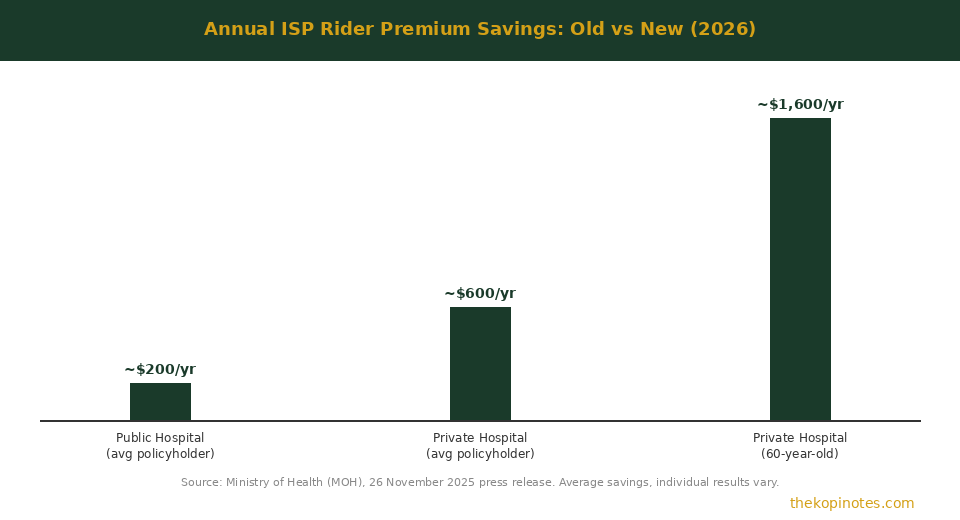
Source: MOH, 26 November 2025. Average annual premium savings from switching to new ISP riders. Older policyholders see the largest savings.
Old vs New Rider: Real Bill Comparison
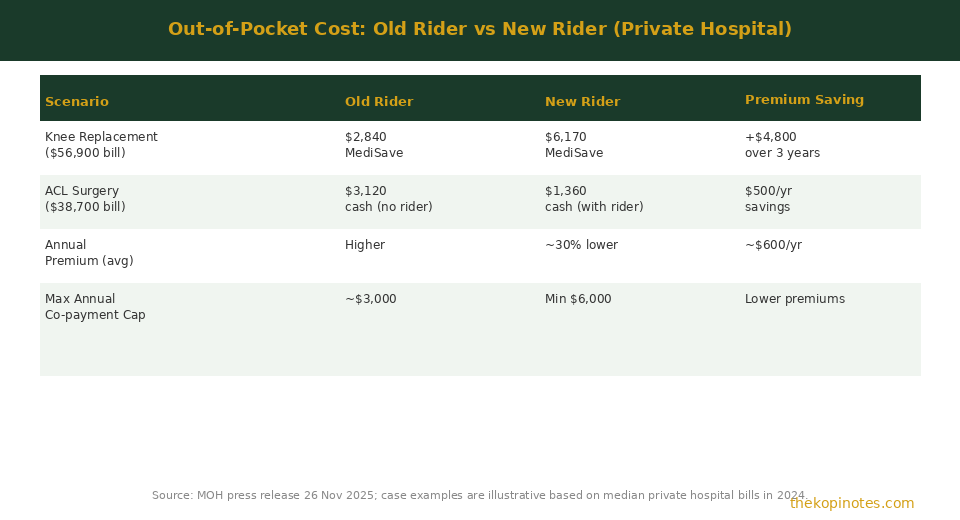
Source: MOH Annex B case examples, 26 November 2025. Based on median private hospital bill sizes from 2024. Actual amounts vary.
Frequently Asked Questions
What is the deadline to switch from my old ISP rider to the new one?
Will I need to go through underwriting again if I switch?
Can I use MediSave to pay the new deductible?
What is the minimum deductible for a private hospital ward?
How much cheaper are the new ISP riders?
Are existing policyholders forced to switch now?
What is the $6,000 co-payment cap?
Data verified as at 29 August 2026. This article is for educational reference only and does not constitute financial or insurance advice. All figures are sourced from MOH’s official press release dated 26 November 2025. Actual premiums, deductibles, bill amounts, and MediSave withdrawal limits may vary. Consult a licensed financial adviser before making changes to your insurance coverage.
Get Free Insurance Advice
Speak with a licensed insurance advisor. No obligation, no cost.
By submitting this form, you agree to our Privacy Policy.
This article was researched with the help of AI. While we strive to keep all information accurate and up to date, there may be errors. If you notice any discrepancies, please contact us.