Best Integrated Shield Plan Singapore 2026
AIA · Prudential · Great Eastern · NTUC Income · Singlife — Updated for April 2026 Rider Changes
The best integrated shield plan in Singapore for 2026 is the one that matches your preferred hospital, your budget, and how much out-of-pocket risk you can handle — especially now that MOH changed the rider rules in April 2026. AIA HealthShield Gold Max leads for private hospital coverage and post-hospitalisation benefits, Prudential PRUShield offers the highest claim limits, Great Eastern SupremeHealth stands out for value, and NTUC Income Enhanced IncomeShield wins on affordability. This guide compares all five insurers side by side so you can choose the right plan.
Not financial advice. All figures are for educational reference only. Data as at June 2026 unless noted.
- From April 2026, ISP riders can no longer cover your deductible — your minimum out-of-pocket just went up.
- The co-payment cap doubled from $3,000 to $6,000 per year, but new rider premiums are ~30% cheaper.
- Choose your plan based on which hospitals are on the insurer’s panel, not just the annual premium.
Table of Contents
- What Is an Integrated Shield Plan?
- April 2026 Rider Changes: What Changed and Why
- Best Integrated Shield Plans Compared (2026)
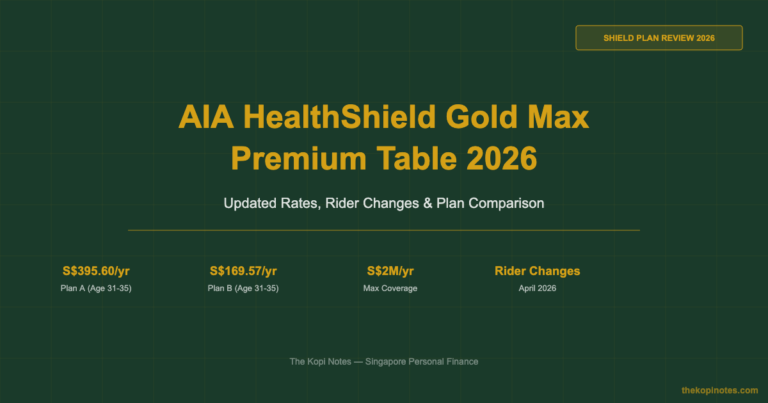
- AIA HealthShield Gold Max Review
- Prudential PRUShield Review
- Great Eastern SupremeHealth Review
- NTUC Income Enhanced IncomeShield Review
- Singlife Shield Plan Review
- How to Choose the Right ISP for You
- Premium Comparison Chart
- Out-of-Pocket Costs Under New 2026 Rules
- Frequently Asked Questions
What Is an Integrated Shield Plan?
MediShield Life covers all Singaporeans and PRs for B2/C-class ward stays at subsidised rates. An Integrated Shield Plan (ISP) is a private insurance policy that sits on top of MediShield Life, extending coverage to A-class wards or private hospitals.
You pay premiums for both MediShield Life (the base layer) and the private insurer’s add-on. The private insurer handles the claims process and pays out above what MediShield Life covers.
Most Singaporeans pair their ISP with a rider — a separate policy that covers the deductible and co-payment portions so your out-of-pocket cost is near zero. That changed in April 2026.
| Ward Class | What Covers It | Who It’s For |
|---|---|---|
| C Ward | MediShield Life only | Subsidised, shared ward |
| B2 Ward | MediShield Life only | Subsidised, shared ward |
| B1 Ward | ISP (public hospital tier) | Single/twin room, public hospital |
| A Ward | ISP (private tier) | Single room, public hospital |
| Private Hospital | ISP (highest tier) | Any room, private hospital |
Source: Ministry of Health Singapore, 2026
You can use MediSave to pay ISP premiums up to the applicable withdrawal limits, which vary by age. That means you’re not paying entirely out of pocket for your premiums.
April 2026 Rider Changes: What Changed and Why
MOH introduced major rider reforms effective 1 April 2026. These are the most significant changes to ISP riders since the 5% co-payment rule was introduced in 2018.
The Two Big Changes
1. Riders can no longer cover your deductible. The deductible is the first chunk of your hospital bill you pay before insurance kicks in. It ranges from $1,500 to $3,500 depending on your ward class. Before April 2026, full-rider holders paid $0 of this. Now, you must pay it yourself.
2. The annual co-payment cap doubled to $6,000. After your deductible, you still pay 5% co-payment on the rest of your bill. The old cap was $3,000 per year. The new cap is $6,000. So in a bad hospital year, your maximum out-of-pocket can be $7,500–$9,500 (deductible + $6,000 cap).
The Silver Lining: Premiums Drop ~30%
New riders covering private hospital stays are expected to cost about 30% less than the old “full coverage” riders. That’s because they’re no longer taking on the deductible risk. If you’re young and healthy, the new riders may cost significantly less while still protecting you from catastrophic bills.
What Happens to Existing Riders
If you bought a rider before 1 April 2026, you’re not immediately affected. Insurers can honour existing riders until renewal. However, you’ll be transitioned to compliant new riders no later than your next policy renewal after 1 April 2028. So you have time to plan.
| Item | Before April 2026 | From April 2026 |
|---|---|---|
| Deductible coverage by rider | ✅ Allowed (full riders) | ❌ Not allowed (new riders) |
| Co-payment minimum | 5% | 5% (unchanged) |
| Annual co-payment cap | $3,000 | $6,000 |
| New rider premiums | Higher (full coverage) | ~30% lower on average |
| Max out-of-pocket (private hosp.) | ~$3,000/year | ~$7,500–$9,500/year |
Source: MOH newsroom, April 2026
Best Integrated Shield Plans Compared (2026)
Here’s how the five ISP insurers stack up at a glance for private hospital coverage. All figures are for illustration — your actual premium depends on age, health, and plan tier selected.
| Insurer | Plan Name | Annual Claim Limit | Pre/Post Hosp. | Best For |
|---|---|---|---|---|
| AIA | HealthShield Gold Max A | As charged | 180/365 days (preferred panel) | Longest post-hosp. coverage |
| Prudential | PRUShield Premier | $600,000 | 180/365 days | Highest claim limits |
| Great Eastern | SupremeHealth P Plus | As charged | 180/365 days | Best value for coverage |
| NTUC Income | Enhanced IncomeShield | As charged | 90/365 days | Most affordable premiums |
| Singlife | Shield Plan 1 | As charged | 180/365 days | Flexibility + digital tools |
Source: Individual insurer product summaries, June 2026. Pre/Post-hospitalisation benefit periods shown for preferred/panel doctor visits where applicable.
All five plans cover private hospital stays on an “as charged” basis (except Prudential’s $600,000 cap on its Standard tier — Premier tier is also as charged). The real differentiation comes from: panel doctor networks, pre/post hospitalisation coverage, and rider options.
AIA HealthShield Gold Max Review
AIA HealthShield Gold Max is widely considered the top choice for Singaporeans who want maximum private hospital coverage. Its standout feature is the longest pre- and post-hospitalisation benefit period in the market — 180 days before admission and 365 days after discharge, but only if you use AIA’s Preferred Provider network.
What Makes AIA Stand Out
The 365-day post-hospitalisation benefit is a big deal. After a major surgery or cancer treatment, your follow-up care can stretch for months. AIA covers specialist visits, physiotherapy, and medication during this period — as long as you stick to their panel providers.
However, if you go outside AIA’s Preferred Provider list, coverage drops to 90 days pre- and 180 days post-hospitalisation. Choosing your specialist matters.
Plan Tiers
AIA HealthShield Gold Max comes in three tiers: A (private hospitals), B (A-class wards), and C (B1-class wards). Most Singaporeans buying private coverage choose Gold Max A.
Premiums for Gold Max A at age 30 run approximately $1,100 per year (MediShield Life base + AIA’s add-on). Your MediSave can cover most of this, with a small cash top-up for the excess over the withdrawal limit.
For a Singapore investor building a retirement plan, factoring in healthcare costs is essential. An ISP with strong post-hospitalisation coverage reduces your risk of unexpected bills derailing your retirement.
Prudential PRUShield Review
Prudential PRUShield is the pick if you want the highest guaranteed claim limits. Even at the Standard tier, you get $600,000 annual claim limit. The Premier tier is “as charged” with no annual cap.
PRUPanel Connect
Prudential’s PRUPanel Connect network covers over 1,000 specialists and clinics across Singapore. Using panel doctors unlocks enhanced benefits — similar to AIA’s Preferred Provider model. For private hospital stays, Prudential covers major hospitals including Mount Elizabeth, Gleneagles, and Parkway East.
PRUShield Pricing
PRUShield Premier premiums at age 30 are approximately $980 per year. That’s lower than AIA at the same age, though the gap narrows as you age. Prudential’s pricing tends to be competitive in the 30–50 age bracket.
If you’re looking to build long-term wealth alongside your healthcare coverage, tools like the Singapore retirement calculator can help you budget for both premiums and out-of-pocket costs over time.
Great Eastern SupremeHealth Review
Great Eastern SupremeHealth P Plus is the best-value private hospital ISP in 2026. It offers “as charged” coverage with 180-day pre- and 365-day post-hospitalisation benefits, at premiums roughly 10–20% lower than AIA at most age bands.
GREAT TotalCare Rider
Paired with the GREAT TotalCare rider, SupremeHealth becomes one of the most comprehensive packages on the market. The rider minimises out-of-pocket costs within the new 2026 co-payment rules — you pay 5% co-payment up to the $6,000 annual cap, but the rider structure means most routine hospitalisations cost you very little.
Good For: Value-Conscious Buyers
If your priority is strong private hospital coverage without paying top premiums, Great Eastern SupremeHealth P Plus is hard to beat. Premiums at age 30 are approximately $890 per year — among the most competitive for full private hospital coverage.
Building your wealth while protecting your health is the core TKN philosophy. Great Eastern is also one of Singapore’s oldest insurers, with over 110 years of operating history — a trustworthiness signal worth noting for a long-term policy.
NTUC Income Enhanced IncomeShield Review
NTUC Income Enhanced IncomeShield is consistently the most affordable ISP for private hospital coverage. If budget is your primary concern, Income is where to start.
The Trade-Off: Shorter Post-Hosp. Coverage
The affordability comes with a trade-off. Income’s post-hospitalisation benefit is 90 days after discharge (versus 365 days for AIA and Great Eastern when on-panel). For most straightforward hospitalisations, 90 days is plenty. For complex conditions like cancer, it may not be.
Income Classic Care Rider
NTUC Income’s Classic Care Rider is the most budget-friendly rider option post-2026. It limits your co-payment to 5% up to the $6,000 cap, which is the minimum required under new MOH rules. Premiums for Income’s private hospital plan plus rider at age 30 are approximately $820 per year combined — the lowest of the big five.
If you’re also looking at building passive income to offset insurance costs over time, passive income strategies in Singapore can help you create a healthcare buffer fund.
Singlife Shield Plan Review
Singlife (formerly Aviva) offers a modern, digitally-forward ISP with competitive pricing. Singlife Shield Plan 1 covers private hospitals on an “as charged” basis with 180-day pre- and 365-day post-hospitalisation benefits on panel.
Digital-First Experience
Singlife’s app-based claims process is among the smoothest in Singapore. If you prefer managing your insurance digitally rather than through agent visits, Singlife scores highly on user experience.
Pricing and Riders
Singlife Shield Plan 1 premiums at age 30 are approximately $810 per year — close to Income’s pricing. Their rider options post-2026 are compliant with MOH’s new rules, with clear documentation on what you’ll pay out of pocket.
For Singaporeans combining insurance with investment, platforms like Endowus (use Endowus referral code for bonus cash credits) let you grow your CPF OA savings while your ISP protects your health.
How to Choose the Right ISP for You
Here’s a simple decision framework. Answer these four questions in order:
1. Which hospitals do you want access to?
Private hospital preference is the first question. All five insurers cover the major private hospitals (Mount Elizabeth Orchard, Gleneagles, Parkway East, Mount Alvernia, Thomson Medical). However, panel doctor availability varies. Check whether your preferred specialist is on the insurer’s panel — this directly affects your pre/post hospitalisation benefit days.
2. How much out-of-pocket can you absorb?
Under the new 2026 rules, you’ll pay the deductible ($1,500–$3,500 depending on ward) plus 5% co-payment up to $6,000. So your worst-case annual out-of-pocket at a private hospital is roughly $7,500–$9,500. If that’s manageable, you don’t need a premium rider — a basic compliant rider works fine.
3. Do you have chronic conditions or family history concerns?
If yes, prioritise plans with longer post-hospitalisation coverage (AIA, Great Eastern, Singlife offer 365 days on panel). Chronic disease management often requires long follow-up care.
4. What’s your budget?
Rank by annual premium (age 30, private hospital, approximate):
- Singlife Shield Plan 1 — ~$810/yr
- NTUC Income Enhanced IncomeShield — ~$820/yr
- Great Eastern SupremeHealth P Plus — ~$890/yr
- Prudential PRUShield Premier — ~$980/yr
- AIA HealthShield Gold Max A — ~$1,100/yr
Remember these are base ISP premiums only. Add rider premiums on top — typically $300–$800/yr for a compliant 2026 rider, depending on age and insurer. Most of the base ISP premium can be paid from MediSave.
If you’re managing your finances holistically, consider linking your CPF investment strategy with your insurance planning. Your MediSave grows at 4% per year — a guaranteed return that helps fund future premiums.
ISP Premium Comparison Chart (Private Hospital, Age 30)
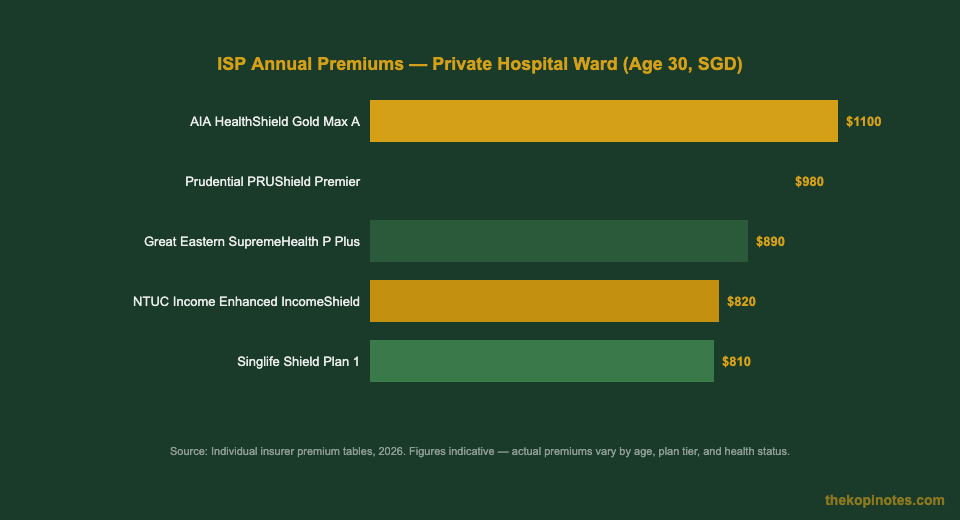
Source: Individual insurer premium tables, June 2026. Figures are approximate and for illustrative purposes only. Actual premiums vary by age, health declaration, and exact plan chosen. Not financial advice.
Your Out-of-Pocket Costs Under New 2026 Rider Rules
This chart shows how much you’d pay out of pocket under old versus new rider rules, at different bill sizes. The key takeaway: for large bills above $60,000, your maximum exposure is now capped at $6,000 co-payment + deductible — roughly $7,500–$9,500 total. For smaller bills under $30,000, the difference is less dramatic.
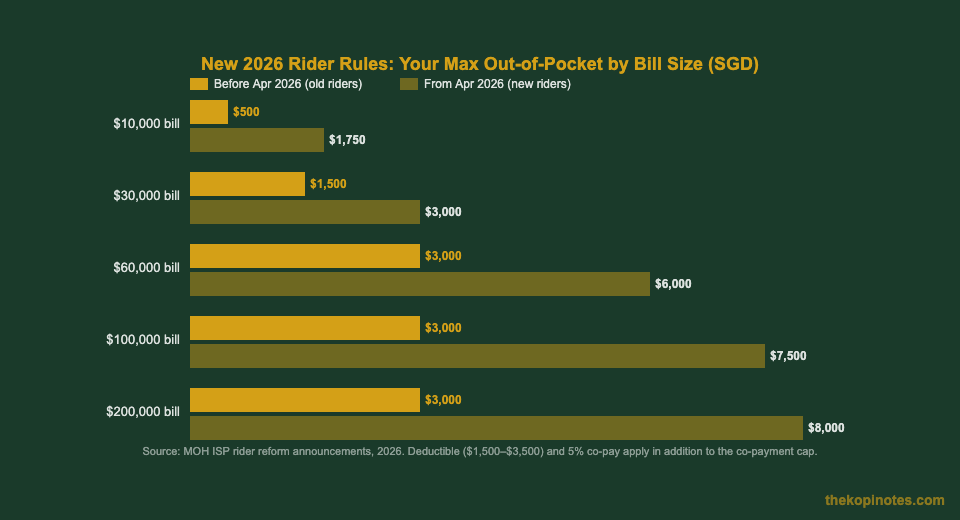
Source: MOH ISP rider reform announcements, April 2026. Deductible amounts ($1,500–$3,500) apply in addition to the co-payment amounts shown. Figures are for private hospital ward class.
Recommended Next Steps
Once you’ve picked your ISP, here’s how to round out your financial plan:
- Open a brokerage account to start building your investment portfolio — check out Syfe referral code for a fee waiver on your first investment with Syfe.
- Use the Singapore retirement calculator to see how much you need to save to retire comfortably, accounting for healthcare costs.
- Consider CPF investment strategy to grow your MediSave and OA balances for future premiums.
- Build a passive income stream via Singapore REITs and dividend stocks to create a healthcare buffer fund.
Disclaimer: This article is for general informational purposes only and does not constitute financial or insurance advice. Please consult a licensed financial adviser before making insurance decisions. TKN may earn referral fees from some links above.
Frequently Asked Questions
What is the best integrated shield plan in Singapore for 2026?
What changed with ISP riders in April 2026?
Can I use MediSave to pay ISP premiums?
How much does an integrated shield plan cost per year?
Do I need an ISP rider in 2026?
Is AIA HealthShield Gold Max the best ISP?
What is the difference between MediShield Life and an integrated shield plan?
Get Free Insurance Advice
Speak with a licensed insurance advisor. No obligation, no cost.
By submitting this form, you agree to our Privacy Policy.
This article was researched with the help of AI. While we strive to keep all information accurate and up to date, there may be errors. If you notice any discrepancies, please contact us.