Fed’s Hawkish Hold Sends 30-Year Treasury Yields to a 19-Year High — What It Means for REIT Investors in Singapore, the US, UK and Australia
The FOMC held rates at 3.50–3.75% on 29 July 2026 with the most hawkish dissent in nearly a decade — and REITs everywhere, not just in the US, are priced off exactly the yield that just spiked.
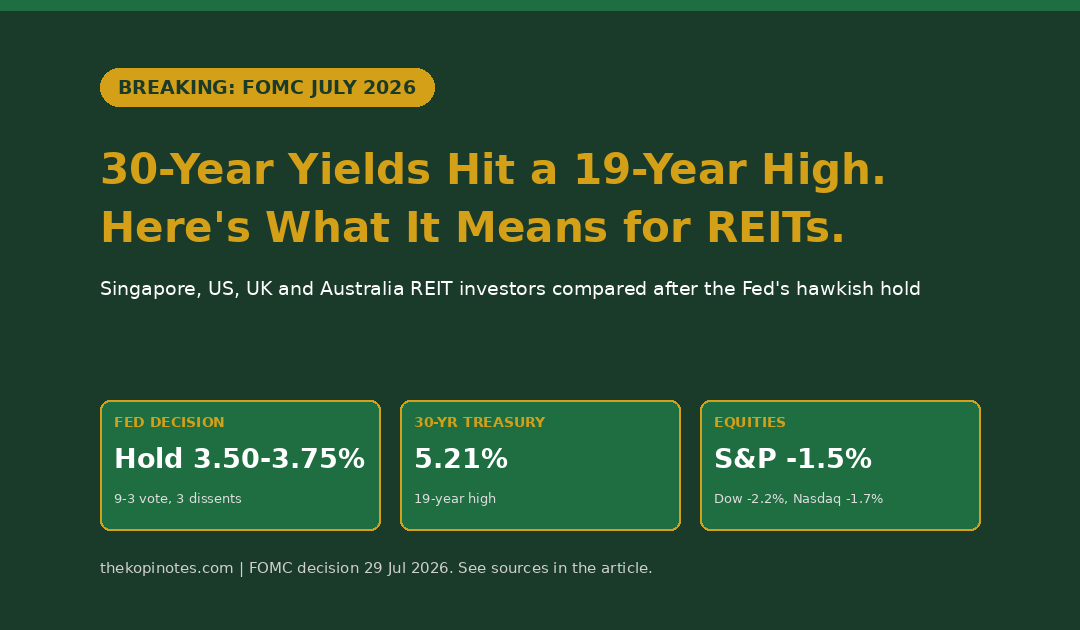
The US Federal Reserve held its benchmark rate at 3.50–3.75% on 29 July 2026 — the decision itself was expected. What wasn’t expected was the vote: three regional Fed presidents dissented in favour of an immediate rate hike, the first time since September 2016 that three policymakers have unified behind a hawkish dissent. The market reaction was immediate: the 30-year Treasury yield jumped to 5.21%, a 19-year high, and equities sold off broadly. For REIT investors, that 30-year yield move matters more than the headline “hold” — and it matters in Singapore, the UK and Australia too, not only in the US.
This is an editorial news analysis by The Kopi Notes, not financial advice. Figures are sourced from named primary and financial-press reports (see below) and are accurate as at 29–30 July 2026.
- The Fed held rates at 3.50–3.75% on 29 July 2026 in a 9-3 vote — but all three dissenters wanted a hike, not a cut, the most hawkish FOMC split in nearly ten years.
- The 30-year Treasury yield surged to 5.21%, a 19-year high; the Dow fell ~2.2%, the S&P 500 ~1.5%, and the Nasdaq ~1.7% on the day.
- REITs are priced off long-bond yields as a class, everywhere — a higher 30-year yield compresses the spread between REIT distribution yields and “risk-free” bond yields, pressuring valuations and raising refinancing costs globally, not just in the US.
- This is a short-term rate-cycle move. The structural tax gap between Singapore S-REITs (0% withholding for individuals) and the US, UK and Australia (15–30% withholding) persists across every rate cycle — see the Global REIT Income Report 2026 for the full comparison.
What the Fed Actually Decided
The Federal Open Market Committee (FOMC) voted 9-3 on 29 July 2026 to hold the federal funds rate at 3.50–3.75%. The hold itself was priced in and unremarkable. What moved markets was the composition of the dissent: Cleveland Fed president Beth Hammack, Minneapolis Fed president Neel Kashkari and Dallas Fed president Lorie Logan all voted for an immediate quarter-point increase, not a cut — the first time since September 2016 that three FOMC members have dissented together in a hawkish direction. Their shared rationale, per post-meeting commentary, centred on inflation running above the Fed’s 2% target for an extended period and the risk of it becoming entrenched in wage expectations.
The statement itself gave no explicit forward guidance, but the dissent alone was enough to shift market pricing: futures markets moved to price in over 57% odds of a rate hike at the September meeting, a sharp reversal from the rate-cut expectations that had dominated for most of 2025 and early 2026.
Markets reacted immediately and broadly. The 30-year Treasury yield rose roughly 11 basis points to 5.21% — a 19-year high — while the 2-year yield actually fell about 4 basis points to 4.24%, reflecting the market repricing toward a possible near-term hike. Equities sold off across the board: the Dow Jones Industrial Average fell approximately 2.2%, the S&P 500 about 1.5%, and the Nasdaq Composite around 1.7%. The 30-year fixed mortgage rate, which tracks the 10-year Treasury, was already averaging 6.58% in the days before the decision.
Why REITs Care About a 30-Year Treasury Yield
REITs are commonly described as “bond proxies,” and the 30-year Treasury yield is exactly why. Investors generally value a REIT’s distribution yield relative to the yield on a long-dated “risk-free” government bond — the gap between the two is often called the cap rate spread. When REITs yield meaningfully more than long bonds, the extra income compensates investors for taking on property, credit and liquidity risk. When bond yields rise sharply, as they just did, that spread compresses unless REIT prices fall (or distributions rise) to restore it — which is the basic mechanism behind REITs selling off on rate-shock days.
There is a second, separate channel: financing cost. Most REITs carry meaningful leverage and continuously refinance maturing debt. When benchmark long-term yields rise, the cost of that refinancing rises with it, directly reducing the cash available for distributions even before any change in rental income. Both channels — valuation compression and refinancing cost — are driven by the same underlying number: long-term government bond yields, which the Fed’s hawkish dissent just pushed higher.
Crucially, neither channel is US-specific. Global capital markets treat US Treasury yields as the benchmark “risk-free rate” against which most other government bonds and risk assets are priced, including in markets whose own central bank has nothing directly to do with the Fed’s decision.
Reading Across Four REIT Markets
| Market | Direct Fed Link | What to Watch |
|---|---|---|
| United States | Direct — home central bank | US REITs already priced for cuts that didn’t come; maturing debt now refinances at higher rates than expected months ago |
| Singapore | Indirect via SGD funding costs | MAS manages SGD via an exchange-rate band rather than an independent policy rate, so USD rate moves flow through to SGD funding (SORA); S-REITs are already rolling over debt locked in near 1.5% into a market baseline closer to 3.5% |
| United Kingdom | Indirect via Gilt correlation | The Bank of England sets UK rates independently, but Gilt yields historically track US Treasuries; UK REITs with near-term refinancing needs face the same higher-for-longer backdrop |
| Australia | Indirect via bond-yield correlation | The RBA is independent of the Fed, but Australian government bond yields tend to move with US Treasuries with a lag; A-REIT gearing levels determine how exposed each trust is to refinancing risk |
The common thread: none of these markets are insulated from a US long-bond yield shock, even though only one of them answers to the Fed directly. The size of the effect on any individual REIT still depends heavily on its own gearing level, debt maturity profile, and how much of its distribution is already covered by contracted rental income — broad-based market moves like this one affect sentiment and valuation multiples faster than they affect the underlying property cash flows.
The Bigger Picture: Tax Still Matters More Than One Rate Decision
A single FOMC meeting moves REIT valuations for a quarter or two; it doesn’t change the structural features of any given REIT market. Rate cycles turn — the tax treatment of REIT distributions in each jurisdiction does not, at least not on anything like the same timescale. Singapore’s REIT distributions are exempt from withholding tax for individual investors (resident or not); the US withholds 30% on ordinary REIT dividends to foreign individuals, the UK 20%, and Australia 15–30% depending on treaty status. That gap exists in every rate environment, hawkish or dovish.
We’ve published the full cross-market breakdown — gross yields, withholding rates, net yields after tax, and the market-size trade-offs — in a separate data report: the Global REIT Income Report 2026. If today’s rate news is what brought you here, that report is where the longer-term comparison lives.
Sources
- FOMC statement, 29 July 2026: Federal Reserve Board
- Dissent detail and market reaction: Tech Times
- Market/analysis context: U.S. News (Reuters analysis); CNBC live coverage
Frequently Asked Questions
What did the Fed decide on 29 July 2026?
The FOMC voted 9-3 to hold the federal funds rate at 3.50–3.75%. Three regional Fed presidents (Hammack, Kashkari, Logan) dissented in favour of an immediate quarter-point hike — the first unified hawkish dissent by three members since September 2016.
Why is this considered such a hawkish outcome?
Because the dissent pushed for tightening, not easing, at a moment when markets had been expecting rate cuts through 2025 and into 2026. Three policymakers unifying behind a hike is unusually aggressive dissent and shifted market pricing toward a possible September hike (over 57% implied odds).
Why do REITs react to a 30-year Treasury yield, not just the Fed funds rate?
REIT distribution yields are typically valued relative to long-term “risk-free” bond yields (the cap rate spread), and REIT refinancing costs track long-term benchmark yields more closely than the short-term Fed funds rate. A 19-year high in the 30-year yield affects both REIT valuations and financing costs directly.
Does a US Fed decision really affect Singapore REITs?
Indirectly, yes. Singapore’s MAS manages monetary policy through an exchange-rate band rather than an independent policy rate, so US dollar rate moves flow through to Singapore dollar funding costs (SORA). S-REITs are also refinancing older, lower-rate debt into today’s higher rate environment regardless of what the Fed does next.
What happened to markets after the decision?
The 30-year Treasury yield rose to 5.21% (a 19-year high), the 2-year yield fell to about 4.24% on hike-odds repricing, and equities sold off broadly — the Dow fell roughly 2.2%, the S&P 500 about 1.5%, and the Nasdaq around 1.7%.
Where can I find a deeper comparison of REIT markets, beyond this rate story?
See the Global REIT Income Report 2026, which compares gross and after-tax REIT yields across Singapore, the US, UK and Australia — a structural comparison that holds regardless of where we are in the current rate cycle.
Go Deeper on REIT Yields
This rate story will move on. The tax and yield comparison underneath it won’t.
This article was researched with the help of AI. While we strive to keep all information accurate and up to date, there may be errors. If you notice any discrepancies, please contact us.