SINGAPORE BUSINESS NEWS · 7 SEPTEMBER 2026
CapitaLand Investment Retrenches 90 Staff: What Singapore’s Biggest REIT Manager Resetting Its Playbook Means for CICT, CLAR & CLAS Investors (2026)
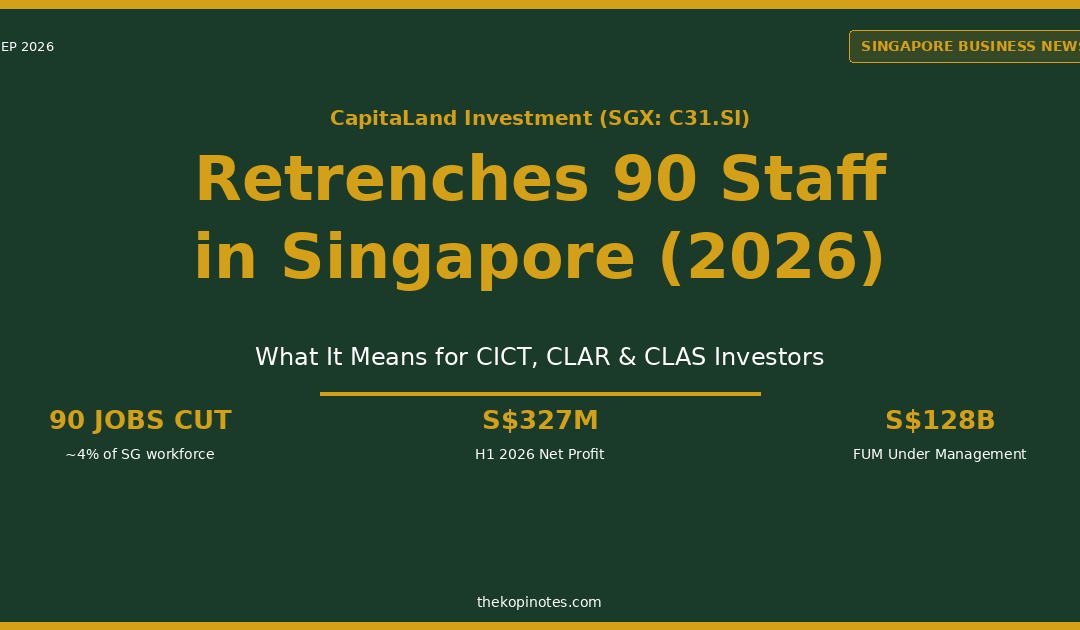
On September 3, 2026, CapitaLand Investment (CLI, SGX: C31.SI) announced it would retrench 90 staff — roughly 4% of its 2,200-person Singapore workforce — as part of a strategic restructuring. The move, announced in a joint statement with SISEU, came just three weeks after CLI posted its strongest H1 net profit in recent years. For Singapore retail investors holding CICT, CLAR, or CLAS units, this is a story worth understanding beyond the headlines.
Not financial advice. All figures are for educational and informational purposes only. Data as at September 2026 unless otherwise noted. Past performance is not indicative of future results.
Table of Contents
Contents — Click to expand
- What Happened: CLI Cuts 90 Jobs, 4% of Its Singapore Workforce
- Why CLI Is Restructuring Despite Surging Profits
- The Three REITs: How CICT, CLAR & CLAS Are Positioned
- The Bigger Play: CEO’s Ascott Stake Sale and the Asset-Light Pivot
- CLI H1 2026 Snapshot: Numbers That Tell a Different Story
- What Should S-REIT Investors Do Now?
- Bottom Line for Singapore Investors
- Frequently Asked Questions
What Happened: CLI Cuts 90 Jobs, 4% of Its Singapore Workforce
On September 3, 2026, CapitaLand Investment issued a joint statement with the Singapore Industrial and Services Employees’ Union (SISEU) confirming that it would lay off 90 employees in Singapore. The affected roles are primarily head-office functions — corporate, operational, and support positions rather than frontline property management staff.
The 90 jobs represent approximately 4% of CLI’s Singapore-based workforce of around 2,200. That is not an insignificant cut, but it is far from a company in distress. CLI remains one of Asia’s largest real estate investment managers, with S$128 billion in funds under management (FUM) across 40+ countries as at June 30, 2026.
What makes this retrenchment unusual — and what has caught the attention of Singapore’s investing community — is its timing. Just three weeks earlier, on August 13, 2026, CLI had reported a 13.9% year-on-year increase in net profit to S$327 million for the first half of 2026, surpassing S$287 million in H1 2025. This is a company trimming staff while posting strong profits, which signals strategic intent rather than financial necessity.
The announcement was made before trading hours and in conjunction with a union partner — consistent with Singapore’s Tripartite Advisory on Managing Excess Manpower, which encourages companies to engage unions and support affected employees through retrenchment benefits, retraining, and outplacement assistance.
Why CLI Is Restructuring Despite Surging Profits
CLI is reorganising around a leaner, more capital-efficient operating model. Three concurrent strategic moves were telegraphed by CEO Lee Chee Koon at the August 13 results briefing.
Rationalising headcount to match a shifting business mix. CLI has been accelerating its transition from an asset-heavy property developer to an asset-light fund manager. As its portfolio becomes increasingly institutionalised — with more third-party capital, fewer on-balance-sheet holdings, and greater reliance on fee income from its S$128B FUM — the required support infrastructure is fundamentally different. Roles built for the old developer-operator model are being shed as CLI sharpens its identity as a pure-play real estate fund manager.
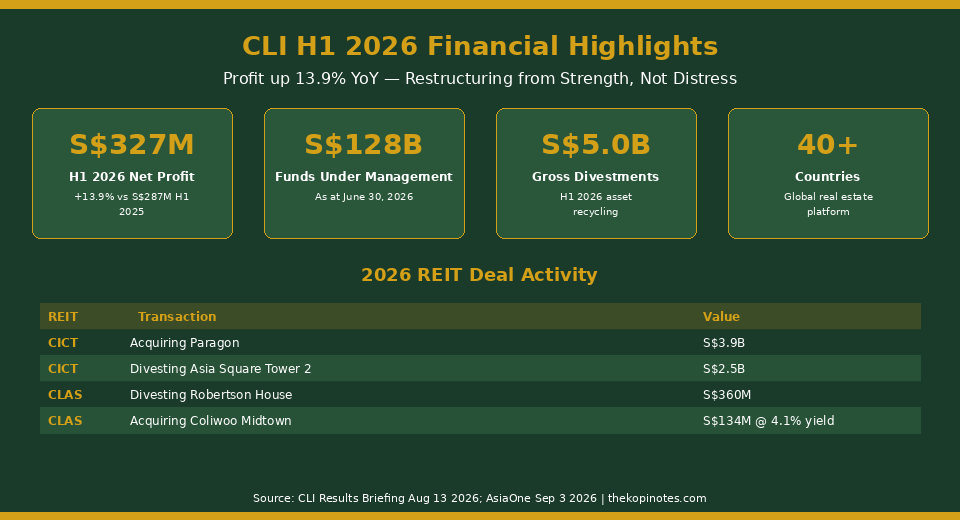
Streamlining after heavy divestment activity. CLI completed S$5.0 billion in gross divestments across the group in H1 2026 alone. When you are actively recycling capital and divesting large assets — CICT’s Asia Square Tower 2 (S$2.5B), CLAS’s Robertson House (S$360M) — the teams that managed those assets are no longer needed at the same scale. Each major divestment can render certain corporate roles redundant as the corresponding portfolio shrinks.
Preparing for the Ascott partial monetisation. CEO Lee Chee Koon indicated at the August results briefing that CLI is considering a partial divestment of its lodging arm, The Ascott Limited. If Ascott is separately monetised or partially listed, the corporate structure supporting it within CLI would need to be reshaped — and headcount reductions at the CLI level are likely part of that preparatory work.
The Three REITs in the Frame: CICT, CLAR & CLAS
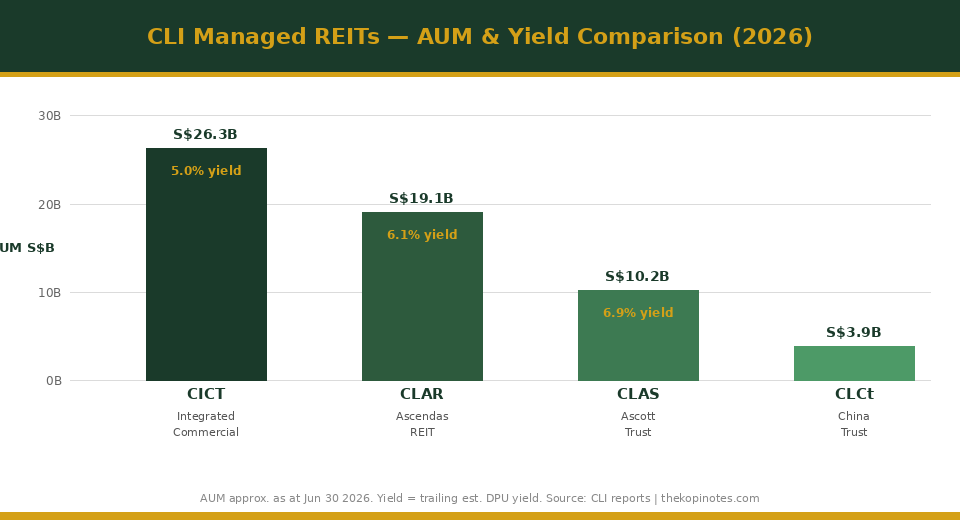
CLI manages four listed Singapore REITs: CapitaLand Integrated Commercial Trust (CICT, SGX: C38U), CapitaLand Ascendas REIT (CLAR, SGX: A17U), CapitaLand Ascott Trust (CLAS, SGX: HMN), and CapitaLand China Trust. Here is how each sits in 2026 and what the CLI restructuring means for each.
| REIT | Code | Est. AUM | Est. Yield | Key 2026 Move |
|---|---|---|---|---|
| CICT | C38U | ~S$26B | ~5.0% | Acquiring Paragon (S$3.9B); Divesting Asia Square Tower 2 (S$2.5B); DPU +2.1% |
| CLAR | A17U | ~S$19B | ~6.1% | Japan hyperscale data centre entry; Spain logistics acquisitions; Singapore logistics expansion |
| CLAS | HMN | ~S$10B | ~6.9% | Divesting Robertson House (S$360M); Acquiring Coliwoo Midtown (S$134M at 4.1% yield) |
| CLCt | AU8U | ~S$4B | ~7.2% | China commercial assets; higher yield reflects market risk premium |
AUM and yield figures are approximate, based on available H1 2026 data and trailing 12-month DPU estimates. Not investment advice.
The key question for unitholders: does a leaner CLI management team affect how well the REITs are run? The honest answer is: probably not in the short term. CICT, CLAR, and CLAS each have their own separate management entities, boards, and dedicated operations teams. The retrenchment at CLI level is at the group corporate level, not within the individual REIT management companies. Day-to-day asset management, tenant relations, and DPU delivery for each REIT continue independently.
What could matter over the medium term is deal sourcing. CLI’s corporate team plays a role in identifying acquisition targets and structuring transactions for its REITs. A leaner CLI corporate office could slow the pace of new acquisitions — or it could mean a more focused pipeline. For CICT, CLAR, and CLAS investors who rely on active capital recycling for DPU growth, this is worth monitoring over the next 12–18 months. For broader context on which Singapore REITs offer the best risk-adjusted yield, see TKN’s Best S-REITs Singapore 2026 Guide.
The Bigger Play: CEO’s Ascott Stake Sale and the Asset-Light Pivot
The retrenchment is only one piece of a larger CLI repositioning. The development that carries more long-term significance for investors is CEO Lee Chee Koon’s publicly stated consideration of a partial divestment of The Ascott Limited — CLI’s global lodging arm, which is the world’s largest serviced apartment operator with over 160,000 units across 900+ properties globally.
Ascott is currently a wholly-owned CLI subsidiary, distinct from CapitaLand Ascott Trust (CLAS), the listed REIT that holds a portion of Ascott’s assets. A partial sale of Ascott itself — or a stake in the Ascott management company — would unlock significant capital for CLI shareholders and provide fresh equity to recycle into higher-yielding opportunities.
For CLAS investors, this is a nuanced situation. A monetised Ascott stake could see CLI reinvest proceeds into CLAS to grow the listed REIT’s asset base. Alternatively, if a third-party buyer acquires a meaningful Ascott stake, CLAS’s relationship with its sponsor changes — which could affect future deal flow, preferential access to pipeline assets, and the right of first refusal (ROFR) that underpins many sponsor-to-REIT transactions in Singapore. Neither scenario is decided yet, but the direction of travel at CLI is unmistakable: asset-light, fee-driven, with a leaner but more productive headcount.
CLI H1 2026 Snapshot: Numbers That Tell a Different Story
To understand why the retrenchment is strategic rather than distress-driven, look at what CLI reported on August 13, 2026. CLI’s H1 2026 net profit rose 13.9% year-on-year to S$327 million, compared to S$287 million in H1 2025. Revenue growth was driven by strong performance from Ascott’s lodging operations, rising fee income from its expanded S$128B FUM base, and gains from its S$5.0 billion gross divestment programme.
CLI’s total FUM of S$128 billion as at June 30, 2026 spans more than 40 countries, making it one of the largest real assets fund managers in Asia. The scale of its operations demands corporate infrastructure — but CLI is clearly betting that a streamlined, technology-enabled team can manage the same FUM at lower overhead and greater agility. That is the operating leverage play behind the restructuring.
For investors tracking CLI shares directly (SGX: C31.SI), broader Singapore market context matters. The STI stood at 5,801.96 on September 4, 2026. Markets tend to view strategic restructurings positively when they signal management discipline — especially when the company is profitable and the restructuring is clearly telegraphed in advance.
What Should S-REIT Investors Do Now?
Short-term — no action needed. The 90 jobs cut are at CLI’s group corporate level, not within the REIT management entities. CICT, CLAR, or CLAS distributions in the next 1–2 quarters are not affected by this announcement. Continue monitoring the individual REIT results and distributions as they report in October and November 2026.
Medium-term — watch deal activity. CLI’s corporate team plays a role in originating and structuring acquisitions for its REITs. If the restructured CLI team originates fewer deals, you may see a modest slowdown in acquisitions or capital recycling at the REIT level. This is not necessarily negative — it could mean lower gearing and higher distribution retention — but it is worth tracking over the next 2–4 quarterly reports.
CLAS investors in particular — watch the Ascott question. Pay attention to how the Ascott monetisation story develops. The outcome could reshape CLAS’s sponsor dynamic in material ways. For investors who prefer diversified REIT exposure with lower single-sponsor risk, TKN’s S-REIT ETF Guide covers the main REIT ETF options available to Singapore retail investors.
General context. Singapore’s S-REIT average distribution yield in the 6.0–6.5% range (as at September 2026) remains structurally attractive in the current interest rate environment. CLI’s restructuring does not change this fundamental yield case for the three REITs it manages. It is, however, a useful reminder that sponsor quality and strategic direction matter alongside DPU yield when selecting individual S-REITs for a long-term income portfolio.
Bottom Line for Singapore Investors
CapitaLand Investment’s retrenchment of 90 Singapore staff is not a red flag — it is a calculated strategic reset from Asia’s most powerful REIT manager. CLI is profitable (S$327M H1 net profit, +13.9% YoY), well-capitalised (S$128B FUM), and actively restructuring toward a leaner, asset-light model that should deliver better operating margins over time.
For S-REIT investors, the immediate impact on CICT, CLAR, and CLAS distributions is minimal. The more significant watchpoints are the Ascott divestment decision and the pace of deal origination from a leaner CLI corporate team over the next 12–18 months. Neither warrants panic — but both warrant staying informed.
TKN’s view: CLI is making moves from a position of strength. The 90 retrenchments are a cost management story bundled inside a strategic transformation story. Watch the REIT-level half-year results due in October and November for clearer signals on how the restructured CLI machine performs for its unitholders.
Frequently Asked Questions
Why did CapitaLand Investment retrench 90 staff in Singapore in 2026?
Does the CLI retrenchment affect CICT, CLAR, or CLAS distributions?
Is CapitaLand Investment in financial difficulty?
What is the Ascott divestment that CLI's CEO mentioned?
What is CLI's funds under management (FUM) as at 2026?
How does this news affect Singapore's S-REIT market broadly?
Should I sell my CICT, CLAR, or CLAS units because of this news?
Track Singapore’s Best S-REITs in 2026
Compare CICT, CLAR, CLAS and 15+ other S-REITs for yield, gearing, and growth potential.
This article was researched with the help of AI. While we strive to keep all information accurate and up to date, there may be errors. If you notice any discrepancies, please contact us.