Global REIT Income Report 2026: How Singapore’s S-REIT Yields Compare to the US, UK and Australia After Tax
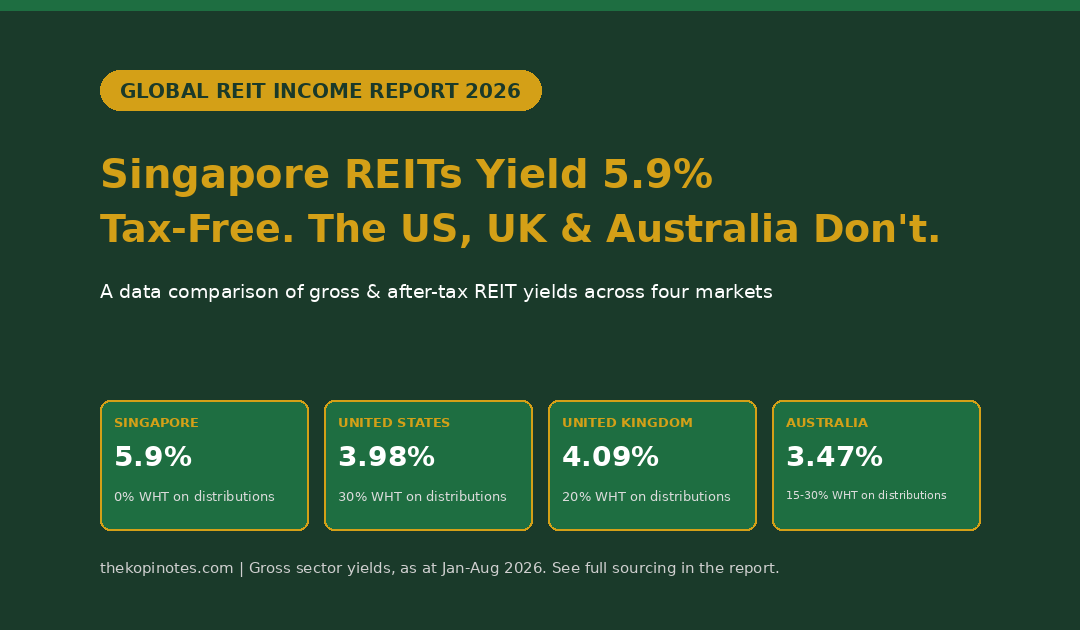
Singapore REITs pay individual investors a 5.9% average yield with zero withholding tax — a net income edge that global peers in the US, UK and Australia cannot match.
Most global income investors compare REIT markets on gross yield alone — and by that measure, Singapore’s S-REITs already lead the pack at an average 5.9%. But the bigger gap only shows up after tax. Singapore charges individual investors, resident or not, zero withholding tax on REIT distributions. The United States, United Kingdom and Australia all withhold tax at source for foreign individual investors — 30%, 20%, and 15–30% respectively — which quietly erodes a 3.5–4.1% headline yield down to roughly 2.4–3.3% in an investor’s pocket.
This is an original data compilation and editorial analysis by The Kopi Notes, not financial or tax advice. All figures are sourced from named primary sources (see Methodology & Sources) and are accurate as at the dates cited, mostly January–August 2026. Journalists and researchers are welcome to cite this report; please verify figures against the linked primary sources before publication, since market yields and withholding rates change.
- Singapore S-REITs pay an average 5.9% gross yield (REITAS, Dec 2025) — and individual investors keep all of it. There is no withholding tax on REIT distributions to individuals, resident or non-resident.
- The US (30%), UK (20%) and Australia (15–30%) all withhold tax on REIT/property-trust distributions paid to foreign individual investors, turning their higher-looking headline yields into a lower real return.
- After tax, Singapore’s income edge over the next-best market widens from roughly 1.8 percentage points gross to about 2.6 percentage points net.
- The trade-off: Singapore’s S-REIT sector is about S$100 billion across 39 counters — a fraction of the US REIT sector’s US$1.5 trillion. Scale and liquidity favour the US; net income favours Singapore.
Table of Contents
Contents — Click to expand
- Why Global Income Investors Often Overlook Singapore REITs
- Gross Yield Comparison: Singapore vs the US, UK and Australia
- The Withholding Tax Difference Most Investors Miss
- Net Yield After Tax: The Real Comparison
- Market Size and Liquidity: Where Singapore Doesn’t Win
- What This Means for Global Income Investors
- Risks and Limitations to Weigh
- Methodology and Sources
- Frequently Asked Questions
Why Global Income Investors Often Overlook Singapore REITs
Ask a US or UK dividend investor to compare REIT markets and they will usually reach for the same three: their own home market, whichever market their broker covers best, and maybe Australia if they follow global income ETFs. Singapore rarely makes the shortlist, even though the S-REIT sector is one of the largest and most internationally diversified REIT markets in Asia.
Part of the reason is framing. Singapore’s REIT coverage is written almost entirely for a domestic audience — CPF investing, SRS accounts, retirement planning — because that is genuinely how most S-REIT unitholders access the market. But the underlying REITs themselves are far from parochial. Names like Mapletree Logistics Trust, Keppel DC REIT and CapitaLand Ascendas REIT hold warehouses, data centres and business parks across the US, Europe, Japan, China and Australia — Singapore is simply where the trust is listed and regulated, not necessarily where the rental income originates.
The other reason is access, or the perception of it. S-REITs trade on the Singapore Exchange (SGX) and are directly purchasable by non-residents through most global brokers — Interactive Brokers, Saxo, moomoo and others all offer SGX access — with no Singapore bank account, CDP account restriction, or residency requirement for individual investors buying through a broker’s nominee account. A UK, US or Australian investor can hold S-REITs the same way they hold any other foreign-listed stock.
What almost never gets compared, because it requires pulling tax rules from four different jurisdictions, is what each market’s REIT distributions are actually worth after withholding tax. That comparison is the point of this report.
Gross Yield Comparison: Singapore vs the US, UK and Australia
To keep the comparison apples-to-apples, each market’s figure below is the broadest, most commonly cited sector-average yield — not a cherry-picked high-yield individual REIT. Singapore’s figure is REITAS’s official sector average; the other three are drawn from the benchmark index (or the lowest-cost fund tracking it) that global investors would actually encounter when researching each market.
| Market | Benchmark | Gross Avg. Yield | As At |
|---|---|---|---|
| Singapore | S-REIT sector average (REITAS) | 5.90% | 31 Dec 2025 |
| United Kingdom | FTSE EPRA Nareit UK Index (iShares IUKP) | 4.09% | Aug 2026 |
| United States | FTSE Nareit All Equity REITs Index | 3.98% | 31 Jan 2026 |
| Australia | S&P/ASX 200 A-REIT Index (SPDR SLF ETF) | 3.47% | 29 Jul 2026 |
On gross yield alone, Singapore already leads — by 1.8 percentage points over the UK, its closest rival. That gap is the part most comparisons stop at. It is also the smaller of the two gaps.
The Withholding Tax Difference Most Investors Miss
Every market in this comparison taxes REIT distributions differently at the point of payment, and the differences are large enough to reorder the ranking entirely.
Singapore. Under the S-REIT tax transparency framework, distributions paid to individual unitholders — whether Singapore tax residents or not — are exempt from tax and paid gross, with no withholding, provided the units are not held through a partnership or as part of a trade or business. The one carve-out is “foreign non-individual” investors (corporate entities, not natural persons), who face a reduced concessionary withholding rate, historically 10%. For an individual investor buying S-REIT units directly, the distribution is exempt in Singapore’s hands — full stop.
United States. Ordinary REIT dividends paid to non-US persons are treated as FDAP income (fixed, determinable, annual or periodic) and are subject to a standard 30% withholding tax at source. This can be reduced under an applicable US tax treaty — but the United States and Singapore do not have a comprehensive bilateral income tax treaty, so a Singapore-resident investor in a US REIT generally cannot claim treaty relief and faces the full 30% rate. Investors resident in treaty countries (the UK, for instance) may access a reduced rate, subject to their own country’s treaty terms and paperwork.
United Kingdom. UK REITs pay the property-income portion of their distribution as a Property Income Distribution (PID), which is withheld at 20% at source for anyone outside an ISA or pension wrapper — UK residents and non-residents alike. Non-resident investors may be able to reclaim some of this withholding if their country of residence has a UK tax treaty that provides for it, but the standard deduction at source is 20%.
Australia. Australian REITs (A-REITs) typically distribute through a Managed Investment Trust (MIT) structure. MIT fund payments to foreign investors resident in a country with an effective exchange-of-information (EOI) arrangement with Australia — which covers most major economies, including Singapore, the US and the UK — are withheld at a final rate of 15%. Investors resident in non-EOI countries face a 30% final withholding rate instead.
Net Yield After Tax: The Real Comparison
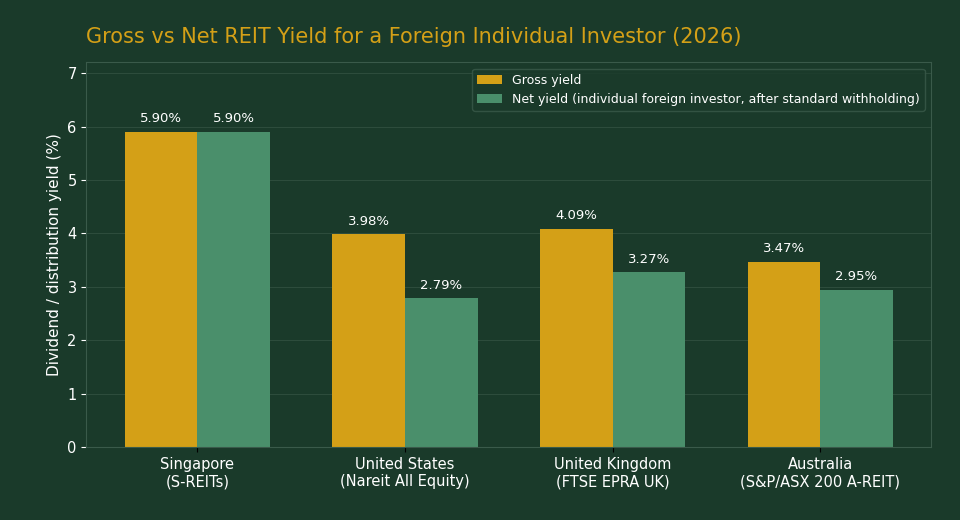
Applying each market’s standard withholding rate to its gross yield gives a first-order estimate of what a foreign individual investor actually receives. This is a simplified calculation — see the caveats in Risks & Limitations — but it is directionally accurate and the gaps it reveals are too large to be a rounding error.
| Market | Gross Yield | Standard WHT (individual) | Net Yield |
|---|---|---|---|
| Singapore | 5.90% | 0% | 5.90% |
| United Kingdom | 4.09% | 20% | ~3.27% |
| Australia (EOI country) | 3.47% | 15% | ~2.95% |
| United States | 3.98% | 30% | ~2.79% |
| Australia (non-EOI country) | 3.47% | 30% | ~2.43% |
After tax, Singapore’s lead over the next-best market (the UK) widens to roughly 2.6 percentage points — nearly 1.5× the gross-yield gap. Against the US, a 1.9-point gross gap becomes a 3.1-point net gap. The chart below shows the same comparison visually.
Market Size and Liquidity: Where Singapore Doesn’t Win
None of this makes Singapore a strictly “better” REIT market — it makes it a better after-tax income market for individual investors, which is a narrower and more specific claim. On scale, the US is not close.
| Market | Sector Size | Listed REITs / Trusts |
|---|---|---|
| United States | ~US$1.5 trillion (FTSE Nareit All Equity REITs Index) | 150+ across dozens of property sub-sectors |
| Singapore | ~S$100 billion (~US$74 billion) | 39 REITs and property trusts |
A roughly S$100 billion market spread across 39 counters is genuinely small next to a US$1.5 trillion market with 150-plus listed REITs spanning niche sub-sectors — timberland, cell towers, data centres, self-storage, and more — that Singapore’s market cannot fully replicate on its own. Trading volumes, bid-ask spreads and analyst coverage are correspondingly deeper in the US. Investors choosing between markets should weigh Singapore’s tax and yield edge against the US market’s far greater breadth, depth and liquidity — this report is a yield-and-tax comparison, not a claim that one market is categorically superior to the others.
What This Means for Global Income Investors
For an income-focused investor comparing REIT markets purely on what lands in their account after tax, three practical points follow from the data above:
Access is not the barrier it may appear to be. SGX-listed S-REITs can be bought directly by non-residents through most international brokers that offer Singapore market access, in the same way an investor might buy a Japanese, Hong Kong or European stock. No Singapore residency, CDP-linked bank account, or CPF eligibility is required for a straightforward brokerage purchase — those schemes are specific to Singapore residents’ own retirement accounts, not a gate on foreign ownership of the units themselves.
The tax advantage is structural, not promotional. Singapore’s REIT tax-transparency regime for individual investors has been in place for years and is not a temporary incentive; it reflects how Singapore taxes REIT income at the trust level once the required distribution threshold is met, rather than withholding again at the investor level. That is different from the US, UK and Australian approaches, which withhold at the point of distribution regardless of the underlying entity-level tax treatment.
Currency is the offsetting variable. A UK, US or Australian investor buying S-REITs takes on Singapore dollar exposure — both the distributions and any capital gain or loss on the units are in SGD. The 2.6–3.1 percentage point net-yield advantage documented here can be partly or fully offset by SGD movements against the investor’s home currency over a holding period, and currency swings can also work in the investor’s favour. This report deliberately measures yield in each market’s own currency; it does not attempt to forecast currency-adjusted total return.
Risks and Limitations to Weigh
This report is a yield-and-tax comparison, not investment or tax advice, and several simplifications are worth stating explicitly:
- Net yields are first-order estimates. Each net figure is simply gross yield × (1 − standard withholding rate). It does not account for an investor’s home-country tax on foreign income, available foreign tax credits, treaty filing requirements, or the tax treatment of the specific investment vehicle used (direct shares vs. a UCITS ETF wrapper, for example, can change the effective outcome).
- Averages mask dispersion. A 5.9% sector average for S-REITs spans individual REIT yields from roughly 4.4% to 8.5% depending on sub-sector and balance-sheet quality — the same is true of every market in this report, not just Singapore’s.
- Withholding rates change. Tax treaties are renegotiated, concessionary rates lapse or are renewed (Singapore’s 10% rate for foreign non-individual investors has historically required periodic renewal), and UK income tax bands are already scheduled to shift from April 2027. Figures here are a snapshot as at the dates cited.
- Currency and liquidity risk are not reflected in the yield figures. See Market Size and Liquidity and What This Means, above.
- This is not personalised advice. Tax outcomes depend on an investor’s specific residency, account structure and applicable treaties. Consult a qualified tax advisor before making investment decisions based on this report.
Methodology and Sources
Gross yield figures were taken from the most widely cited sector-average or benchmark-index source available for each market as at the date shown, rather than any single high- or low-yield constituent. Net yield figures are calculated as gross yield × (1 − standard withholding tax rate applicable to a foreign individual investor with no treaty relief, except where noted), for illustrative comparison only.
Primary sources:
- Singapore S-REIT sector yield and market statistics: REIT Association of Singapore (REITAS), data as at 31 December 2025
- Singapore individual-investor tax treatment: ESR-REIT investor tax information; general S-REIT tax transparency framework
- US REIT sector yield: Nareit market commentary, FTSE Nareit All Equity REITs Index, data as at 31 January 2026
- US REIT sector market cap: Nareit, US$1.5 trillion as at June 2026
- US withholding tax on REIT dividends to foreign investors: The Tax Adviser (FDAP/FIRPTA treatment)
- Absence of a comprehensive US–Singapore income tax treaty: Greenback Tax Services
- UK REIT yield: iShares UK Property UCITS ETF (IUKP) fund data, tracking the FTSE EPRA Nareit UK Index, as at August 2026
- UK PID withholding tax treatment: Monevator; Chartered Institute of Taxation
- Australia A-REIT yield: SPDR S&P/ASX 200 Listed Property ETF (SLF) fund data, tracking the S&P/ASX 200 A-REIT Index, as at 29 July 2026
- Australia MIT withholding tax rates: PwC Australia tax summary; Australian Taxation Office
About this report: Compiled by the editorial team at The Kopi Notes, a Singapore-focused investing publication covering S-REITs, ETFs, CPF and retirement planning, alongside a library of 95+ free Singapore-dollar financial calculators. This report is published for informational and journalistic reference use; media and researchers citing it should link to this page and verify figures against the primary sources above, as yields and withholding rates are subject to change. For data requests, interviews, or a custom cut of the underlying comparison, contact The Kopi Notes editorial team via thekopinotes.com.
Frequently Asked Questions
What is the average dividend yield of Singapore REITs (S-REITs) in 2026?
The S-REIT sector average dividend yield was 5.9% as at 31 December 2025, according to the REIT Association of Singapore (REITAS), and remained around that level through mid-2026. Individual sector yields range roughly from 4.4% for premium data centre REITs to 8.5% for higher-risk sub-sectors.
Do foreign investors pay tax on Singapore REIT distributions?
No, not if they are individual investors. Singapore REIT distributions paid directly to individual unitholders, whether Singapore tax residents or not, are exempt from tax and paid without withholding. The exception is “foreign non-individual” investors — corporate entities rather than natural persons — who face a reduced concessionary withholding rate, historically 10%.
How much withholding tax do US REITs charge foreign investors?
US REIT ordinary dividends paid to non-US persons are subject to a standard 30% withholding tax as FDAP income. This can be reduced under an applicable US tax treaty, but the United States and Singapore do not have a comprehensive bilateral income tax treaty, so Singapore-resident investors generally cannot claim a reduced rate on US REIT dividends.
What is the withholding tax on UK REIT dividends (PIDs) for non-residents?
UK REITs withhold 20% at source on the Property Income Distribution (PID) portion of their payout, for both UK and non-UK-resident investors outside a tax-sheltered account. Non-residents may be able to reclaim part of this if their country of residence has a UK tax treaty permitting it, but the standard deduction at source is 20%.
Are Australian REIT (A-REIT) distributions taxed for foreign investors?
Yes. Australian REIT distributions typically flow through a Managed Investment Trust (MIT) structure, which withholds at a final rate of 15% for investors resident in a country with an effective exchange-of-information arrangement with Australia (which covers most major economies, including Singapore, the US and the UK), or 30% for investors in non-participating countries.
Which REIT market has the highest yield in 2026 — Singapore, the US, the UK or Australia?
Singapore has the highest gross sector-average yield at 5.9%, ahead of the UK (4.09%), the US (3.98%) and Australia (3.47%). The gap widens further after tax: Singapore’s 5.9% net yield for individual investors compares with roughly 2.4% to 3.3% net for foreign individual investors in the other three markets, once standard withholding tax is applied.
Can non-Singaporeans buy Singapore REITs?
Yes. S-REITs trade on the Singapore Exchange (SGX) and can be bought by non-residents through most global brokers that offer SGX market access, such as Interactive Brokers, Saxo, moomoo and Tiger Brokers. No Singapore residency, local bank account or CPF eligibility is required to buy the units through a standard brokerage account — those schemes apply only to Singapore residents’ own retirement savings, not to foreign ownership of the units themselves.
Why is the Singapore REIT market so much smaller than the US or UK REIT market?
Singapore’s domestic property base is naturally smaller than that of the US or UK, so its REIT sector — about S$100 billion across 39 counters — is a fraction of the US REIT sector’s roughly US$1.5 trillion. However, many individual S-REITs hold internationally diversified property portfolios across the US, Europe, Australia and Asia, so the sector’s small domestic footprint understates its actual geographic reach.
Is this report's net-yield calculation exact for every investor?
No. The net yields in this report are first-order estimates — gross yield multiplied by the standard withholding rate for a foreign individual investor with no treaty relief. An individual investor’s actual after-tax outcome depends on their country of tax residence, treaty eligibility and filing status, and the investment vehicle used (direct shares vs. an ETF wrapper, for example). This report is not tax advice; consult a qualified tax advisor for your specific situation.
Explore Singapore REITs Further
Whether you’re comparing income markets or investing in Singapore directly, these guides go deeper.
This article was researched with the help of AI. While we strive to keep all information accurate and up to date, there may be errors. If you notice any discrepancies, please contact us.