Singapore Data Centre REITs: The AI Boom Play for Income Investors
4 SGX-listed data centre REITs, yields up to 8%, and the hyperscaler demand story that is reshaping Singapore real estate.
Singapore’s data centre REITs are riding the biggest demand wave in the sector’s history. Hyperscalers like AWS, Google, and Microsoft are pouring billions into Singapore data centre capacity to power AI workloads. Four SGX-listed REITs give income investors direct exposure to this megatrend — Keppel DC REIT, Digital Core REIT, Mapletree Industrial Trust, and CapitaLand Ascendas REIT — with dividend yields ranging from 4.4% to 7.2%.
This is an editorial analysis. Not financial advice. All figures are for educational reference only. Data verified as at July 2026 unless noted.
- Global data centre REIT market forecast to grow at 13.95% CAGR through 2031, powered by AI and cloud demand
- Keppel DC REIT leads on DPU growth (+13.2% YoY), Digital Core REIT leads on yield (7.2%)
- Singapore has lifted its data centre moratorium and is allocating 200MW+ of new capacity — bullish for landlords
Table of Contents
Contents — Click to expand
- Why Data Centres Are Booming
- Singapore’s Data Centre Advantage
- The 4 Data Centre REITs on SGX
- Keppel DC REIT: The Pure-Play Growth Leader
- Digital Core REIT: The High-Yield Contrarian Pick
- MIT and CLAR: The Diversified DC Plays
- Risks and What Could Go Wrong
- How to Invest in Data Centre REITs
- Frequently Asked Questions
Why Data Centres Are Booming
Every time you ask an AI chatbot a question, stream a video, or back up your files to the cloud, that request gets processed in a data centre. These are the physical buildings that house thousands of servers powering the digital economy.
And right now, demand is exploding. The reason is AI. Training and running large language models like ChatGPT, Claude, and DeepSeek requires enormous computing power. Hyperscalers — the likes of Amazon Web Services (AWS), Google Cloud, and Microsoft Azure — are racing to build out data centre capacity to serve enterprise and consumer AI demand. For a deeper look at how AI developments like DeepSeek are impacting Singapore investors, see our coverage.
The numbers are staggering. The global data centre REIT market is forecast to grow at a 13.95% compound annual growth rate (CAGR) through 2031, according to industry research from Mordor Intelligence. AI inference — running trained AI models to generate responses — is expected to become an even bigger driver of data centre demand than training itself.
For Singapore income investors, data centre REITs offer a way to participate in this structural growth while collecting regular dividends. You are essentially becoming a landlord to the companies building the AI future.
Singapore’s Data Centre Advantage
Singapore is one of the most important data centre markets in Asia Pacific. Here is why.
Strategic location. Singapore sits at the crossroads of undersea cable networks connecting Asia, Europe, and the US. It is the natural hub for serving Southeast Asia’s 700 million internet users.
Political stability and rule of law. Hyperscalers need to place billions of dollars worth of hardware in jurisdictions they trust. Singapore’s stable government, robust legal system, and strong intellectual property protections make it a preferred location.
Government support. After imposing a moratorium on new data centres from 2019 to 2022 due to energy concerns, Singapore has reopened capacity allocation. The Data Centre Call for Application 2 (DC-CFA2) is allocating at least 200MW of new capacity. Additionally, approximately 20 hectares on Jurong Island have been set aside for what could become Singapore’s largest low-carbon data centre park, with potential capacity of up to 700MW.
Hyperscaler commitments. AWS has pledged SGD 12 billion for Singapore expansion. Google’s cumulative investment commitment exceeds US$5 billion. These are not speculative — they are concrete, multi-year infrastructure buildouts.
The 4 Data Centre REITs on SGX
There are four SGX-listed REITs that give you meaningful exposure to the data centre theme. Two are pure-play data centre REITs, and two are diversified REITs with significant data centre allocations. Here is the best S-REITs in Singapore 2026 comparison for full context.
| REIT | Ticker | Yield | DC Exposure | AUM | Type |
|---|---|---|---|---|---|
| Keppel DC REIT | AJBU | 4.4% | 100% | S$6.3B | Pure-play DC |
| Digital Core REIT | DCRU | 7.2% | 100% | US$1.7B | Pure-play DC |
| Mapletree Industrial Trust | ME8U | 6.8% | ~40% | S$8.8B | Industrial + DC |
| CapitaLand Ascendas REIT | A17U | 5.5% | ~13% | S$16.9B | Diversified + DC |
Source: REIT factsheets, SGX. As at July 2026.
Keppel DC REIT: The Pure-Play Growth Leader
Keppel DC REIT (SGX: AJBU) is Singapore’s largest pure-play data centre REIT, with S$6.3 billion in assets under management across 25 data centres in 10 countries as at March 2026.
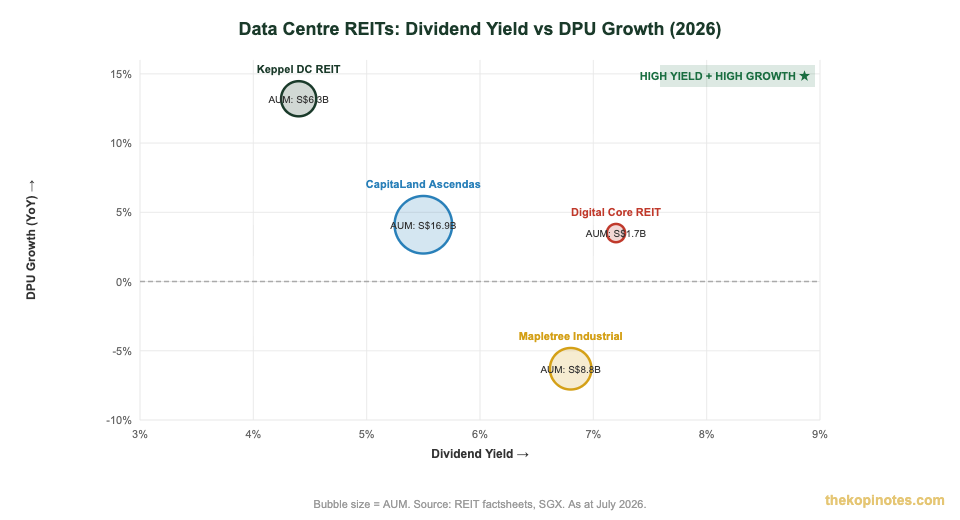
The headline number: DPU grew 13.2% year-on-year in Q1 2026 to 2.833 Singapore cents. That is exceptional growth for a REIT. It was driven by contributions from Tokyo Data Centre 3 and full ownership of Keppel DC Singapore 3 and 4.
Keppel DC REIT is actively pivoting towards hyperscale and AI inference workloads. Its tenant base includes some of the world’s largest cloud providers, locked in on long-term master leases. Occupancy sits at 98%.
OCBC Investment Research has a fair value estimate of SGD 2.78, implying 23% upside from the S$2.27 unit price as at June 2026. However, at a 4.4% yield, this is a growth REIT — you buy it for DPU trajectory, not current income.
Digital Core REIT: The High-Yield Contrarian Pick
Digital Core REIT (SGX: DCRU) offers the highest dividend yield among the four at 7.2%, based on its FY2025 DPU of US$0.036. It is sponsored by Digital Realty, the world’s largest data centre REIT by market cap.
The portfolio comprises 11 data centres with US$1.7 billion in AUM, primarily in the US, with assets in Canada, Germany, and Japan. All assets are 100% freehold with a 98% occupancy rate.
Digital Core REIT’s strategy is shifting. It is targeting S$500–600 million in North American divestitures while pivoting capital towards Asia Pacific — Singapore and Japan in particular. It recently acquired a 20% interest in a data centre on its sponsor’s Osaka campus.
The key risk is concentration. The REIT has a smaller portfolio than Keppel DC REIT, and its income is USD-denominated. A strong Singapore dollar reduces the value of translated distributions. Pro forma DPU accretion of 3–4% is expected, with double-digit DPU growth projected for 2027 from the Linton Hall lease-up.
MIT and CLAR: The Diversified Data Centre Plays
Mapletree Industrial Trust (MIT) offers a 6.8% yield and blends data centre exposure (~40% of portfolio) with traditional industrial properties. It reported FY2026 DPU of 12.71 Singapore cents, down 6.3% YoY due to North American divestments and FX headwinds. However, its Singapore industrial portfolio remains strong with positive rental reversions.
MIT is the pick for investors who want data centre upside without going all-in on the sector. The industrial backbone provides income stability.
CapitaLand Ascendas REIT (CLAR) is Singapore’s largest REIT by AUM at S$16.9 billion. Data centres represent about 13% of its portfolio — and growing. It recently completed S$1.4 billion in acquisitions including a hyperscale data centre in Japan, pushing its pro forma DPU accretion to 4.1%.
CLAR is the most diversified option. You get data centre exposure alongside logistics (27% of AUM), business space, and science parks. OCBC’s fair value estimate is SGD 3.28. If you want to build a passive income portfolio in Singapore, CLAR is a solid anchor holding.
Risks and What Could Go Wrong
Data centre REITs are not risk-free. Here are the key risks to consider before investing.
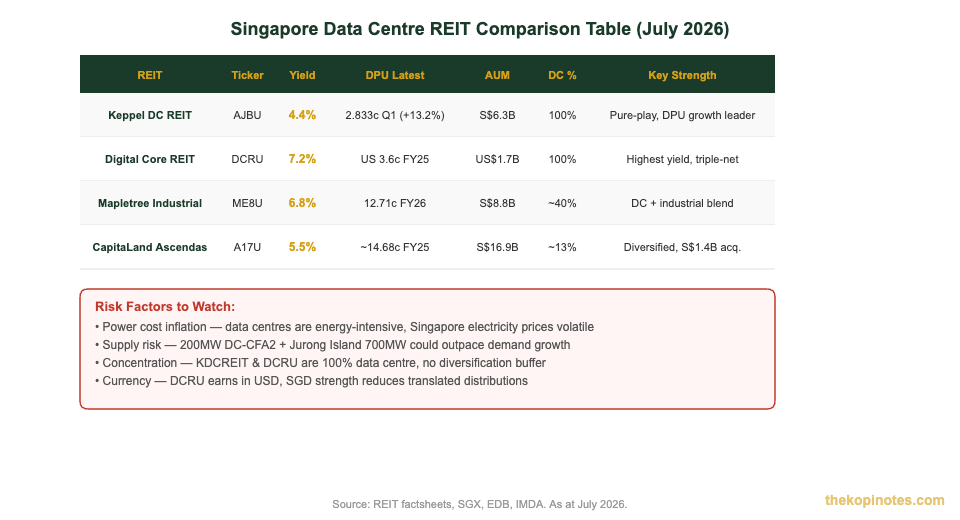
Power cost inflation. Data centres are energy-hungry. Singapore’s electricity prices can be volatile, and while long-term contracts help, rising energy costs can squeeze margins — especially for older, less efficient facilities.
Supply overshooting demand. Singapore’s DC-CFA2 is allocating 200MW, and the Jurong Island park could add up to 700MW. Across the region, Malaysia (Johor), Indonesia, and Thailand are aggressively building data centre capacity. If supply growth outpaces demand, rental growth could slow.
Concentration risk. Keppel DC REIT and Digital Core REIT are 100% data centre. If the sector faces a downturn — say, a pullback in hyperscaler capex or a shift in AI infrastructure needs — there is no diversification buffer.
Currency risk. Digital Core REIT earns in USD. MIT and CLAR have significant overseas income. A strengthening SGD reduces translated distributions.
Technology obsolescence. Data centres require constant upgrades. Older facilities may struggle to compete with purpose-built green data centres that meet the latest efficiency standards. Investors should favour REITs with newer portfolios or active asset enhancement programmes.
How to Invest in Data Centre REITs
All four REITs are listed on SGX and can be bought through any Singapore brokerage account. Here is how to get started.
Step 1: Open a brokerage account. You will need a CDP-linked brokerage account. Popular options include Interactive Brokers, moomoo Singapore, Tiger Brokers, and Saxo Markets.
Step 2: Fund your account. Transfer SGD from your bank. Most brokers offer free or low-cost SGD transfers.
Step 3: Search for the REIT. Use the ticker codes: AJBU (Keppel DC), DCRU (Digital Core), ME8U (MIT), or A17U (CLAR).
Step 4: Place your order. Buy at market price or set a limit order. Minimum lot size is 100 units on SGX.
If you prefer a managed approach, platforms like Syfe offer REIT-focused portfolios that include data centre exposure. You can also check out the Singapore REIT ETF guide for index-based options.
Use our retirement calculator to model how data centre REIT income compounds alongside your CPF savings over time.
Data verified as at July 2026. Past performance is not indicative of future results. Always do your own due diligence before investing.
Frequently Asked Questions
What are the best data centre REITs in Singapore?
The four SGX-listed REITs with data centre exposure are Keppel DC REIT (100% DC, 4.4% yield), Digital Core REIT (100% DC, 7.2% yield), Mapletree Industrial Trust (~40% DC, 6.8% yield), and CapitaLand Ascendas REIT (~13% DC, 5.5% yield). Keppel DC REIT is the largest pure-play option with the strongest DPU growth, while Digital Core REIT offers the highest yield.
How does the AI boom benefit data centre REITs?
AI models require massive computing power housed in data centres. As companies like Google, Microsoft, AWS, and Meta expand their AI capabilities, they need more data centre space. This drives up demand for colocation and hyperscale facilities, supports higher rental rates, and enables long-term master leases with creditworthy tenants. The global data centre REIT market is forecast to grow at 13.95% CAGR through 2031.
Is Keppel DC REIT overvalued at a 4.4% yield?
Keppel DC REIT trades at a lower yield than other S-REITs because the market prices in its superior DPU growth — 13.2% YoY in Q1 2026. OCBC’s fair value is SGD 2.78, implying 23% upside from its June 2026 price of S$2.27. Whether it is overvalued depends on your investment objective. For income-first investors seeking 6%+ yield, other options may be better. For total return investors willing to accept lower current income for growth, it could still be attractive.
What is Singapore's data centre moratorium and DC-CFA2?
Singapore banned new data centre construction from 2019 to 2022 due to concerns about energy consumption — data centres already used 7% of Singapore’s total electricity. The moratorium was lifted in phases, and the Data Centre Call for Application 2 (DC-CFA2) announced in December 2025 allocates at least 200MW of new capacity to operators that meet strict sustainability requirements. Jurong Island also has land set aside for up to 700MW of low-carbon data centre capacity.
Can I buy data centre REITs using CPF or SRS?
Yes, you can buy SGX-listed REITs including Keppel DC REIT, Digital Core REIT, MIT, and CLAR using your CPF Investment Scheme (CPFIS) Ordinary Account or Supplementary Retirement Scheme (SRS) funds, provided you use an eligible brokerage and the REIT is on the CPFIS approved list. Check with your broker for the latest approved list, as it may change.
What is the biggest risk with data centre REITs?
The biggest risk is supply outpacing demand. Singapore, Malaysia (Johor), Indonesia, and Thailand are all building data centre capacity aggressively. If hyperscaler capex slows or AI infrastructure needs shift, occupancy and rental growth could weaken. Power cost inflation is a secondary risk, as data centres are energy-intensive and Singapore electricity prices can be volatile.
Should I invest in pure-play or diversified data centre REITs?
Pure-play REITs (Keppel DC, Digital Core) offer maximum exposure to the data centre theme but carry concentration risk. Diversified REITs (MIT, CLAR) give you data centre upside alongside industrial, logistics, and other asset classes — reducing sector-specific risk. For most income investors, a diversified approach combining one pure-play and one diversified DC REIT provides the best balance of growth and stability.
How do data centre REIT lease structures work?
Data centre leases typically fall into two categories. Master leases are long-term agreements (often 10–20 years) where a single tenant leases an entire facility. Triple-net leases require the tenant to cover property taxes, insurance, and maintenance, providing predictable income for the landlord. Keppel DC REIT primarily uses master leases, while Digital Core REIT uses triple-net structures. Both benefit from long lease tenors and creditworthy hyperscaler tenants.
Start Investing in Data Centre REITs
Open a brokerage account and start building your data centre REIT portfolio.
This article was researched with the help of AI. While we strive to keep all information accurate and up to date, there may be errors. If you notice any discrepancies, please contact us.