S-REIT H2 2026 Outlook: The K-Shaped Recovery and Where to Position
$925M in retail inflows, sector yields from 4.8% to 8.5%, and a market that rewards stock-picking over index-buying.
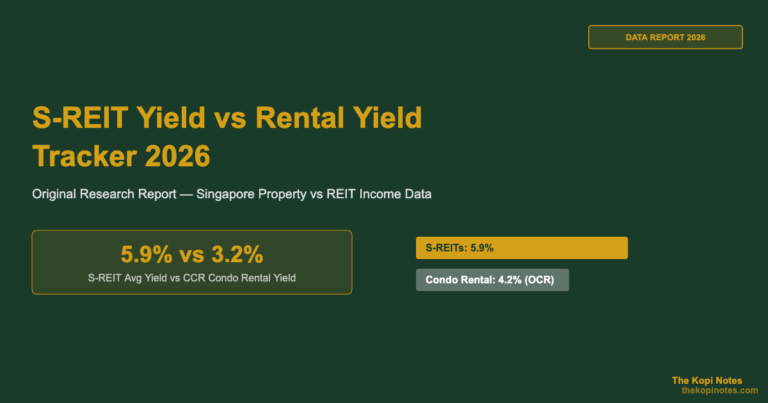
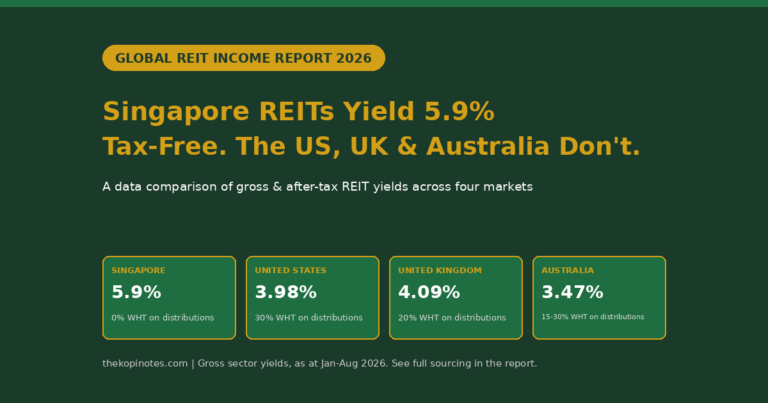
Singapore REITs are in the middle of a K-shaped recovery heading into H2 2026. Data centre and industrial REITs are delivering double-digit total returns, while office and hospitality names continue to lag. Retail investors have poured $925 million into S-REITs through May 2026 — nearly double the pace of 2025. The average S-REIT dividend yield sits at 5.9%, but smart positioning across the right sectors can push your income yield well above 7%.
This is an editorial analysis. Not financial advice. All figures are for educational reference only. Data verified as at July 2026 unless noted.
- Data centre and industrial S-REITs are the clear winners — Keppel DC REIT’s DPU rose 13.2% YoY in Q1 2026
- Office and hospitality REITs are dragging the index down with negative total returns YTD
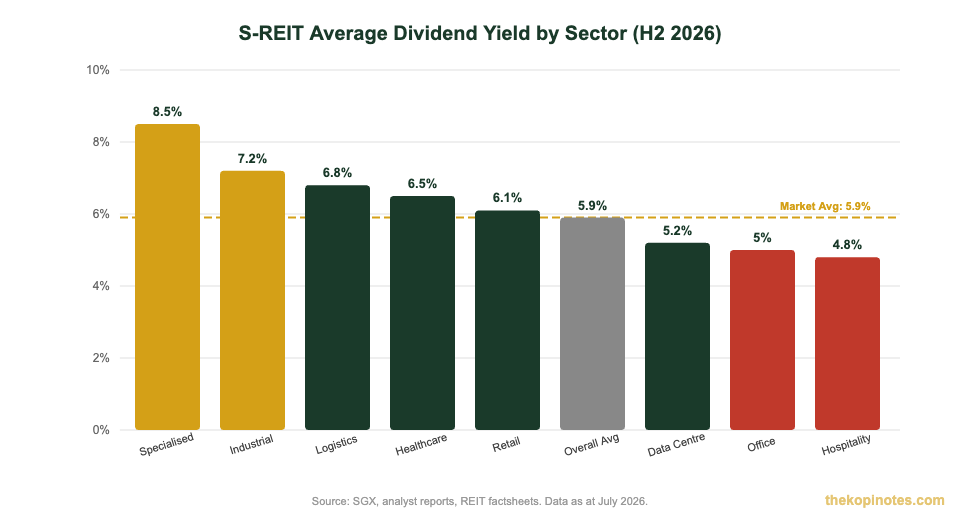
- Average S-REIT yield is 5.9%, but industrial and specialised names offer 7–9% — stock-picking matters more than ever
Table of Contents
The K-Shaped Recovery Explained
If you have been watching the S-REIT market in 2026, you have probably noticed something unusual. Some REITs are flying, while others keep sliding. That is the K-shaped recovery in action.
Here is what is happening. Industrial, data centre, and logistics REITs are riding structural demand from AI infrastructure buildouts, e-commerce growth, and supply chain reshoring. Their rental reversions are running at high single-to-double-digit percentages. Occupancy rates remain tight. Distribution Per Unit (DPU) — the cash each REIT unit pays you — is growing quarter after quarter.
On the other hand, office and hospitality REITs are battling headwinds. Office occupancy has not fully recovered post-COVID, with flexible work arrangements reducing space demand. Hospitality REITs face declining visitor arrivals — down 8.1% year-on-year in January 2026, according to the Singapore Tourism Board. Revenue per available room (RevPAR) slipped 0.4% in 2025.
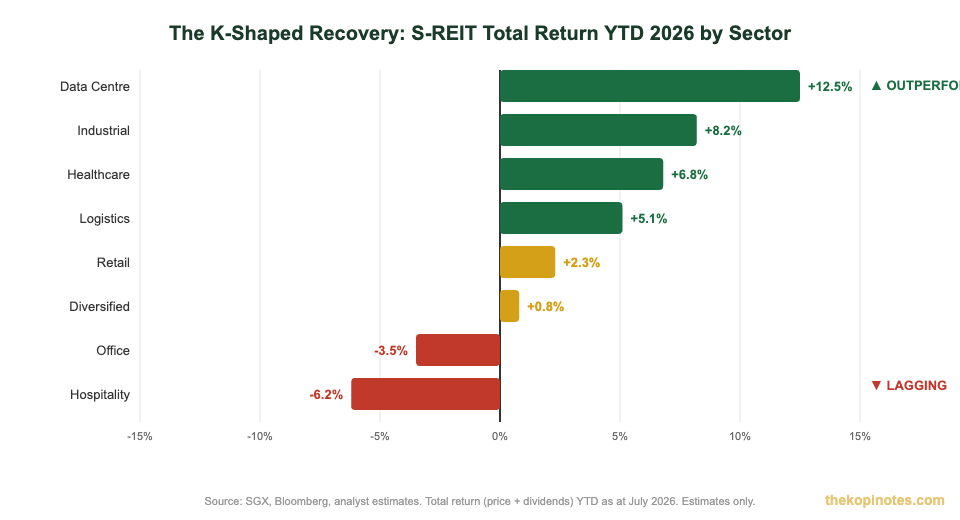
The result is a market where the iEdge S-REIT Index tells you very little about what individual sectors are actually doing. If you bought the index, your total return YTD sits around +1 to +2%. But if you picked the right industrial or data centre REITs, you could be sitting on +8 to +12% total returns.
That is a massive spread. And it means stock-picking — or at least sector-picking — matters far more in H2 2026 than simply buying a REIT ETF and forgetting about it. For a broader overview of the REIT landscape, see our guide to the best S-REITs in Singapore 2026.
Sector-by-Sector Breakdown
Let us walk through each S-REIT sub-sector and how it is performing as we enter H2 2026.
| Sector | Avg Yield | YTD Total Return (Est.) | Rental Reversion | Outlook |
|---|---|---|---|---|
| Data Centre | 4.4–8.2% | +12.5% | +10–15% | Strong |
| Industrial | 6.5–7.5% | +8.2% | +5–10% | Strong |
| Healthcare | ~6.5% | +6.8% | Stable | Defensive |
| Logistics | ~6.8% | +5.1% | +3–7% | Positive |
| Retail | ~6.1% | +2.3% | +3–5% | Stable |
| Diversified | ~5.5% | +0.8% | Mixed | Neutral |
| Office | ~5.0% | -3.5% | Flat to -2% | Weak |
| Hospitality | ~4.8% | -6.2% | N/A (RevPAR-driven) | Cyclical risk |
Source: SGX, OCBC Investment Research, DBS Equity Research, REIT factsheets. Estimates as at July 2026.
Industrial REITs are the sweet spot for most income investors. They combine high yields (6.5–7.5%) with solid DPU growth driven by tight supply conditions and positive rental reversions. Names like AIMS APAC REIT and Mapletree Industrial Trust sit in this camp.
Retail REITs are more defensive than most people expect. OCBC Research rates the retail sub-sector as the most defensive after healthcare, supported by healthy occupancy costs and a high proportion of base rents within total gross rental income. However, total returns have been modest.
Office REITs continue to struggle. New supply is coming online while demand stays soft. If you are building a passive income portfolio in Singapore, this is the sector to underweight.
Hospitality REITs are the most cyclical sub-sector. OCBC warns that weakening consumer sentiment and exceptional Singapore dollar strength are key headwinds for hospitality S-REITs. Visitor arrivals from China — a critical tourism segment — fell 27.8% YoY in January 2026.
Data Centre REITs: The Star Performers
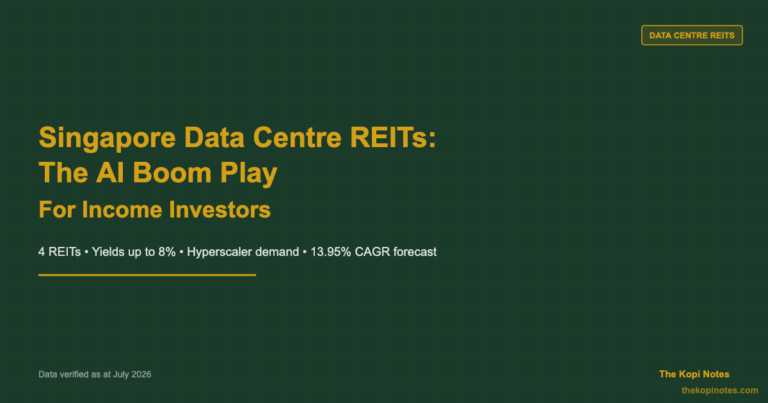
Data centre REITs are the undisputed stars of the S-REIT universe right now. The global data centre REIT market is forecast to grow at a 13.95% compound annual growth rate (CAGR) through 2031, driven by the explosion in AI workloads, cloud computing demand, and hyperscaler expansion across Asia Pacific.
Singapore is a key beneficiary. The government’s decision to lift the data centre moratorium and release new capacity has attracted billions in investment from hyperscalers like Google, Microsoft, and Amazon Web Services. For S-REITs with data centre exposure, this translates to strong tenant demand, long lease terms, and rising rents.
Here are the four key data centre-exposed S-REITs you should know:
| REIT | Ticker | Yield | DPU (Latest) | DC Exposure | Key Metric |
|---|---|---|---|---|---|
| Keppel DC REIT | AJBU | 4.4% | 2.833c (Q1 FY26, +13.2% YoY) | 100% | Pure-play DC, OCBC TP $2.78 |
| Digital Core REIT | DCRU | 8.2% | ~2.5c USD (annualised) | 100% | Highest yield pure-play DC |
| Mapletree Industrial Trust | ME8U | 6.8% | 12.71c (FY26) | ~40% | DC + industrial blend |
| CapitaLand Ascendas REIT | A17U | 5.5% | ~14.68c (FY25, pro forma ~15.6c) | ~13% | S$1.4B acquisitions inc. Japan DC |
Source: Keppel DC REIT FY2025 results, MIT FY26 results, CLAR 1Q 2026 business update, SGX data. As at July 2026.
Keppel DC REIT stands out with its 13.2% YoY DPU growth in Q1 2026, boosted by contributions from Tokyo Data Centre 3. However, its yield at 4.4% is the lowest of the four because the market has already priced in its growth premium.
Digital Core REIT offers the highest yield at 8.2%, but it carries concentration risk with its North American portfolio and is still executing a pivot towards Asia Pacific. For income investors who want the highest payout, it is worth considering, but size your position carefully.
CapitaLand Ascendas REIT (CLAR) is the diversified play. It recently completed S$1.4 billion in acquisitions, including a hyperscale data centre in Japan, pushing its data centre exposure to 13% of assets under management (AUM). OCBC has a fair value estimate of SGD 3.28 on CLAR — well above its current trading price around SGD 2.55–2.70.
Top S-REIT Picks by Sector for H2 2026
Based on analyst recommendations, DPU trends, and the macro backdrop, here are the top S-REIT picks by sector going into H2 2026. Remember — this is not financial advice, but a summary of market consensus and publicly available data.
| Sector | Top Pick | Yield | Why |
|---|---|---|---|
| Data Centre | Keppel DC REIT | 4.4% | DPU growth leader, OCBC TP $2.78 |
| Industrial | Mapletree Industrial Trust | 6.8% | DC pivot + industrial backbone, strong yield |
| Diversified | CapitaLand Ascendas REIT | 5.5% | S$1.4B acquisitions, DPU accretion 4.1% |
| Healthcare | Parkway Life REIT | ~3.5% | Defensive, long WALE, OCBC TP $4.83 |
| Retail | Frasers Centrepoint Trust | ~5.5% | Suburban retail focus, resilient shopper traffic |
| High Yield | Digital Core REIT | 8.2% | Highest yield DC play, but higher risk |
Source: OCBC Investment Research, DBS Equity Research, SGX factsheets. As at July 2026.
If you want to use a Singapore retirement calculator to model how these REIT yields compound over time, the difference between a 5.5% and 7.5% yield portfolio is staggering over a 20-year horizon.
Retail Investor Flows: $925M and Counting
Here is a number that should make you pay attention: retail investors poured $925 million into S-REITs through May 2026. That is nearly double the pace of accumulated retail buying throughout all of 2025, according to Singapore Wall Street.
However, there is a catch. The 10 most heavily purchased S-REITs by retail investors declined roughly 8% on average on a total return basis. Meanwhile, the most net-sold REITs declined only around 4%. In other words, retail investors have been buying the dip aggressively — but in many cases, they are catching falling knives in the underperforming office and hospitality segments.
The lesson here is not to avoid S-REITs. It is to be selective. The $925 million in inflows signals genuine retail appetite for REIT income, especially as Singapore fixed deposit rates drift lower from their 2023–2024 peaks. But the money needs to flow into the right sectors.
For investors looking to access S-REITs through a managed approach, platforms like Syfe offer REIT-focused portfolios, while Endowus provides access to REIT-focused unit trusts through CPF and SRS.
What This Means for Your Portfolio
So how should you position your S-REIT allocation for H2 2026? Here is a framework based on the data.
If you are an income-focused investor looking for yields above 6%, overweight industrial REITs. Names like Mapletree Industrial Trust (6.8% yield) and AIMS APAC REIT (6.9% yield) offer the best balance of yield and DPU sustainability. Digital Core REIT’s 8.2% yield is attractive but comes with higher risk.
If you are a growth-focused investor willing to accept a lower yield for capital appreciation, data centre REITs are the play. Keppel DC REIT’s 4.4% yield understates its total return potential — its DPU is growing at double digits. CapitaLand Ascendas REIT offers a middle ground with its 5.5% yield and data centre expansion pipeline.
If you want defensive positioning, stick with healthcare (Parkway Life REIT) and suburban retail (Frasers Centrepoint Trust). These sectors are less sensitive to economic cycles and provide steady, predictable income.
What to avoid or underweight: Office REITs facing supply headwinds and hospitality REITs exposed to tourism volatility. These sectors may eventually recover, but H2 2026 is not the turning point.
You can check our Singapore REIT ETF guide if you prefer a broader index approach — just be aware that index exposure includes the lagging sectors too.
Risks to Watch in H2 2026
No outlook is complete without acknowledging the risks. Here are the ones that could derail the S-REIT recovery in H2 2026:
Interest rates staying higher for longer. S-REITs are rolling over cheap fixed-rate debt (locked in at ~1.5% years ago) into today’s 3.5% baseline. Even when rental revenue grows, higher interest costs can eat into DPU. This is the single biggest headwind for the sector.
Singapore dollar strength. For REITs with significant overseas assets — especially in USD-denominated markets — a strong SGD reduces the value of foreign income when translated back. This particularly affects logistics and data centre REITs with North American exposure.
Data centre oversupply risk. While demand is booming today, several new data centre projects are coming online across Southeast Asia. If capacity growth outpaces demand from hyperscalers, rental growth could slow.
Global recession risk. Trade tensions, geopolitical uncertainty, and slowing global growth could hit corporate demand for commercial real estate. Hospitality and office REITs are most vulnerable here.
Regulatory changes. Any changes to Singapore’s REIT tax framework or CPF investment scheme (CPFIS) rules could affect investor flows and valuations. Keep an eye on CPF Board announcements.
Data verified as at July 2026. Past performance is not indicative of future results. Always do your own due diligence before investing.
Frequently Asked Questions
What is the average S-REIT dividend yield in H2 2026?
The market-cap-weighted average S-REIT dividend yield is approximately 5.9% as at July 2026. However, yields vary significantly by sector — from around 4.4% for premium data centre REITs like Keppel DC REIT, to 7–9% for industrial and specialised REITs. The equal-weighted average across all SGX-listed REITs is closer to 6.8–7.0%.
What is the K-shaped recovery in Singapore REITs?
The K-shaped recovery refers to the divergence in performance across S-REIT sectors. Data centre and industrial REITs are delivering strong total returns (up 8–12% YTD), while office and hospitality REITs are posting negative returns (down 3–6% YTD). This means the overall index performance masks significant sector-level differences.
Which S-REIT sector has the best outlook for H2 2026?
Industrial and data centre REITs have the strongest outlook, driven by AI infrastructure demand, e-commerce logistics growth, and tight supply conditions. Rental reversions in these sectors are running at high single-to-double-digit percentages. Healthcare REITs also offer a defensive option with stable income.
Why are retail investors pouring money into S-REITs in 2026?
Retail investors have invested $925 million into S-REITs through May 2026, nearly double the 2025 pace. The primary driver is the attractive 5.9% average yield at a time when Singapore fixed deposit rates are declining from their 2023–2024 peaks. REITs offer higher regular income compared to savings accounts and T-bills. However, retail buying has been concentrated in underperforming sectors, suggesting some investors are buying the dip aggressively.
Is Keppel DC REIT a good buy in 2026?
Keppel DC REIT delivered 13.2% DPU growth year-on-year in Q1 2026, making it the DPU growth leader among S-REITs. OCBC Investment Research has a fair value estimate of SGD 2.78. However, at a 4.4% yield, the market has already priced in much of the growth. It may be a better fit for investors seeking capital appreciation rather than high current income. This is not a buy or sell recommendation — do your own research.
Should I avoid office REITs in Singapore?
Office REITs are the weakest sub-sector in H2 2026, with negative YTD total returns and flat-to-negative rental reversions. New supply is coming online while hybrid work arrangements reduce space demand. However, “avoid” depends on your investment horizon. If you believe in a multi-year office demand recovery, current prices could represent value. For most income investors focused on H2 2026, underweighting office REITs in favour of industrial and data centre names makes more sense.
How do data centre REITs benefit from the AI boom?
AI models require massive computing power housed in data centres. As companies like Google, Microsoft, and Amazon expand their AI capabilities, they need more data centre capacity in strategic locations like Singapore. This drives up demand for data centre space, supports higher rents, and enables long-term master leases with creditworthy hyperscaler tenants. The global data centre REIT market is forecast to grow at 13.95% CAGR through 2031.
What is the biggest risk for S-REITs in H2 2026?
The biggest risk is interest rates staying higher for longer. S-REITs are currently rolling over old fixed-rate debt (locked in at around 1.5% years ago) into today’s higher 3.5% baseline. Even when rental revenue grows, the increased interest costs can reduce the cash available for distributions. A strong Singapore dollar is a secondary risk for REITs with significant overseas income, as it reduces the value of foreign distributions when converted back to SGD.
Build Your S-REIT Portfolio
Use our tools and referral links to start investing in Singapore REITs with exclusive sign-up bonuses.
This article was researched with the help of AI. While we strive to keep all information accurate and up to date, there may be errors. If you notice any discrepancies, please contact us.