Great Eastern Rider 2026: GREAT TotalCare 2 vs GREAT TotalCare 2 Prime Explained
Premiums, deductible coverage, co-payment caps, and whether you should switch from your old GREAT TotalCare rider.
GREAT TotalCare 2 (GTC2) is Great Eastern’s supplementary rider for GREAT SupremeHealth, launched 1 April 2026 to meet MOH’s new rider rules. GTC2 P and GTC2 A/B no longer cover your deductible and are 5% co-insurance, cash-only. GTC2 Prime, paired with the new P Prime tier, still covers most of the deductible if you use Great Eastern’s panel providers, at a lower premium than GTC2 P.
Not financial advice. All figures are for educational reference only. Data verified as at 20 August 2026 against Great Eastern’s official GREAT SupremeHealth and GREAT TotalCare 2 brochure (information correct as at 1 April 2026) unless otherwise noted.
- GREAT TotalCare 2 replaced the old GREAT TotalCare rider from 1 April 2026. It no longer covers your deductible, but premiums are noticeably lower.
- GTC2 Prime is the cheaper option — it’s paired with the new P Prime plan, which limits you to Great Eastern’s panel doctors at four private hospitals, but still helps with the deductible there.
- Whichever rider you pick, it’s cash-only. MediSave cannot pay for GTC2 premiums.
Table of Contents
Contents — Click to expand
- What Is GREAT TotalCare 2?
- The GREAT TotalCare 2 Family at a Glance
- GTC2 P vs GTC2 Prime: The Key Difference
- Premium Comparison by Tier (2026)
- Real Cost Example: How Much You Actually Save
- Cancer Cover and Other Enhanced Benefits
- Should You Switch From Your Old GREAT TotalCare Rider?
- Who Should Buy GTC2 vs GTC2 Prime?
- Frequently Asked Questions
What Is GREAT TotalCare 2?
Your GREAT SupremeHealth (GSH) plan is a MediSave-approved Integrated Shield Plan (IP). It pays the bulk of your hospital bill at Restructured or Private Hospitals. But it doesn’t pay everything. You still owe a deductible upfront, plus 10% co-insurance on what’s left. That’s where a rider comes in.
GREAT TotalCare 2 (GTC2) is Great Eastern’s current rider, sold alongside GSH since 1 April 2026. It’s not a standalone plan — you can only buy it if you already hold the matching GSH tier. Its job is simple: shrink the gap between what GSH pays and what you owe out of pocket.
GTC2 replaced the older GREAT TotalCare (GTC) rider family, including GTC P Signature, GTC A, and GTC B. If you bought one of those before 1 April 2026, you keep your existing terms for now — you’re not automatically moved onto GTC2. More on that switch decision later in this guide.
For the base GSH plan itself — ward tiers, hospital access, and premium tables — see our complete guide to the Great Eastern Shield Plan.
The GREAT TotalCare 2 Family at a Glance
GTC2 isn’t one product — it’s four variants, each attached to a specific GSH tier. Here’s how they line up.
| Rider | Attaches To | Deductible Covered? | Co-Insurance You Pay | Co-Payment Cap | Rider Benefit Limit |
|---|---|---|---|---|---|
| GTC2 P | GSH P Plus | Not covered | 5% | S$6,000/yr | S$400,000 |
| GTC2 Prime | GSH P Prime | Excess above S$3,500 at panel providers | 5% (panel/restructured only) | S$6,000/yr | S$400,000 |
| GTC2 A | GSH A Plus | Not covered | 5% | S$6,000/yr | S$200,000 |
| GTC2 B | GSH B Plus | Not covered | 5% | S$6,000/yr | S$150,000 |
Source: Great Eastern GREAT SupremeHealth & GREAT TotalCare 2 brochure, information correct as at 1 April 2026.
Notice the pattern: three of the four riders (P, A, B) follow MOH’s April 2026 template exactly — no deductible cover, half your co-insurance shaved off (10% down to 5%), and a S$6,000 annual co-payment cap. Only GTC2 Prime breaks that pattern, and it does so by trading away hospital choice for a lower deductible. That trade-off is worth unpacking on its own.
GTC2 P vs GTC2 Prime: The Key Difference
GTC2 P attaches to GSH P Plus, which gives you access to every private hospital in Singapore and every private panel specialist. GTC2 Prime attaches to GSH P Prime, a narrower plan limited to Great Eastern’s four Partnering Medical Institutions (PMIs): Mount Alvernia Hospital, Farrer Park Hospital, Raffles Hospital, and Thomson Medical Centre.
Here’s why that narrower access matters for your wallet. GTC2 P doesn’t touch your deductible at all — you always pay the first S$3,500 yourself. GTC2 Prime is different: if you’re treated by a panel provider at one of those four PMIs, it covers any deductible above S$3,500 (the base deductible for P Prime is S$5,000, so GTC2 Prime effectively brings your out-of-pocket deductible back down to S$3,500 too — but only within the panel).
Step outside the panel with a P Prime plan — say, to Mount Elizabeth or Gleneagles — and GTC2 Prime’s co-insurance benefit doesn’t apply. You’d be paying full co-insurance yourself, on top of a higher base deductible. GTC2 Prime rewards you for staying within the network; GTC2 P doesn’t care where you go, but never softens your deductible.
Premium Comparison by Tier (2026)
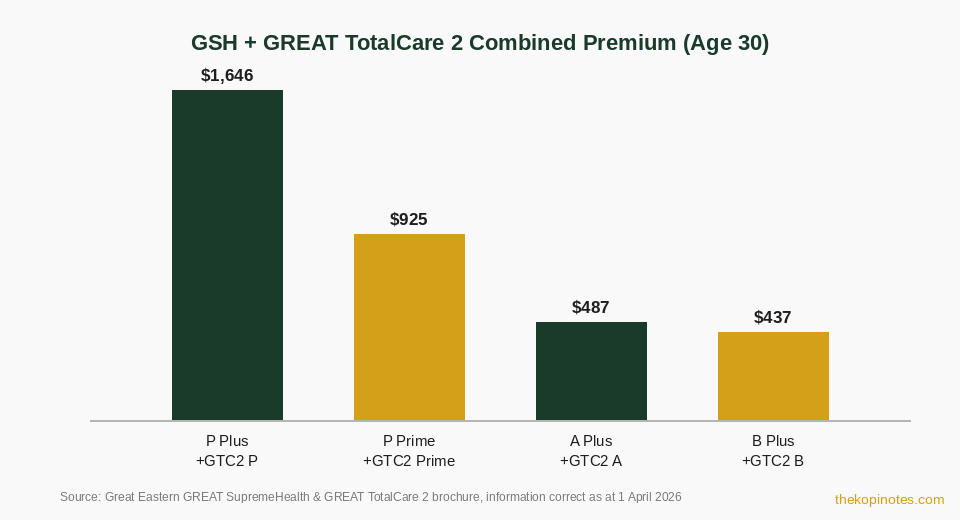
Great Eastern publishes illustrative combined premiums (GSH plus the matching GTC2 rider) for a Life Assured aged 30 next birthday. These figures include GST and, for the GSH portion, your MediShield Life premium.
| Plan Combo | GSH Premium | GTC2 Premium | Total (Age 30) |
|---|---|---|---|
| P Plus + GTC2 P | S$751.71 | S$893.80 | S$1,645.51 |
| P Prime + GTC2 Prime | S$550.06 | S$374.96 | S$925.02 |
| A Plus + GTC2 A | S$398.55 | S$88.29 | S$486.84 |
| B Plus + GTC2 B | S$372.39 | S$64.31 | S$436.70 |
Source: Great Eastern GREAT SupremeHealth premium illustration, Life Assured aged 30 next birthday, as at 1 April 2026.
At age 40, Great Eastern’s own “right-size your policy” tool quotes annual premiums (rider included, MediShield Life excluded) of roughly S$1,715 for P Plus + GTC2 P and S$848 for P Prime + GTC2 Prime — projected to a lifetime cost from age 40 to 80 of about S$358,823 and S$194,635 respectively. That’s nearly S$164,000 less over four decades for choosing the panel-restricted Prime option. If you’re comfortable being treated at Mount Alvernia, Farrer Park, Raffles Hospital, or Thomson Medical Centre, that’s a substantial saving to weigh against the loss of full private hospital choice.
For how these numbers fit into your CPF and cash budgeting, our guide to using MediSave for your Shield Plan premium breaks down exactly how much of your GSH premium MediSave can cover — note that GTC2, like all riders since 2021, is cash-only regardless of your age.
Real Cost Example: How Much You Actually Save
Numbers on a brochure only mean something once you attach them to an actual hospital bill. Great Eastern illustrates this with a S$150,000 eligible bill (their example: a heart condition requiring coronary artery bypass graft) for a policyholder aged 30 next birthday.
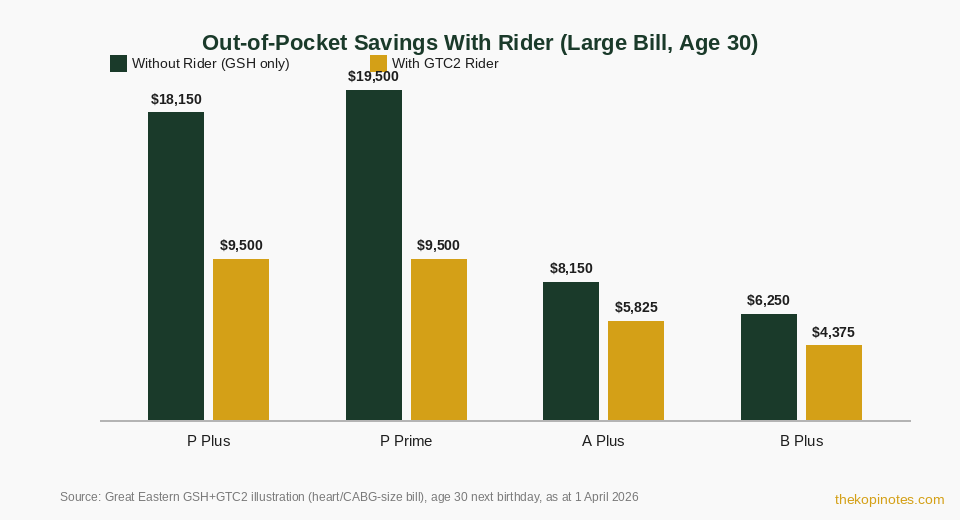
On GSH P Plus alone, that S$150,000 bill leaves you paying S$18,150 out of pocket — a S$3,500 deductible plus 10% co-insurance on the rest. Add GTC2 P, and your out-of-pocket cost drops to S$9,500. The rider itself doesn’t touch the deductible, but it halves your co-insurance and caps your total co-payment at S$6,000, so the savings still add up to S$8,650 on this single claim.
On GSH P Prime alone, the same-size bill costs you S$19,500 (a S$5,000 deductible, since you’re outside the S$3,500 panel-provider band, plus 10% co-insurance). Add GTC2 Prime, and if you stayed within the PMI panel, your out-of-pocket cost falls to S$9,500 too — a S$10,000 saving, the largest of any combination in Great Eastern’s illustration.
The takeaway: for a genuinely large bill, GTC2 Prime can save you more in absolute dollars than GTC2 P, precisely because P Prime’s base deductible starts higher and the rider claws more of it back — provided you stick to the panel.
Cancer Cover and Other Enhanced Benefits
Beyond deductible and co-insurance relief, every GTC2 variant adds a set of “special benefits” on top of your base GSH plan. The headline one is outpatient cancer drug treatment.
GSH alone covers outpatient cancer drugs on MOH’s Cancer Drug List (CDL) up to 5 times MediShield Life’s monthly claim limit for one primary cancer. Layer on GTC2, and that rises to 20 times the MediShield Life limit — a meaningful jump for anyone on an ongoing targeted therapy or immunotherapy regimen. For non-CDL cancer drug treatments, GTC2 P and Prime add up to S$200,000 of cover (subject to a 5% co-payment), while GTC2 A adds S$200,000 and GTC2 B adds S$150,000.
Other GTC2 additions include a Home Health Care Benefit of up to S$10,000 (S$6,000 for GTC2 B) for post-discharge nursing and rehabilitation, up to S$2,000 of post-stroke outpatient care support, and up to S$6,000 of post-hospital Traditional Chinese Medicine treatment within 180 days of discharge — all subject to a 5% co-payment. If you want worldwide treatment access on top of these, an optional GREAT TotalCare Plus 2 rider can be attached to any GTC2 plan, adding lifetime cover of up to S$5 million (P/Prime) or S$1–3 million (A/B) for non-emergency treatment overseas, plus emergency evacuation.
Should You Switch From Your Old GREAT TotalCare Rider?
If you’re still on the original GREAT TotalCare (GTC) rider — GTC P Signature, GTC A, or GTC B — nothing forces you onto GTC2 automatically. Your existing benefits continue as they are. But the older riders were priced and designed before MOH’s April 2026 rider reform, which means their premiums have been climbing to reflect the same rising claims that drove the reform in the first place.
If your GTC P Signature premium is starting to strain your budget, Great Eastern offers a specific downgrade path: converting to GTC P Optimum, a more affordable private hospital rider, within six months of your policy renewal date. Alternatively, you can switch to GTC2 at any time — but be clear-eyed about the trade-off. GTC2 is roughly 30% cheaper on average than the old-style riders it replaces, but in exchange it no longer covers your deductible (except GTC2 Prime, partially, within the panel). For a full breakdown of what the deductible actually costs you across ward classes, see our Integrated Shield Plan deductible guide for 2026.
In practice: if you claim rarely and want the lowest possible premium, GTC2 is the better deal. If you’ve had frequent hospitalisations and valued your old rider covering the deductible in full, run the numbers before switching — you may end up paying more out of pocket at claim time, even though your annual premium falls.
Who Should Buy GTC2 vs GTC2 Prime?
GTC2 P suits you if you want unrestricted access to any private hospital and any private panel specialist in Singapore, and you’re willing to pay a higher premium and a firm S$3,500 deductible for that flexibility.
GTC2 Prime suits you if you’re comfortable being treated at Mount Alvernia, Farrer Park, Raffles Hospital, or Thomson Medical Centre by a panel provider. In exchange, you get meaningfully lower premiums and partial deductible relief within that network.
GTC2 A or GTC2 B suit you if you’re comfortable with Restructured Hospital Class A or B1 wards rather than private care — these are the lowest-premium combinations and still come with the same 5% co-insurance and S$6,000 co-payment cap structure.
Whichever tier you’re leaning towards, compare it against the other six MOH-approved insurers before committing — see our Integrated Shield Plan comparison for 2026, and check how AIA’s equivalent rider stacks up in our AIA HealthShield Gold Max rider review. It’s also worth running your numbers through our insurance gap calculator to see whether your total coverage — Shield Plan, rider, and any standalone policies — actually matches your risk.
Disclaimer: This article is for educational purposes only and does not constitute financial, insurance, or medical advice. All premium and benefit figures are sourced from Great Eastern’s official GREAT SupremeHealth and GREAT TotalCare 2 product brochure and policy management pages, information correct as at 1 April 2026, and verified against those sources as at 20 August 2026. Premiums are not guaranteed and may be adjusted based on future experience. Always verify current rates and terms with Great Eastern or a licensed financial adviser before making a decision.
Frequently Asked Questions
What is GREAT TotalCare 2 and do I need it?
GREAT TotalCare 2 (GTC2) is Great Eastern’s supplementary rider for GREAT SupremeHealth, launched 1 April 2026. It reduces your co-insurance from 10% to 5% and caps your annual co-payment at S$6,000. You don’t strictly need it — GSH alone still gives you full Integrated Shield Plan coverage — but without a rider you bear the full deductible and 10% co-insurance yourself on every claim.
What is the difference between GREAT TotalCare 2 and GREAT TotalCare 2 Prime?
GTC2 P attaches to GSH P Plus and works at any private hospital in Singapore, but never covers your deductible. GTC2 Prime attaches to GSH P Prime and is restricted to Great Eastern’s four Partnering Medical Institutions (Mount Alvernia, Farrer Park, Raffles Hospital, Thomson Medical Centre) with a panel provider — but within that network, it covers your deductible above S$3,500 and costs roughly 42% less in premium at age 30.
Can I pay for GREAT TotalCare 2 using MediSave?
No. GREAT TotalCare 2 and the GREAT TotalCare Plus 2 worldwide rider are not MediSave-approved. Premiums must be paid fully in cash, regardless of your age. Only your GREAT SupremeHealth base plan premium (up to your Additional Withdrawal Limit) can draw on MediSave.
Should I switch from my old GREAT TotalCare rider to GREAT TotalCare 2?
Not automatically. If you hold an older GTC rider (like GTC P Signature), your existing terms continue unless you choose to switch. GTC2 is around 30% cheaper on average, but it no longer covers your deductible in full the way some older riders did. If you claim frequently, compare your expected out-of-pocket cost under both before switching — a lower premium doesn’t always mean lower total cost.
Does GREAT TotalCare 2 cover my deductible?
GTC2 P, GTC2 A, and GTC2 B do not cover your deductible at all — you pay it in full before co-insurance kicks in, in line with MOH’s April 2026 rider rules. GTC2 Prime is the exception: it covers any deductible above S$3,500 for treatment at Great Eastern’s Partnering Medical Institutions when seen by a panel provider.
Is GREAT TotalCare 2 Prime cheaper than GREAT TotalCare 2 P?
Yes. At age 30, the combined GSH P Prime plus GTC2 Prime premium is S$925.02 a year, versus S$1,645.51 for GSH P Plus plus GTC2 P — a difference of roughly 44%. The trade-off is that P Prime and GTC2 Prime restrict you to four Partnering Medical Institutions for full benefits, rather than any private hospital in Singapore.
Compare Your Shield Plan Options Before You Renew
See how Great Eastern stacks up against AIA, Prudential, NTUC Income, and Singlife, and check your total coverage gap.
Get Free Insurance Advice
Speak with a licensed insurance advisor. No obligation, no cost.
By submitting this form, you agree to our Privacy Policy.
This article was researched with the help of AI. While we strive to keep all information accurate and up to date, there may be errors. If you notice any discrepancies, please contact us.