AIA HealthShield Gold Max Rider 2026: AIA Max VitalHealth Pro Explained (Premiums, Benefits & Should You Switch)
AIA’s replacement rider under MOH’s April 2026 reform — what it covers, what you now pay in cash, and how it stacks up against NTUC and PRUShield’s new riders.
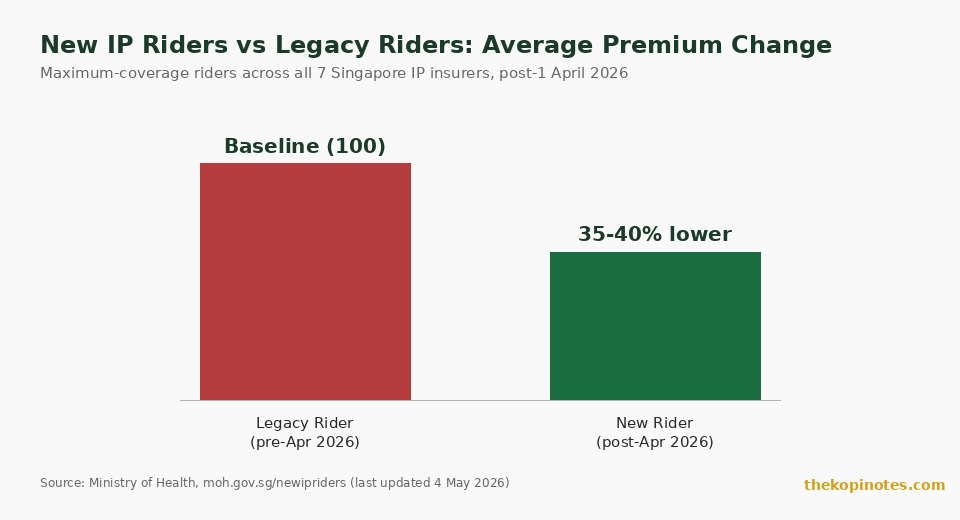
AIA Max VitalHealth Pro is AIA’s replacement rider for AIA HealthShield Gold Max, launched on 1 April 2026 to meet MOH’s new rider rules. It comes in three tiers — Pro A, Pro B and Pro B Lite — and no longer covers your policy’s minimum deductible. In exchange, the co-payment cap you’re protected by rises to at least S$6,000 a year, and premiums for the new riders are running 35-40% lower on average than the legacy riders they replaced.
Not financial advice. All figures are for educational reference only. Data verified as at 18 August 2026 against official MOH and AIA Singapore sources.
- AIA Max VitalHealth Pro (A / B / B Lite) replaced AIA Max VitalHealth on 1 April 2026 — the old rider can no longer be bought or upgraded.
- You now pay your ward-class deductible (S$1,500 to S$3,500) fully in cash before any rider kicks in — no rider can cover this anymore.
- If you bought your rider before 27 November 2025, you keep your current benefits until AIA notifies you of a change — you don’t have to switch today.
Table of Contents
Contents — Click to expand
What Is AIA Max VitalHealth Pro?
AIA Max VitalHealth Pro is the add-on rider that sits on top of your AIA HealthShield Gold Max plan. On its own, HealthShield Gold Max already pays for large chunks of a hospital bill. The rider’s job is to shrink what’s left — the deductible and co-insurance — down to a smaller, capped cash amount.
From 1 April 2026, AIA replaced its old Max VitalHealth, Max VitalCare and Max Essential C riders with a new “Pro” series: Max VitalHealth Pro A, Max VitalHealth Pro B and Max VitalHealth Pro B Lite. Existing VitalCare policyholders who want to move to the new structure can switch into any of these three, depending on the ward class they usually claim in.
You’ll still see co-insurance protection, a capped annual out-of-pocket amount, and — for Pro A only — some extra perks like early cancer screening. What you won’t see anymore is deductible coverage. That part has been removed industry-wide, not just at AIA.
Why AIA Changed Its Rider in 2026
This wasn’t AIA’s decision alone. On 26 November 2025, the Ministry of Health announced new design rules for every Integrated Shield Plan rider sold in Singapore, taking effect 1 April 2026. The goal, according to MOH, was to rein in over-consumption of private healthcare that generous old-style riders had encouraged — richer riders meant patients (and sometimes doctors) had less reason to keep costs down, and that pushed claims, and premiums, higher every year.
All seven IP insurers had to comply, including AIA, Great Eastern, Prudential, NTUC Income, Singlife, Raffles Health and HSBC Life. AIA’s answer was the Max VitalHealth Pro series. According to the Ministry of Health, average premiums for new maximum-coverage riders across the industry are running 35-40% lower than the legacy riders they replaced — the trade-off being that you now shoulder the deductible yourself.
MOH’s New Rider Rules at a Glance
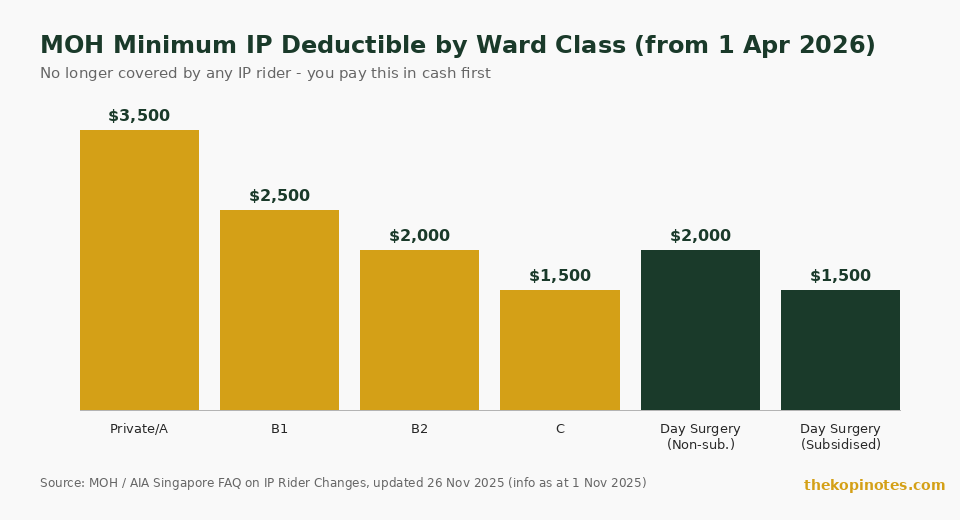
Two changes matter most. First, no rider sold from 1 April 2026 can cover the minimum IP deductible — the amount set by MOH that varies by the ward class you’re admitted to. Second, the minimum co-payment cap that protects you from runaway bills has doubled, from S$3,000 to S$6,000 a year, and that cap excludes the deductible.
| Ward Class / Setting | Minimum IP Deductible (per policy year) |
|---|---|
| Private hospital / A-class | S$3,500 |
| B1-class | S$2,500 |
| B2-class | S$2,000 |
| C-class | S$1,500 |
| Day surgery — non-subsidised | S$2,000 |
| Day surgery — subsidised | S$1,500 |
Source: AIA Singapore, FAQ on MOH Revisions to IP Riders (updated 26 November 2025, information correct as at 1 November 2025).
Say you’re warded in a private hospital under Plan A. From 1 April 2026, you pay the first S$3,500 of that bill yourself — no rider covers it. After that, co-insurance kicks in, and the most you’d pay on top (if you use AIA’s panel or get pre-authorised) is capped at S$6,000 a year. Under the old rules, some riders covered the deductible entirely, so your worst-case cash outlay could be lower — but you paid a much higher premium for that.
Pro A, Pro B and Pro B Lite Compared
AIA’s three new riders map onto the ward classes you typically claim in. All three share the same core mechanic: co-insurance coverage subject to the S$6,000 minimum co-payment cap. Pro A adds the most extras, because it’s built for policyholders who use private hospitals and want the fullest protection AIA currently offers under the new rules.
| Rider | Built For | Co-Payment Cap | Covers Deductible? | Extra Benefits |
|---|---|---|---|---|
| Max VitalHealth Pro A | Plan A / private hospital | S$6,000/yr min. | No | Early detection screening from age 40 (after 2 years in force); family accommodation; home nursing; add-ons Cancer Care Pro & Emergency Care Pro |
| Max VitalHealth Pro B | Plan B / public hospital | S$6,000/yr min. | No | Family accommodation; home nursing; post-hospitalisation TCM benefit |
| Max VitalHealth Pro B Lite | Plan B, lower budget | S$6,000/yr min. | No | Core co-insurance protection only, at a lower premium than Pro B |
Source: AIA Singapore, AIA HealthShield Gold Max product page (information correct as at 1 April 2026).
All three riders also come with an AIA Vitality perk: members who complete a Weekly Fitness Challenge within 100 days of the policy starting can earn back 3% of their first year’s premium in Vitality coins, rising to as much as 10% a year from year two if they keep their Vitality status up. That’s a genuine cash-back mechanic, not just a wellness gimmick — worth factoring in if you’re already an AIA Vitality member.
What You Still Pay in Cash
Here’s the part that catches people out: your rider premium buys you co-insurance protection, not deductible protection. For a Singaporean admitted to a private hospital under Plan A, that means the first S$3,500 of any hospital bill comes out of your own pocket (or your MediSave, subject to the Additional Withdrawal Limit) before your Max VitalHealth Pro A rider does anything at all.
After the deductible, co-insurance applies — typically a minimum of 5% of the remaining bill — and your rider caps your total co-payment exposure at S$6,000 a year if you stick to AIA’s preferred provider network or get pre-authorised. Go outside the panel without pre-authorisation, and you may not get the capped protection at all.
If you’re weighing whether the lower premium is worth the higher upfront deductible, it helps to run the numbers against your own claims history. Our Integrated Shield Plan deductible guide breaks down exactly how the deductible interacts with co-insurance across a full claim, with worked examples by ward class.
AIA’s New Rider vs Other Insurers
Every insurer had to redesign its riders under the same MOH framework, so the broad strokes look similar across the board: no deductible coverage, a S$6,000 minimum co-payment cap, and premiums that are meaningfully cheaper than the old riders. Where insurers differ is in the extras bundled on top and how they structure their tiers.
NTUC Income’s answer is its new Optima Care rider, sitting alongside a leaner Essential Care option. Prudential went with the PRUExtra Care series. AIA’s three-tier Pro A / Pro B / Pro B Lite structure gives you more granularity by ward class than a simple two-tier split, which can work in your favour if you only need public hospital coverage — Pro B Lite is priced for exactly that.
| Insurer | New Rider Series | Covers Deductible? | Min. Co-Payment Cap |
|---|---|---|---|
| AIA | Max VitalHealth Pro A / B / B Lite | No | S$6,000/yr |
| NTUC Income | Optima Care / Essential Care | No | S$6,000/yr |
| Prudential | PRUExtra Care series | No | S$6,000/yr |
Source: MOH IP rider requirements (moh.gov.sg/newipriders); insurer product pages, as at April 2026. All figures reflect MOH’s mandated minimum — insurers may offer a lower co-payment cap than S$6,000 at a higher premium.
For the full seven-insurer picture, our Shield Plan Comparison 2026 lines up every new rider side by side, and our Best Integrated Shield Plan Singapore 2026 guide ranks the base plans themselves.
Should You Switch to Max VitalHealth Pro?
Whether you need to act depends entirely on when you bought your current rider.
You don’t need to switch yet if you bought your AIA Max VitalHealth rider before 27 November 2025. AIA has said you’ll keep your existing benefits, and you’ll get at least 31 days’ notice by letter before anything changes. There’s no forced move to Max VitalHealth Pro on a fixed date for this group.
You’re on a transition timeline if you bought your rider between 27 November 2025 and 31 March 2026. Your policy will be updated to meet MOH’s new requirements no later than your first renewal after 1 April 2028 — so you have a runway, but the change is coming.
You have no choice if you’re a new applicant. The old Max VitalHealth riders were withdrawn on 1 April 2026 and can’t be bought or upgraded into anymore — Max VitalHealth Pro A, B or B Lite are now the only options on the table.
If you’re an existing policyholder deciding whether to voluntarily downgrade, weigh your actual claims history against the premium saving. Someone who rarely claims and mainly wants catastrophic protection may come out ahead paying the new, lower premium and self-insuring the deductible through MediSave or cash savings. Someone with a chronic condition and frequent admissions may prefer to keep their legacy rider’s fuller coverage for as long as AIA allows it.
How to Switch or Apply
If you want to move to Max VitalHealth Pro, or you’re a new applicant setting up AIA HealthShield Gold Max for the first time, you can apply through the AIA+ app, an AIA Financial Services Consultant, or directly via AIA’s website. You’ll need to select the ward class you intend to claim in — Plan A for private hospital, Plan B for public hospital — since that determines which Pro tier you’re eligible for.
MediSave cannot be used to pay the AIA Max VitalHealth Pro rider premium itself — riders are paid fully in cash, on top of whatever MediSave covers for your base HealthShield Gold Max plan. If you want the full breakdown of what MediSave can and can’t pay for under the new rules, see our guide on using MediSave for Integrated Shield Plan premiums.
Before switching, it’s worth reading the product summary in full and, if you have pre-existing conditions, checking whether a new underwriting review could affect your coverage. MOH’s own Health Insurance Planner is a useful independent check on how much you’re currently paying versus what you actually need.
Not financial advice. Premiums are not guaranteed and may be revised by AIA over time. Speak with an AIA Consultant or your own financial adviser before switching or downgrading any rider, since there may be disadvantages to switching that aren’t obvious upfront.
Frequently Asked Questions
What is AIA Max VitalHealth Pro?
AIA Max VitalHealth Pro is the rider AIA launched on 1 April 2026 to replace its old Max VitalHealth, Max VitalCare and Max Essential C riders. It comes in three versions — Pro A, Pro B and Pro B Lite — and covers co-insurance up to a S$6,000-a-year cap, but it no longer covers your policy’s minimum deductible, in line with new Ministry of Health rules.
Is AIA Max VitalHealth Pro the same as the old AIA Max VitalHealth rider?
No. They share a name but not the same coverage. The old rider could cover your deductible in full; the new Pro series cannot, because MOH banned deductible coverage in any rider sold from 1 April 2026. In exchange, the new rider’s premium is meaningfully cheaper — part of an industry-wide average premium drop of 35-40% for maximum-coverage riders, according to MOH.
Do I have to switch to AIA Max VitalHealth Pro if I already have a rider?
Not immediately. If you bought your rider before 27 November 2025, AIA has confirmed you keep your existing benefits until they notify you of a change, with at least 31 days’ notice. If you bought between 27 November 2025 and 31 March 2026, your policy transitions to the new rules by your first renewal after 1 April 2028. Only new applicants must take up the Pro series from the start.
Can I use MediSave to pay for the AIA Max VitalHealth Pro rider?
No. Rider premiums for AIA Max VitalHealth Pro must be paid fully in cash — MediSave can only be used, subject to the Additional Withdrawal Limit, for the base AIA HealthShield Gold Max plan premium, not the rider on top of it.
How much is the deductible under AIA Max VitalHealth Pro A?
For private hospital or A-class ward admissions, the MOH-mandated minimum deductible is S$3,500 per policy year, and no rider — including Max VitalHealth Pro A — can cover this amount. It applies before your co-insurance protection and S$6,000 co-payment cap kick in.
Which AIA rider tier should I choose — Pro A, Pro B or Pro B Lite?
Pro A suits policyholders who claim in private hospitals or Class A wards and want extras like early cancer screening and add-ons for emergency and cancer care. Pro B fits those who use public hospital B1 wards but still want a fuller set of benefits. Pro B Lite is the most affordable option, offering core co-insurance protection for policyholders who mainly want catastrophic-bill protection at the lowest possible premium.
Compare Your Integrated Shield Plan Options
See how AIA’s new rider stacks up against every other insurer before you renew or switch.
Get Free Insurance Advice
Speak with a licensed insurance advisor. No obligation, no cost.
By submitting this form, you agree to our Privacy Policy.
This article was researched with the help of AI. While we strive to keep all information accurate and up to date, there may be errors. If you notice any discrepancies, please contact us.