Latest T-Bill Rates Singapore 2026: Current Yields, History & What to Do
Current cut-off yield, full 2026 rate history, and how the latest T-bill rates compare to fixed deposits, SSBs, and CPF OA.
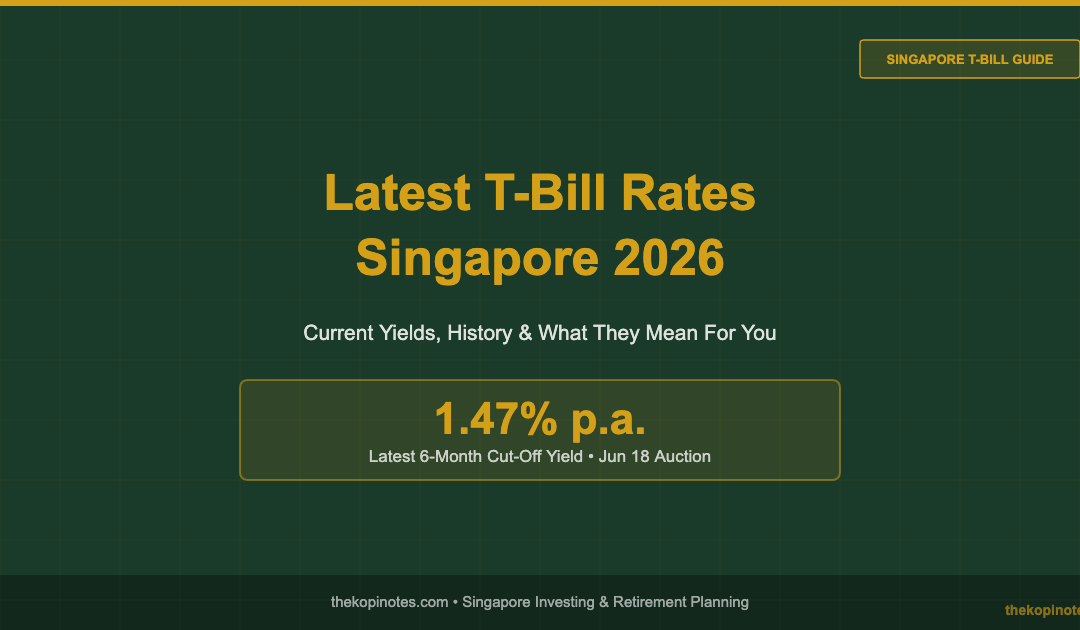
The latest Singapore T-bill rate is 1.47% p.a., set at the 18 June 2026 auction for 6-month bills. Yields have fallen sharply from 3.02% in February 2026 as global interest rates declined. T-bills remain government-backed and capital-safe, but at current levels they no longer clearly beat the best fixed deposits (up to 1.60%) or CPF OA (2.50%). Here is everything you need to know about the latest rates and what to do with your cash.
Not financial advice. All figures are for educational reference only. Data as at July 2026 unless noted.
- Latest 6-month T-bill yield: 1.47% p.a. (Jun 18 auction). Next auction Jul 16 — yield expected ~1.45–1.47%.
- T-bills are now neck-and-neck with SSBs (1.46%) and beaten by best fixed deposits (~1.60%) and CPF OA (2.50%).
- Still worth it if you want government-backed capital safety, a defined 6-month maturity, or are deploying SRS funds.
Table of Contents
Contents — Click to expand
What Is the Latest Singapore T-Bill Rate?
The latest Singapore T-bill cut-off yield is 1.47% p.a. for the 6-month tenor. This was set at the most recent auction on 18 June 2026 (issue code BS26112T), with an issuance size of S$8.2 billion and total applications of S$19.4 billion.
Here are the key facts from the most recent auction at a glance:
| Detail | Value |
|---|---|
| Auction Date | 18 June 2026 |
| Issue Code | BS26112T |
| Cut-Off Yield | 1.47% p.a. |
| Tenor | 6 months (182 days) |
| Issuance Size | S$8.2 billion |
| Total Applications | S$19.4 billion |
| Allotment Rate (est.) | ~42% (competitive bids) |
Source: Monetary Authority of Singapore (MAS), June 2026.
The next 6-month T-bill auction is expected around 16 July 2026. Based on secondary market levels, the cut-off yield is expected to remain close to 1.45–1.47%. Always verify the exact date and deadline on the MAS Auctions and Issuance Calendar before applying.
For a full breakdown of how to apply — including CPF OA and SRS application steps — see our Singapore T-bill auction results 2026 guide, which is updated after every auction.
Full T-Bill Yield History 2026
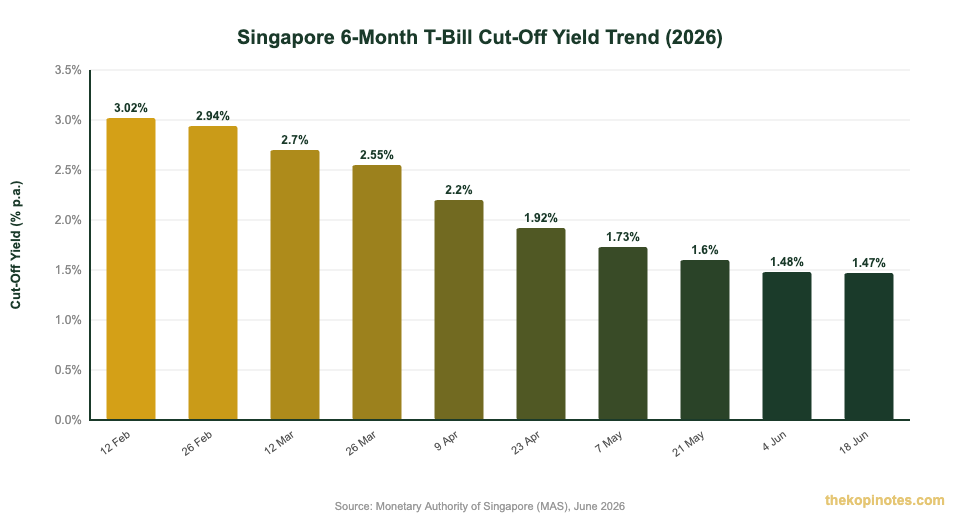
Singapore 6-month T-bill yields have dropped sharply through 2026. They started the year above 3% — still elevated from the global rate cycle of 2024–25. By mid-2026, yields have more than halved to around 1.47%. Here is the complete auction-by-auction record for 2026:
| Auction Date | Issue Code | Cut-Off Yield | Change vs Prior |
|---|---|---|---|
| 18 Jun 2026 | BS26112T | 1.47% | −0.01% |
| 4 Jun 2026 | BS26111Z | 1.48% | +0.01% |
| 21 May 2026 | BS26110F | 1.60% | −0.13% |
| 7 May 2026 | BS26109J | 1.73% | −0.19% |
| 23 Apr 2026 | BS26108N | 1.92% | −0.28% |
| 9 Apr 2026 | BS26107R | 2.20% | −0.35% |
| 26 Mar 2026 | BS26106V | 2.55% | −0.15% |
| 12 Mar 2026 | BS26105Z | 2.70% | −0.24% |
| 26 Feb 2026 | BS26104D | 2.94% | −0.08% |
| 12 Feb 2026 | BS26103H | 3.02% (2026 peak) | — |
Source: Monetary Authority of Singapore (MAS) Treasury Bills Statistics, July 2026.
The yield has fallen by 1.55 percentage points — more than half — from the February 2026 peak of 3.02% to the current 1.47%. The steepest monthly drop was in March–April 2026, when yields fell 0.35% in a single fortnight. Since early June, the rate has stabilised in a tight 1.47–1.48% band, suggesting the market may be near a short-term floor.
Why Are T-Bill Rates Falling in 2026?
Singapore T-bill yields track short-term money market rates, which in turn follow global interest rate movements — especially the US Federal Reserve’s policy rate and Singapore’s own Singapore Overnight Rate Average (SORA).
Here’s what has driven yields down in 2026:
1. Global rate cuts filtering through. The US Fed began cutting rates in late 2024. That cycle continued into early 2026, pulling short-term borrowing costs down globally. Singapore’s 3-month SORA has dropped from around 3.1% in early 2025 to approximately 1.05% by mid-2026.
2. MAS monetary policy easing. The Monetary Authority of Singapore manages monetary policy through the Singapore Dollar exchange rate rather than interest rates directly. A slightly looser exchange rate stance in 2026 has reduced the carry return on SGD, contributing to lower short-term rates.
3. High T-bill demand keeping yields compressed. Even as yields fell, retail demand for T-bills remained strong — applications for recent auctions have been S$14–19 billion against an issuance of S$8 billion. Heavy demand relative to supply keeps the cut-off yield lower than it might otherwise be.
4. Inflation easing. Singapore’s core inflation has moderated to around 1.5% by mid-2026 from the highs of 2024. With real yields (yield minus inflation) turning marginally positive, investors accept lower nominal yields.
The key question for 2026: will yields fall further? Secondary market T-bill yields have stabilised near 1.46–1.48% since early June. Unless the Fed signals aggressive further cuts or Singapore inflation collapses below 1%, yields are unlikely to fall much below 1.40% in the near term. That said, they are unlikely to recover quickly toward 2–3% without a major global shock that pushes inflation higher.
T-Bill vs Fixed Deposit vs SSB vs CPF OA
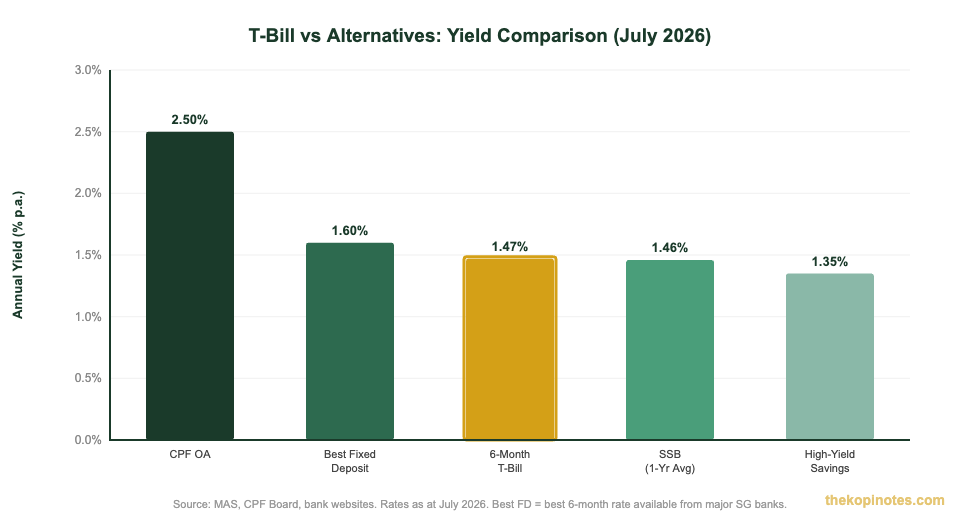
With T-bill yields now well below their 2024–2025 peaks, it is worth comparing them directly against other safe cash parking options. Here is how every major alternative stacks up as at July 2026:
| Option | Yield (Jul 2026) | Tenor | Capital Safe? | Liquidity |
|---|---|---|---|---|
| CPF OA | 2.50% | Ongoing | ✓ Govt-guaranteed | Very Low |
| Best Fixed Deposit | ~1.60% | 3–12 months | ✓ SDIC-insured | Low (penalty if early) |
| 6-Month T-Bill | ~1.47% | 6 months | ✓ Govt-backed | Low (secondary market) |
| SSB (1-Year avg) | ~1.46% | Up to 10 years | ✓ Govt-backed | High (redeem anytime) |
| High-Yield Savings | ~1.20–1.50% | None | ✓ SDIC-insured | High (anytime) |
Source: MAS, CPF Board, bank websites, July 2026. SDIC = Singapore Deposit Insurance Corporation.
The honest verdict: T-bills no longer stand out on yield alone. Here is when each option wins:
CPF OA (2.50%) wins for: Anyone with idle CPF OA funds. If you have money sitting in CPF OA that you will not need in the next 6 months, do not move it into T-bills at 1.47% — you are giving up 1.03 percentage points per year. Use our Singapore retirement calculator to see how much that compounding difference adds up to over 10–20 years.
Best fixed deposit (~1.60%) wins for: Cash you can lock away for 3–12 months and do not need to be government-backed. You earn 0.13% more per year. On S$100,000, that is S$130 extra per year — meaningful but not dramatic.
SSB (~1.46%) wins for: Flexibility. SSBs match T-bill yields almost exactly, but you can redeem them any month with no penalty and full principal returned. If there is any chance you need the money before 6 months, SSBs are clearly better. See our Singapore Savings Bonds guide for full details.
T-bills (1.47%) win for: Situations where you want pure government-backed capital safety for exactly 6 months, especially for SRS funds where flexibility is less critical, or when fixed deposit offers at your specific bank are below 1.47%.
A worked example: you have S$50,000 in idle cash. Over 6 months, the difference between the best fixed deposit (1.60%) and a T-bill (1.47%) is approximately S$32.50 in your pocket. Not life-changing — but the T-bill’s government-backing is a genuine advantage if bank safety is a concern.
How to Apply for the Next T-Bill
The next 6-month T-bill auction is expected around 16 July 2026. Applying is straightforward — you do not need a brokerage account. Just use your internet banking with DBS/POSB, OCBC, or UOB.
The minimum application is S$1,000, in multiples of S$1,000. There is no maximum for non-competitive bids from individuals — you can apply for up to S$1 million and be guaranteed allotment.
Step-by-step for DBS/POSB: Log in to DBS iBanking or the digibank app → Invest → Singapore Government Securities (SGS) → Treasury Bills → select the upcoming auction → enter your amount → choose Non-competitive bid → confirm before the deadline (typically 9pm the day before the auction). The T-bill discount (your interest) is credited on the issue date; your principal returns at maturity.
OCBC and UOB follow similar flows. Always confirm the exact deadline on the MAS Auctions and Issuance Calendar before applying — deadlines can vary slightly by bank.
Non-competitive vs competitive bids: For most retail investors, choose non-competitive. You accept whatever cut-off yield the auction produces, and you are guaranteed allotment. Competitive bids let you specify a minimum yield — but if the cut-off yield falls below your bid, you get nothing. The cut-off yield is hard to predict, so non-competitive is the sensible default.
Using CPF OA or SRS to Buy T-Bills
You can use both CPF Ordinary Account (OA) and Supplementary Retirement Scheme (SRS) funds to invest in T-bills. The logic differs significantly for each, so it is worth understanding before you apply.
CPF OA: Probably not worth it right now. Your CPF OA earns a guaranteed 2.5% per year — more than double the current T-bill yield of 1.47%. Moving CPF OA funds into T-bills means earning 1.47% instead of 2.50% for 6 months. On S$50,000, that costs you S$257 in foregone interest over 6 months. You need a CPFIS-OA account (open at DBS, OCBC, or UOB) and a minimum OA balance of S$20,000 to invest. For most people, just leave CPF OA funds where they are.
There are a few edge cases where CPF OA T-bill investment makes sense: if you plan to withdraw CPF soon for a property purchase and want to park the funds temporarily while maintaining flexibility, or if you expect the CPF OA rate to be cut (which is unlikely given the current policy environment). Otherwise, stick with CPF OA’s guaranteed 2.5%.
SRS funds: More useful here. SRS money is already outside the CPF system, so there is no 2.5% baseline to beat. T-bills at 1.47% are a decent short-term parking option for SRS funds — government-backed, liquid at maturity, and better than leaving SRS funds in cash earning near-zero interest. Apply through your SRS operator’s internet banking (DBS, OCBC, or UOB). SRS T-bill applications typically close one business day before the cash deadline.
If you want to put SRS funds to work more productively over the long term, consider a robo-advisor. You can use an Endowus referral code (referral code 2V343) to invest SRS funds on Endowus with zero platform fee for the first S$10,000.
Should You Still Buy T-Bills in 2026?
T-bills used to be a no-brainer when yields were 3–4%. At 1.47%, the calculus is more nuanced. Here is a simple framework:
Buy T-bills if:
- You want government-backed capital safety — no bank counterparty risk, no SDIC limits to worry about
- You have SRS funds to park short-term and prefer government securities
- Your bank’s best fixed deposit rate is below 1.47% — T-bills beat the FD outright
- You want a defined 6-month maturity aligned with a known future expense (e.g. property purchase, renovation)
Consider alternatives if:
- You can get a fixed deposit at 1.55% or above — that beats T-bills on yield
- The money is from CPF OA — leave it earning 2.50% in CPF
- You might need the cash before 6 months — choose SSBs instead (flexible redemption)
- You want to build long-term wealth — explore passive income in Singapore through dividend stocks, REITs, or a diversified ETF portfolio
For investors looking beyond safe-haven yields, the best S-REITs in Singapore 2026 currently offer distribution yields of 5–7% — far higher than T-bills, but with corresponding price and income risk. If you are building a long-term portfolio, a mix of safe-haven instruments (T-bills or SSBs) for your emergency fund and dividend-generating assets (REITs, ETFs) for your investment portfolio gives you both stability and growth. Consider using a platform like Syfe (referral code SRPRFFFCD) to access diversified REIT portfolios with low minimums.
Disclaimer: T-bills and other Singapore Government Securities are considered very low risk. However, all yields and rates are subject to change. Past yields do not guarantee future results. This article is for educational purposes only and does not constitute financial advice. Please consult an independent financial advisor if needed.
Frequently Asked Questions
What is the latest Singapore T-bill interest rate?
The latest Singapore 6-month T-bill cut-off yield is 1.47% p.a., set at the 18 June 2026 auction (issue code BS26112T). The next auction is expected around 16 July 2026, with the yield forecast to remain close to 1.45–1.47% based on secondary market rates. Official results are published on the MAS website on the day of each auction.
How do I find the latest T-bill rate in Singapore?
The official source for Singapore T-bill rates is the Monetary Authority of Singapore (MAS) website at mas.gov.sg, under Bonds & Bills → Treasury Bills → Auction Results. Results are published on the auction date (typically Thursdays). Your bank’s internet banking portal will also show the cut-off yield and the amount credited to your account after each auction. Alternatively, bookmark this page — we update it after every auction.
Why have Singapore T-bill rates fallen so much in 2026?
Singapore T-bill yields have fallen from 3.02% in February 2026 to 1.47% by June 2026 — a drop of 1.55 percentage points. The main drivers are: US Federal Reserve rate cuts flowing through to global short-term rates; Singapore’s 3-month SORA falling to around 1.05%; easing Singapore core inflation; and a slight loosening in MAS exchange rate policy. The rate decline was steepest in March–April 2026, and yields have since stabilised near 1.47–1.48%.
Is the T-bill rate better than fixed deposit rates in Singapore?
Not always. The best 6-month fixed deposit rates from Singapore banks are currently around 1.50–1.60% p.a. — higher than the T-bill cut-off yield of 1.47%. However, T-bills have the advantage of being backed directly by the Singapore Government (no bank counterparty risk, no SDIC limit). If your bank’s best FD rate is below 1.47%, the T-bill is the better choice on yield. If you can get 1.55% or above on a FD, the FD wins on raw yield — the decision then comes down to whether the government backing justifies the small yield sacrifice.
Should I use CPF OA to buy T-bills in 2026?
Generally no. Your CPF Ordinary Account earns a guaranteed 2.50% per year — significantly more than the current T-bill yield of 1.47%. Moving CPF OA money into T-bills means giving up 1.03 percentage points per year in guaranteed return. On S$50,000 over 6 months, that is approximately S$257 you would lose versus leaving the money in CPF OA. The only scenarios where CPF OA T-bill investment might make sense are very specific: for example, if you are planning a property purchase within 6 months and want the funds outside CPF temporarily, or if CPF OA rules change in a way that affects your strategy.
What is the minimum amount to invest in a Singapore T-bill?
The minimum investment in a Singapore T-bill is S$1,000, applied in multiples of S$1,000. You can apply for S$1,000, S$2,000, S$5,000, S$10,000, and so on up to S$1 million per non-competitive application. Non-competitive applicants (retail investors who accept the auction cut-off yield) are guaranteed full allotment up to S$1 million. T-bills are one of the most accessible government-backed investments available to Singapore residents, with no brokerage account required — just a DBS, OCBC, or UOB internet banking account.
Will Singapore T-bill rates go up again?
T-bill yields could rise again if global inflation picks up, the US Federal Reserve raises rates, or Singapore’s MAS tightens monetary policy. However, the baseline scenario for 2026 and early 2027 is for yields to remain in the 1.40–1.60% range unless there is a significant macro shift. If the Fed pivots to rate hikes due to renewed inflation — particularly driven by trade tariffs or commodity prices — T-bill yields could recover toward 2% or above. For now, yields appear to have stabilised. Monitor secondary market T-bill yields (published by MAS daily) as a leading indicator of where the next auction cut-off will land.
Want Higher Returns Beyond T-Bills?
T-bill yields have fallen. Explore higher-return options — from robo-advisors to dividend REITs — with our sign-up bonuses.
This article was researched with the help of AI. While we strive to keep all information accurate and up to date, there may be errors. If you notice any discrepancies, please contact us.