What is MediShield Life? Singapore’s National Health Insurance Explained (2026)
Coverage, premiums, deductibles & how it protects every Singapore resident
MediShield Life is a mandatory, lifelong health insurance scheme administered by the CPF Board that covers all Singapore Citizens and Permanent Residents. It pays for large hospital bills and selected costly outpatient treatments — including cancer chemotherapy and kidney dialysis — at restructured hospitals, shielding Singaporeans from catastrophic medical costs. Unlike the old MediShield scheme it replaced in 2015, MediShield Life covers you for life with no lifetime claim limit and cannot be cancelled even if you develop serious illness.
Not financial advice. All figures are for educational reference only. Data as at June 2026 unless noted.
Table of Contents
What is MediShield Life?
MediShield Life is Singapore’s basic national health insurance plan. It was launched on 1 November 2015, replacing the previous MediShield scheme, and covers every Singapore Citizen (SC) and Permanent Resident (PR) from birth automatically. You cannot opt out.
The scheme is run by the CPF Board under the Ministry of Health (MOH) and is part of Singapore’s 3M framework for healthcare financing: MediSave (personal medical savings), MediShield Life (insurance for large bills), and MediFund (safety net for the very poor).
Key Features at a Glance
| Feature | Details |
|---|---|
| Coverage scope | All SCs and PRs, from birth |
| Duration | Lifelong — no expiry, no cancellation |
| Hospital wards covered | Class B2 and below at restructured hospitals |
| Annual claim limit | $150,000 per policy year |
| Lifetime claim limit | No lifetime cap (unlimited) |
| Premium payment | From MediSave; cash top-up if MediSave insufficient |
| Administered by | CPF Board / MOH |
Source: Ministry of Health Singapore, MediShield Life overview, June 2026
Think of MediShield Life as the foundation layer of your health insurance. It handles the catastrophic tail — the bills that would otherwise wipe out a family’s savings — while you (or your employer) pay smaller bills out of pocket or from MediSave.
How MediShield Life Works
MediShield Life works on a deductible + co-insurance model. When you are hospitalised, here is the payment waterfall:
- You pay the deductible first — a fixed amount per policy year ($2,000 for adults in Class B2 wards, less for children) before MediShield Life pays anything.
- Co-insurance kicks in — after the deductible, you pay a percentage (10% for most claims above $5,000) and MediShield Life pays the remainder, up to the claim limits.
- MediSave covers your share — your deductible and co-insurance can be paid from your MediSave account, so you rarely pay cash out of pocket for restructured hospital stays.
A practical example: A Singapore Citizen aged 50 is admitted to a Class B2 ward at SGH for a knee replacement. The total bill is $28,000.
| Component | Amount | Paid By |
|---|---|---|
| Deductible | $2,000 | You (from MediSave) |
| Co-insurance (10% of next $5,000) | $500 | You (from MediSave) |
| Co-insurance (5% of remainder up to claim limit) | $1,050 | You (from MediSave) |
| MediShield Life payout | $24,450 | MediShield Life |
Source: Illustrative example based on MOH MediShield Life Schedule of Benefits 2026. Actual amounts depend on ward type, diagnosis and procedure.
In this example, MediShield Life covers about 87% of the bill. Your out-of-pocket share ($3,550) can come from your MediSave — no cash needed if you have sufficient MediSave balance.
What Does MediShield Life Cover?
MediShield Life covers inpatient stays and selected expensive outpatient treatments at restructured hospitals (public hospitals like SGH, NUH, CGH, TTSH, KTPH, SKH, NCC and Alexandra Hospital). It does not cover private hospital charges directly, though you can use Integrated Shield Plan (ISP) top-ups for that.
Inpatient Coverage
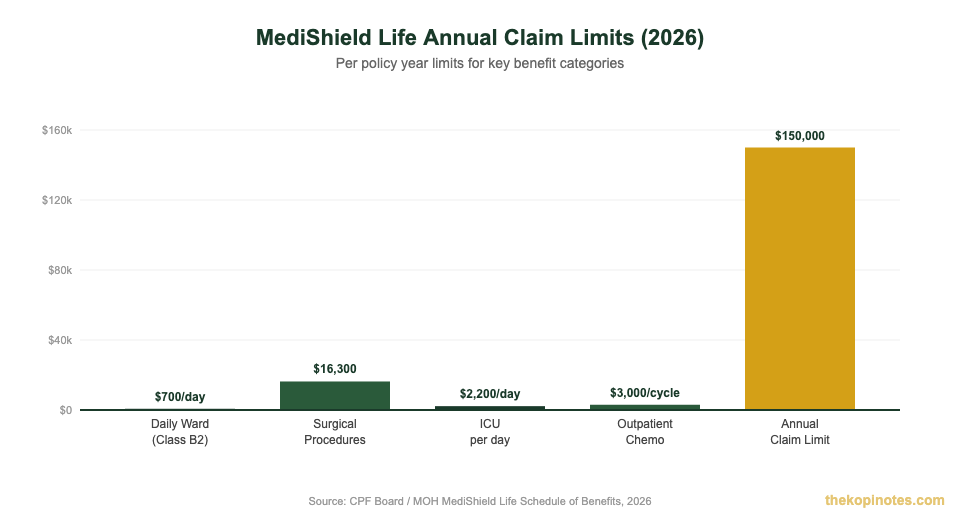
For each hospitalisation at Class B2 or lower wards, MediShield Life pays up to the schedule of benefits for ward charges, surgical procedures, specialist consultations, diagnostic tests, and implants.
Outpatient Coverage
Beyond hospitalisation, MediShield Life also covers selected costly outpatient treatments:
- Cancer chemotherapy and immunotherapy — up to $3,000 per cycle at accredited centres
- Cancer radiotherapy — up to specified limits per course
- Kidney dialysis — at approved centres
- Erythropoietin for chronic kidney failure patients
- Immunosuppressants following organ transplantation
What is NOT Covered
MediShield Life is designed for large, catastrophic bills — it does not cover:
- Outpatient GP or specialist clinic visits (routine consultations)
- Dental treatment
- Cosmetic procedures
- Treatments for pre-existing conditions are covered — but pre-existing conditions had premium loadings in the old scheme (MediShield Life removed lifetime exclusions)
- Private hospital bills unless you have an Integrated Shield Plan
MediShield Life Premiums & MediSave
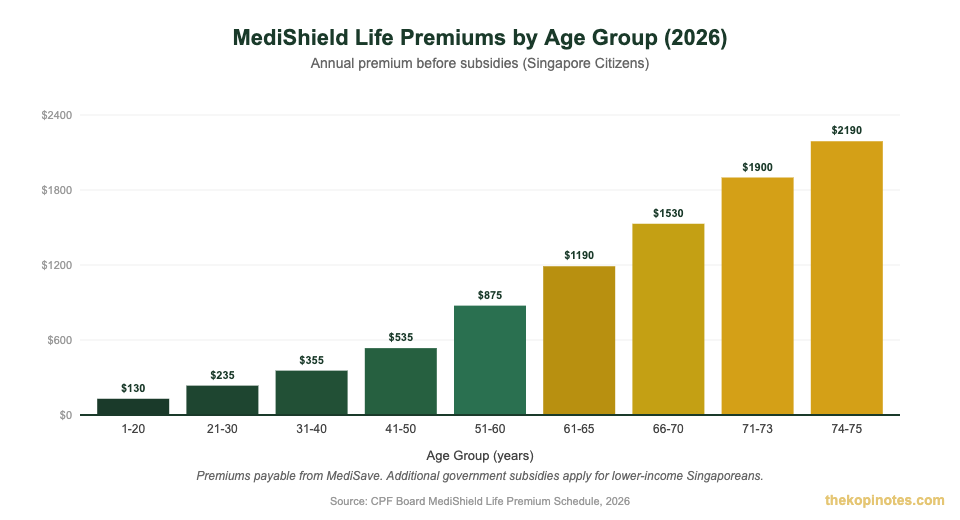
MediShield Life premiums are age-banded — older policyholders pay higher premiums because they are statistically more likely to need hospitalisation. All premiums are payable from your MediSave account, so most Singaporeans never feel these as a cash expense.
Government Subsidies on Premiums
Not everyone pays the full premium. The government provides Additional Premiums Support (APS) for lower- and middle-income households:
- Means-tested subsidy of 10%–30% for those with Per Capita Household Income (PCHI) ≤ $2,800/month
- Pioneer Generation (PG) cardholders receive additional premium subsidies on top of APS
- Merdeka Generation (MG) cardholders also receive their own subsidy tier
If your MediSave is insufficient to cover the premium, you must top up in cash. However, CPF Board will send you a bill — you are not at risk of losing coverage due to a single missed payment without prior notice.
Premium Increases Over Time
Premiums are not fixed forever. MOH reviews MediShield Life premium rates periodically to keep pace with medical inflation and increasing healthcare costs. The most recent review took effect in 2021, when premiums were adjusted alongside enhanced benefits. As a Singaporean investor, factor in premium increases when planning long-term retirement healthcare costs — your Singapore retirement calculator should include a healthcare cost line item.
Deductibles and Co-insurance
Understanding deductibles and co-insurance is key to knowing what you actually pay when hospitalised.
Deductible
The deductible is the amount you must pay before MediShield Life kicks in. It applies once per policy year (not per hospitalisation), so if you are admitted multiple times in one year, you only pay the deductible once.
| Ward Class | Deductible (Adult) | Deductible (Child / Senior above 80) |
|---|---|---|
| Class B2 and below | $2,000 | $1,000 |
| Class B1 | $3,500 | $2,000 |
| Class A / Private (with ISP) | $3,500–$5,000+ | Varies by insurer |
Source: MOH MediShield Life deductible schedule, 2026
Co-insurance
After the deductible is met, you share the remaining bill with MediShield Life. The co-insurance rates for bills above the deductible are:
- 10% on the next $5,000 of the claimable bill
- 5% on the next $10,000
- 3% on amounts above that (up to the claim limit)
Your co-insurance portion can be paid using MediSave, and if you have an Integrated Shield Plan with a rider, the rider may cover some or all of your co-insurance — though MOH requires all riders sold after March 2018 to have at least 5% co-payment to deter over-consumption.
Integrated Shield Plans: Upgrading MediShield Life
MediShield Life covers Class B2 ward treatment at restructured hospitals. If you want to be treated in a Class A ward, a private hospital, or to have a choice of specialist, you need an Integrated Shield Plan (ISP).
An ISP is a private insurance plan sold by authorised insurers that wraps around MediShield Life. The ISP component covers the gap between what MediShield Life pays and the actual bill at your chosen ward class. The five authorised insurers in Singapore are:
- AIA — AIA HealthShield Gold Max
- Great Eastern — Supreme Health
- Income (NTUC Income) — IncomeShield
- Prudential — PruShield
- Singlife with Aviva — Singlife Shield
When comparing ISPs, pay attention to the panel vs non-panel distinction, rider co-payment rules, and premium escalation at older ages. If you are looking for help on understanding your integrated shield plan comparison, TKN has a dedicated guide breaking down all five providers side by side.
ISP + Rider = Maximum Coverage (With a Catch)
Adding a rider to your ISP can eliminate your co-insurance and deductible — but MOH requires a minimum 5% co-payment on all riders sold from March 2018 onward. This means no ISP rider gives you 100% cashless coverage from 2018 onwards; you will still pay at least 5% of your hospital bill.
For most healthy Singaporeans in their 30s and 40s, a mid-tier ISP (Class A ward coverage, no rider) offers a sensible balance between premium and protection. Use your CPF investment strategy page to understand how your MediSave balance grows to cover premiums long-term.
How to Claim MediShield Life
The good news: you don’t need to file a claim yourself. MediShield Life claims are processed directly between the restructured hospital and CPF Board. When you are discharged:
- The hospital submits your final bill to CPF Board automatically.
- CPF Board processes the claim and pays the hospital directly for the MediShield Life portion.
- You receive a Statement of Account showing what MediShield Life paid and what you owe.
- You pay your share (deductible + co-insurance) using MediSave from the hospital’s billing counter.
For private hospitals or overseas treatment, you typically pay upfront and then submit a claim form to your Integrated Shield Plan insurer. MediShield Life’s portion is then reimbursed to you or your insurer.
You can check your MediShield Life coverage status and past claims on my.cpf.gov.sg.
MediShield Life for PRs and Foreigners
Permanent Residents (PRs) are automatically enrolled in MediShield Life upon obtaining PR status, just like Singapore Citizens. They pay the same premiums and receive the same benefits — but government premium subsidies (Pioneer Generation, Merdeka Generation) are only for Singapore Citizens.
Employment Pass and Work Permit holders are NOT covered by MediShield Life. If you are a foreigner working in Singapore, your employer is required to provide basic medical insurance, but this is separate from MediShield Life. Most expats supplement this with private international health insurance.
Foreigners considering long-term residency should factor healthcare coverage into their planning. Once you obtain PR status, MediShield Life enrollment is automatic, and your first premium is deducted from MediSave. For more on building wealth and passive income as a Singapore resident, see our guide to passive income Singapore strategies.
Build Your Healthcare & Wealth Foundation
MediShield Life is your baseline — but a complete financial plan includes growing your wealth alongside protecting your health. Explore these TKN resources:
- Compare all five Integrated Shield Plan providers: integrated shield plan comparison guide
- Grow your savings: Syfe referral code and sign-up bonus (use code SRPRFFFCD)
- Invest via robo-advisor: Endowus referral code (use code 2V343)
- Plan your retirement: Singapore retirement calculator
Frequently Asked Questions about MediShield Life
Is MediShield Life compulsory for Singapore Citizens?
Can I use MediShield Life at private hospitals?
What is the difference between MediShield Life and an Integrated Shield Plan?
Does MediShield Life cover pre-existing conditions?
How do I check my MediShield Life coverage and claims?
What happens to my MediShield Life if I move overseas permanently?
What is the MediShield Life deductible for 2026?
Can MediSave cover MediShield Life premiums?
Get Free Insurance Advice
Speak with a licensed insurance advisor. No obligation, no cost.
By submitting this form, you agree to our Privacy Policy.
This article was researched with the help of AI. While we strive to keep all information accurate and up to date, there may be errors. If you notice any discrepancies, please contact us.