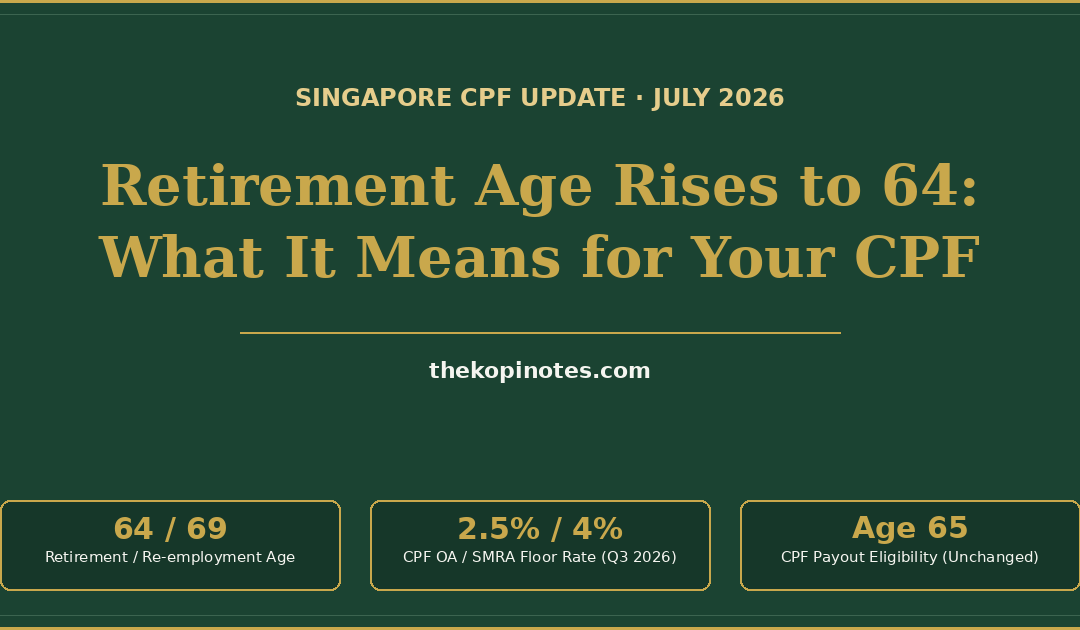
Singapore’s retirement age climbed to 64 and the re-employment age to 69 on 1 July 2026, while CPF Board confirmed interest rates for Ordinary, Special, MediSave and Retirement Accounts stay unchanged for Q3 2026. For retail investors, this reshapes how long CPF keeps compounding, when payouts start, and how much cushion CPF alone can realistically provide. Data verified as at 22 July 2026.
This is an editorial analysis. Not financial advice.
What Changed on 1 July 2026 — Retirement and Re-Employment Ages Rise
From 1 July 2026, Singapore’s statutory retirement age rose from 63 to 64, and the re-employment age rose from 68 to 69. This is the latest step in a multi-year roadmap that will eventually take both ages to 65 and 70 respectively by 2030, first flagged by Manpower Minister Tan See Leng at the Ministry of Manpower’s Committee of Supply debate in March 2026. Under the Retirement and Re-employment Act, employers cannot dismiss an employee purely on account of age before the prescribed minimum retirement age, and eligible employees must be offered re-employment contracts of at least one year, renewable annually up to the new statutory ceiling.
What this means for Singapore retail investors: a later legal retirement age does not automatically mean you should work one more year — but it does widen the window for voluntary CPF top-ups, SRS contributions, and continued employer/employee CPF contributions for those who choose to keep working. If you are 55–64 and healthy, the extra working years are an underrated lever for closing a retirement shortfall without touching your investment portfolio.
CPF Payout Eligibility Age Stays at 65 — Here’s Why It Matters
Crucially, the CPF payout eligibility age remains unchanged at 65. CPF Board has explicitly clarified that this age is not linked to either the retirement age or the re-employment age. Members can start their CPF LIFE monthly payouts as early as three months before turning 65 via the Plan My Monthly Payouts service, or defer payouts up to age 70 — with each year of deferment increasing the eventual monthly payout by up to 7%.
What this means for Singapore retail investors: don’t assume “retirement age 64” means your CPF LIFE payouts also shift. Your retirement income planning timeline around age 65 is unaffected by this policy change — but the 7%-per-year deferment bonus deserves a fresh look for anyone weighing whether to draw down CPF LIFE early or lean more heavily on dividend-paying S-REITs and other passive income sources in the interim.
CPF Interest Rates for Q3 2026: What You’re Earning Right Now
CPF Board’s latest quarterly announcement confirms interest rates for the period 1 July to 30 September 2026 are unchanged from the prior quarter. The Ordinary Account (OA) stays at its floor rate of 2.5% per annum, and the Special, MediSave and Retirement Accounts (SMRA) stay at their floor rate of 4% per annum, since the pegged market rates for both remain below their respective floors. The HDB concessionary housing loan rate, pegged at 0.1% above the OA rate, also holds steady at 2.6% per annum.
| Account Type | Interest Rate (1 Jul–30 Sep 2026) | Basis |
|---|---|---|
| Ordinary Account (OA) | 2.5% p.a. | Floor rate (pegged rate below floor) |
| Special, MediSave & Retirement Accounts (SMRA) | 4.0% p.a. | Floor rate (pegged to 12-month average 10YSGS yield + 1%, capped by floor) |
| HDB Concessionary Housing Loan | 2.6% p.a. | Pegged at OA rate + 0.1% |
| Extra interest (below 55) | +1% on first $60,000 combined balances (capped at $20,000 for OA) | Government top-up |
| Extra interest (55 and above) | +2% on first $30,000, +1% on next $30,000 of combined balances | Government top-up |
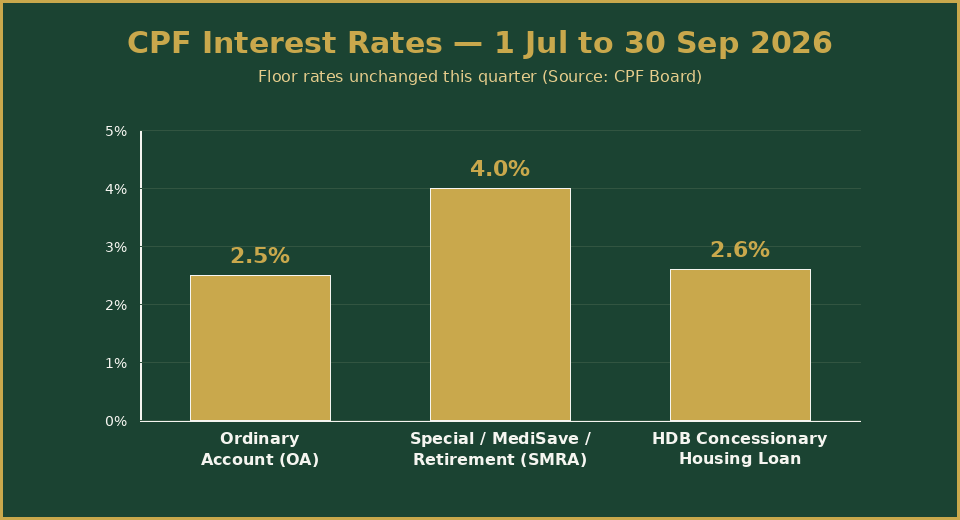
What this means for Singapore retail investors: at a guaranteed, government-backed 4% on SMRA (effectively up to 6% for the first $30,000 once you’re 55 and above, after extra interest), CPF remains one of the highest genuinely risk-free yields available to Singaporeans — comfortably ahead of most savings account and fixed deposit rates on offer this quarter. Before chasing yield in T-bills, CSPX, or VWRA with money earmarked for retirement, many investors under-appreciate that maximising voluntary CPF top-ups (subject to the Full Retirement Sum and annual contribution caps) is often the higher risk-adjusted return.
2026 CPF Contribution Rates by Age Band — and the 2027 Increase Already Locked In
Alongside the retirement age change, it’s worth revisiting where CPF contribution rates currently stand, and what’s already confirmed for next year. As of 2026, total CPF contribution rates (for monthly wages above $750) are 37% for employees aged 55 and below, 34% for those above 55 to 60, 25% for those above 60 to 65, 16.5% for those above 65 to 70, and 12.5% for those above 70.
| Age Band | Total Rate (2026) | Employer | Employee | Total Rate (from 1 Jan 2027) |
|---|---|---|---|---|
| 55 and below | 37% | 17% | 20% | 37% (no change) |
| Above 55 to 60 | 34% | 16% | 18% | 35.5% (+1.5) |
| Above 60 to 65 | 25% | 12.5% | 12.5% | 26% (+1) |
| Above 65 to 70 | 16.5% | 9% | 7.5% | 16.5% (no change) |
| Above 70 | 12.5% | 7.5% | 5% | 12.5% (no change) |
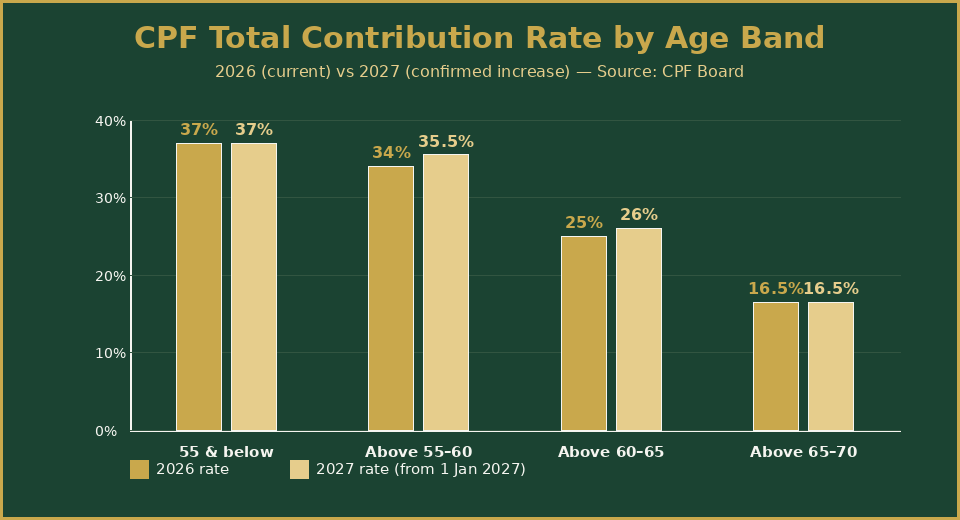
CPF Board has confirmed that from 1 January 2027, total contribution rates for senior workers rise again — by 1.5 percentage points for those above 55 to 60 (reaching 35.5%) and by 1 percentage point for those above 60 to 65 (reaching 26%). The increases are fully allocated to the CPF Retirement Account up to the Full Retirement Sum, or to the Ordinary Account once the FRS is met.
What this means for Singapore retail investors: if you’re an employer or a senior employee planning cash flow, the 2027 increase is not speculative — it’s a confirmed, dated change worth budgeting for now. For those close to their Full Retirement Sum, the extra contributions will increasingly flow to the OA, which you can then consider channelling into CPF Investment Scheme-eligible instruments rather than letting it sit at the 2.5% floor rate.
Deferring CPF LIFE Payouts — The Overlooked Lever
With the CPF payout eligibility age fixed at 65 regardless of the retirement age change, the deferment option becomes more relevant for anyone re-employed under the new age-69 ceiling. CPF Board confirms that deferring CPF LIFE payouts beyond age 65, up to age 70, increases the eventual monthly payout by up to 7% for each year deferred. For someone who is re-employed and doesn’t need the monthly payout immediately, this is a guaranteed uplift that is difficult to replicate with market-based instruments without taking on volatility.
What this means for Singapore retail investors: retirees who are still earning an income under re-employment should model whether deferring CPF LIFE — and living off REIT dividends, bond ladders, or SRS withdrawals in the interim — produces a better lifetime outcome than starting payouts immediately at 65.
How This Intersects With REITs, ETFs and SRS for Retail Investors
None of these CPF changes happen in a vacuum. Many Singaporeans build a three-pillar retirement stack: CPF LIFE as the guaranteed income floor, SRS for tax-deferred investing, and a taxable portfolio of S-REITs and global ETFs like CSPX, VWRA or IWDA for growth and diversification. With CPF’s guaranteed 4% SMRA floor (plus extra interest) sitting near the long-run expected real return of a globally diversified equity portfolio, some investors are re-examining how much of their “bond-like” allocation should sit in CPF versus fixed income ETFs.
What this means for Singapore retail investors: the case for topping up CPF Special Account (for those below 55) or Retirement Account (55 and above) strengthens when SMRA rates hold at the 4% floor while broad market yields on cash and short-duration bonds compress. At the same time, the retirement age shift buys older workers more time to keep contributing to SRS before the statutory retirement age, potentially extending the runway for tax relief before drawdown.
Bottom Line for SG Investors
The 1 July 2026 retirement and re-employment age increase to 64 and 69, paired with unchanged CPF interest rates for Q3 2026 (2.5% OA, 4% SMRA floor), doesn’t change your CPF LIFE payout start age of 65 — but it does extend the runway for voluntary contributions, employer CPF inflows, and deferment strategies for those who keep working. Combined with the confirmed 2027 contribution rate hike for workers aged 55–65, the practical takeaway is to revisit your retirement income plan now: model whether deferring CPF LIFE, maximising top-ups at the guaranteed 4% floor, or rebalancing toward REITs and ETFs for the growth sleeve of your portfolio gets you closer to your retirement number.
Frequently Asked Questions
Does the CPF payout eligibility age change to 64 along with the retirement age?
No. The CPF payout eligibility age remains 65 and is not linked to the statutory retirement age or re-employment age, according to CPF Board. Only the legal minimum retirement age (now 64) and re-employment age (now 69) changed on 1 July 2026.
What is the CPF Ordinary Account interest rate for Q3 2026?
The OA interest rate remains at its floor rate of 2.5% per annum from 1 July to 30 September 2026, unchanged from the previous quarter, as confirmed by CPF Board’s official interest rate announcement.
What is the CPF Special, MediSave and Retirement Account interest rate for Q3 2026?
SMRA accounts remain at their floor rate of 4% per annum for 1 July to 30 September 2026. The SMRA rate is pegged to the 12-month average yield of 10-year Singapore Government Securities plus 1%, but stays at the floor since the pegged rate is currently lower.
How much extra interest can I earn on my CPF savings?
Members below 55 earn an extra 1% on the first $60,000 of combined CPF balances (capped at $20,000 for OA). Members 55 and above earn an extra 2% on the first $30,000 and an extra 1% on the next $30,000 of combined balances.
Will CPF contribution rates increase again after 2026?
Yes. CPF Board has confirmed that from 1 January 2027, total contribution rates for workers above 55 to 60 rise by 1.5 percentage points to 35.5%, and for those above 60 to 65, rates rise by 1 percentage point to 26%. Rates for those 55 and below, and above 65, are unchanged.
What happens if I defer my CPF LIFE payouts past age 65?
You can defer CPF LIFE payouts up to age 70. For each year deferred, your eventual monthly payout increases by up to 7%, as stated by CPF Board. This can be a useful strategy for members who continue working under the new re-employment age of 69.
Does the retirement age increase mean I have to keep working until 64?
No. The retirement age is a legal floor that protects workers from being dismissed purely due to age before that age — it does not compel anyone to work until 64. Employees can still retire earlier if they choose to.
This article was researched with the help of AI. While we strive to keep all information accurate and up to date, there may be errors. If you notice any discrepancies, please contact us.