Fed Rate Hike Odds Hit 65% for September 2026: What It Means for Singapore Investors
Markets just flipped from pricing a Fed hold to pricing a hike. Here’s what that shift means for your T-bills, CPF, REITs and SGD savings — with the actual numbers.
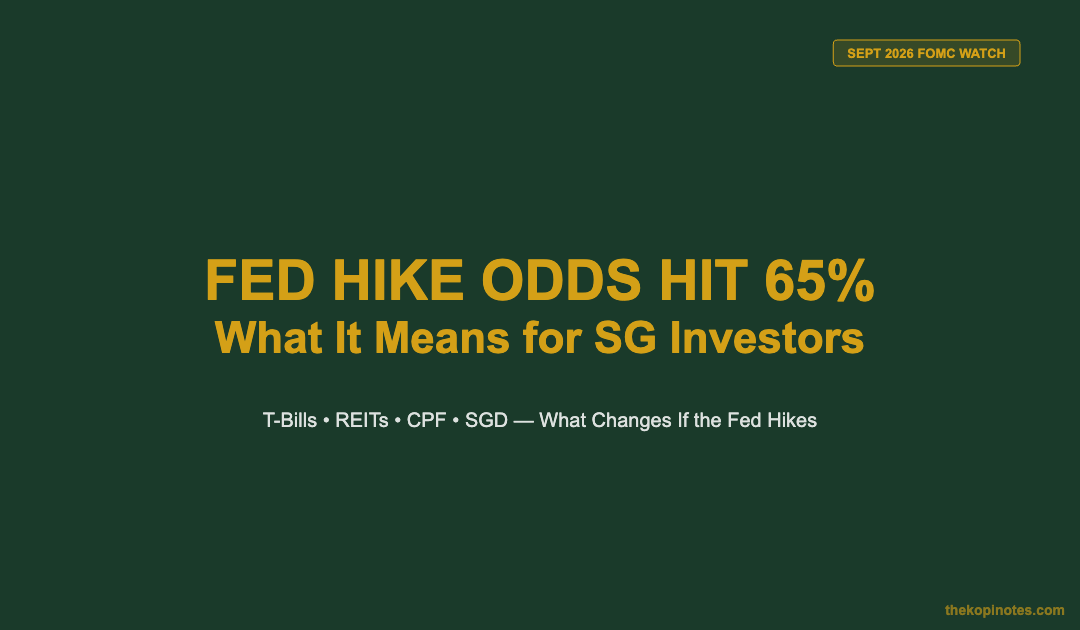
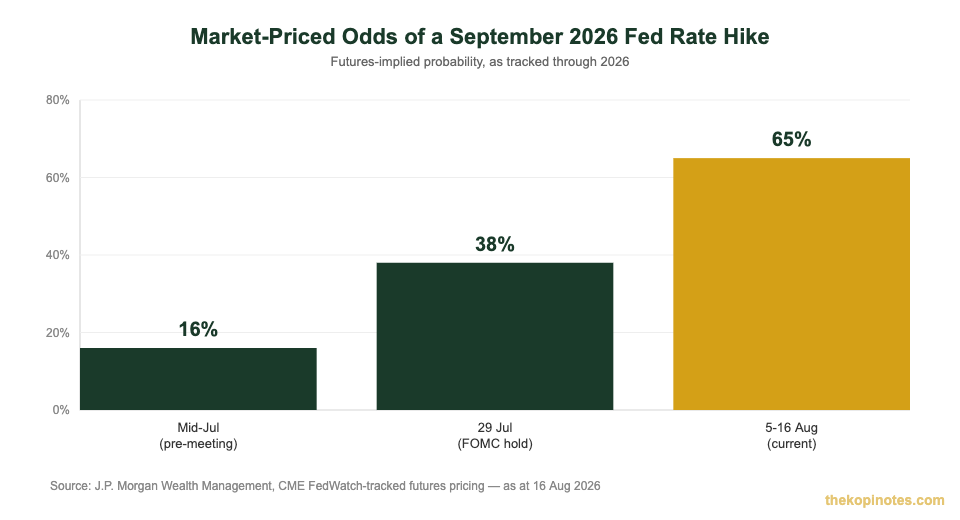
Markets now price a 65% chance the US Federal Reserve hikes rates on 16 September 2026 — up from just 16% odds a month ago. The shift is driven by Iran-linked oil shocks and fading confidence in the Fed’s inflation fight. For Singapore investors, that changes the math on T-bills, CPF OA transfers, REIT valuations and SGD-denominated returns.
Not financial advice. All figures are for educational reference only and reflect data available as at 16 August 2026.
- Fed hike odds for the 16 September 2026 FOMC meeting have jumped to 65%, up from just 16% a month ago — a sharp reversal from July’s “hold.”
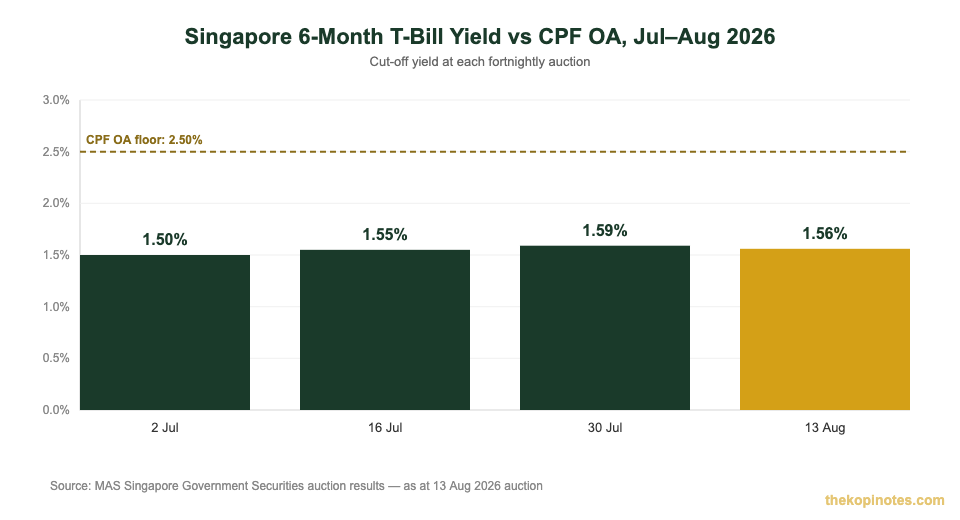
- Singapore’s 6-month T-bill yield actually dipped slightly to 1.56% at the 13 August auction, even as hike odds climbed — SGD demand is running its own race.
- If the Fed does hike, expect renewed pressure on S-REIT valuations and a possible bump in the next T-bill auction’s cut-off yield.
Table of Contents
Contents — Click to expand
- What Changed: Fed Odds Flip From Hold to Hike
- Why Oil and Iran Are Driving the Flip
- Singapore T-Bill Yields: The 13 August Signal
- T-Bills vs CPF vs SSB: Where Should Your Cash Sit?
- What a Hike Could Cost or Earn You (A Real Example)
- MAS, SGD Strength and the October Policy Meeting
- What a September Hike Means for S-REITs
- What Singapore Investors Should Do Now
What Changed: Fed Odds Flip From Hold to Hike
The Federal Reserve held its benchmark rate at 3.50%–3.75% on 29 July 2026. The vote was close: nine policymakers backed a hold, three pushed for a hike. That split alone told markets the committee was divided. See our full breakdown of what July’s hawkish hold meant for Singapore investors.
Since then, the mood has shifted hard. J.P. Morgan Wealth Management strategists now expect a 25-basis-point hike at the next Federal Open Market Committee (FOMC) meeting on 16 September 2026. That’s a reversal from their earlier call of no rate changes for the rest of 2026.
Futures markets agree. Traders are now pricing roughly a 65% chance of a September hike — more than four times the 16% odds priced in mid-July. The chart below shows how fast that shift happened.
Why Oil and Iran Are Driving the Flip
Two forces are pushing the Fed toward a hike. First, supply-chain disruptions tied to the Iran conflict are keeping oil prices elevated near the Strait of Hormuz — a critical shipping route for global energy. Oil sat around $80 a barrel as of early August 2026. If blockades persist, J.P. Morgan strategists estimate oil could climb toward $120. Prices above $140 would likely trigger a sharper, more recessionary market reaction.
Second, July’s hold left markets uneasy about the Fed’s inflation-fighting credibility. Fed Chair Kevin Warsh gave little forward guidance in his press conference, and investors read that as tolerance for near-term inflation. In practice, that pushed longer-term bond yields higher even as short-term yields eased slightly — the 30-year US Treasury yield hit its highest level since 2007.
Here’s why that matters: when markets question a central bank’s resolve, the central bank often has more reason to act — even a single “insurance” hike — just to reassure everyone it’s still serious about inflation.
Singapore T-Bill Yields: The 13 August Signal
Singapore’s 6-month T-bill (Treasury bill) — a short-term government IOU sold to investors every two weeks — had climbed for three straight auctions, from 1.50% on 2 July to 1.59% on 30 July. Then something interesting happened: the 13 August auction cut-off yield actually dipped, to 1.56%.
That’s a small move, but the direction matters. It happened even as Fed hike odds were already climbing toward 65% in the days before the auction. Total applications rose too, from S$18.1 billion to S$18.5 billion, while the average yield bid by investors held flat at 1.47%.
What’s going on? Two things, most likely. Singapore’s own currency policy is doing some of the tightening work already — MAS has strengthened its S$NEER policy band twice this year, pulling capital into SGD assets independent of what the Fed does. And with a hike now more likely in September, some investors may be locking in the current 1.56% now rather than waiting and risking a lower yield if the Fed ultimately holds instead.
The bottom line: don’t assume SG T-bill yields move in lockstep with Fed odds. They haven’t this cycle — and the next auction, landing days before the FOMC decision, will be a clearer test of that link.
T-Bills vs CPF vs SSB: Where Should Your Cash Sit?
At 1.56%, the 6-month T-bill still sits well below CPF Ordinary Account’s (OA) fixed 2.50% p.a. floor. Withdrawing OA savings to chase T-bill yield still doesn’t make mathematical sense — that trade only starts to work again if T-bill yields climb back above 2.5%, which a genuine September hike could help nudge along, though probably not by enough on its own.
CPF Special, MediSave and Retirement Account (SMRA) savings remain the standout: 4.00% p.a., with that floor rate extended through 31 December 2026. For balances you don’t need liquid, that’s hard to beat with any T-bill or Singapore Savings Bond (SSB) right now.
The table below lines up where each instrument stands as at mid-August 2026.
| Instrument | Latest Rate | Type |
|---|---|---|
| SG 6-Month T-Bill (13 Aug auction) | 1.56% p.a. | Market-set, re-auctioned every 2 weeks |
| CPF Ordinary Account (OA) | 2.50% p.a. | Fixed, gazetted quarterly |
| CPF Special / MediSave / Retirement Account | 4.00% p.a. (floor extended to Dec 2026) | Fixed, gazetted quarterly |
| Singapore Savings Bond (Aug 2026 tranche) | 1.46% Year 1 / 2.06% 10-yr average | Step-up, re-issued monthly |
Source: MAS, CPF Board — rates as at 13 August 2026. Use our T-Bill, SSB & Fixed Deposit Comparison Calculator to model your own numbers.
What a Hike Could Cost or Earn You (A Real Example)
Here’s the real dollar impact of these small percentage moves. Say you roll S$50,000 into 6-month T-bills at each recent auction:
| Auction Date | Cut-Off Yield | Interest on S$50,000 (6 months) |
|---|---|---|
| 2 Jul 2026 | 1.50% | ~S$374 |
| 16 Jul 2026 | 1.55% | ~S$386 |
| 30 Jul 2026 | 1.59% | ~S$396 |
| 13 Aug 2026 | 1.56% | ~S$389 |
Calculated as principal × yield × (182/365). Illustrative, before any fees.
That’s a S$22 swing over six months just from timing between the low and high points — small change on paper, but it shows how much these fortnightly moves actually add up to in real dollars.
Now look ahead. If the Fed hikes on 16 September and Singapore’s T-bill yield follows its recent pattern of tracking hawkish surprises, the next auction could push toward 1.65%–1.70%. On S$50,000, that’s about S$419 in interest over six months. If the Fed holds instead and yields drift back toward the SSB’s 1.46% level, that same S$50,000 would earn closer to S$366 — a difference of roughly S$50 either way.
This is illustrative, not a forecast — actual auction results depend on demand, MAS policy, and global conditions on the day. But it’s the right order of magnitude to know before you decide how much cash to commit at the next auction.
MAS, SGD Strength and the October Policy Meeting
The Monetary Authority of Singapore (MAS) doesn’t set an interest rate the way the Fed does. Instead, it manages the Singapore dollar against an undisclosed basket of currencies — called the S$NEER — within a policy band. In April 2026, MAS slightly increased the pace at which it lets the SGD appreciate within that band, a tightening move aimed at capping imported inflation.
That’s part of why the SGD has strengthened against the US dollar recently — the USD/SGD rate eased from around 1.294 in mid-July to about 1.279 by mid-August 2026, meaning each US dollar now buys fewer Singapore dollars.
A Fed hike could complicate that trend. Higher US rates typically draw capital toward the US dollar, which could slow or briefly reverse SGD strength — relevant if you hold USD-denominated ETFs like CSPX or VWRA inside your SRS or CPFIS account, since a weaker SGD-to-USD conversion works in your favour when you eventually convert gains back.
MAS’s next Monetary Policy Statement is due in October 2026 — right after the Fed’s September decision. Expect that statement to respond, at least partly, to whatever the Fed does on 16 September.
What a September Hike Means for S-REITs
S-REITs (Singapore Real Estate Investment Trusts) are sensitive to interest rates in two ways: higher rates raise refinancing costs on their debt, and they make REIT distribution yields look less attractive next to safer instruments like T-bills and fixed deposits.
The 30-year US Treasury yield already sits at its highest level since 2007 after July’s hawkish hold. A confirmed September hike would likely reinforce that pressure rather than create a new shock — markets have had over a month to price in the possibility.
That said, don’t assume every REIT sells off equally. Retail money hasn’t been scared off this year — S$925 million flowed into S-REITs by end-May 2026 alone, even as rate worries built. Data-centre and logistics REITs, in particular, have kept posting strong results: Keppel DC REIT’s 1H2026 DPU (distribution per unit — basically how much cash each REIT unit pays you) rose 11.3% year-on-year on AI-driven demand. For a sector-wide view, see our Best S-REITs in Singapore 2026 guide.
The practical takeaway: pick REITs on fundamentals like occupancy and gearing, not on trying to time the next Fed decision.
Want your cash ready to move before the next T-bill auction? Trust Bank offers a competitive daily-interest savings account with no minimum balance.
What Singapore Investors Should Do Now
- Don’t rush CPF OA into T-bills for yield alone. At 1.56%, it’s still below OA’s 2.50% floor — wait for a sustained move above 2.5% before considering that trade.
- Expect more T-bill auction volatility. The next auction lands close to the FOMC decision, so submit your bid with a wider “worst case” yield in mind.
- Hold REIT positions on fundamentals, not Fed timing. Occupancy, DPU growth and gearing against MAS’s leverage cap matter more than any single rate call.
- Diversify cash across SSBs, T-bills and CPF SA/MA/RA. Relative yields have shifted every few weeks through 2026 — spreading reduces timing risk.
- If you hold USD assets via SRS or CPFIS, watch the SGD. A Fed hike could briefly pause SGD strength, changing your effective returns on conversion. See our CPF investment strategy guide for how to structure this.
Building a diversified income portfolio around this rate cycle?
Frequently Asked Questions
When is the Fed's next rate decision?
Why did Fed rate hike odds jump so much?
Does a Fed hike directly change Singapore's interest rates?
Why did the Singapore T-bill yield fall even as Fed hike odds rose?
Should I move my CPF OA savings into T-bills right now?
How does a Fed hike affect Singapore REIT investors?
What's the outlook for the next Singapore T-bill auction?
This article was researched with the help of AI. While we strive to keep all information accurate and up to date, there may be errors. If you notice any discrepancies, please contact us.