DoubleDragon’s S$300M Hotel101 REIT: SGX’s Next Hospitality Trust Explained
A Philippine developer wants to list a S$300 million hospitality REIT on SGX using a lesser-known exemption route. Here’s what it means before you get excited about a new S-REIT.
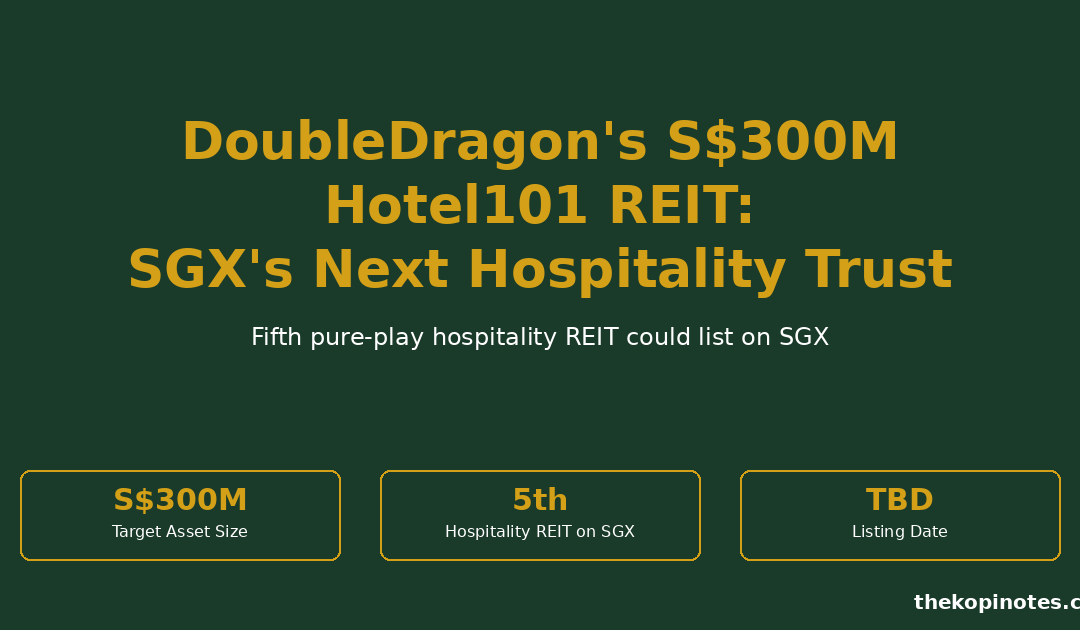
Philippine developer DoubleDragon Corp’s board has approved setting up a Singapore special purpose vehicle, DD Hotel101 Worldwide One, to be sponsored as a S$300 million hospitality REIT on SGX. It would become the fifth pure-play hospitality REIT on the exchange — but there’s no IPO date, prospectus, or confirmed yield yet.
This is an editorial analysis. Not financial advice. Data verified as at 9 August 2026 against DoubleDragon’s corporate disclosures and cross-checked against SGX-listed REIT data.
- DoubleDragon’s board approved a Singapore SPV, “DD Hotel101 Worldwide One,” targeting a S$300 million initial asset size — the minimum needed to skip SGX’s usual 3-year operating track record requirement for REIT IPOs.
- The REIT would hold Hotel101-branded “uniform units” carved out from projects across several countries, not a single Singapore property.
- If listed, it becomes the fifth pure hospitality REIT on SGX, joining CDL Hospitality Trusts, Far East Hospitality Trust, CapitaLand Ascott Trust and Acrophyte Hospitality Trust.
- There is no confirmed listing date, offer price, or DPU yield — this is a pre-IPO structuring step, not an investable security yet.
What DoubleDragon Just Announced
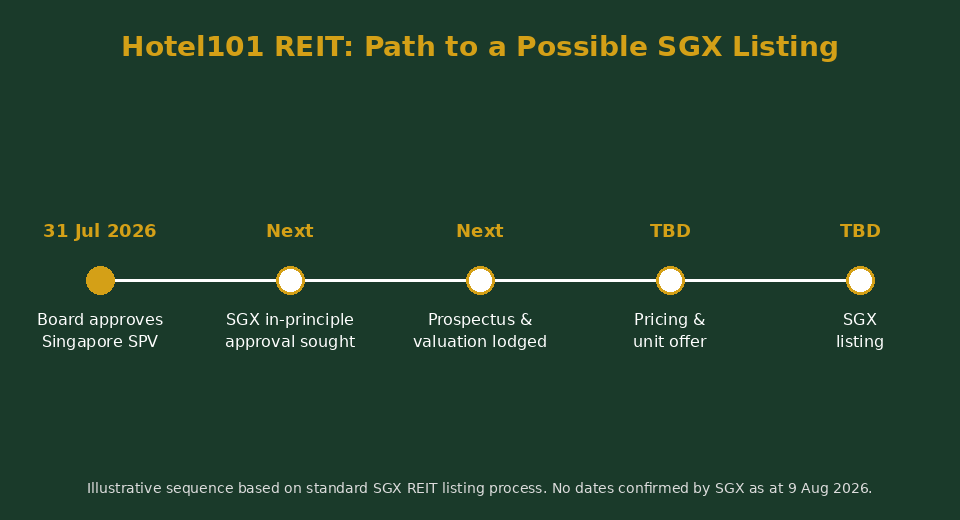
On 31 July 2026, DoubleDragon Corporation — a Philippine-listed property developer — disclosed that its board had approved the creation of a Singapore special purpose vehicle named DD Hotel101 Worldwide One. The vehicle is intended to be sponsored as a real estate investment trust and listed on the Singapore Exchange (SGX), with an initial asset base of roughly S$300 million.
The REIT would not hold a single hotel in Singapore. Instead, it’s designed to hold a diversified basket of Hotel101-branded “uniform units” — standardised condotel-style rooms — carved out from completed and in-progress Hotel101 projects in different countries, mainly built around DoubleDragon’s home base in the Philippines. The stated goal is to create a “permanent capital recycling mechanism” that funds the next phase of Hotel101’s global rollout, which the company has pitched as a plan to eventually license out up to a million standardised hotel rooms worldwide via its H101 PropTech platform.
This is a corporate structuring announcement, not an IPO. There’s no prospectus, no listing date, no confirmed unit price, and no disclosed distribution yield.
Why This Structure, and Why Now
The S$300 million figure isn’t arbitrary. Under SGX’s listing framework, a REIT sponsor without a three-year operating track record for its properties can still list if the initial portfolio meets a minimum asset size threshold — commonly cited around the S$300 million mark. Hitting that number lets a newer sponsor bypass the track-record requirement that would otherwise apply.
For DoubleDragon, this matters because Hotel101 as a hospitality operating brand is relatively young outside the Philippines. Structuring a S$300 million REIT lets the group tap SGX’s deeper capital markets and REIT-friendly tax treatment (no corporate tax on distributed income, provided at least 90% of taxable income is paid out to unitholders) without waiting years to build an operating history.
Singapore is also simply the region’s REIT listing venue of choice. SGX hosts Asia’s largest concentration of hospitality and diversified REITs outside Japan, and a Singapore listing gives international investors — including Singapore retail investors — direct access to what would otherwise be a foreign, unlisted hotel portfolio.
How It Compares to SGX’s Existing Hospitality REITs
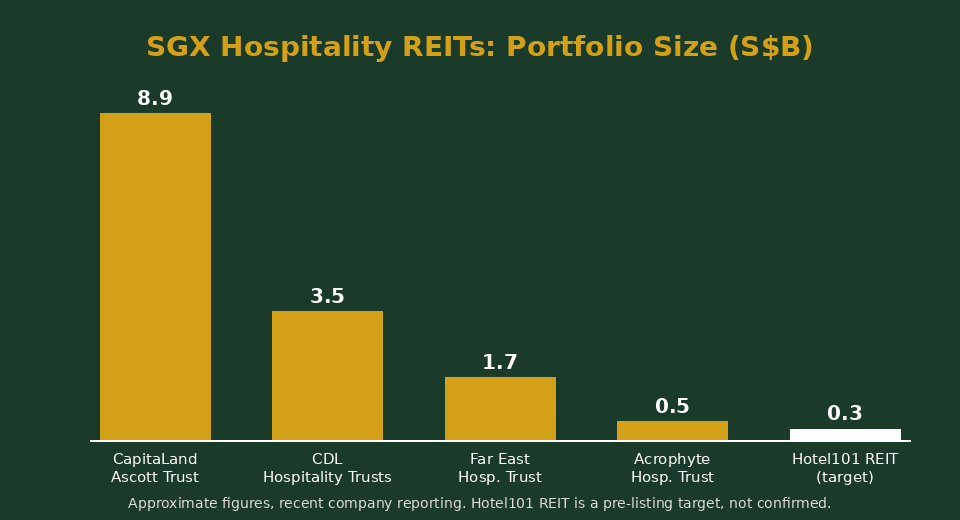
As at August 2026, SGX has four pure-play hospitality REITs. A listed Hotel101 REIT would be the fifth. Here’s how the proposed vehicle stacks up against the incumbents on portfolio size and geographic focus:
| REIT | Approx. Portfolio Size | Geographic Focus | Status |
|---|---|---|---|
| CapitaLand Ascott Trust | ~S$8.9 billion, 103 properties | 16 countries | Listed |
| CDL Hospitality Trusts | ~S$3.5 billion, 22 properties | Singapore, regional, Europe, Japan | Listed |
| Far East Hospitality Trust | Singapore-centric portfolio | Singapore | Listed |
| Acrophyte Hospitality Trust | Smaller, niche portfolio | Diversified | Listed |
| DD Hotel101 Worldwide One | ~S$300 million (target) | Philippines-led, multi-country | Pre-listing, SPV stage |
Portfolio figures for existing REITs are approximate, drawn from recent company reporting; figures move with quarterly results and are not a live feed. Verify current numbers via SGinvestors’ hospitality REIT tracker before making any decisions.
What TKN Readers Should Actually Watch For
It’s tempting to treat “new SGX REIT” as an automatic watchlist add. For this one, patience is warranted. Here’s what actually needs to happen before it’s investable:
- SGX in-principle approval. Board approval from DoubleDragon is a corporate decision, not a regulatory green light. SGX still needs to approve the listing.
- A published prospectus. Unit price, distribution policy, gearing ratio, sponsor fee structure, and projected yield will only be known once a prospectus is lodged.
- Confirmed asset valuation. The S$300 million figure is a target threshold, not an independently appraised valuation. Expect this number to move once professional valuers weigh in.
- Track record of the “uniform unit” model. Hotel101’s condotel-licensing model is less established outside the Philippines, so occupancy and RevPAR history for the specific units going into the REIT matters more than the brand’s broader growth pitch.
Until those boxes are ticked, this remains a story to follow, not a REIT to buy. If you already hold Singapore-listed hospitality exposure and want a read on how the existing players are performing, our recent coverage of Far East Hospitality Trust’s price targets and Frasers Centrepoint Trust’s leverage-cutting divestment are useful reference points for how established S-REITs are managing capital right now.
Where a Hotel101 REIT Could Fit an S-REIT Portfolio — If and When It Lists
For Singapore retail investors who already hold S-REITs for income, a new hospitality trust would add a fifth option in a sector most portfolios are already exposed to via CapitaLand Ascott Trust or CDL Hospitality Trusts. The differentiator, on paper, is geography: a portfolio anchored outside Singapore gives diversification away from local tourism cycles, at the cost of currency and country-specific risk (Philippine peso exposure, in this case, alongside whatever markets the “uniform units” eventually cover).
That trade-off — diversification versus unfamiliar-market risk — is the same one investors weigh when choosing between S-REITs and globally diversified instruments like commodity ETFs or broad-market index funds. If you’re building a CPF or SRS-funded portfolio around this kind of decision, it’s worth revisiting how you’re sequencing cash, CPF and brokerage accounts — our guide to pairing CPF/SRS investing with a high-yield cash sleeve covers that groundwork.
It’s also worth remembering that CPF Investment Scheme (CPFIS) rules restrict which REITs and funds are eligible for CPF Ordinary Account investment — a newly listed, foreign-sponsored REIT is unlikely to qualify on day one, if at all. Readers tracking how CPF-eligible investment options are evolving more broadly may want to read our explainer on the new CPF life-cycle investment scheme launching in 2028, which is a separate but related shift in how CPF savings can be deployed.
Bottom Line for SG Investors
DoubleDragon’s Hotel101 REIT is a corporate structuring story right now, not an investment opportunity. The S$300 million target size is designed specifically to unlock SGX’s track-record exemption, which tells you this is a young hospitality operator using a technical pathway to list faster — not evidence of an already-proven, income-generating portfolio. Add it to your watchlist for when a prospectus lands, but don’t reshuffle your existing S-REIT holdings in anticipation of it. If SGX approves the listing, expect a wave of coverage once pricing and yield guidance are confirmed — that’s the point at which the numbers become real enough to evaluate.
FAQ
Is the Hotel101 REIT already listed on SGX?
No. As at 9 August 2026, DoubleDragon’s board has only approved creating the Singapore SPV. SGX approval, a prospectus, and a listing date have not been announced.
What is DD Hotel101 Worldwide One?
It’s the Singapore special purpose vehicle DoubleDragon Corp set up to eventually be sponsored as a REIT, holding a basket of Hotel101-branded hotel units from projects in multiple countries.
Why does the REIT need S$300 million in assets?
That’s the approximate minimum initial portfolio size SGX generally requires for a REIT sponsor to skip the standard three-year operating track record requirement for listing.
How many hospitality REITs are currently on SGX?
Four: CapitaLand Ascott Trust, CDL Hospitality Trusts, Far East Hospitality Trust and Acrophyte Hospitality Trust. Hotel101 REIT would be the fifth if it lists.
Can I buy this REIT with my CPF savings?
Not yet, and possibly not at all — CPF Investment Scheme eligibility is assessed per counter, and newly listed, foreign-sponsored REITs are not automatically CPFIS-eligible.
What’s the risk with a Philippines-anchored hospitality REIT?
Currency risk (Philippine peso and other local currencies against SGD), a shorter operating history for the “uniform unit” condotel model outside the Philippines, and sponsor concentration risk, since the assets and brand are closely tied to one developer group.
Where can I track official updates on this listing?
Watch SGX’s official announcements portal and DoubleDragon Corp’s disclosures on the Philippine Stock Exchange for the prospectus and listing timeline.
This article was researched with the help of AI. While we strive to keep all information accurate and up to date, there may be errors. If you notice any discrepancies, please contact us.