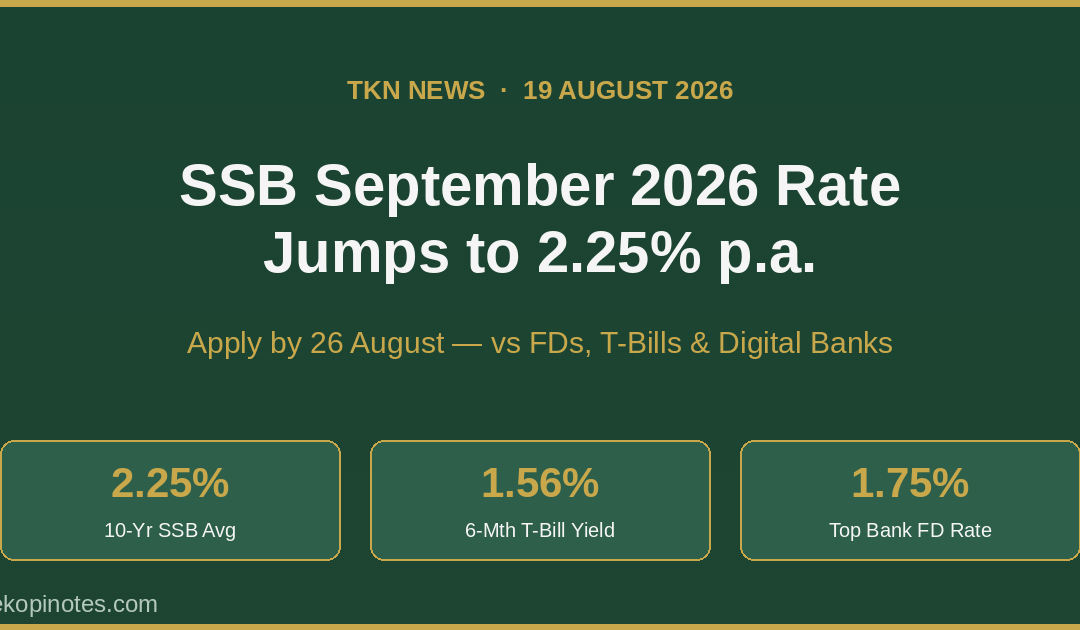
The Singapore Savings Bond (SSB) issue for September 2026 offers a 10-year average return of 2.25% p.a., up sharply from 2.06% in August — the biggest month-on-month jump in recent memory. Applications close 26 August, 9pm. Here’s how this SSB tranche stacks up against fixed deposits, T-bills, digital banks and CPF for Singapore savers deciding where to park spare cash right now.
This is an editorial analysis. Not financial advice. Data verified as at 19 August 2026.
What Changed: SSB September 2026 at a Glance
The latest Singapore Savings Bond, issue code SBSEP26 (GX26090V), was announced on 3 August 2026 with a 10-year average return of up to 2.25% p.a. That’s a 0.19 percentage point jump from the August 2026 tranche (SBAUG26), which offered 2.06% — one of the sharpest single-month moves in the SSB’s recent history, according to the official rate schedule.
The first-year rate is 1.52%, stepping up every year until it reaches 2.82% in year 10. Applications opened 3 August 2026 and close 26 August 2026 at 9pm. As always, the minimum investment is S$500 (in multiples of S$500), and total SSB holdings are capped at S$200,000 per individual across cash and SRS accounts. A non-refundable S$2 bank transaction fee applies per application and per redemption.
What this means for SG retail investors: a jump of this size usually reflects a repricing further out on the Singapore Government Securities yield curve. For anyone who has been sitting on cash waiting for a better SSB rate, this is the best 10-year average on offer since early 2025 — but the window to apply is short. Read our August 2026 SSB breakdown for how the previous tranche compared.
SSB Year-by-Year Interest Schedule (SBSEP26)
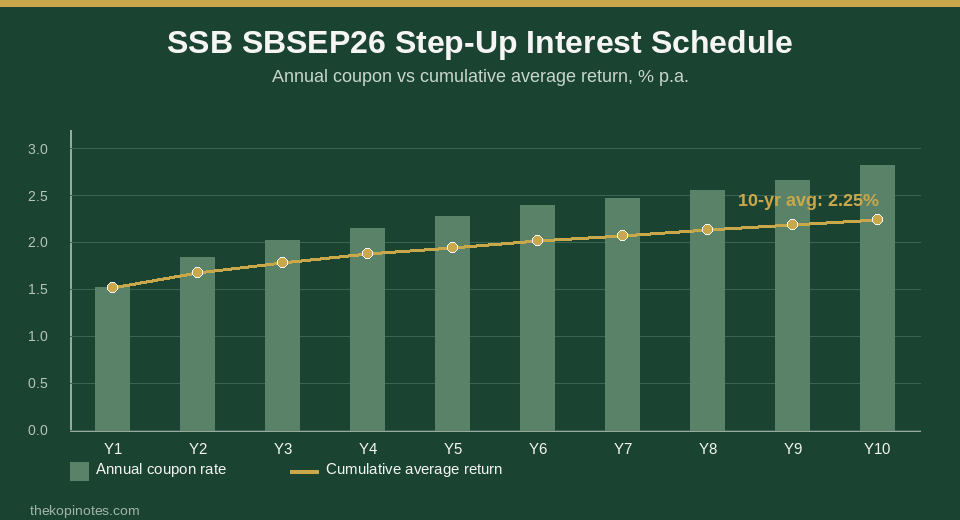
| Year from issue | 1 | 2 | 3 | 4 | 5 | 6 | 7 | 8 | 9 | 10 |
|---|---|---|---|---|---|---|---|---|---|---|
| Interest rate (% p.a.) | 1.52 | 1.84 | 2.02 | 2.15 | 2.28 | 2.39 | 2.47 | 2.56 | 2.66 | 2.82 |
| Average return (% p.a., compounded) | 1.52 | 1.68 | 1.79 | 1.88 | 1.95 | 2.02 | 2.08 | 2.14 | 2.19 | 2.25 |
What this means for SG retail investors: the step-up structure rewards patience — you only capture the full 2.25% p.a. if you hold to year 10. Redeem in year 1 and you’re locked into 1.52%, barely above a T-bill. Use our SSB Interest Calculator to model your own holding period before applying.
SSB vs Fixed Deposits vs T-Bills vs Digital Banks: The Full Comparison
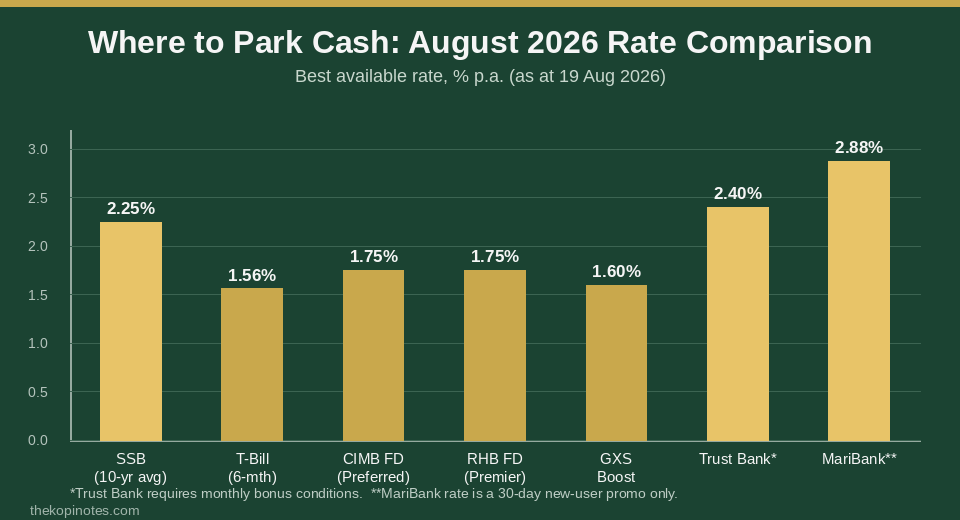
The SSB doesn’t exist in a vacuum. Banks have also been repricing fixed deposits this month, and the 6-month T-bill yield just posted its first decline since June. Here’s how the main cash-parking options compare as at 19 August 2026:
| Instrument | Rate (p.a.) | Tenor / Lock-in | Minimum | Capital Risk |
|---|---|---|---|---|
| SSB (SBSEP26) | 1.52% (yr 1) / 2.25% (10-yr avg) | Up to 10 years, redeemable any month, no penalty | S$500 | None (Government-backed) |
| 6-month T-bill (13 Aug auction) | 1.56% cut-off yield | 6 months, fixed | S$1,000 | None (Government-backed) |
| CIMB FD (Preferred Banking) | Up to 1.75% | 9 or 12 months | S$10,000 | SDIC-insured to S$100,000 |
| CIMB FD (Personal Banking) | Up to 1.70% | 9 or 12 months | S$10,000 | SDIC-insured to S$100,000 |
| RHB FD (Premier Banking, branch) | Up to 1.75% | 12 months | S$20,000 | SDIC-insured to S$100,000 |
| GXS Boost Pocket | Up to 1.60% | No lock-in | None | SDIC-insured to S$100,000 |
| Trust Bank (with bonus conditions) | Up to 2.40% | No lock-in, monthly conditions | None | SDIC-insured to S$100,000 |
| MariBank (new-user, 30 days) | Up to 2.88% | 30-day promo only | None | SDIC-insured to S$100,000 |
Sources: SSB and T-bill rates from MAS; fixed deposit promo rates from CIMB (7–31 Aug 2026 promo) and RHB (from 1 Aug 2026); digital bank rates per each bank’s published terms as at 19 August 2026.
What this means for SG retail investors: on headline numbers alone, MariBank’s 2.88% and Trust Bank’s 2.40% look unbeatable — but both come with strings attached (a 30-day new-user window, or monthly bonus conditions like salary crediting and card spend). For cash you genuinely don’t need to touch, the SSB’s 2.25% 10-year average is the highest no-conditions, no-lock-in-risk return among government-backed instruments right now, and it beats every mainstream fixed deposit’s blended return once you account for the FD’s shorter tenor. See our Digital Bank Interest Rates: August 2026 Update and GXS vs Trust Bank vs MariBank comparison for the fine print on bonus conditions.
Why the SSB Rate Jumped: Reading the T-Bill Signal
SSB rates are derived from the average of the daily Singapore Government Securities (SGS) yields in the month before the bond is issued, so the September tranche’s jump reflects where SGS yields moved through July. That’s a separate market from the short-end T-bill auctions, which have been more mixed: the 6-month T-bill cut-off yield dipped to 1.56% on 13 August, its first decline since 18 June, after three consecutive increases, even as total applications rose to S$18.5 billion from S$18.1 billion, per auction data.
What this means for SG retail investors: the SSB and T-bill markets are sending slightly different signals — longer-dated yields firming while the very short end eases on strong demand. That’s a useful cue for laddering: if you’re building a cash ladder, this month favours locking in the SSB for the “long” leg and treating T-bills as the flexible short leg you roll every six months. Our SSB vs T-Bills rate comparison covers the laddering mechanics in more depth.
Where CPF Still Beats Everything — For Money You Can Lock Away
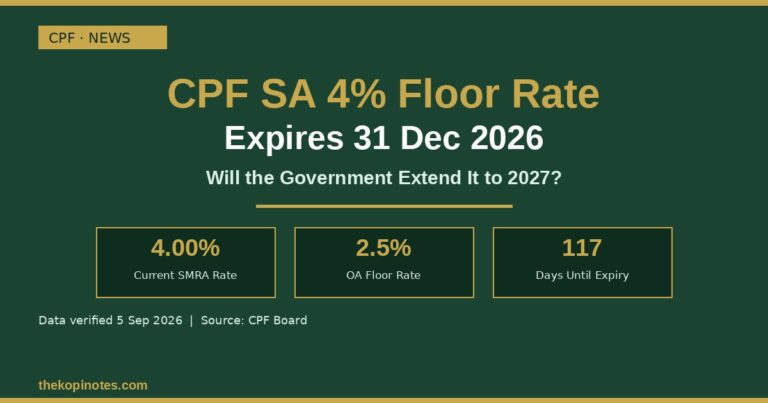
For context, CPF Ordinary Account (OA) interest stays at the floor rate of 2.5% p.a. and the Special, MediSave and Retirement Accounts stay at 4% p.a. for the quarter from 1 July to 30 September 2026, per the CPF Board’s official release. Members also earn extra interest of up to 2% p.a. on the first S$30,000 of combined balances (for those 55 and above) or 1% p.a. (below 55), capped at S$20,000 for OA.
What this means for SG retail investors: CPF remains the highest guaranteed return available to Singaporeans bar none — but it’s not liquid, and voluntary top-ups are a one-way door until retirement age. The SSB and T-bills are the right tools for money you might need in the next 1–10 years; CPF top-ups make sense only after you’ve built an emergency fund and covered near-term goals.
Who Should (and Shouldn’t) Apply for SBSEP26
This tranche suits savers with a multi-year time horizon who want zero default risk and full liquidity — you can redeem in any month with no penalty beyond the S$2 transaction fee, which is a real edge over a fixed deposit that forfeits interest on early withdrawal. It’s less suited to anyone chasing the highest possible headline rate this month; MariBank’s 2.88% new-user promo or Trust Bank’s conditional 2.40% will out-earn the SSB’s first-year 1.52% if you’re able to meet the conditions.
What this means for SG retail investors: a sensible split for many TKN readers is to keep an emergency fund in a no-conditions digital bank account (GXS or MariBank’s base rate), use fixed deposits or T-bills for money earmarked for a purchase in the next 6–12 months, and use the SSB for the portion of savings you’re happy to lock away for potentially a decade while retaining the option to exit early if plans change.
How to Apply Before the 26 August Deadline
Applications for SBSEP26 (GX26090V) can be made via ATMs or internet banking with DBS/POSB, OCBC or UOB, or through your SRS operator if applying with SRS funds. A CDP account is required for cash applications. CPF funds cannot be used to buy Singapore Savings Bonds. The application window closes 26 August 2026, 9pm, with allotment results typically released within a few business days after close, and the bond issued on the first business day of the following month.
Bottom Line for SG Investors
The September 2026 SSB’s jump to a 2.25% p.a. 10-year average is the most attractive government-backed, no-lock-in-risk rate in months, and it now outpaces the blended return on most mainstream fixed deposits once tenor and flexibility are factored in. It won’t beat the headline rates on MariBank’s new-user promo or Trust Bank’s conditional tier, and it won’t beat CPF for money you’re willing to lock away for decades — but for spare cash sitting idle with a multi-year horizon, this tranche is worth a serious look before applications close on 26 August, 9pm.
Frequently Asked Questions
What is the interest rate for the September 2026 Singapore Savings Bond?
When is the deadline to apply for SBSEP26?
How does the SSB rate compare to fixed deposits in August 2026?
Is the Singapore Savings Bond safer than a fixed deposit?
What is the minimum amount to invest in Singapore Savings Bonds?
Can I use CPF funds to buy Singapore Savings Bonds?
What happens if I redeem my SSB before it matures?
How does the SSB compare to the latest T-bill yield?
This article was researched with the help of AI. While we strive to keep all information accurate and up to date, there may be errors. If you notice any discrepancies, please contact us.