Silver ETF Singapore: Price Surges to $62/oz — Should You Buy in August 2026?
Silver just touched its highest price since early July. Here’s what’s driving the rally, and how Singapore investors can get exposure through LSE-listed silver ETFs.
Silver jumped 3.5% to USD 62.49 an ounce on 5 August 2026, its highest level since 6 July, driven by a structural supply deficit and rising industrial demand from solar panels and EVs. Singapore investors don’t have a locally listed silver ETF, so most buy LSE-listed options like iShares Physical Silver (ISLN) or WisdomTree Core Physical Silver (WSLV) — both taxed more favourably than their US-listed equivalents.
Not financial advice. All figures are for educational reference only. Data as at 5 August 2026 unless noted.
- Silver hit USD 62.49/oz on 5 August 2026 — up from a July low near USD 58.90, driven by a structural supply deficit and safe-haven demand.
- There’s no SGX-listed silver ETF. Singapore investors typically buy LSE-listed silver ETCs like ISLN or WSLV, which carry lower US withholding tax than US-listed options like SLV.
- Silver is more volatile than gold and has no yield — treat it as a small, tactical slice of your portfolio, not a core holding.
Table of Contents
What Is a Silver ETF?
A silver ETF is a fund that holds physical silver bullion (or tracks its price) so you can invest without storing bars yourself. Most silver ETFs are “physically backed” — the fund actually buys and vaults real silver, and each share represents a claim on a slice of that metal.
Unlike gold, silver has a dual identity. About half of global silver demand comes from industry — solar panels, electronics, and electric vehicles all use it. The other half is investment and jewellery demand. That’s why silver tends to swing harder than gold in both directions.
You won’t find a dedicated silver ETF listed on the SGX. Singapore has SPDR Gold Shares and the LionGlobal Physical Gold ETF for gold, but no local silver equivalent. So if you want silver, you’re buying on an overseas exchange — usually the London Stock Exchange (LSE) or a US exchange.
Why Silver Is Surging in August 2026
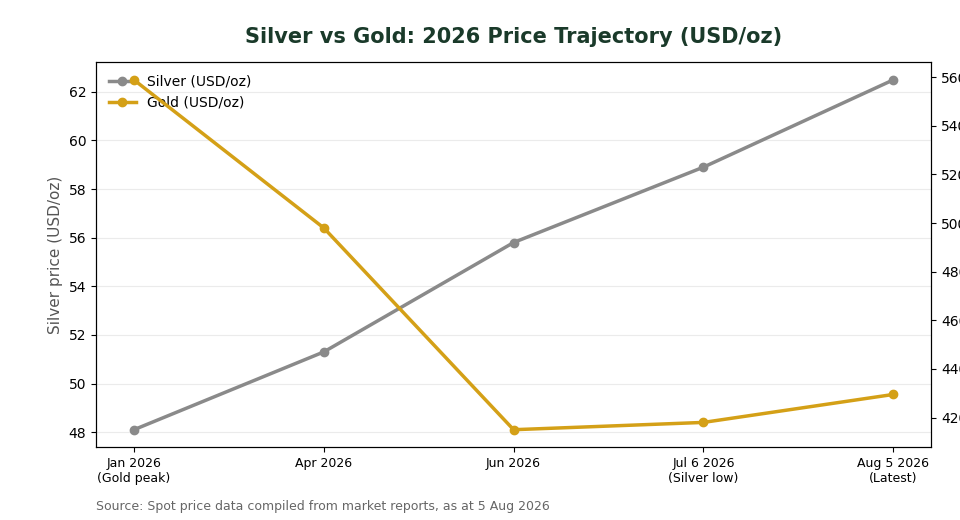
Silver touched USD 62.49 an ounce on 5 August 2026, its highest price since 6 July. That’s a sharp move from around USD 58.90 just a month earlier. A few forces are behind it.
First, there’s a structural supply deficit. The silver market has run a supply shortfall every year since 2021. The cumulative gap from 2021 to 2025 is estimated near 800 million ounces, according to The Silver Institute. Mine supply simply hasn’t kept up with industrial demand, especially from solar panel manufacturing.
Second, gold’s rally is pulling silver along with it. Gold touched a seven-week high near USD 4,295 an ounce on 6 August 2026, driven by a weaker US dollar and shifting Federal Reserve rate expectations. Silver often tracks gold’s direction, but with bigger percentage swings — traders call this “high beta to gold.”
Third, a weaker payrolls report reignited rate-cut bets. When investors expect the Fed to cut rates, non-yielding assets like precious metals become relatively more attractive versus interest-bearing cash and bonds.
Silver’s August 2026 Rally at a Glance
| Date | Silver Price (USD/oz) | Note |
|---|---|---|
| 6 Jul 2026 | ~58.90 | Prior local high before the latest pullback and rebound |
| Early Aug 2026 | ~60.30 | Gradual climb as gold firmed on rate-cut bets |
| 5 Aug 2026 | 62.49 | +3.5% single-day move — highest since 6 July 2026 |
Source: Market spot price reports compiled as at 5 Aug 2026.
For context, gold still trades more than 20% below its own record of USD 5,589 an ounce set in late January 2026. Silver’s move has been sharper on a percentage basis, which is typical during metals rallies — silver tends to outperform gold on the way up and fall harder on the way down.
Best Silver ETFs for Singapore Investors
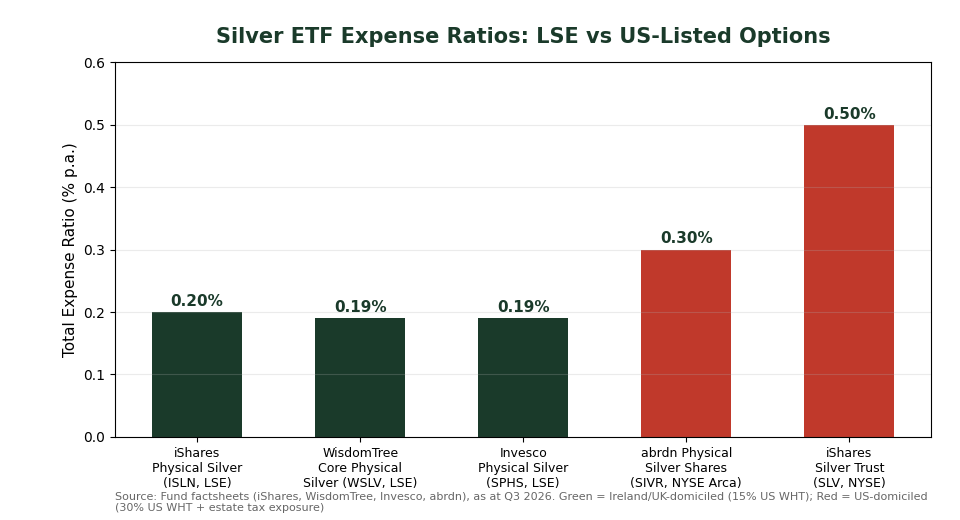
Since there’s no SGX-listed silver ETF, you’ll buy on the LSE (recommended for most SG investors, similar to how CSPX or VWRA work) or a US exchange. The table below compares the main options, using data from the iShares Physical Silver ETC factsheet and each provider’s official fund pages.
| ETF | Exchange | Domicile | TER | US Dividend WHT |
|---|---|---|---|---|
| iShares Physical Silver ETC (ISLN) | LSE | Ireland | 0.20% | N/A (no dividend) |
| WisdomTree Core Physical Silver (WSLV) | LSE | Jersey | 0.19% | N/A (no dividend) |
| Invesco Physical Silver (SPHS) | LSE | Ireland | 0.19% | N/A (no dividend) |
| abrdn Physical Silver Shares (SIVR) | NYSE Arca | USA | 0.30% | N/A (no dividend), but US estate tax risk applies |
| iShares Silver Trust (SLV) | NYSE Arca | USA | 0.50% | N/A (no dividend), but US estate tax risk applies |
Source: iShares, WisdomTree, Invesco and abrdn fund factsheets, Q3 2026.
None of these funds pay a dividend, so the usual withholding-tax comparison you’d see for equity ETFs like CSPX vs VOO doesn’t apply here in the same way. The real difference is estate tax exposure. US-domiciled funds like SLV and SIVR expose non-resident foreigners to US estate tax on holdings above USD 60,000 if you pass away while holding them. Ireland or Jersey-domiciled funds like ISLN, WSLV, and SPHS carry no such risk.
For a Singapore investor putting SGD 20,000 into silver, the annual cost difference between ISLN (0.20% TER) and SLV (0.50% TER) is about SGD 60 a year — small in isolation, but the estate tax exposure on SLV is the bigger practical reason most Singapore investors choose the LSE-listed options.
How to Buy Silver ETFs in Singapore
Buying a silver ETF works the same way as buying CSPX in Singapore — you’re just selecting a different ticker on the LSE.
Step 1: Fund your brokerage account. Interactive Brokers (IBKR), Saxo Markets, and moomoo Singapore all offer LSE access. Read our moomoo Singapore review if you’re comparing platforms.
Step 2: Search for the ticker. Type “ISLN” or “WSLV” into your broker’s search bar and confirm it’s the London Stock Exchange listing, priced in USD or GBP depending on the counter you select.
Step 3: Place your order. Silver ETCs trade like shares — enter the quantity and submit a limit order to control your entry price, since silver can be more volatile intraday than broad equity ETFs.
Step 4: Size it sensibly. Most advisors treat precious metals, including silver, as a satellite position — typically 2-5% of a diversified portfolio, not a core holding. You can check how this fits your broader plan using our Singapore retirement calculator.
Silver ETFs are not CPF-investable and are not typically available through CPFIS. If you’re investing SRS funds, check with your SRS-approved broker (such as FSMOne) whether the specific LSE ticker is supported — coverage varies by platform. You can read more about diversifying beyond silver in our Singapore REIT ETF guide if you want income-generating exposure alongside a small precious metals allocation.
Risks to Consider
Silver isn’t a “safe” trade just because it’s a precious metal. A few risks are worth knowing before you buy.
Volatility. Silver regularly moves 2-4% in a single day during active periods — roughly double gold’s typical daily swings. The same industrial-demand link that drives silver higher in a boom can drag it down hard in a slowdown.
No yield. Unlike an S-REIT or a dividend ETF, silver pays you nothing while you hold it. Your entire return depends on the price going up. Compare that against passive income Singapore options if regular cash flow matters more to you than a speculative metals position.
Currency risk. Silver is priced in USD. A stronger SGD against the USD works against your returns even if the USD silver price rises, and vice versa.
Concentration risk. Because silver has industrial and investment demand overlapping, a slowdown in solar panel manufacturing or a shift in Fed policy can move the price sharply in ways that have nothing to do with “safe haven” demand.
Frequently Asked Questions
Is there a silver ETF listed on the SGX?
No. As at August 2026, the SGX has no dedicated silver ETF. Singapore investors buy silver through LSE-listed ETCs like iShares Physical Silver (ISLN) or WisdomTree Core Physical Silver (WSLV), or through US-listed funds like SLV, using a broker that offers overseas market access.
Why did silver hit $62.49 an ounce in August 2026?
Silver rose to USD 62.49 an ounce on 5 August 2026 — its highest level since 6 July — due to a structural supply deficit dating back to 2021, gold’s own rally to a seven-week high, and rising rate-cut expectations after a weak US payrolls report.
Is silver a better investment than gold right now?
Neither is inherently “better” — they serve different roles. Silver tends to move further in both directions than gold because of its industrial demand component, making it higher-risk and higher-reward. Gold is generally viewed as the steadier store of value. Many investors hold both in small proportions rather than choosing one.
Can I buy silver ETFs using my CPF or SRS funds?
Silver ETFs are not CPF-investable and are not covered under CPFIS. Some SRS-approved brokers may support specific LSE-listed silver tickers, but this varies by platform — check with your broker directly before assuming SRS funds can be used.
How much of my portfolio should be in silver?
Most financial planners suggest limiting precious metals, including silver, to a small satellite allocation — typically 2-5% of a diversified portfolio. Silver’s volatility and lack of yield make it unsuitable as a core, long-term holding for most Singapore investors.
What's the difference between ISLN and SLV for a Singapore investor?
ISLN (iShares Physical Silver, LSE, Ireland-domiciled) carries a 0.20% TER and no US estate tax exposure. SLV (iShares Silver Trust, NYSE, US-domiciled) carries a higher 0.50% TER and exposes non-resident holders to US estate tax on positions above USD 60,000. Most Singapore investors prefer ISLN or similar LSE-listed options for this reason.
Ready to Diversify Beyond Silver?
Open a brokerage account and build a balanced portfolio. Use our referral links for exclusive sign-up bonuses.
This article was researched with the help of AI. While we strive to keep all information accurate and up to date, there may be errors. If you notice any discrepancies, please contact us.