Best Rider for Your Integrated Shield Plan in Singapore (2026)
How MOH’s April 2026 rider reform changes your co-payment, and how to pick the rider that actually fits your budget.
A rider tops up your Integrated Shield Plan (IP) to lower your out-of-pocket co-payment on hospital bills. From 1 April 2026, MOH banned new riders from covering your deductible and raised the minimum co-payment cap to $6,000 a year — but new rider premiums are about 30% cheaper on average. The best rider for you balances that saving against how much cash buffer you can afford if hospitalised.
Not financial advice. All figures are for educational reference only. Data verified as at 11 August 2026 against Ministry of Health (MOH) and CPF Board sources unless otherwise stated.
- New IP riders sold from 1 April 2026 can’t cover your deductible — that’s $1,500 to $3,500 in cash first, depending on ward class.
- The rider co-payment cap doubled from $3,000 to $6,000 a year, but premiums are roughly 30% lower on average — about $600/year cheaper for private hospital riders.
- Rider premiums are always cash-only. MediSave can only help pay the deductible and co-payment portion of an actual hospital bill, not the rider’s yearly premium.
Table of Contents
Contents — Click to expand
- What Is an Integrated Shield Plan Rider?
- The 2026 Rider Reform: What Changed on 1 April
- Minimum Deductibles by Ward Class
- New Rider vs Old Rider: Which Is Better?
- How to Choose the Best Rider for You
- Can You Pay Your Rider With MediSave?
- Should You Switch to the New Rider?
- Frequently Asked Questions
What Is an Integrated Shield Plan Rider?
Your Integrated Shield Plan (IP) already combines MediShield Life — the universal, government-run layer — with a private insurance component from an insurer. But even with an IP, you still pay a deductible (a fixed amount per year) and a co-payment (a percentage of the rest of the bill) before your insurer covers the balance.
A rider is an optional add-on that reduces or removes that co-payment share. In practice, it works like an insurance policy for your insurance policy: you pay an extra premium, and in exchange, your out-of-pocket cash outlay if you’re hospitalised drops sharply.
All 7 MOH-approved IP insurers in Singapore — AIA, Great Eastern, HSBC Life, Income (NTUC Income), Prudential, Raffles Health Insurance, and Singlife — sell their own rider alongside their IP. You don’t have to buy a rider from the same insurer as your IP, but most people do, since it’s bundled into one policy.
The 2026 Rider Reform: What Changed on 1 April
MOH found that private hospital IP policyholders with riders were 1.4 times as likely to make a claim, with claims averaging 1.4 times larger, than policyholders without a rider. Near-zero co-payment was encouraging over-servicing and over-consumption, which pushed up bill sizes — and, in turn, premiums — for everyone.
To fix this, MOH introduced new design rules for riders sold from 1 April 2026:
- Riders can no longer cover your deductible. You now pay this fixed amount yourself before your insurer pays out anything.
- The minimum annual co-payment cap doubled, from $3,000 to $6,000. This cap excludes the deductible and applies to eligible claims, such as those using panel doctors or with pre-authorisation.
- The minimum 5% co-payment rule is unchanged — you still pay at least 5% of your bill (above the deductible) out of pocket, even with the most comprehensive new rider.
In exchange for less coverage, MOH expects new riders to cost around 30% less on average than existing riders with maximum coverage — translating to roughly $600 a year in savings for private hospital rider holders, and about $200 a year for public hospital (Class A/B1) rider holders.
Insurers had to launch compliant new riders by 1 April 2026 and stop selling non-compliant ones from that date. If you bought an old-style rider on or after 27 November 2025, your insurer must move you to a compliant rider no later than your policy renewal after 1 April 2028. For the exact cut-off dates that affect your own policy, see our Integrated Shield Plan rider switch deadline guide.
Minimum Deductibles by Ward Class
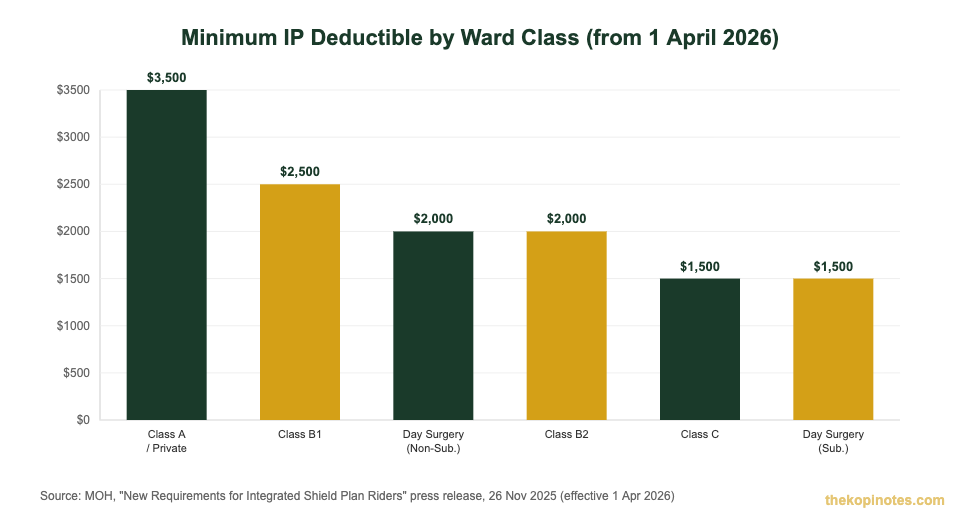
Since your rider can no longer cover this amount, knowing your minimum deductible matters more than ever. MOH sets a minimum deductible for every IP, based on the lower of your plan’s targeted ward class or the ward class you actually use.
| Ward Class | Minimum Deductible (from 1 Apr 2026) |
|---|---|
| Class A / Private Hospital | $3,500 |
| Class B1 | $2,500 |
| Class B2 | $2,000 |
| Class C | $1,500 |
| Day Surgery (non-subsidised) | $2,000 |
| Day Surgery (subsidised) | $1,500 |
Source: MOH, “New Requirements for Integrated Shield Plan Riders” press release, 26 November 2025 (rules effective 1 April 2026).
For example, if your IP is targeted at Class A/private coverage but you’re admitted to a Class B1 ward, your minimum deductible is $2,500 — the lower of the two. Multiple bills within the same policy year count towards the same deductible, so you only pay it once annually, not per admission.
New Rider vs Old Rider: Which Is Actually Better?
There’s no single “best” rider — it depends on how often you expect to claim and how much cash buffer you’re comfortable holding. Here’s how the two designs compare.
| Feature | Old-Style Rider | New-Style Rider (from 1 Apr 2026) |
|---|---|---|
| Covers your deductible | Yes | No — you pay it yourself |
| Annual co-payment cap (excl. deductible) | From $3,000 | From $6,000 |
| Minimum co-payment | 5% | 5% (unchanged) |
| Premium vs old rider | Baseline | ~30% lower on average |
| Best suited for | Frequent claimants who want near-zero cash outlay | Lower-risk policyholders prioritising premium savings |
Source: MOH press release, 26 November 2025.
MOH’s own worked examples make the trade-off concrete. A 60-year-old who switches to the new rider saves 30% in premiums — about $1,600 in cash that year. Three years later, if he needs a $56,900 knee replacement at a private hospital, he pays a $3,500 deductible plus 5% co-payment, totalling $6,170 (fully payable from MediSave at claim time). That’s $3,330 more out-of-pocket than under his old rider — but he’d already banked $4,800 in premium savings over those three years.
A 40-year-old who previously skipped a rider because premiums felt too high can now afford one under the new design, paying about $500 less a year than peers who bought riders under the old rules. If she later needs a $38,700 ACL reconstruction, her deductible and co-payment come to $5,260, of which $3,900 is MediSave-payable — leaving $1,360 out-of-pocket with the rider, versus $3,120 without one.
However, hospitalisation isn’t an annual event for most people. MOH notes an average 60-year-old is hospitalised about twice in the next 10 years, and an average 40-year-old only once or twice in the next 20 years — which is why the premium savings tend to outweigh the higher co-payment for most policyholders over time.
How to Choose the Best Rider for You
Once you’ve compared the two designs, use these questions to figure out which rider actually suits your situation. There’s no universal winner — only the right fit for your finances.
Consider a new-style rider (or switching to one) if:
- You have at least $3,500 to $6,000 in emergency cash savings that you could draw on if hospitalised — enough to cover the deductible and co-payment cap.
- You rarely make hospital claims and would rather pay lower premiums every year than “insure” against a low-probability event.
- You’re younger, generally healthy, and your premiums still have decades to compound if left unspent.
Stick with your existing old-style rider (if you’re still eligible to renew it) if:
- You have a chronic condition or family history that makes frequent hospitalisation more likely.
- You don’t have a comfortable cash buffer and would struggle to find $3,500+ on short notice.
- Peace of mind matters more to you than the premium saving — some policyholders are simply more risk-averse, and that’s a valid reason on its own.
Can You Pay Your Rider With MediSave?
No. Rider premiums are always cash-only, no matter which insurer or design you pick. This is a common point of confusion, because MediSave can cover part of your base IP premium and, separately, the deductible and co-payment on an actual hospital bill.
Here’s how MediSave actually applies across the three components of your coverage:
- MediShield Life premium: fully payable by MediSave, no withdrawal limit.
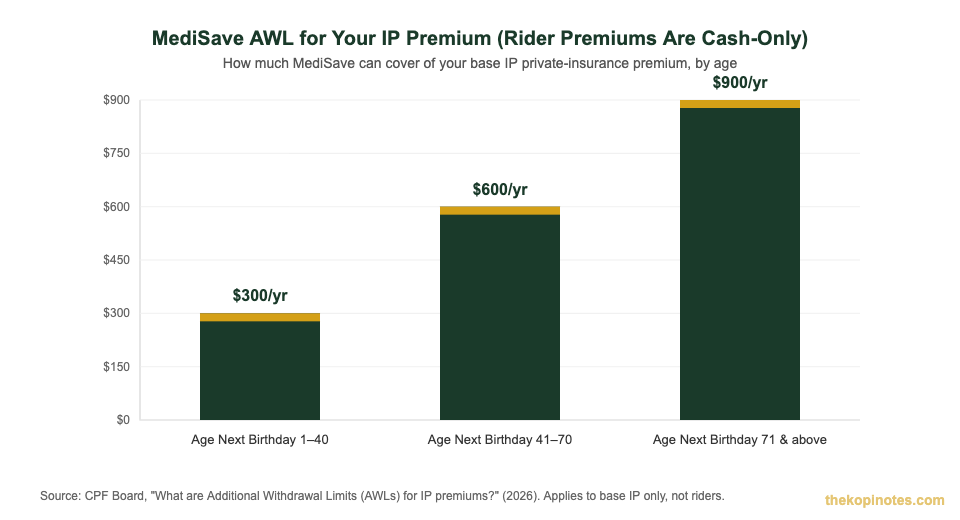
- Base IP private insurance premium: payable by MediSave up to your Additional Withdrawal Limit (AWL), which rises with age. Anything above the AWL must be paid in cash.
- Rider premium: 100% cash. MediSave cannot be used at all (confirmed by MOH), by design — this keeps a real cost attached to buying extra co-payment protection.
- Deductible and co-payment on an actual bill (when you’re hospitalised): payable by MediSave, subject to the standard MediSave hospitalisation withdrawal limits — this is a different limit from the AWL.
| Age Next Birthday | Additional Withdrawal Limit (base IP premium only) |
|---|---|
| 1 – 40 | $300 / year |
| 41 – 70 | $600 / year |
| 71 and above | $900 / year |
Source: CPF Board, “What are Additional Withdrawal Limits (AWLs) for IP premiums?” (2026).
For a full walkthrough of how the AWL interacts with your total IP premium, see our MediSave for Integrated Shield Plan premiums guide.
Should You Switch to the New Rider?
If you bought your rider before 27 November 2025, you’re not forced to switch immediately. Your insurer will transition you to a compliant rider no later than your policy renewal after 1 April 2028. That gives you time to plan, rather than a decision you need to make today.
That said, it’s worth reviewing your policy now instead of waiting for the deadline. Ask your insurer or financial adviser for a side-by-side illustration: your current premium versus the new rider’s premium, and how that gap compares against your emergency savings. If you’re already comfortable self-funding a $3,500 deductible plus 5% co-payment, switching early locks in the savings sooner.
If you don’t have a rider today, the lower premiums under the new design make this a reasonable time to reconsider one — especially if you’re leaning towards private or Class A hospital care, where deductibles and co-payment caps are highest. Compare quotes from more than one insurer, since premiums for the same coverage level can vary meaningfully. Our comparison of all 7 Integrated Shield Plan insurers is a good starting point, and our AIA Integrated Shield Plan review breaks down one of the more popular options in detail.
Whatever you decide, don’t let deadline anxiety push you into a plan that doesn’t fit your budget. For a full picture of how insurers stack up beyond just the rider, our best Integrated Shield Plan guide and full breakdown of the new MOH rider rules cover the base plan decision in more depth.
Frequently Asked Questions
What is the best rider for an Integrated Shield Plan in Singapore in 2026?
There’s no single best rider for everyone. New-style riders (sold from 1 April 2026) suit policyholders who want lower premiums and can self-fund a $1,500–$3,500 deductible plus 5% co-payment if hospitalised. Older-style riders, where still available to you, suit people who prioritise near-zero cash outlay over premium savings. Compare quotes across AIA, Great Eastern, HSBC Life, Income, Prudential, Raffles Health Insurance, and Singlife before deciding.
What changed for Integrated Shield Plan riders on 1 April 2026?
From 1 April 2026, new riders can no longer cover your IP deductible, and the minimum annual co-payment cap rose from $3,000 to $6,000. In exchange, new rider premiums are around 30% cheaper on average than existing riders with maximum coverage.
Can I still keep my old-style rider with full deductible coverage?
Insurers stopped selling non-compliant riders from 1 April 2026. If you already hold one bought before 27 November 2025, you can typically keep renewing it until your policy renewal after 1 April 2028, when you’ll be moved to a compliant rider. Check with your insurer for your specific transition date.
Can I use MediSave to pay for my Integrated Shield Plan rider?
No. Rider premiums must always be paid in cash. MediSave can cover your MediShield Life premium in full and your base IP private insurance premium up to your Additional Withdrawal Limit ($300–$900 a year by age), but never the rider premium itself.
Is it worth switching to the new rider if I already have one?
It depends on your cash buffer and claim frequency. MOH’s own illustrations show a 60-year-old switcher saving $4,800 in premiums over three years, but paying $3,330 more out-of-pocket for a major claim in that period. If you rarely claim and have savings to cover the deductible, switching usually comes out ahead financially.
What is the minimum co-payment I still have to pay with a rider?
Even with the most comprehensive new-style rider, you still pay at least 5% of your bill above the deductible — this minimum co-payment rule is unchanged from before the reform. The rider only caps how high your total annual co-payment can go, currently at a minimum of $6,000 for compliant claims.
Compare Your Integrated Shield Plan Options
See how all 7 MOH-approved insurers stack up before you commit to a rider.
Get Free Insurance Advice
Speak with a licensed insurance advisor. No obligation, no cost.
By submitting this form, you agree to our Privacy Policy.
This article was researched with the help of AI. While we strive to keep all information accurate and up to date, there may be errors. If you notice any discrepancies, please contact us.