Integrated Shield Plans · MediSave
New ISP Rider Rules 2026: What Changed and How It Affects Your MediSave
Updated August 2026 · By The Kopi Notes
From 1 April 2026, new Integrated Shield Plan (ISP) riders can no longer cover your minimum deductible. The annual co-payment cap has doubled from $3,000 to $6,000. But here is the upside: new rider premiums are expected to drop by around 30%, saving private hospital policyholders about $600 a year. Your MediSave can still be used to cover both the deductible and co-payment — nothing changes there. Data verified as at 23 August 2026.
Not financial advice. All figures are for educational reference only. Data sourced from MOH press releases and official insurer information as at August 2026 unless noted.
- New riders from April 2026 no longer cover the deductible ($1,500–$3,500 depending on ward class).
- The co-payment cap doubled from $3,000 to $6,000 per year — but rider premiums drop ~30%.
- MediSave can still pay your deductible and co-payment, subject to prevailing withdrawal limits.
What Exactly Changed from 1 April 2026?
On 26 November 2025, the Ministry of Health (MOH) announced significant reforms to how ISP riders work. The changes took effect on 1 April 2026 for all new rider sales.
Before April 2026, you could buy an ISP rider that covered almost everything — your deductible, your co-payment, right down to nearly the last dollar. These “full riders” were popular, but they were also expensive and drove up healthcare costs across the board.
Here is what MOH changed:
| Feature | Before 1 April 2026 | From 1 April 2026 (New Riders) |
|---|---|---|
| Deductible coverage | Rider could fully cover it | Rider cannot cover the minimum deductible |
| Co-payment | Minimum 5% | Minimum 5% (unchanged) |
| Annual co-pay cap | $3,000 per year | $6,000 per year (minimum) |
| Rider premiums | Higher (max coverage) | ~30% lower on average |
| MediSave for deductible | Allowed (subject to limits) | Still allowed (unchanged) |
Source: Ministry of Health Singapore, November 2025
In plain terms: you now pay more out-of-pocket when hospitalised if you buy a new rider. But your monthly or annual rider premiums will be significantly cheaper.
For a full overview of how ISPs work in Singapore, see our integrated shield plan complete guide.
Why MOH Made This Change
The numbers tell the story. MOH data shows that private hospital IP policyholders who had full riders were 1.4 times more likely to make a claim and incurred 1.4 times larger average claim sizes compared to those without riders.
This led to a spiral: more claims → higher bill sizes → higher insurance premiums → more expensive riders for everyone.
By requiring new riders to leave the deductible uncovered, MOH aims to bring health insurance back to its original purpose: protecting you from large, catastrophic bills — not insulating you from every dollar of a hospital stay.
That rate of increase was unsustainable. These changes are designed to slow it down — for everyone’s benefit, including yours as a long-term policyholder.
The New Deductible Rules by Ward Class
The minimum deductible you must pay depends on the ward class your IP targets and the ward you actually use. Here are the amounts, as set by MOH (effective from April 2026):
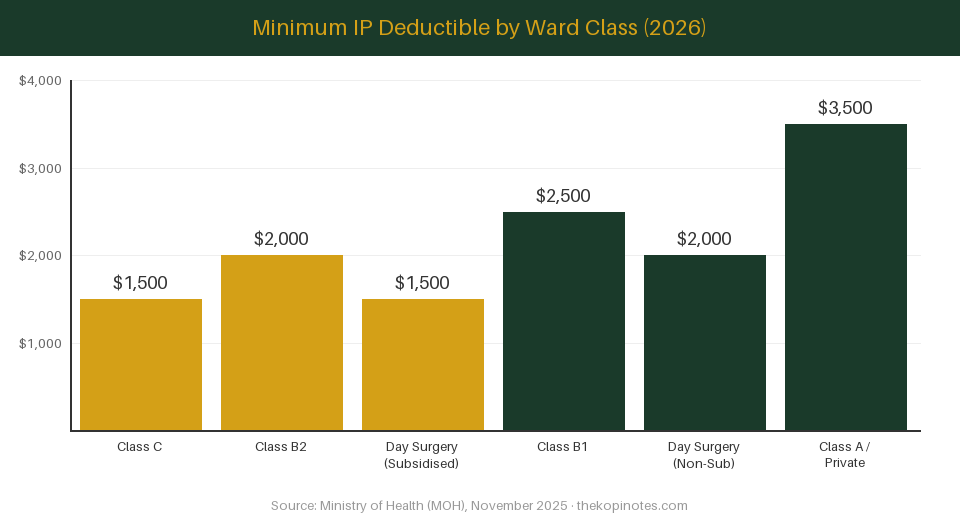
| Ward Class Used | IP Coverage Targeted | Minimum Deductible |
|---|---|---|
| Class A or Private | Class A / Private | $3,500 |
| Class B1 | Class B1 and above | $2,500 |
| Class B2 | Any | $2,000 |
| Class C | Any | $1,500 |
| Day Surgery (Non-Subsidised) | Any | $2,000 |
| Day Surgery (Subsidised) | Any | $1,500 |
Source: MOH, Annex A, November 2025. Minimum deductibles may be revised over time.
There is one nuance to note. The deductible that applies to you is the lower of: (a) the amount for your IP’s targeted ward class, and (b) the ward class you actually use. For example, if your plan targets Class B1 wards but you end up in a Class C ward, your deductible is $1,500 — not $2,500.
How MediSave Fits In
Nothing has changed about MediSave’s role. You can still use your MediSave account to pay both the deductible and the co-payment, subject to the prevailing MediSave withdrawal limits.
This is important. Many Singaporeans assume the new rules mean more cash out-of-pocket. That is not necessarily true. Your MediSave can absorb much of the new deductible, as long as you have the balance and you are within MOH’s withdrawal limits for your procedure.
Here is how it plays out in a real example:
Mrs B, 40 years old, tears her knee playing sport. She undergoes ACL reconstruction at a private hospital. Bill: $38,700.
- IP deductible (Class A/Private): $3,500
- 5% co-payment on remaining bill: $1,760
- Total deductible + co-pay: $5,260
- Covered by MediSave (subject to limits): $3,900
- Remaining cash out-of-pocket: $1,360
- Balance of bill ($38,700 − $5,260): covered by IP and rider
Without a rider, Mrs B would have paid $3,120 in cash. With the new rider, she pays $1,360. The rider still saves her money — just not as dramatically as the old “near-zero” rider did.
For context on how MediSave integrates with your CPF savings strategy, read our guide on CPF investment strategy for Singaporeans.
The Premium Savings: What You Actually Save
Here is the trade-off in numbers. Because new riders cover less, their premiums drop significantly — by around 30% on average, according to MOH.
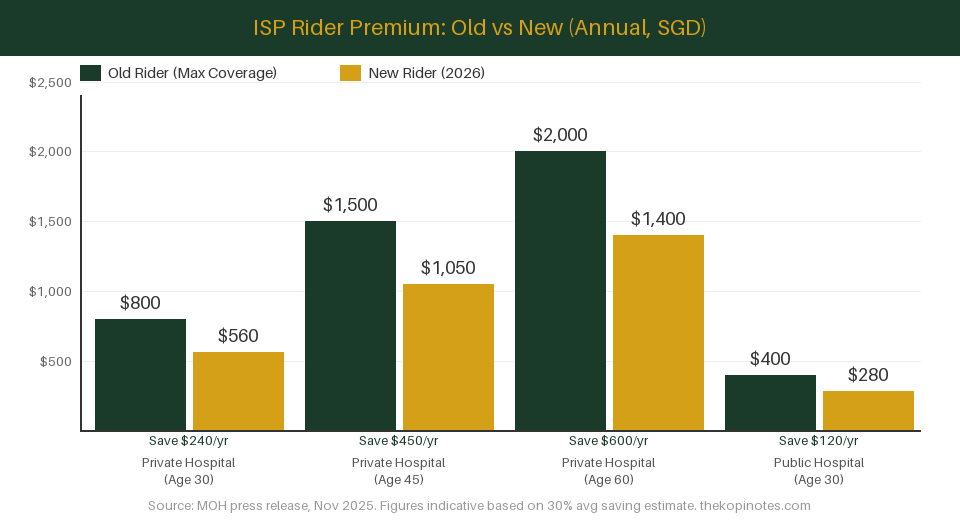
In cash terms:
- Private hospital IP rider policyholders: save about $600 per year on average
- Public hospital IP rider policyholders: save about $200 per year on average
- Older policyholders enjoy greater absolute savings because their premiums are higher
MOH modelled a 60-year-old (Mr A) who switches from his old full rider to a new rider in April 2026. He immediately saves $1,600 in rider premiums that year. Three years later, he has a knee replacement surgery that costs $56,900. Under the new rider, he pays $6,170 out-of-pocket (deductible + 5% co-pay). Under his old rider, he would have paid $2,840. That is $3,330 more.
However — he already saved $4,800 in rider premiums over those three years. Net result: he is $1,470 better off by switching, even after the more expensive hospital bill.
The average 60-year-old Singaporean is hospitalised about twice in their next 10 years. Over that period, the premium savings tend to outweigh the additional out-of-pocket from higher deductibles and co-pay caps — especially for policyholders who maintain good health and use MediSave to offset hospital bills.
Should You Switch to the New Rider?
There is no single right answer. It depends on your health situation, financial comfort, and how much cost predictability matters to you. Here is a simple framework:
The new rider may suit you better if:
- You are generally healthy and rarely hospitalised
- You have a healthy MediSave balance that can absorb deductibles
- You want lower monthly premiums to free up cash flow
- You are comfortable with some uncertainty in hospital bills
Keep your existing rider if:
- You have ongoing health conditions requiring frequent hospital visits
- You strongly prefer “near-zero” out-of-pocket predictability
- Your MediSave balance is low and you cannot absorb the deductible in cash
- You are older and your risk of hospitalisation is meaningfully higher
For Singaporeans comparing specific insurer plans, our Singlife Shield Plan review and Prudential PRUShield guide explain how each insurer has adapted their offerings for the new rules.
You might also use our Singapore retirement planning calculator to see how higher annual insurance premiums affect your long-term financial picture.
What If You Already Have a Rider?
If you purchased your rider before 27 November 2025, your current plan stays intact. Nothing changes automatically on 1 April 2026. Your deductible coverage, co-payment cap, and benefits remain as-is under your existing contract.
However, there is a transition pathway to know about:
- If you bought a rider between 27 November 2025 and 31 March 2026, your insurer will transition it to the new structure at your next renewal after 1 April 2028.
- If you choose to voluntarily switch to a new rider after April 2026, no new underwriting is required. Your existing medical conditions remain covered.
- Insurers will also review their legacy rider portfolios individually. Some may keep older plans as-is; others may encourage switching.
The bottom line: if you are on an old full rider and it suits your needs, you can keep it for now. But watch your renewal notice — your insurer must inform you of any changes before they happen.
Frequently Asked Questions
Can I still use MediSave to pay the new deductible?
Do the new rules apply to my existing rider?
How much is the co-payment cap under the new rider?
What are the minimum deductibles for each ward class?
Will rider premiums actually go down?
Do I need new medical underwriting if I switch to the new rider?
Which insurers sell new ISP riders in Singapore?
Not sure which ISP is right for you?
Compare your current plan against the new rider options. Our integrated shield plan guide walks you through what each insurer offers for private, Class A, and Class B1 coverage.
Get Free Insurance Advice
Speak with a licensed insurance advisor. No obligation, no cost.
By submitting this form, you agree to our Privacy Policy.
This article was researched with the help of AI. While we strive to keep all information accurate and up to date, there may be errors. If you notice any discrepancies, please contact us.