Life Insurance Policy Singapore 2026: Complete Buyer’s Guide
Term, Whole Life, Critical Illness & DPS — What You Need, How Much Cover, and How to Buy
A life insurance policy in Singapore is a contract that pays a lump sum or income to your family if you die, become critically ill, or suffer total permanent disability. Singapore offers four main policy types — term life, whole life, critical illness, and endowment — with sum assured from S$50,000 to over S$2 million. The cheapest coverage starts from around S$200 per year for a 30-year-old, making life insurance one of the most affordable forms of financial protection available.
Not financial advice. All figures are for educational reference only. Data as at June 2026 unless noted.
- Most Singaporeans need at least 9–10× their annual income in life cover — S$500k for a S$50k/yr earner.
- Term life is cheapest for pure protection; whole life builds cash value but costs 10–15× more annually.
- Buy early: a 25-year-old pays 30–40% less than a 35-year-old for the same coverage.
Table of Contents
Contents — Click to expand
What Is a Life Insurance Policy?
A life insurance policy is a legal contract between you and an insurer. You pay regular premiums. In return, the insurer pays a lump sum — called the sum assured — to your beneficiaries when a covered event occurs.
In Singapore, covered events typically include death, total and permanent disability (TPD), and sometimes terminal illness. Critical illness (CI) plans add a further payout trigger: diagnosis of a serious illness like cancer, stroke, or heart attack.
The Life Insurance Association Singapore (LIA) reports that Singapore’s average life insurance protection gap is roughly S$382,000 per working adult. That means most people are underinsured — even if they have some coverage.
The key terms you’ll encounter when buying any life insurance policy in Singapore:
| Term | What It Means |
|---|---|
| Sum Assured | The lump-sum payout your beneficiaries receive on a claim. Should cover your debts + income replacement + family expenses. |
| Premium | The monthly or annual payment you make to keep the policy active. Missed payments lapse the policy. |
| Beneficiary | The person(s) who receive the payout. Can be a spouse, children, or estate. Must be named in the policy. |
| Cash Value | Savings component that builds up in whole life and endowment policies. You can surrender the policy for cash, but early surrender values are low. |
| Exclusions | Events the policy will NOT pay for — typically suicide within 1 year, pre-existing conditions, and war. |
| Waiting Period | Some CI plans have a 90-day waiting period from policy start before CI benefits activate. |
Source: LIA Singapore, MAS MoneySense. Definitions as at June 2026.
4 Main Types of Life Insurance in Singapore
Before you buy any policy, you need to understand what each type does — and doesn’t — cover. Here’s a plain-English breakdown of the four main life insurance categories in Singapore.
1. Term Life Insurance
Term life pays out a lump sum if you die (or become TPD) within a set period — typically 5 to 40 years, or up to age 65 or 70. There is no cash value. When the term ends, the policy expires with nothing returned.
This is the cheapest way to get pure protection. A 30-year-old male can secure S$500,000 of cover for roughly S$340 per year — that’s less than S$30 per month. If you’re looking purely to protect your family’s income, term life gives the most cover per dollar.
2. Whole Life Insurance
Whole life covers you for your entire life — not just a fixed term. It also builds up a cash value over time, via a participating (par) fund. You can eventually surrender the policy for cash, or use the cash value as collateral for a loan.
The trade-off? It costs significantly more than term. Expect to pay S$3,000–S$5,000 per year for S$300,000 coverage at age 30. The cash value growth is not guaranteed — it depends on the insurer’s par fund performance. That said, whole life can make sense as a wealth transfer tool for high-net-worth individuals or if you want lifelong coverage.
3. Critical Illness (CI) Insurance
CI insurance pays a lump sum on diagnosis of a serious illness — not just death. The LIA defines 37 standard critical illnesses, including all cancers, stroke, and heart attack. You receive the full sum assured at the point of diagnosis, regardless of whether you survive.
CI is separate from hospitalisation coverage. MediShield Life and Integrated Shield Plans (ISPs) cover your hospital bills. CI covers your income replacement while you recover — medical bills, mortgage payments, and living expenses during treatment.
A related product is Early Critical Illness (ECI) insurance, which pays out at earlier stages of illness — for example, early-stage cancer (stage 1 or 2). Read our early critical illness insurance Singapore guide for a full comparison.
4. Dependants’ Protection Scheme (DPS)
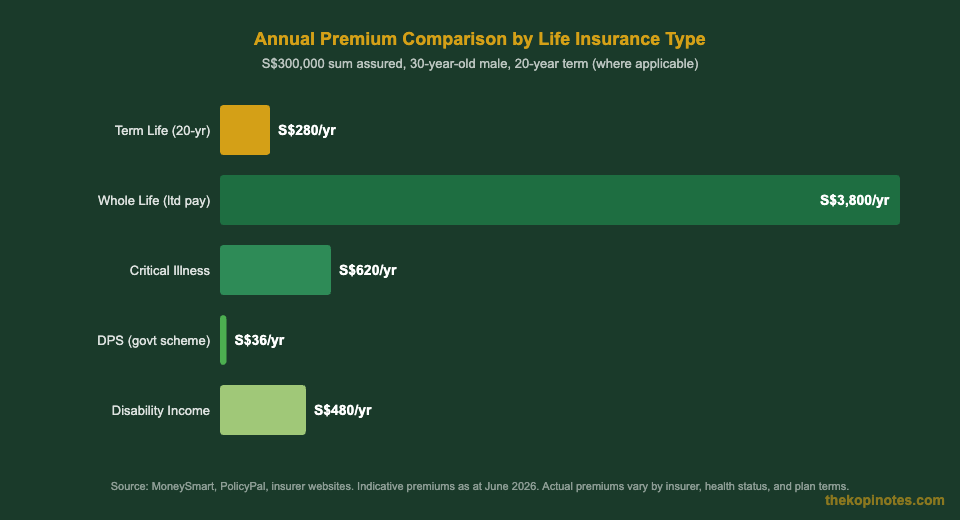
DPS is a government-backed term life scheme for CPF members aged 21–65. It provides S$46,000 in death and TPD cover for premiums as low as S$36 per year — automatically deducted from your CPF OA/SA. Almost all working Singaporeans are enrolled unless they opt out.
DPS is a safety net, not a comprehensive solution. Most families need far more than S$46,000. See our DPS Singapore guide for full details on coverage, premiums, and how to top up.
| Policy Type | Covers | Has Cash Value? | Best For | Typical Cost |
|---|---|---|---|---|
| Term Life | Death / TPD for fixed term | No | Income replacement during working years | S$200–S$500/yr (30yo, S$300k) |
| Whole Life | Death / TPD for life | Yes (par fund) | Wealth transfer, lifelong cover | S$3,000–S$5,000/yr |
| Critical Illness | Diagnosis of 37 illnesses | Some plans | Income replacement during illness | S$500–S$900/yr (30yo, S$300k) |
| DPS (govt) | Death / TPD up to S$46k | No | Basic safety net for CPF members | S$36–S$190/yr (CPF deducted) |
| Disability Income | Monthly income if unable to work | No | Self-employed, breadwinners | S$400–S$700/yr |
Source: LIA Singapore, insurer websites, MoneySense. Indicative premiums as at June 2026. Actual premiums vary by health, smoking status, and plan chosen.
How Much Life Insurance Do You Need?
The most widely used rule of thumb in Singapore is the DIME method — Debt, Income, Mortgage, Education. Add these four numbers together to get your total coverage need.
Here’s how it works for a typical 35-year-old Singaporean with a S$60,000 annual income:
| DIME Component | How to Calculate | Example (S$60k income) |
|---|---|---|
| D — Debt | All outstanding debts (car loan, credit cards, personal loan) | S$30,000 |
| I — Income | Annual income × years until retirement (use 25–30 years) | S$60,000 × 25 = S$1,500,000 |
| M — Mortgage | Outstanding home loan balance | S$350,000 |
| E — Education | Estimated education costs for each child (university: ~S$60k local, S$200k overseas) | S$120,000 (2 children) |
| Total Coverage Needed | S$2,000,000 | |
Source: DIME method adapted from LIA Singapore financial planning framework. Example for illustration only.
S$2 million sounds like a lot — but a S$500k, 30-year term life policy costs a 35-year-old male roughly S$520 per year. That’s S$43 per month to protect S$2 million in family financial obligations. Many people are genuinely underinsured simply because they haven’t done this calculation.
You can use TKN’s free life insurance needs calculator to run your own DIME calculation in under 2 minutes. And if you already have some coverage, the insurance gap calculator will show exactly how much additional cover you still need.
Premium Comparison Table by Type & Age
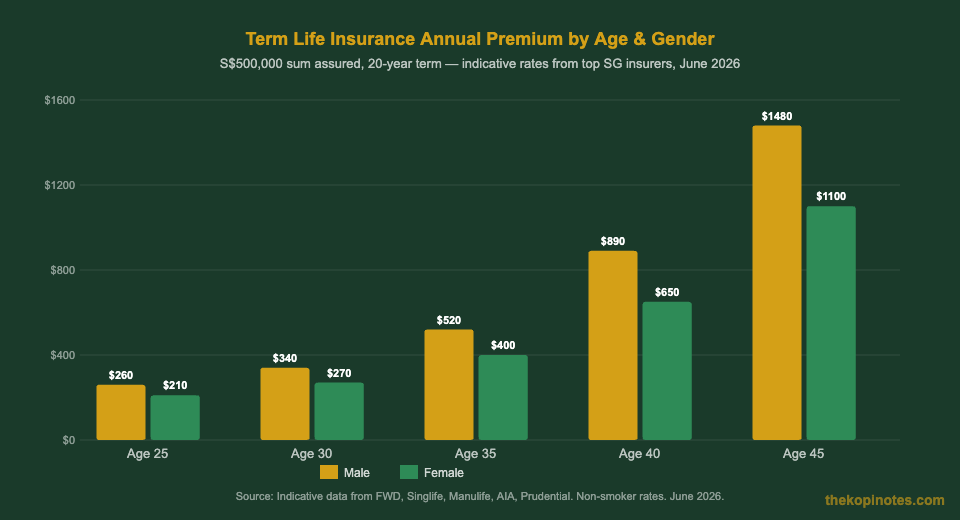
Premiums rise sharply with age — which is why buying earlier saves money. Here’s a comparison of indicative annual premiums for term life (S$500,000, 20-year term) and critical illness (S$300,000) across age groups, for non-smoker males and females:
| Age | Term Life (M) | Term Life (F) | CI (M) | CI (F) |
|---|---|---|---|---|
| 25 | S$260/yr | S$210/yr | S$480/yr | S$560/yr |
| 30 | S$340/yr | S$270/yr | S$620/yr | S$720/yr |
| 35 | S$520/yr | S$400/yr | S$950/yr | S$1,100/yr |
| 40 | S$890/yr | S$650/yr | S$1,600/yr | S$1,850/yr |
| 45 | S$1,480/yr | S$1,100/yr | S$2,600/yr | S$2,900/yr |
Source: Indicative rates compiled from FWD, Singlife, Manulife, AIA, Prudential websites. Non-smoker, standard health, Singapore resident. Term life: S$500k, 20-year term. CI: S$300k, 20-year term. June 2026. Actual premiums depend on health declaration, plan selected, and insurer.
Notice how a 45-year-old male pays more than 5× the premium of a 25-year-old for the same cover. Buying at 25 vs 35 saves you roughly S$260/yr on term life alone — that’s S$5,200 over a 20-year term. The cost of waiting is real.
Best Life Insurance Plans 2026 (by Type)
There is no single “best” life insurance policy in Singapore — it depends on your age, budget, health, and what you’re protecting against. That said, here are the top-rated plans in each category as at 2026, based on premium competitiveness, financial strength ratings, and policy terms.
Best Term Life Plans
| Insurer | Plan | Key Features | Premium (30M, S$500k, 20yr) |
|---|---|---|---|
| FWD | FWD Term Life | Direct purchase, no advisor needed, CI rider available | ~S$310/yr |
| Singlife | Singlife Term Life Elite | Convertible to whole life, TPD included, CI rider option | ~S$330/yr |
| Manulife | ManuProtect Term II | Renewable, convertible, waiver of premium rider | ~S$340/yr |
| AIA | AIA Secure Flexi Term | Flexible term length (5–40yr), multi-CI rider option | ~S$350/yr |
| Prudential | PRUActive Term II | Convertible, guaranteed renewability, Vitality discounts | ~S$360/yr |
| NTUC Income | iTerm | Direct purchase, co-op pricing, return of premium option | ~S$340/yr |
Source: Indicative premiums from insurer websites and MoneySmart. Non-smoker, 30-year-old male, S$500,000, 20-year term. June 2026. Subject to underwriting.
Best Whole Life Plans
For those who want lifelong coverage with a cash value component, these plans consistently rank well on par fund performance and premium competitiveness:
| Insurer | Plan | Pay Term | Key Strength |
|---|---|---|---|
| Great Eastern | GREAT Whole Life | 15/20/25yr or to age 65 | Strong par fund track record, high bonus rates |
| AIA | AIA Whole Life | 20yr or to age 65 | Vitality wellness discounts, strong financial rating |
| Prudential | PRULife II | 15/20yr or to age 65 | Long-standing par fund, estate planning tools |
| Manulife | ManuLife Whole Life | 20yr or to age 65 | Competitive guaranteed cash values |
Source: Insurer brochures and MAS product highlights. June 2026.
For a full breakdown of whole life plans including cash value projections and who should buy, see our whole life insurance Singapore guide.
Step-by-Step Buying Guide
Buying the right life insurance policy in Singapore is easier than most people think. Here are 6 steps to get covered correctly.
Step 1: Calculate your coverage need. Use the DIME method above, or the life insurance needs calculator. Write down the number before you talk to anyone.
Step 2: Decide between term vs whole life. If your main goal is income protection for your family during your working years, term life wins on cost and simplicity. If you want lifelong coverage and have budget for savings + protection, whole life may suit you. Most financial planners recommend term life + separately investing the savings difference.
Step 3: Choose your platform. You have two main routes in Singapore:
- Financial Adviser (FA): Gives you access to multiple insurers, personalized advice, and help with claims. Usually no extra cost (FA earns commission from insurer). Recommended if you want guidance or have complex needs.
- Direct Purchase Insurance (DPI): Buy online without an adviser via FWD, Singlife, or NTUC Income. Premiums are 10–30% lower since no commission is paid. Best if you know exactly what you need and want the cheapest price.
Step 4: Compare quotes. Get at least 3 quotes. You can compare term life premiums on CompareFirst.sg (MAS’s free comparison portal) before committing. For CI and whole life, an FA comparison is more efficient.
Step 5: Complete the health declaration honestly. Non-disclosure of pre-existing conditions is the most common reason claims are rejected. Disclose everything — the insurer may add exclusions or load premiums, but your claim will be protected.
Step 6: Review annually and after life events. When you get married, have children, take on a mortgage, or get a pay raise — review your coverage. Your needs change. What was sufficient at 28 may be inadequate at 35.
If you’re ready to start, Endowus (referral code 2V343) and Syfe (referral code SRPRFFFCD) both offer insurance and investment products alongside financial planning tools — useful if you want to manage your protection and investments in one place.
CPF, Medisave & Life Insurance
Your CPF accounts can play a useful role in funding life insurance, depending on the policy type.
| Policy Type | Can Use CPF OA? | Can Use Medisave? | Annual CPF/Medisave Limit |
|---|---|---|---|
| DPS (term life govt) | Yes (OA/SA auto-deducted) | No | Auto (S$36–S$190/yr) |
| Term Life (private) | Yes (approved plans only) | No | Up to S$5,000/yr (OA) |
| Whole Life | Yes (approved plans only) | No | Up to S$5,000/yr (OA) |
| CI Insurance | No (cash only) | No | N/A |
| Integrated Shield Plan (ISP) | Yes (Medisave) | Yes (premium) | S$600–S$1,600/yr (Medisave) |
Source: CPF Board, MAS MoneySense. CPF OA usage rules for insurance as at June 2026. Check with your insurer for plan-specific eligibility.
One important note: using CPF OA for insurance premiums reduces the compound interest you earn on your OA balance (currently 2.5% p.a.). For most people, paying premiums in cash and leaving CPF OA to compound is the better financial outcome — but it depends on your cash flow.
If you want to optimise your retirement savings while covering your protection needs, see our CPF investment strategy guide and use the Singapore retirement calculator to model different scenarios.
Frequently Asked Questions
What is the minimum sum assured for a life insurance policy in Singapore?
How much does life insurance cost in Singapore per month?
Should I buy term or whole life insurance in Singapore?
Is life insurance compulsory in Singapore?
Can I use CPF to pay for life insurance?
What is the difference between life insurance and critical illness insurance?
When is the best age to buy life insurance in Singapore?
What happens if I miss a premium payment?
Can I have multiple life insurance policies in Singapore?
Get Free Insurance Advice
Speak with a licensed insurance advisor. No obligation, no cost.
By submitting this form, you agree to our Privacy Policy.
This article was researched with the help of AI. While we strive to keep all information accurate and up to date, there may be errors. If you notice any discrepancies, please contact us.