Disability Income Insurance for Self-Employed Singapore 2026: The Freelancer Coverage Guide
Table of Contents
Jump to a section
- What Is Disability Income Insurance?
- Why Self-Employed Singaporeans Need It More
- The MAS 75% Cap: How Much Can You Claim?
- Choosing the Right Deferment Period
- Key DI Plans Compared (2026)
- Income Documentation for Self-Employed Applicants
- Is DI Insurance Worth It for Freelancers?
- Frequently Asked Questions
If you are self-employed in Singapore and you cannot work due to illness or injury, you lose 100% of your income from day one. Unlike salaried employees who get sick leave and employer-paid coverage, freelancers and gig workers bear all the risk themselves. Disability income (DI) insurance replaces up to 75% of your pre-disability income — up to MAS caps — giving you a monthly payout during recovery so your bills get paid even when you cannot earn.
Not financial advice. All figures are for educational reference only. Premiums shown are indicative estimates. Always consult a licensed financial adviser before purchasing insurance. Data verified as at 23 September 2026.
- Self-employed Singaporeans have no employer sick leave, making DI insurance even more critical than it is for employees.
- MAS caps your total DI benefit at 75% of your average monthly income across all policies.
- Choose a 30 to 60 day deferment period if you have 1 to 2 months of savings set aside.
What Is Disability Income Insurance?
Disability income (DI) insurance pays you a monthly benefit if you are unable to work due to illness or injury. It is sometimes called income replacement insurance or income protection insurance.
The payout replaces a portion of your lost income during the time you cannot work. Benefits typically last until you recover, reach the end of the benefit period, or hit the policy age limit (usually 60 or 65).
DI insurance is different from critical illness (CI) insurance. CI pays a lump sum on a diagnosis — cancer, heart attack, stroke. DI pays a monthly income for as long as you remain unable to work. Both serve different needs, and many Singaporeans carry both.
For a deeper look at how DI insurance works and what the main Singapore plans cover, see the full disability income insurance Singapore guide on TKN.
Why Self-Employed Singaporeans Need DI Cover More
A salaried employee in Singapore typically receives 14 days of paid sick leave per year. Their employer also contributes to their CPF, which builds a safety buffer. If the illness is serious, group insurance from the employer may kick in.
None of that applies to you as a freelancer, sole proprietor, or gig worker.
When you cannot work, your income stops immediately. Fixed costs — rent, loan repayments, utilities, insurance premiums — keep running regardless. The result is a financial shock that can drain months of savings within weeks.
The stakes are especially high in Singapore because the cost of living is significant. A graphic designer earning S$5,000 a month who is out for six months faces a S$30,000 income shortfall on top of any medical bills not covered by MediShield Life or an integrated shield plan.
DI insurance is the one product specifically designed to bridge that gap. It pays you monthly — just like a salary — while you recover.
The MAS 75% Cap: How Much Can You Claim?
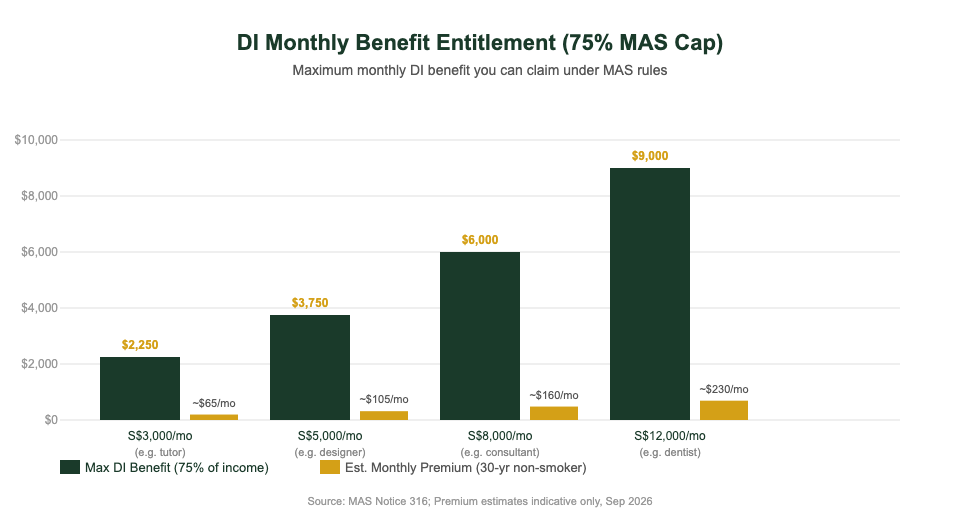
MAS (the Monetary Authority of Singapore) caps total DI benefits at 75% of your pre-disability income across all policies combined. This rule applies whether you hold one DI policy or three.
The cap exists to preserve a financial incentive to return to work. If DI replaced 100% of your income, some claimants might delay recovery. At 75%, you always recover more by returning to work.
For self-employed workers, your insurable income is calculated as your average monthly income over the 36 months before the policy application date. This means you need three full years of income history to maximise your coverage.
If you are a newer freelancer with less than three years of history, insurers will typically base the calculation on the income you can document — which means younger freelancers may start with lower coverage and increase it as their income history builds.
| Monthly Income | Max DI Benefit (75%) | Annual Income Lost (6 months out) | DI Benefit Covers |
|---|---|---|---|
| S$3,000 | S$2,250 | S$18,000 | S$13,500 |
| S$5,000 | S$3,750 | S$30,000 | S$22,500 |
| S$8,000 | S$6,000 | S$48,000 | S$36,000 |
| S$12,000 | S$9,000 | S$72,000 | S$54,000 |
Source: MAS Notice 316 on disability income insurance; figures are illustrative. Sep 2026.
Choosing the Right Deferment Period as a Self-Employed Worker
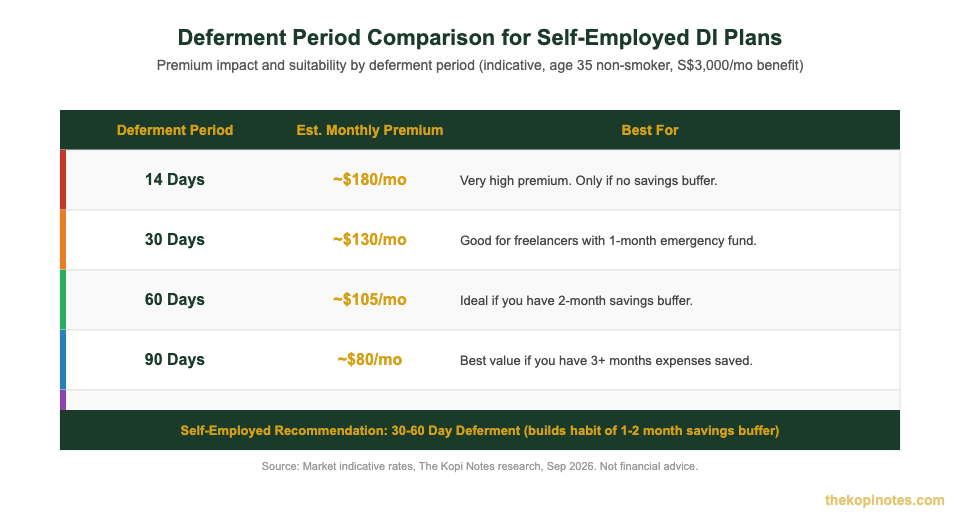
The deferment period (also called the waiting period or elimination period) is the time you must be disabled before your DI benefits start paying out. Common options in Singapore are 14, 30, 60, 90, and 180 days.
A longer deferment period means lower premiums but a longer wait before money arrives. A shorter deferment period costs more but protects you faster.
For employees, a 90-day deferment often works fine. Employer sick leave covers the first two weeks, savings cover the rest until DI kicks in.
For self-employed workers, this logic breaks down. You have no employer sick leave. Every day without income is immediately felt. As a result, most financial advisers recommend a 30 to 60 day deferment period for freelancers and sole proprietors.
The practical rule: your deferment period should match your emergency fund. If you have one month of expenses saved, choose a 30-day deferment. If you have two months, a 60-day deferment saves you roughly 20 to 30% on your monthly premium while still keeping risk manageable.
For a detailed breakdown of how different deferment periods affect your total payout and savings, see the TKN article on the disability income insurance waiting period in Singapore.
Key DI Plans in Singapore Compared (2026)
The main DI plans available to self-employed Singaporeans in 2026 come from AIA, Singlife, Great Eastern, and Prudential. Each handles self-employed income documentation differently, so it pays to compare before applying.
| Insurer | Plan Name | Deferment Options | Own-Occupation Def. | Notes for Self-Employed |
|---|---|---|---|---|
| AIA | Premier Disability Cover | 30, 60, 90, 180 days | Yes (first 2 years) | 2x monthly benefit on claim onset; higher premiums than peers |
| Singlife | Disability Income | 30, 60, 90 days | Yes (first 2 years) | More affordable premiums; good for budget-conscious freelancers |
| Great Eastern | Pay Assure | 30, 60, 90 days | Yes (first 2 years) | Strong claims track record; 3-month income averaging used for payout |
| Prudential | PRUIncome | 14, 30, 60, 90, 180 days | Yes (first 2 years) | Most flexible deferment options; suitable for varying income profiles |
Source: Individual insurer product summaries, The Kopi Notes research. Sep 2026. Features subject to change. Consult an adviser for personalised quotes.
One key feature to understand is the definition of disability. Most DI plans in Singapore use an own-occupation definition for the first two years of a claim. After that, it typically switches to any-occupation. Under own-occupation, you qualify for benefit if you cannot do your specific job. Under any-occupation, you must be unable to do any work at all — a much stricter threshold.
For creatives and knowledge workers — writers, designers, photographers — own-occupation protection is critical. A hand injury that prevents you from working as a graphic designer should still trigger your benefit even if you could theoretically work as a cashier.
If you are comparing critical illness coverage alongside your DI plan, the best critical illness insurance Singapore comparison covers the top CI plans in detail.
Income Documentation: What Insurers Ask From Self-Employed Applicants
This is where self-employed applications get more complex. Insurers need to verify your income before they can set your benefit amount. Without proper documentation, your application may be delayed or your coverage limited.
Here is what most Singapore insurers require from self-employed applicants:
- Notice of Assessment (NOA) from IRAS — typically for the last 2 to 3 years. This is the most important document. Download it from myTax Portal.
- Business registration proof — ACRA Bizfile for sole proprietors, or your freelance contracts and invoices.
- Bank statements — 3 to 6 months of business or personal account statements showing income deposits.
- CPF contribution history — if you make voluntary CPF contributions as a self-employed person, this supports your income claim.
If your income varies significantly from year to year, insurers will typically average your earnings over the last 36 months. A year with unusually high income followed by a lower year may result in a lower-than-expected benefit level.
The practical takeaway: maintain clean income documentation from the start of your freelance career. File your taxes on time, keep your NOA up to date, and issue proper invoices. Good financial hygiene makes DI applications significantly smoother.
Is Disability Income Insurance Worth It for Freelancers?
The short answer is yes — especially if you have dependants, a mortgage, or fixed monthly obligations that cannot pause when your income does.
Consider this scenario. A 35-year-old Singapore-based photographer earns S$6,000 a month. She develops a repetitive strain injury and cannot work for nine months. Her DI policy pays 75% of S$6,000, which is S$4,500 a month.
Over nine months, that is S$40,500 in income replacement — against a monthly premium of roughly S$120 to S$150. Her total premiums paid over 10 years to that point would have been under S$18,000. The policy pays more than double its lifetime cost in a single claim.
That said, DI insurance does not make sense for everyone in every situation:
- If you have 12 months of liquid savings and no dependants, the urgency is lower. You could self-insure for short disabilities.
- If your work is fully passive (rental income, investment dividends), DI insurance protects nothing that does not already continue on its own.
- If premiums are unaffordable, prioritise a shorter benefit period or lower sum assured rather than skipping DI entirely.
The key question is: how long could you sustain your current expenses without any income? If the honest answer is less than six months, DI insurance belongs in your coverage plan.
You can estimate your retirement readiness and savings buffer using the Singapore retirement planning calculator on TKN.
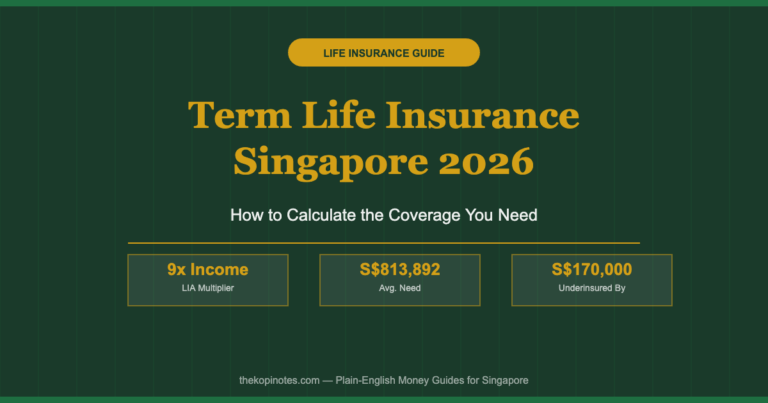
For broader protection as a self-employed Singaporean, consider pairing DI insurance with a term life policy. See the TKN guide on term life insurance Singapore 2026 for current premium benchmarks.
If you want to invest alongside your protection coverage, Endowus (referral code 2V343) offers CPF and SRS investing for self-employed Singaporeans making voluntary contributions.
Frequently Asked Questions
Can self-employed Singaporeans get disability income insurance?
What income documents do I need to apply for DI insurance as a freelancer?
How is my DI benefit amount calculated if my income varies each month?
What is the best deferment period for a self-employed person in Singapore?
Is disability income insurance different from critical illness insurance?
Does DI insurance cover mental health conditions that prevent me from working?
Protect Your Income Before You Need To
Disability income insurance is the protection layer that most self-employed Singaporeans overlook until they need it. By then, it is too late to apply. You cannot purchase DI coverage after an illness or injury has already occurred.
The best time to get covered is when you are healthy, your income is stable, and premiums are at their lowest. A 30-year-old freelancer pays significantly less than a 40-year-old for the same coverage.
Start with your emergency fund target. Once you have 1 to 2 months of expenses saved, a DI policy with a matching deferment period gives you complete income protection coverage at a manageable monthly cost.
Get Free Insurance Advice
Speak with a licensed insurance advisor. No obligation, no cost.
By submitting this form, you agree to our Privacy Policy.
This article was researched with the help of AI. While we strive to keep all information accurate and up to date, there may be errors. If you notice any discrepancies, please contact us.