Best Whole Life Insurance Singapore 2026: Top Plans Compared
Lifelong protection that also builds cash value — here’s how 7 major insurers stack up, and what to check before you sign.
Table of Contents
What Is Whole Life Insurance?
Whole Life vs Term Life: The Real Cost Difference
How the Illustrated Rate of Return Works
7 Best Whole Life Plans in Singapore (2026)
How to Choose the Right Whole Life Plan
Who Should (and Shouldn't) Buy Whole Life
Frequently Asked Questions
The best whole life insurance plans in Singapore for 2026 include Income Insurance Complete Life Secure, Great Eastern GREAT Life Multiplier, Prudential PRUActive Life V, AIA Guaranteed Protect Plus (IV), Manulife LifeReady Plus (II), Singlife Whole Life Choice, and Tokio Marine TM FlexiAssurance. Each covers you for life against death, TPD, and terminal illness, and builds cash value you can borrow against or cash out — but premiums run 6 to 20 times higher than term life for the same coverage.
Not financial advice. All figures are for educational reference only. Data verified as at August 2026 unless otherwise noted.
- Whole life insurance protects you forever and builds cash value — but you pay 6 to 20 times more than term life for the same coverage.
- The “return” on your cash value isn’t guaranteed. Only 3.00% to 4.25% p.a. is illustrated, not promised, by law.
- Most Singaporeans are better off buying term life for pure protection and investing the premium difference — whole life makes sense mainly for legacy planning or if you struggle to save on your own.
What Is Whole Life Insurance?
Whole life insurance covers you for your entire life, not just a fixed term. As long as you keep paying (or finish your premium term), your family gets a payout whenever you pass away — whether that’s next year or in 60 years.
Here’s the twist. Part of every premium you pay goes into a “cash value” account. This cash value grows slowly over your policy, and you can borrow against it, surrender the policy for a lump sum, or in some plans, convert it into a retirement income stream.
That’s very different from term life insurance, which only pays out if you die within a fixed window — say, 20 or 30 years — and has zero cash value if you outlive the term.
Most whole life plans sold in Singapore are “participating” (par) policies. This means you’re pooling your premiums with other policyholders in a Par Fund, which invests in a mix of bonds, equities, and property. Any profit gets shared back to you as bonuses — but those bonuses are never guaranteed.
Whole Life vs Term Life: The Real Cost Difference
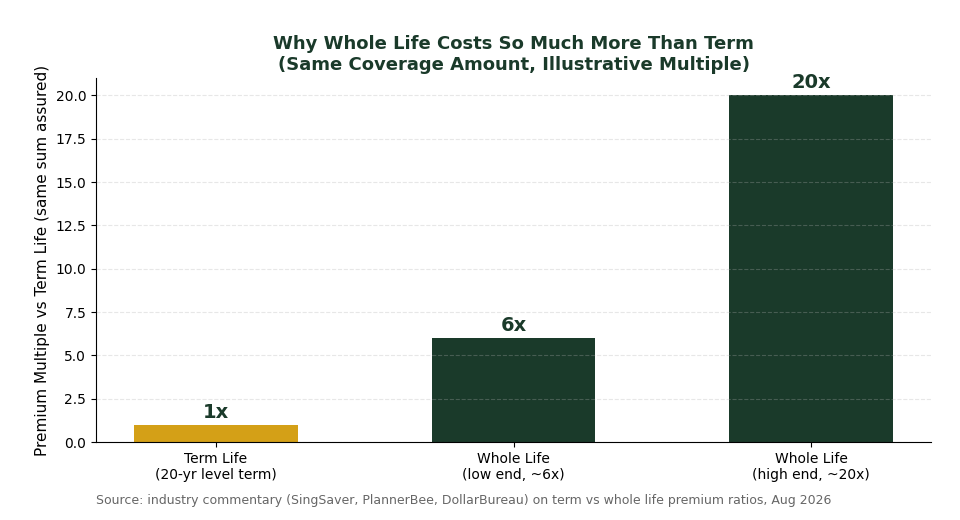
Here’s the number that surprises most first-time buyers. For the same S$500,000 death coverage, a healthy 30-something might pay S$18 to S$100 a month for term life. A whole life policy with identical coverage can cost S$200 to over S$1,000 a month — roughly 6 to 20 times more, according to industry estimates.
That’s not a pricing gimmick. Term life only has to cover the statistical chance you die within the term, which is low for most working adults. Whole life has to cover you no matter when you die, plus fund the cash value account building up behind the scenes. You’re paying for certainty, not just protection.
How the Illustrated Rate of Return Actually Works
Every par whole life policy comes with a “benefit illustration.” It shows two numbers: a guaranteed cash value (small, sometimes close to zero in early years) and a non-guaranteed projection based on an illustrated rate of return.
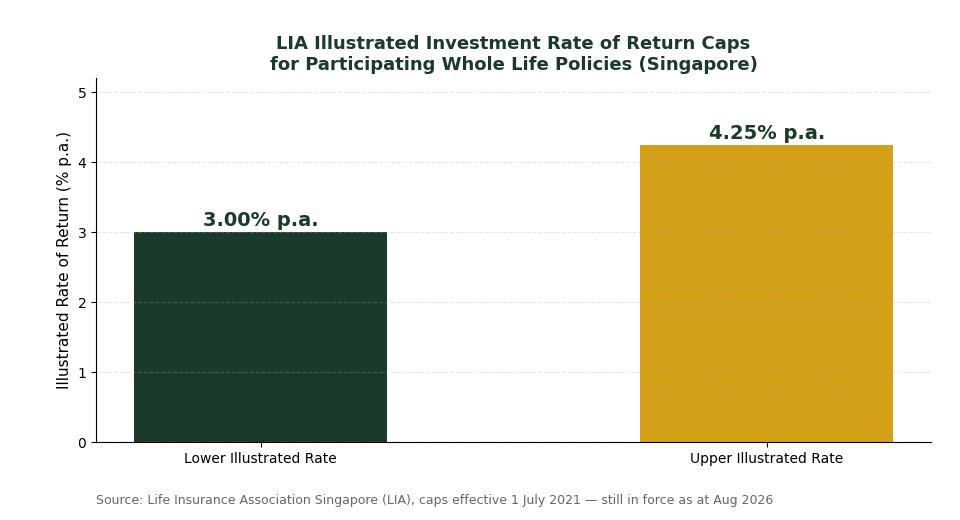
Since 1 July 2021, the Life Insurance Association Singapore (LIA) caps that illustrated rate at 3.00% p.a. (lower) and 4.25% p.a. (upper). Every insurer must use these same two caps — nobody can show you a rosier projection than that, even if their fund actually does better.
Here’s why this matters for you. That 4.25% is not a promise. It’s a ceiling on what insurers are allowed to illustrate, based on LIA’s guidelines on policy illustrations. Your actual bonus depends on how the insurer’s Par Fund performs, and can come in lower than even the 3.00% floor in a bad year.
7 Best Whole Life Plans in Singapore (2026)
Here’s a quick side-by-side of the main whole life plan from each major insurer. Use this as a starting shortlist — always ask for a personalised benefit illustration before you commit, since actual premiums depend on your age, gender, smoker status, and health.
| Insurer | Plan | Notable Feature |
|---|---|---|
| Income Insurance | Complete Life Secure | Coverage up to 500% of sum assured; option to convert into annual cash payouts from age 50; covers up to 159 conditions |
| Great Eastern | GREAT Life Multiplier | Limited-pay participating plan; optional CI riders; multiplier structure for higher early-years payout |
| Prudential | PRUActive Life V | Coverage multiplier up to 5x until age 80; “Kinship Booster” gives +10% coverage when a family member also buys in; CI add-on covers 182 conditions |
| AIA | Guaranteed Protect Plus (IV) | TPD cover up to age 70; optional CI rider extends to age 100 |
| Manulife | LifeReady Plus (II) | Death/TPD/terminal illness cover to age 99; premium discount in years 1-2 for healthy applicants, extendable if health targets are met |
| Singlife | Whole Life Choice | Lifelong death and terminal illness cover; flexible sum assured and premium term options |
| Tokio Marine | TM FlexiAssurance | Investment-linked whole life structure — cash value tied to fund performance rather than a traditional par fund, so read the fund fact sheets closely |
Source: insurer product pages (income.com.sg, greateasternlife.com, prudential.com.sg, aia.com.sg, manulife.com.sg, singlife.com, tokiomarine.com), verified August 2026.
A quick note on Income Insurance: their long-running VivoLife plan has been discontinued and replaced by Complete Life Secure. If you see VivoLife quoted anywhere online, that’s outdated — always check the insurer’s current product page.