MediSave for Your Integrated Shield Plan After You Retire: What Changes at 55, 65 & 71 (2026)
Your Shield Plan premium doesn’t stop when your paycheque does — here’s what happens to your MediSave account at each retirement milestone.
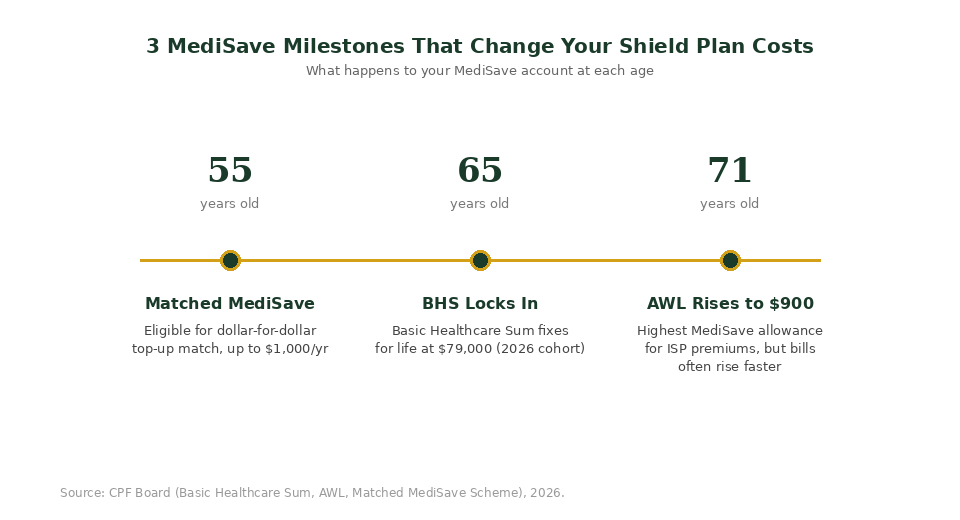
MediSave keeps paying part of your Integrated Shield Plan (ISP) premium after you retire — but your MediSave Account stops growing once your salary does. Three age milestones change your options: at 55 you may qualify for a dollar-for-dollar top-up match, at 65 your Basic Healthcare Sum locks in for life, and at 71 your withdrawal limit for premiums rises to $900 a year, even as premiums keep climbing.
Not financial advice. All figures are for educational reference only. Data as at August 2026 unless otherwise stated. Data verified as at 3 August 2026 against CPF Board and IRAS sources.
- Once you stop working, your MediSave Account stops getting fresh CPF contributions — but it keeps earning interest and can still pay your ISP premium up to your Additional Withdrawal Limit (AWL).
- Three milestones matter most: age 55 (Matched MediSave Scheme eligibility), age 65 (your Basic Healthcare Sum freezes for life), and age 71 (your AWL rises to $900/year, its highest band).
- If your MediSave balance is low, cash top-ups plus government matching (up to $1,000/year) can meaningfully extend how long your account covers premiums in retirement.
Table of Contents
Contents — Click to expand
- Why Retiring Doesn’t Stop MediSave From Paying Your Premium
- Age 55: The Matched MediSave Scheme Kicks In
- Age 65: Your Basic Healthcare Sum Locks In For Life
- Age 71: Your AWL Rises to $900 — But So Do Premiums
- Worked Example: Auntie Mary’s MediSave Runway
- How to Keep MediSave Healthy After You Stop Working
- What to Do Before You Retire
- Frequently Asked Questions
Why Retiring Doesn’t Stop MediSave From Paying Your Premium
Your Integrated Shield Plan premium is partly paid from MediSave while you’re working. That doesn’t change the day you retire. Your MediSave Account (MA) keeps functioning exactly the same way — it just stops getting fresh money from your payslip.
Here’s the part people miss. While you’re employed, roughly 8% to 10.5% of your wage (depending on age) flows into your MA every month, courtesy of your own and your employer’s CPF contributions. The moment you stop working — whether you retire at 62, 65, or later — that inflow stops. Your MA doesn’t shrink on its own, but it also doesn’t refill itself unless you or your family top it up.
Meanwhile, your MediShield Life (MSL) premium is still fully MediSave-payable, and your ISP’s private insurance component is still capped by your Additional Withdrawal Limit (AWL), exactly as before. What changes is where the money to pay that AWL portion comes from once your paycheque stops.
This is why three specific ages matter more than any other birthday on your MediSave journey: 55, 65, and 71. Each one changes either how much support you can get, how big your account can ever become, or how much of your premium MediSave can absorb.
Age 55: The Matched MediSave Scheme Kicks In
At 55, many Singaporeans are still working, but this is also the earliest age you can qualify for the Matched MediSave Scheme (MMSS) — a government scheme that matches your cash top-ups to your MA, dollar for dollar, up to $1,000 a year.
You’re eligible for MMSS if you meet all of the following, per CPF Board:
| Criterion | Requirement |
|---|---|
| Citizenship | Singapore Citizen only |
| Age | 55 to 70 (inclusive), as at 31 December of the assessment year |
| MediSave balance | Less than half of the current Basic Healthcare Sum |
| Income | Average monthly income not more than $4,000 |
| Property | Annual value of residence not more than $21,000; own no more than one property |
| Matching amount | Dollar-for-dollar, capped at $1,000 per year |
Source: CPF Board, Matched MediSave Scheme, 2026.
In plain English: if you’re 55–70, a retiree or semi-retiree with a modest income and a MediSave balance under roughly $39,500 (half of the 2026 Basic Healthcare Sum of $79,000), the government will top up every dollar you or your children put into your MA — up to $1,000 a year. That’s free money specifically earmarked for healthcare costs, including your ISP premium.
You don’t need to apply. CPF Board assesses eligibility automatically each year and notifies you between January and February via your Healthcare Dashboard, email, or post. One trade-off worth knowing: cash top-ups that receive the matching grant are not eligible for separate tax relief, unlike ordinary MediSave top-ups.
Age 65: Your Basic Healthcare Sum Locks In For Life
The Basic Healthcare Sum (BHS) is the ceiling on how much can sit in your MediSave Account. Any CPF contributions beyond your BHS spill over into your Special Account (before 55) or Retirement Account (55 and above) instead. MOH raises the BHS every year to keep pace with rising healthcare costs — it’s $79,000 for 2026, up from $75,500 in 2025.
Here’s the milestone that catches people off guard: once you turn 65, your BHS freezes for the rest of your life at whatever the prevailing amount is that year. If you turn 65 in 2026, your personal BHS is locked at $79,000 forever — it will not rise again even as MOH continues adjusting the national BHS for younger cohorts in future years.
This matters for retirement planning in two ways. First, it caps how much MediSave you can ever accumulate for healthcare use, which is one more reason to build your MA balance up before 65 if you can. Second, it means two retirees of different ages can have permanently different BHS ceilings for the rest of their lives — an 80-year-old who turned 65 in 2011 has a far lower locked-in BHS than someone turning 65 in 2026.
| Milestone Age | What Changes | Why It Matters for Your ISP |
|---|---|---|
| 55 | Matched MediSave Scheme eligibility begins | Top-ups can be matched dollar-for-dollar, up to $1,000/year, to fund future premiums |
| 65 | Basic Healthcare Sum locks in for life | Caps how much MediSave you can ever hold for future premiums and claims |
| 71 | Additional Withdrawal Limit rises to $900/year | Highest MediSave allowance toward your ISP’s private insurance premium — but premiums usually rise faster |
Source: CPF Board (Basic Healthcare Sum, Additional Withdrawal Limits, Matched MediSave Scheme), 2026.
Age 71: Your AWL Rises to $900 — But So Do Premiums
The Additional Withdrawal Limit (AWL) governs how much MediSave can pay toward the private insurance component of your ISP premium each year. It rises in three bands by age, exactly as it does for working adults — retirement doesn’t change the table.
| Age Next Birthday | Additional Withdrawal Limit (AWL) |
|---|---|
| 1 – 40 | $300 per year |
| 41 – 70 | $600 per year |
| 71 and above | $900 per year |
Source: CPF Board, Additional Withdrawal Limits for IP premiums, 2026.
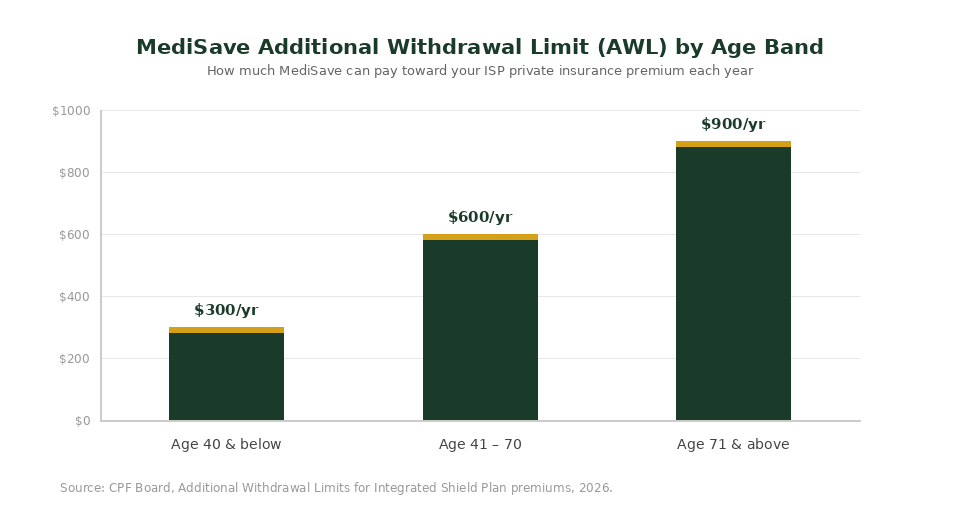
On paper, turning 71 looks like good news — your MediSave allowance for ISP premiums jumps to its highest band. In practice, this is exactly the age range where ISP premiums and rider costs climb fastest, since claim risk rises sharply after 70. Many retirees find their private component premium has grown well past $900, so the cash gap doesn’t shrink at 71 — it often widens, just from a higher starting AWL.
This is also the age where having no fresh income makes the cash portion harder to absorb. A working 45-year-old covering a $300 shortfall in cash barely notices it. A retired 75-year-old living off CPF LIFE payouts and savings has to budget for that same shortfall as a fixed annual healthcare expense, with no salary to draw from.
Worked Example: Auntie Mary’s MediSave Runway
Auntie Mary is 66, retired, and has $34,000 in her MediSave Account — below half of the 2026 Basic Healthcare Sum ($39,500), so she qualifies for MMSS. Her ISP’s private insurance component costs $750 a year. At her age (41–70 band), her AWL is $600, so MediSave covers $600 and she pays $150 in cash every year.
Here’s what happens if her daughter tops up her MA by $1,000 a year for the next five years, from age 66 to 70, while she’s still MMSS-eligible.
| Scenario | Own Top-Up (5 yrs) | Government Match (5 yrs) | Total Added to MA |
|---|---|---|---|
| No top-up | $0 | $0 | $0 |
| $1,000/year top-up (MMSS) | $5,000 | $5,000 | $10,000 |
Illustrative calculation by The Kopi Notes, based on CPF Board’s Matched MediSave Scheme terms (dollar-for-dollar, capped at $1,000/year), 2026. Excludes MediSave interest, which would add further growth.
That $10,000 doesn’t just cover her $150 annual cash gap on ISP premiums — at that rate, it would fund over 60 years of her current shortfall, or far fewer years if she also draws on it for hospitalisation deductibles and co-payments, which are a separate MediSave allowance from the AWL. Either way, the matching grant effectively doubles every dollar her family puts in, specifically while she’s in the 55–70 eligibility window.
How to Keep MediSave Healthy After You Stop Working
Once your salary stops, you have three realistic ways to keep your MA funded for ISP premiums and other healthcare costs.
1. Cash top-ups from yourself or family. Anyone — you, your children, or other family members — can top up your MA directly. If you’re not MMSS-eligible, ordinary cash top-ups still qualify for CPF Cash Top-up Relief of up to $8,000 for yourself and $8,000 for family members, a combined $16,000 a year, subject to the CPF Annual Limit of $37,740.
2. Matched MediSave Scheme (if eligible). As covered above, this is the most efficient way to top up between 55 and 70 if your balance and income are low enough to qualify — every dollar becomes two.
3. Draw down carefully, not automatically. CPF LIFE monthly payouts go to your bank account, not your MediSave Account — retirement income and healthcare savings are separate pools by design. If your MA is likely to run low, it’s worth budgeting a portion of your CPF LIFE payout or other retirement income specifically for MediSave top-ups, rather than assuming your MA will refill itself.
What to Do Before You Retire
Start by checking your current MA balance against your Basic Healthcare Sum on your CPF account dashboard. If you’re within a few years of 65, consider whether it’s worth voluntarily topping up before your BHS locks in, since your ceiling won’t rise again after that birthday.
Next, check your MMSS eligibility if you’re 55 or older — it’s assessed automatically, but knowing the criteria in advance helps you and your family plan top-ups around it rather than missing the window between 55 and 70.
Finally, revisit your Shield Plan and rider premiums a few years before you plan to stop working. If your private component premium already exceeds $600 (the 41–70 AWL band), it will very likely exceed $900 once you cross into the 71-and-above band too — plan the growing cash portion into your retirement budget the same way you’d budget for any other rising fixed cost. Our Singapore retirement planning calculator and CPF LIFE payout table can help you model healthcare costs alongside the rest of your retirement income.
If you’re still working and want to understand how your MA builds up in the years before retirement, see our breakdown of MediSave contribution rates by age for the mechanics of how much flows in every month.
Disclaimer: This article is for educational purposes only and does not constitute financial or insurance advice. Figures are accurate as at August 2026 and subject to change by CPF Board, MOH, or IRAS. Consult a licensed financial adviser or CPF Board directly for guidance specific to your situation.
Frequently Asked Questions
Can MediSave still pay my Integrated Shield Plan premium after I retire?
Yes. Retiring does not change how your ISP premium is paid. MediShield Life premiums remain fully MediSave-payable, and the private insurance component remains capped by your Additional Withdrawal Limit (AWL), which is $300 to $900 a year depending on your age. What changes is that your MediSave Account no longer receives fresh CPF contributions from a salary, so it relies on your existing balance, interest, and any top-ups.
What is the Matched MediSave Scheme and who qualifies?
The Matched MediSave Scheme (MMSS) matches cash top-ups to your MediSave Account dollar-for-dollar, up to $1,000 a year. You qualify if you’re a Singapore Citizen aged 55 to 70, your MediSave balance is less than half the current Basic Healthcare Sum, your average monthly income is $4,000 or less, and the annual value of your residence is $21,000 or less. CPF Board assesses this automatically each year.
What happens to my Basic Healthcare Sum when I turn 65?
Your Basic Healthcare Sum (BHS) locks in for life the year you turn 65, at whatever the prevailing national BHS is that year. For those turning 65 in 2026, the BHS is fixed at $79,000 permanently. It will not increase again in later years, even as MOH continues raising the BHS for younger cohorts.
Does my Additional Withdrawal Limit increase after I retire?
Your Additional Withdrawal Limit (AWL) is based purely on age, not employment status. It rises from $300 a year (age 40 and below) to $600 a year (41 to 70) to $900 a year (71 and above), whether you’re working or retired. Retirement itself doesn’t change the AWL — only your age does.
Can my children top up my MediSave Account for me?
Yes. Family members, including your children, can make cash top-ups to your MediSave Account at any time. If you’re eligible for the Matched MediSave Scheme, these top-ups can also trigger the government’s dollar-for-dollar match, up to $1,000 a year. Ordinary top-ups (outside MMSS) may also qualify the contributor for CPF Cash Top-up Relief, up to $8,000 for a family member’s account.
Do CPF LIFE payouts top up my MediSave Account?
No. CPF LIFE monthly payouts are credited to your bank account as retirement income, not to your MediSave Account. Your MediSave Account and your CPF LIFE payouts are separate pools — one for healthcare costs, one for retirement income — so a growing CPF LIFE payout does not automatically replenish your MediSave balance.
Plan Your MediSave Runway Before You Retire
Check your AWL, your BHS, and your MMSS eligibility while you still have time to act.
Get Free Insurance Advice
Speak with a licensed insurance advisor. No obligation, no cost.
By submitting this form, you agree to our Privacy Policy.
This article was researched with the help of AI. While we strive to keep all information accurate and up to date, there may be errors. If you notice any discrepancies, please contact us.