CGS Fullgoal Singapore Next 50 ETF (Q50): Complete Guide for Singapore Investors (2026)
SGX’s first actively managed Singapore equity ETF — how it works, its fees, and how to invest before it lists on 3 September 2026.
The CGS Fullgoal Singapore Next 50 Active ETF (SGX: Q50) is Singapore’s first actively managed equity ETF, tracking the iEdge Singapore Next 50 Index — 50 mid and small-cap SGX stocks beyond the Straits Times Index (STI). It opened for subscription on 6 August 2026 at S$1.00 per unit, with listing planned for 3 September 2026. The management fee is 0.65% per year.
Not financial advice. All figures are for educational reference only. Data verified as at 11 August 2026 unless otherwise noted.
- Q50 is a new, actively managed ETF that gives you exposure to 50 Singapore mid and small-cap stocks in one trade — something no other SGX ETF currently offers.
- It costs 0.65% a year. That’s more than a passive STI ETF (0.30%), but far cheaper than the unlisted Amova Singapore Small Mid Cap fund (1.50%).
- You can subscribe during the IPO (6–26 August 2026) or simply buy it on SGX after it lists on 3 September 2026 — no CPF/SRS confirmation yet, so check before you commit CPF money.
Table of Contents
Contents — Click to expand
- What Is the CGS Fullgoal Singapore Next 50 ETF (Q50)?
- Key Facts at a Glance
- What Is the iEdge Singapore Next 50 Index?
- Why This ETF Launch Matters for Singapore Investors
- Sector Exposure: Next 50 vs the STI
- Fees and Costs
- How to Buy or Subscribe to Q50
- Q50 vs STI ETFs vs Amova SMID Cap Fund
- Risks to Consider
- Who Should Consider Q50?
- Frequently Asked Questions
What Is the CGS Fullgoal Singapore Next 50 ETF (Q50)?
The CGS Fullgoal Singapore Next 50 Active ETF is a new exchange-traded fund (ETF) launched by CGS International Securities (CGSI), with Fullgoal Asset Management (HK) as investment advisor. It’s the first Singapore-focused actively managed equity ETF ever listed on the SGX.
Most ETFs are passive — they simply copy an index. Q50 is different. It uses a six-factor quant model (valuation, growth, earnings surprise, analyst sentiment, earnings quality, and market factors) to try to beat its benchmark, the iEdge Singapore Next 50 Index, not just track it.
At least 80% of the fund must be invested in Next 50 constituents. The remaining 20% can go into other SGX-listed stocks where the model’s signals look strongest. This gives the fund manager some flexibility that a pure index fund doesn’t have.
You buy and sell Q50 on the SGX just like any other share — through your usual brokerage account, no separate application needed once it lists.
Key Facts at a Glance
| Metric | Detail |
|---|---|
| Full Name | CGS Fullgoal Singapore Next 50 Active ETF |
| SGX Code | Q50 |
| Reference Benchmark | iEdge Singapore Next 50 Index |
| Manager / Advisor | CGS International Securities (Manager); Fullgoal Asset Management HK (Investment Advisor) |
| Issue / Subscription Price | S$1.00 per unit |
| Initial Offer Period (IOP) | 6 Aug 2026 – 26 Aug 2026 |
| Target Listing Date | 3 September 2026 (Mainboard) |
| Minimum Subscription | 1,000 units (S$1,000), in 100-unit increments |
| Management Fee | 0.65% p.a. of Sub-Fund Assets (capped at 1.50% p.a. max) |
| Distribution Policy | Semi-annual, around June and December |
| Trading Currency | SGD |
Source: POEMS / CGS International IOP terms sheet, published 6 Aug 2026.
What Is the iEdge Singapore Next 50 Index?
The iEdge Singapore Next 50 Index tracks 50 liquidity-screened SGX-listed companies that sit just outside the STI’s top 30. Think of it as “the next tier” of investable Singapore stocks — established names that are too small to make the STI cut, but too large to call small-cap.
This is a genuinely different slice of the market. Bloomberg consensus estimates put aggregate EPS growth for the Next 50 basket at around +9%, and about 51% of the group’s combined revenue comes from outside Singapore — so you’re also getting indirect exposure to the wider ASEAN and global economy, not just the domestic market.
Because these stocks get thinner analyst coverage than STI blue chips, there’s also more room for an active manager’s stock-picking to actually matter — which is the whole premise behind Q50’s active approach.
Why This ETF Launch Matters for Singapore Investors
Q50’s launch isn’t happening in a vacuum. It’s part of a broader push by the Monetary Authority of Singapore (MAS) to deepen the SGX market through the Equity Market Development Programme (EQDP) — a S$6.5 billion initiative that funds asset managers running strategies focused on small and mid-cap Singapore stocks.
SGX ETF assets under management crossed S$20.5 billion in 2026, with strong inflows into STI ETFs already. But until Q50, there was no simple, single-trade way to get diversified exposure to Singapore’s mid and small-cap segment. If you wanted that exposure before, you had to stock-pick individual small caps yourself — or buy into an unlisted unit trust like Amova’s new SMID Cap fund.
For context, as at 11 August 2026, the STI itself trades around 5,745 points. The STI is dominated by three local banks and a handful of large-cap REITs and telcos. Q50 gives you a way to diversify away from that concentration without leaving the Singapore market altogether.
Sector Exposure: Next 50 vs the STI
Here’s the part that matters most for your portfolio: Q50 looks nothing like a STI ETF underneath. Financials make up about 58% of the STI’s top 30. In the Next 50 basket, financials fall to just 6%. REITs take over as the largest sector, at roughly 39% of the index — and you also get meaningfully more exposure to technology, consumer staples, materials, and healthcare, sectors that barely register in the STI.
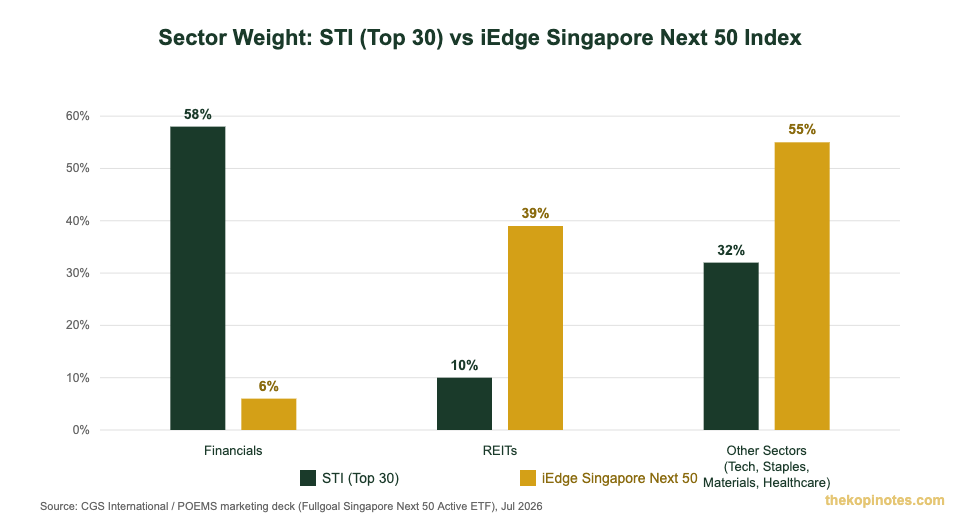
If you already hold a SPDR STI ETF (ES3) or a similar STI tracker, Q50 could genuinely complement it — rather than duplicate it — because the sector mix is so different. That said, REITs at ~39% means your combined portfolio could still end up quite REIT-heavy if you already own Singapore REIT ETFs separately. Check your total allocation before adding Q50 on top.
Fees and Costs
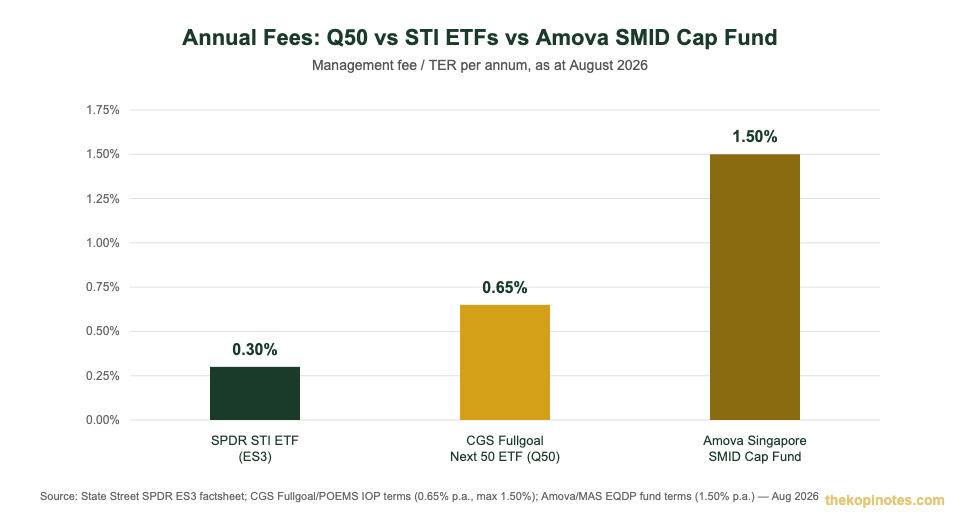
Q50 charges a management fee of 0.65% per year, with a stated cap of 1.50% per year written into the prospectus (the actual fee charged should stay at 0.65% unless the manager changes it, which they’d need to disclose). Total Expense Ratio (TER) — the all-in yearly cost including management fee plus other running costs — hasn’t been separately confirmed yet since the fund has no track record, but expect it to land close to the management fee for a fund this size.
For context: on a S$20,000 position, a 0.65% fee works out to roughly S$130 a year. That’s about S$60 more per year than you’d pay holding the same amount in a passive STI ETF at 0.30%.
You’ll also pay your broker’s standard brokerage commission and clearing fees when you buy or sell Q50 after listing — during the IOP itself, several brokers (including POEMS) were offering zero commission on subscriptions.
How to Buy or Subscribe to Q50
You have two windows to get into Q50:
Option 1: Subscribe during the IPO (6–26 August 2026). This is the initial offer period (IOP). You apply through a Participating Dealer’s brokerage platform (POEMS/Phillip Securities is one). The price is fixed at S$1.00 per unit, minimum 1,000 units, in increments of 100. Note that individual brokers may set their own cut-off — POEMS, for example, closed its own applications at 5pm on 25 August, a day ahead of the official 26 August deadline. Units get credited to your CDP or sub-account by 3 September 2026, the listing date.
Option 2: Buy on SGX after listing (from 3 September 2026). Once Q50 starts trading, you can simply buy it through your regular brokerage account — Interactive Brokers, Saxo, Tiger Brokers, moomoo, FSMOne, or any SGX-enabled broker — the same way you’d buy any other SGX-listed stock. There’s no minimum lot size restriction after listing beyond the normal 1-share board lot.
If you’re new to investing on SGX, our Syfe referral code sign-up page walks through opening a brokerage account, and our retirement calculator can help you figure out how much of your monthly investing budget should go toward SG-focused funds like this one versus global ETFs.
Q50 vs STI ETFs vs Amova SMID Cap Fund
Q50 isn’t the only way to get broader Singapore equity exposure. Here’s how it stacks up against the two most obvious alternatives.
| Feature | Q50 (Next 50 Active ETF) | SPDR / Nikko AM STI ETF | Amova SG SMID Cap Fund |
|---|---|---|---|
| Structure | Exchange-traded (SGX) | Exchange-traded (SGX) | Unlisted unit trust |
| Management Style | Active (6-factor quant model) | Passive (tracks STI) | Active |
| Universe | 50 mid/small-cap SG stocks | 30 large-cap SG stocks | SG small/mid-caps |
| Annual Fee | 0.65% p.a. | 0.30% p.a. (ES3) | 1.50% p.a. |
| Trade Intraday? | Yes | Yes | No — daily NAV only |
| Track Record | None yet (lists Sept 2026) | 20+ years | None yet (2026 launch) |
Source: POEMS/CGS International IOP terms; State Street SPDR ES3 factsheet; Amova/MAS EQDP fund terms. Data as at Aug 2026.
Risks to Consider
Q50 has real risks you should weigh before subscribing or buying in. Here’s a quick answer to “so what does this mean for me”:
No track record. The fund hasn’t traded a single day yet. The backtested alpha of +3.39% per year (Information Ratio 0.82) looks attractive, but backtests are built with hindsight — they don’t guarantee future results. Treat that number as illustrative, not a promise.
Liquidity risk in early trading. New ETFs sometimes trade thinly in their first weeks or months. If few people are buying and selling, your bid-ask spread could be wider than for an established ETF like ES3, meaning you might get a slightly worse price when you trade.
Mid and small-caps are more volatile. Stocks outside the STI’s top 30 tend to swing more than blue chips — both up and down. Backtested tracking error is around 3.97% (with a stated 3–6% range), which tells you the fund’s returns can diverge meaningfully from its own benchmark, let alone from the STI.
Heavy REIT concentration. At roughly 39% of the index, REITs dominate the Next 50 basket. That means Q50’s performance will be unusually sensitive to interest rate moves and S-REIT sentiment — check our guide to the best S-REITs in Singapore if you want to understand what’s driving that sector before you buy in.
Active management can underperform. There’s no guarantee the six-factor model will beat the Next 50 Index after fees. Plenty of actively managed funds fail to beat their benchmark over time — that’s true everywhere, not just for Q50.
Who Should Consider Q50?
Q50 could be a fit if: you already hold a STI ETF and want diversified exposure to Singapore stocks beyond the top 30 banks and blue chips, you’re comfortable with more volatility than a STI tracker, and you want active management without picking individual small-cap stocks yourself.
Consider alternatives if: you want the lowest possible cost (a passive STI ETF is cheaper at 0.30% p.a.), you need a fund with an established track record, or you’re already overweight S-REITs and don’t want more concentration there.
One important caveat: as at 11 August 2026, Q50’s CPF Investment Scheme (CPFIS) status hasn’t been confirmed — new ETFs typically need to go through CPF Board’s review before they’re added to the CPFIS list. If you plan to invest using CPF Ordinary Account funds, check with your broker or CPF Board before assuming it’s eligible. It should, however, be purchasable through an SRS account via any broker that supports SGX SRS trades, the same way you’d buy any other SGX-listed stock.
Not financial advice. Data verified as at 11 August 2026. Always read the prospectus and Product Highlights Sheet before subscribing.
Official sources: CGS Fullgoal Singapore Next 50 Active ETF — IOP terms (POEMS) · SGX IPO prospectus · CGSI launch announcement, The Edge Singapore · SPDR STI ETF (ES3) factsheet, State Street
Frequently Asked Questions
What is the CGS Fullgoal Singapore Next 50 ETF (Q50)?
Q50 is Singapore’s first actively managed equity ETF, listed on SGX. It aims to beat the iEdge Singapore Next 50 Index, which tracks 50 mid and small-cap Singapore stocks outside the STI’s top 30. It’s managed by CGS International, with Fullgoal Asset Management (HK) as investment advisor, and lists on 3 September 2026.
Is Q50 the same as a Singapore STI ETF?
No. STI ETFs like ES3 or G3B passively track Singapore’s 30 largest companies, dominated by banks and financials (about 58% of the index). Q50 tracks a completely different basket — 50 mid/small-cap stocks where financials make up only about 6% and REITs dominate at roughly 39%. They’re complementary, not substitutes.
How do I subscribe to Q50 during its IPO?
You apply through a Participating Dealer’s brokerage platform, such as POEMS, during the Initial Offer Period from 6 to 26 August 2026. The price is fixed at S$1.00 per unit, with a minimum order of 1,000 units in increments of 100. If you miss the IPO, you can simply buy Q50 on SGX like a normal stock once it lists on 3 September 2026.
Can I buy Q50 using my CPF or SRS funds?
SRS should work — Q50 is an SGX-listed security, so any broker supporting SRS trades on SGX should let you buy it with SRS funds. CPFIS (Ordinary Account) eligibility hasn’t been confirmed as at August 2026, since new ETFs typically need separate CPF Board approval. Check with your broker before assuming you can use CPF funds.
What are the risks of investing in Q50?
Q50 has no trading track record yet, so its backtested alpha of +3.39% p.a. isn’t a guarantee. Mid and small-cap stocks are typically more volatile than STI blue chips, the fund is heavily weighted toward REITs (~39%), and as a brand-new ETF it could see thinner liquidity in its first months of trading.
How does Q50 compare to the Amova Singapore Small Mid Cap Equity Fund?
Both target similar Singapore small/mid-cap exposure and launched around the same time under MAS’s Equity Market Development Programme. The key difference: Q50 is exchange-traded, so you can buy and sell it intraday on SGX at 0.65% p.a. Amova’s fund is an unlisted unit trust priced once daily, charging a higher 1.50% p.a. management fee.
Ready to Diversify Beyond the STI?
Open a brokerage account today to be ready when Q50 lists on 3 September 2026. Use our referral links for exclusive sign-up bonuses.
This article was researched with the help of AI. While we strive to keep all information accurate and up to date, there may be errors. If you notice any discrepancies, please contact us.