Singapore Raises 2026 GDP Forecast to 5.5%: What It Means for Dividend Investing
MTI’s third growth-forecast upgrade of 2026, and what it means for S-REITs, bank stocks and dividend ETFs.
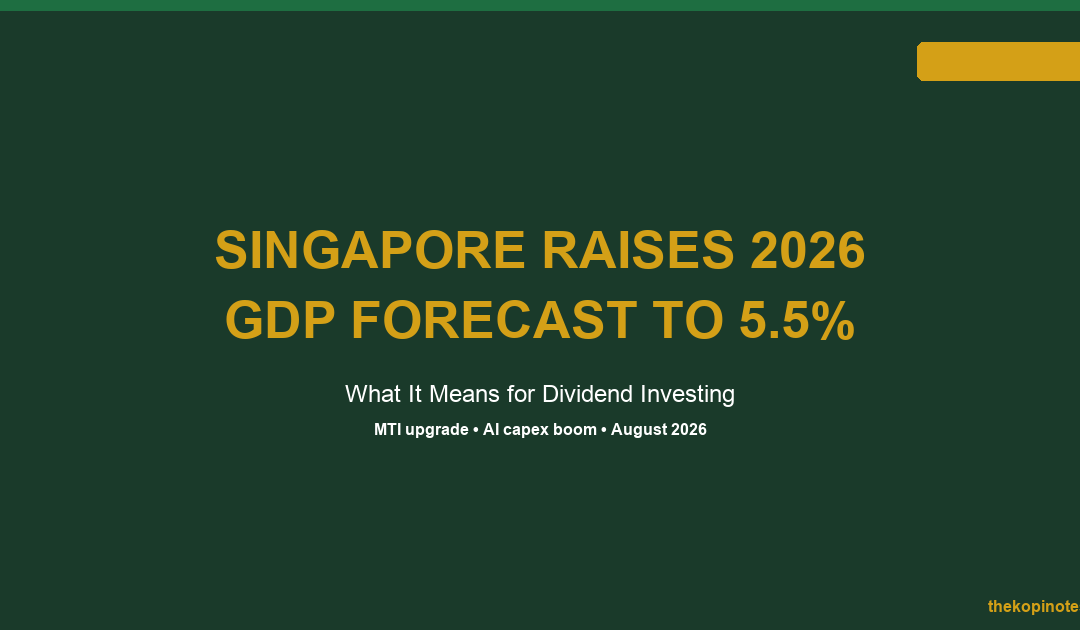
Singapore’s Ministry of Trade and Industry raised its 2026 GDP growth forecast to 4.5%–5.5% on 11 August 2026, up from 2.0%–4.0%, citing an AI-driven capital expenditure boom. For dividend investors, faster growth typically supports stronger loan books, occupancy rates, and distributable income across S-REITs, bank stocks, and dividend ETFs — though elevated oil prices remain a watch item.
Not financial advice. All figures are for educational reference only. Data as at August 2026 unless noted.
- MTI raised Singapore’s 2026 GDP forecast to 4.5%–5.5% — the third upgrade this year — on the back of an AI capex boom and 6.1% year-on-year growth in H1 2026.
- Stronger growth is generally a tailwind for bank stock dividends and AI/data-centre-exposed S-REITs, but SSBs and T-bills are largely unaffected since their yields track interest rates, not GDP.
- Elevated oil prices from Middle East tensions remain the key risk that could squeeze margins even as headline growth accelerates.
Table of Contents
Contents — Click to expand
- What MTI’s GDP Forecast Upgrade Actually Says
- Why Singapore’s Growth Outlook Jumped
- What This Means for Dividend Investing in Singapore
- S-REITs and the AI / Data Centre Tailwind
- Bank Stocks, Dividend ETFs & Fixed Income
- Risks That Could Still Derail the Story
- How to Position Your Portfolio Now
- Frequently Asked Questions
What MTI’s GDP Forecast Upgrade Actually Says
On 11 August 2026, Singapore’s Ministry of Trade and Industry (MTI) upgraded its full-year 2026 GDP growth forecast to a range of 4.5% to 5.5%. That’s a big jump from the 2.0%–4.0% range MTI had maintained earlier in the year, and it’s the third revision to this forecast in under a year.
Here’s how the forecast has moved over the past nine months:
| When | Forecast Range | Midpoint | Source |
|---|---|---|---|
| November 2025 (initial) | 1.0% – 3.0% | 2.0% | MTI |
| Q1 2026 (maintained) | 2.0% – 4.0% | 3.0% | MTI |
| 11 August 2026 (latest) | 4.5% – 5.5% | 5.0% | MTI |
Source: Ministry of Trade and Industry (MTI) press releases, Aug 2026
MTI also confirmed that Singapore’s economy grew 6.1% year-on-year in the first half of 2026 — well ahead of what most economists, including MTI itself, had pencilled in at the start of the year. That strong first-half print is a big reason the full-year number moved up so sharply.
Why Singapore’s Growth Outlook Jumped
The headline reason is AI. MTI pointed to an acceleration in global AI-related capital expenditure as a key driver — think chip fabrication, cloud infrastructure, and data centre build-outs across Asia, many of which route through Singapore’s manufacturing and trade data.
Two other factors matter here. First, external demand held up better than feared. Second, the economic fallout from Middle East tensions turned out to be less severe than initial worst-case scenarios suggested, even though energy prices have stayed elevated.
Enterprise Singapore separately raised its non-oil domestic exports (NODX) forecast for 2026 to 14%–16% growth, up from a previous estimate of just 3%–5%. That’s another signal the trade and manufacturing engine is running hotter than expected.
On the price side, the Monetary Authority of Singapore (MAS) expects both core and headline inflation to land between 1.5% and 2.5% for 2026. Core inflation was running at 1.6% in June, near the bottom of that range — which means Singapore is getting faster growth without runaway inflation, at least for now.
What This Means for Dividend Investing in Singapore
If you’re doing dividend investing in Singapore, a GDP forecast upgrade isn’t just a headline number — it flows through to the things that actually determine your payouts.
Faster economic growth tends to support three things dividend investors care about: higher occupancy and rental reversions for REITs, stronger loan growth and net interest margins for banks, and generally higher corporate earnings that feed into dividend payout ratios across the board.
That said, the relationship isn’t one-to-one. A REIT’s distribution per unit (DPU) — basically how much cash each unit pays you per quarter — depends far more on its own occupancy, rental reversions, and gearing than on the national GDP print. GDP growth is a tailwind, not a guarantee.
| Asset Class | Typical Yield (2026) | GDP Sensitivity | Why |
|---|---|---|---|
| S-REITs (broad) | 5% – 7% | Medium–High | AI/data-centre demand and occupancy tailwinds for exposed sub-sectors |
| Blue-chip bank stocks (DBS, OCBC, UOB) | 5% – 6% | High | Direct correlation to loan growth, GDP, and net interest margins |
| Dividend ETFs (e.g. Lion-Phillip S-REIT ETF) | ~5% – 6% | Medium | Diversified basket that moves with underlying REIT sentiment |
| SSBs / T-bills | ~2.0% – 2.7% | Low | Government-backed; yield tracks interest rates, not GDP |
Source: TKN analysis of public yield data, Aug 2026 — illustrative midpoints, not guaranteed returns
In practice, this means you shouldn’t rebalance your entire portfolio off one macro headline. But it’s a reasonable signal to keep your GDP-sensitive holdings — banks and cyclically exposed REITs — rather than rotating too defensively.
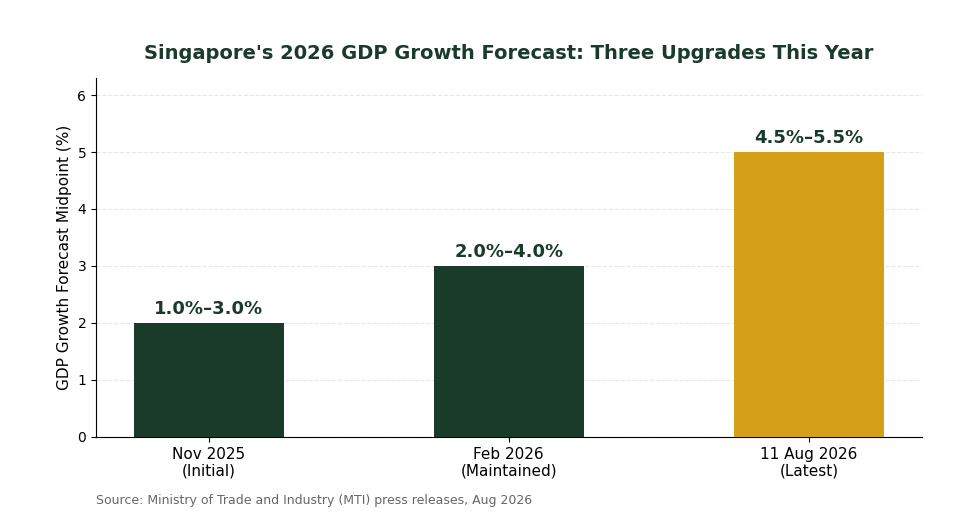
Singapore’s 2026 GDP forecast has been revised upward three times this year. Source: MTI, Aug 2026.
S-REITs and the AI / Data Centre Tailwind
The clearest read-through from an AI-led growth story is to data-centre and industrial S-REITs. Rising AI capex means more demand for data centre space, power infrastructure, and logistics — all sectors where several SGX-listed REITs have direct exposure.
This adds to a theme we’ve already covered: falling local interest rates (SORA around 1.06%–1.07% through mid-2026) have been easing refinancing costs for S-REITs, even as the US Fed holds its policy rate higher for longer near 3.8% into year-end. You can read more in our piece on how falling Singapore rates are affecting S-REITs despite the Fed’s stance.
For a broader view of which REITs currently offer the most attractive risk-adjusted yields, our Best S-REITs in Singapore 2026 yield comparison is a good starting point before you act on any single macro data point.
Retail, hospitality, and office S-REITs benefit more indirectly — through higher consumer spending and business travel that typically accompanies faster GDP growth — rather than the direct AI capex channel that industrial and data-centre REITs enjoy.
Bank Stocks, Dividend ETFs & Fixed Income
Singapore’s three local banks — DBS, OCBC, and UOB — are among the most GDP-sensitive dividend payers on the SGX. Faster growth generally means more loan demand, better asset quality, and healthier net interest margins, all of which support the 5%–6% dividend yields these stocks have offered investors in 2026.
If you’d rather not pick individual names, dividend ETFs like the Lion-Phillip S-REIT ETF give you diversified exposure to the same broad theme without single-stock risk, at the cost of some upside concentration.
Fixed income instruments — Singapore Savings Bonds (SSBs) and T-bills — sit in a different bucket entirely. Their yields (roughly 2.0%–2.7% depending on tenor) are set by interest rates, not GDP growth, so this forecast upgrade doesn’t change their return profile much. They remain a useful ballast for the defensive portion of a portfolio, alongside your Singapore T-Bills 2026 guide if you want the full mechanics of buying them.
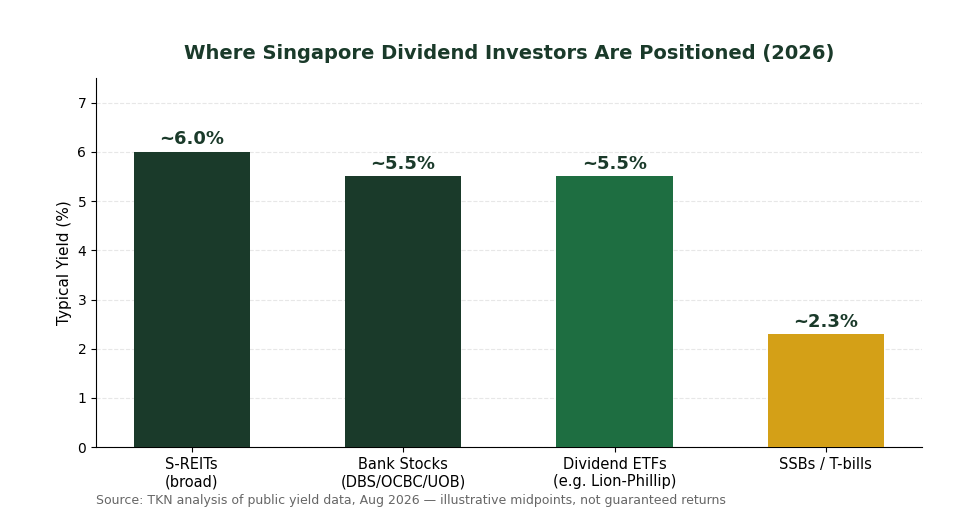
Where Singapore dividend investors are typically positioned across asset classes, 2026. Source: TKN analysis.
Risks That Could Still Derail the Story
A higher growth forecast is good news, but it’s not a free lunch. Here’s what could still go wrong.
Oil and energy prices. Continuing tensions in the Middle East, combined with lower global oil inventories, mean energy prices are expected to stay elevated through the second half of 2026. That raises input costs across shipping, manufacturing, and retail — margins could get squeezed even as revenue grows.
Inflation creeping back up. MAS is watching core inflation closely, and while 1.6% in June sits comfortably within its 1.5%–2.5% target range, a faster-than-expected economy could push price pressures higher over the second half of the year.
Fed policy staying tight. Markets are currently pricing in zero US rate cuts for 2026, with the Fed holding near 3.8% into year-end. If the Fed stays higher for longer while Singapore’s own rates keep drifting down, that policy gap could create currency and capital-flow volatility that indirectly affects REIT and bank valuations.
Concentration risk in the AI trade. A large share of this growth story runs through AI-related capex. If global AI investment slows or gets reallocated away from the region, the sectors driving this upgrade could cool just as quickly as they heated up.
How to Position Your Portfolio Now
You don’t need to overhaul your holdings because of one forecast revision. A few practical takeaways for Singapore dividend investors:
Don’t chase the headline. A GDP upgrade is a backdrop, not a buy signal for any specific stock or REIT. Check individual fundamentals — occupancy, gearing, DPU trends — before adding to any position.
Keep some ballast. Even with a stronger growth outlook, oil-driven inflation risk argues for keeping a portion of your portfolio in rate-insensitive instruments like SSBs or T-bills, rather than going all-in on cyclical names.
Watch data-centre and industrial REITs. These have the most direct read-through to the AI capex story driving this upgrade — worth a closer look if you don’t already have exposure.
Review your CPF and SRS allocation. A stronger domestic growth outlook is also a good prompt to revisit how your CPF and SRS funds are invested. Our CPF investment strategy guide and retirement calculator can help you check whether your current allocation still makes sense.
If you’re looking to start or top up a brokerage-based dividend portfolio, platforms like Syfe and Endowus make it straightforward to build diversified exposure to S-REITs and dividend ETFs without picking individual stocks.
Frequently Asked Questions
Why did MTI raise Singapore's 2026 GDP forecast?
MTI cited an acceleration in global AI-related capital expenditure, resilient external demand, and a smaller-than-feared economic hit from Middle East tensions. Singapore’s economy also grew 6.1% year-on-year in the first half of 2026, well ahead of earlier projections, which pulled the full-year forecast higher.
What does a higher GDP forecast mean for S-REIT dividends?
Faster growth is generally a tailwind — supporting occupancy, rental reversions, and tenant demand — but it isn’t a direct driver of any single REIT’s distribution per unit (DPU). Data-centre and industrial REITs have the clearest read-through via the AI capex story; retail, office, and hospitality REITs benefit more indirectly through consumer and business spending.
Should I change my dividend portfolio because of this forecast?
Not on this news alone. A GDP forecast revision is useful context, not a buy or sell signal for any specific stock or REIT. Continue to evaluate individual holdings on their own fundamentals — occupancy, gearing, DPU trends — before making changes.
Are Singapore bank stocks a good dividend play right now?
DBS, OCBC, and UOB are among the most GDP-sensitive dividend payers on the SGX, typically yielding 5%–6%. Faster growth tends to support loan demand and net interest margins, which is broadly supportive, but bank dividends can still be affected by asset quality and global rate cycles independent of Singapore’s own growth rate.
What risks could still derail this growth story?
The main risks are elevated oil prices from continuing Middle East tensions, a possible pickup in inflation if the economy overheats, the US Federal Reserve holding rates higher for longer into 2026, and concentration risk if global AI-related investment slows or shifts elsewhere.
Does a stronger economy affect CPF or SRS returns?
CPF interest rates are set by statutory formulas tied to government bond yields, not GDP growth, so they won’t move because of this forecast. However, if you invest your CPF-OA or SRS funds in equities, REITs, or ETFs through schemes like CPFIS, a stronger growth outlook can indirectly support the value of those holdings.
This article was researched with the help of AI. While we strive to keep all information accurate and up to date, there may be errors. If you notice any discrepancies, please contact us.