TribeCar + MariBank: Skip the Car, Park the Savings (Singapore 2026)
How much you actually save by using TribeCar instead of owning a car — and why MariBank’s SDIC-insured savings account is the sensible first stop for that money before you decide what to do with it next.
Not financial advice. All figures are for educational reference only. Car ownership costs and COE premiums verified against the 2nd August 2026 COE bidding exercise; MariBank rates verified against MariBank’s official rate page as at August 2026.
Owning a car in Singapore is one of the most expensive ongoing commitments a household can take on — and most of that cost is invisible until you add it up properly. Skip the car and use TribeCar instead, and you can free up over a thousand dollars a month. The harder question is what to do with that money once you have it. This guide walks through the real numbers, then makes the case for parking the savings in a MariBank savings account first — SDIC-insured, no lock-in, no conditions — before you decide whether to invest it.
Table of Contents
Contents — Click to expand
- The Real Monthly Cost of Owning a Car in Singapore (2026)
- TribeCar: The Alternative, and What It Actually Costs
- The Savings — And Why Where You Park Them Matters
- Why MariBank for the Parking Spot
- Worked Example: Growing S$1,250/Month in MariBank
- MariBank vs a Current Account vs Locking It Up
- Who This Combo Suits (and Who It Doesn’t)
- How to Get Started
- Frequently Asked Questions
The Real Monthly Cost of Owning a Car in Singapore (2026)
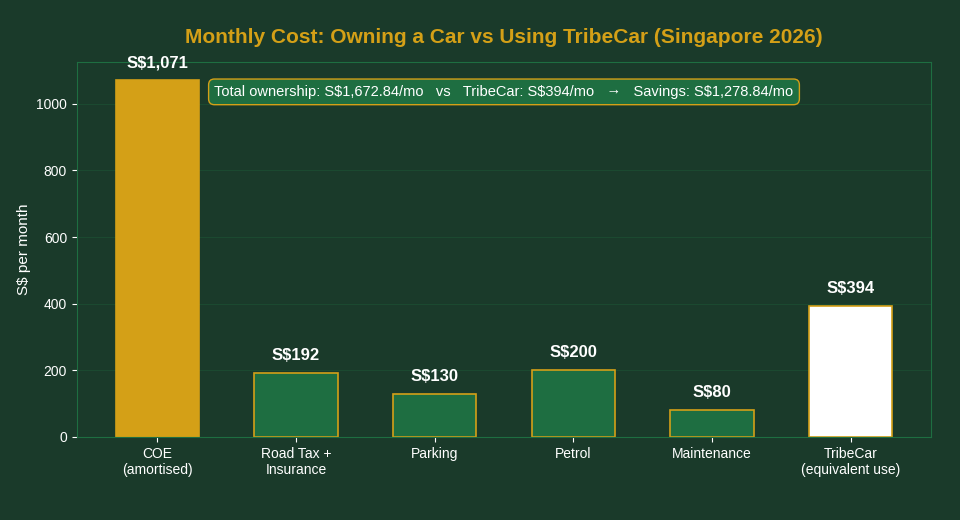
The headline number everyone quotes is the Certificate of Entitlement (COE). In the 2nd COE bidding exercise of August 2026, Category A (cars up to 1,600cc and 130bhp) closed at S$128,501. Spread that over a typical 10-year COE period, and it works out to roughly S$1,070.84 a month — before you’ve paid a single cent for the car itself, petrol, parking or insurance.
Add the other recurring costs a typical Singapore car owner faces, and the full monthly picture looks like this:
| Cost Item | Monthly Amount |
|---|---|
| COE (S$128,501, amortised over 10 years) | S$1,070.84 |
| Road tax + insurance | S$192.00 |
| Parking (home + office/season) | S$130.00 |
| Petrol | S$200.00 |
| Maintenance & servicing | S$80.00 |
| Total ownership cost | S$1,672.84 |
This excludes the car’s purchase price itself, ERP charges and any loan interest — so for many owners, the real number is higher than S$1,672.84/month.
TribeCar: The Alternative, and What It Actually Costs
TribeCar is Singapore’s peer-to-peer car sharing platform — you rent a car by the hour or day from a nearby owner via the app, pay only for the time and distance you actually use, and never touch a COE, insurance renewal or road tax bill. For a household that drives a moderate amount — say, 8 hours and 100km a week, blending weekday errands with a weekend trip — TribeCar’s hourly and per-km rates work out to roughly S$394 a month, all-in.
That’s not a marketing number — it’s what a realistic, non-trivial amount of car use actually costs on a pay-per-use model, once you account for TribeCar’s hourly rate, per-km charge and typical weekly usage pattern. Use the car less, and you’ll pay even less; use it more, and the gap with ownership narrows — which is exactly why this comparison only makes sense for households that don’t need a car every single day.
The Savings — And Why Where You Park Them Matters
S$1,672.84 (ownership) − S$394 (TribeCar) = S$1,278.84 saved every month
Rounded to a conservative S$1,250/month for the worked examples below.
S$1,250 a month is real money — over S$15,000 in a year. The mistake a lot of people make at this point is treating it as spare cash: it drifts into a everyday spending account, earns close to nothing, and quietly gets absorbed into lifestyle creep. If you’ve already got a firm plan (an emergency fund fully stocked, no near-term goal for the money), a growth platform like Syfe, Endowus or FSMOne may be the better next step — we’ve covered those combos separately. But if this is genuinely new savings you haven’t built a buffer around yet, the right first move isn’t to invest it — it’s to park it somewhere safe, liquid and interest-bearing while you decide what it’s for.
That’s where MariBank comes in.
Why MariBank for the Parking Spot
MariBank, Sea Group’s digital bank, is built for exactly this use case: money you want to keep liquid, safe and earning something, without jumping through hoops. As at August 2026:
| Feature | Detail |
|---|---|
| Base savings rate | 0.88% p.a., no minimum deposit, no conditions |
| New-user welcome bonus | +1.60% p.a. for your first 30 days (capped at S$100,000) — up to 2.88% p.a. combined |
| ShopeeVIP bonus | +0.40% p.a. on top of the base rate for ShopeeVIP subscribers |
| Deposit insurance | SDIC-insured up to S$100,000 per depositor |
| Fees | None — no account fees, no fall-below fees |
| Lock-in | None — full liquidity, withdraw anytime |
The appeal isn’t the promo rate — it’s the combination of MAS licensing, SDIC insurance, zero conditions and zero lock-in. You’re not chasing a “3 of 8 monthly scoops” structure like some competing digital banks; you deposit your TribeCar savings and it just sits there, earning interest, ready when you need it. For a full side-by-side against GXS Bank and Trust Bank, see our August 2026 digital bank rates comparison.
Worked Example: Growing S$1,250/Month in MariBank
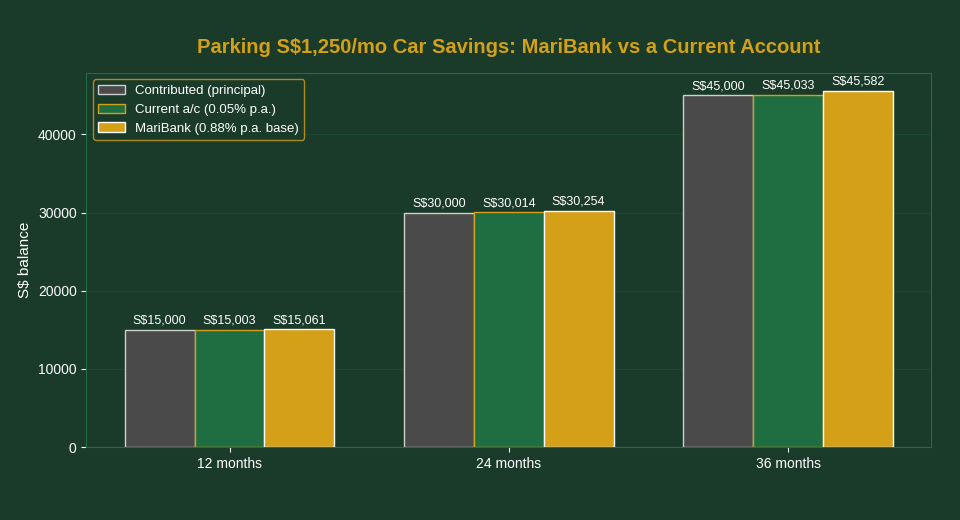
Here’s what happens if you funnel your TribeCar savings straight into MariBank every month, earning the 0.88% p.a. base rate (ignoring the temporary new-user boost, to keep the numbers conservative and repeatable):
| Period | Contributed | MariBank Balance (0.88% p.a.) | Interest Earned |
|---|---|---|---|
| 12 months | S$15,000.00 | S$15,060.65 | S$60.65 |
| 24 months | S$30,000.00 | S$30,254.37 | S$254.37 |
| 36 months | S$45,000.00 | S$45,582.33 | S$582.33 |
Compare that to leaving the same money in a typical bank current account paying around 0.05% p.a.: over 36 months you’d earn just S$32.83 in interest, versus S$582.33 in MariBank — a difference of roughly S$549.50 for doing nothing more than choosing where the money sits.
There’s also a one-off kicker for new MariBank users. Deposit a S$10,000 lump sum and hold it for your first 30 days at the 2.88% p.a. welcome rate, and you’d earn about S$23.67 in that single month — versus S$7.23 at the 0.88% base rate, an extra S$16.44 just for being a new customer. It’s a small amount in isolation, but it’s a free top-up on money you were already planning to park.
MariBank vs a Current Account vs Locking It Up
MariBank isn’t the only place to park savings — it’s just the one with the best combination of liquidity, safety and yield for money you might need on short notice. If you’re willing to lock funds away for a fixed term, a 6-month T-bill or the latest Singapore Savings Bond can pay a comparable or higher rate — our September 2026 SSB rate breakdown covers the current numbers. The trade-off is access: SSBs and T-bills tie your money up (with an early-redemption option for SSBs, but not instant), while MariBank lets you withdraw the moment you need it — which matters if the TribeCar savings are also functioning as a flexible buffer, not just a long-term parking spot.
| Option | Typical Rate | Liquidity | Best For |
|---|---|---|---|
| Bank current account | ~0.05% p.a. | Instant | Money you’ll spend within days |
| MariBank savings | 0.88%–2.88% p.a. | Instant | Flexible buffer, no fixed goal yet |
| Singapore Savings Bond | ~2.25% p.a. (Sep 2026) | Monthly redemption | Money you can wait a month for |
| 6-month T-bill | Market-dependent | Locked to maturity | Money you won’t need for 6 months |
Who This Combo Suits (and Who It Doesn’t)
This combo suits you if: you drive occasionally rather than daily, you’re new to the “skip car ownership” idea and haven’t decided what to do with the freed-up cash yet, you want a buffer for irregular costs (a future car-free house move, a wedding, a home renovation), or you simply want the safety of SDIC insurance while you build confidence with the numbers.
It’s less ideal if: you already have 3–6 months of expenses saved and a clear investing plan — in that case, skip straight to a growth platform (see our TribeCar + Syfe or TribeCar + FSMOne guides). It’s also not the right fit if you drive daily for work or have a large family that genuinely needs a car every day — TribeCar’s pay-per-use pricing narrows the savings gap the more you actually drive.
How to Get Started
- Sign up for TribeCar using referral code zZDeg and book your first drive to see the pricing in action.
- Open a MariBank account using referral code 2DCT80WQ via Singpass MyInfo — takes a few minutes, no paperwork.
- Set up a standing instruction or recurring transfer for the amount you’d otherwise spend on car ownership (use the table above as your starting estimate).
- Let the 30-day new-user rate run its course, then continue at the 0.88% p.a. base rate — no action needed.
- Revisit every few months: once you’ve built a comfortable buffer, decide whether to keep growing it in MariBank or move a portion into an investing platform.
Frequently Asked Questions
How much can I really save by switching from car ownership to TribeCar?
Why park the savings in MariBank instead of investing it straight away?
What interest rate does MariBank actually pay?
Is my money safe in MariBank?
What happens to my MariBank rate after the 30-day welcome bonus ends?
Should I use MariBank or a Singapore Savings Bond for my TribeCar savings?
Does TribeCar work out cheaper than owning a car for everyone?
Can I combine this with the TribeCar + Syfe or TribeCar + FSMOne strategies?
Ready to Skip the Car and Start Saving?
Sign up for both platforms and put your TribeCar savings to work from day one.
This article was researched with the help of AI. While we strive to keep all information accurate and up to date, there may be errors. If you notice any discrepancies, please contact us.