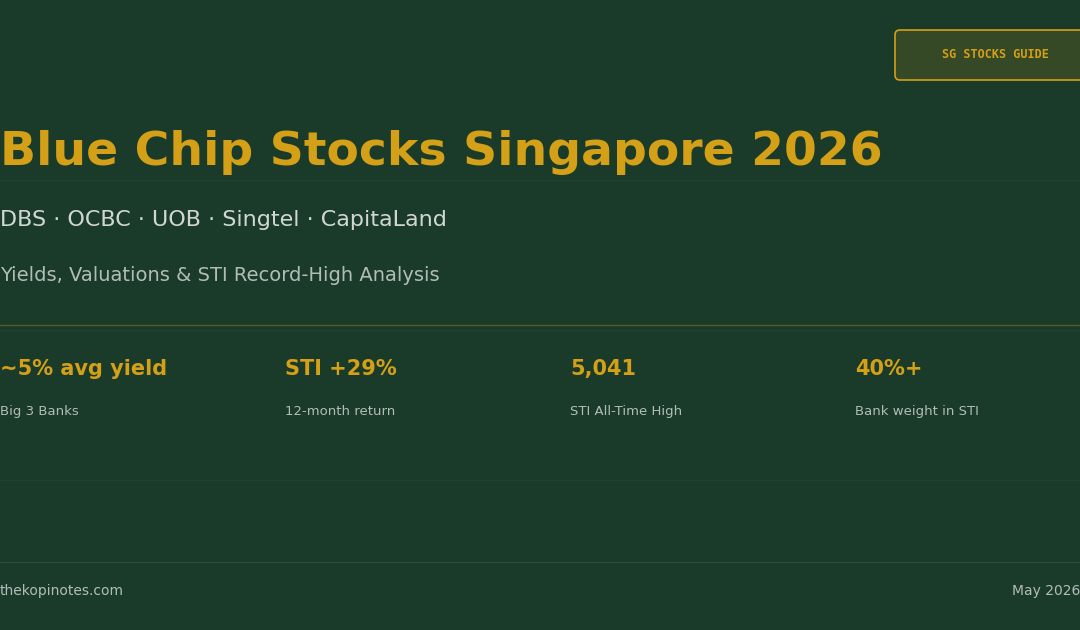
Blue Chip Stocks Singapore 2026: DBS, OCBC, UOB, Singtel & What the STI Record High Means for Investors
The definitive guide to Singapore’s top blue chip stocks — yields, valuations, dividend track records, and how to invest via the STI ETF or direct shareholding in 2026.
Singapore’s blue chip stocks — led by DBS, OCBC, UOB, Singtel, and CapitaLand Investment — delivered exceptional returns in 2025 and 2026, with the Straits Times Index (STI) hitting an all-time high of 5,041 in February 2026. The three local banks together make up over 40% of the STI and offer trailing dividend yields of 4.4–5.4%, comfortably above T-bill rates. For Singapore retail investors, blue chips offer a tax-free dividend income stream, liquidity, and defensive earnings characteristics.
Not financial advice. All figures are for educational reference only. Data as at May 2026 unless noted.
Table of Contents
Contents — Click to expand
- What Are Blue Chip Stocks?
- STI Record High 2026: What It Means
- Singapore’s Top Blue Chip Stocks at a Glance
- DBS Group (D05): Dividend Engine
- OCBC Bank (O39): Capital Strength
- UOB (U11): ASEAN Banking Play
- Singtel (Z74): Turnaround Story
- CapitaLand Investment (9CI): Real Assets Play
- How to Invest in Singapore Blue Chips
- STI ETF vs Buying Stocks Directly
- Risks to Consider
- Frequently Asked Questions
What Are Blue Chip Stocks?
Blue chip stocks are large, financially sound, and well-established companies with a history of reliable earnings and consistent dividend payments. In Singapore, the term is most commonly associated with the 30 component stocks of the Straits Times Index (STI) — the benchmark index maintained by FTSE Russell and SGX.
To qualify as an STI component, a company must rank among the largest by market capitalisation on the Singapore Exchange (SGX) and meet minimum liquidity criteria. The index is reviewed semi-annually and currently includes heavyweights such as DBS Group, OCBC Bank, UOB, Singtel, CapitaLand Investment, Keppel Corporation, and Singapore Airlines.
What makes Singapore’s blue chips distinctive for local investors is the combination of:
- Tax-free dividends: Singapore has no dividend withholding tax for residents. Every dollar of dividend from DBS or OCBC goes straight into your pocket.
- No capital gains tax: Profits from selling shares are also not taxed.
- SGD-denominated: No foreign currency risk for Singapore-based investors.
- CPF and SRS compatibility: Most STI components are eligible under the CPF Investment Scheme (CPFIS) and the Supplementary Retirement Scheme (SRS).
STI Record High 2026: What It Means for Blue Chip Investors
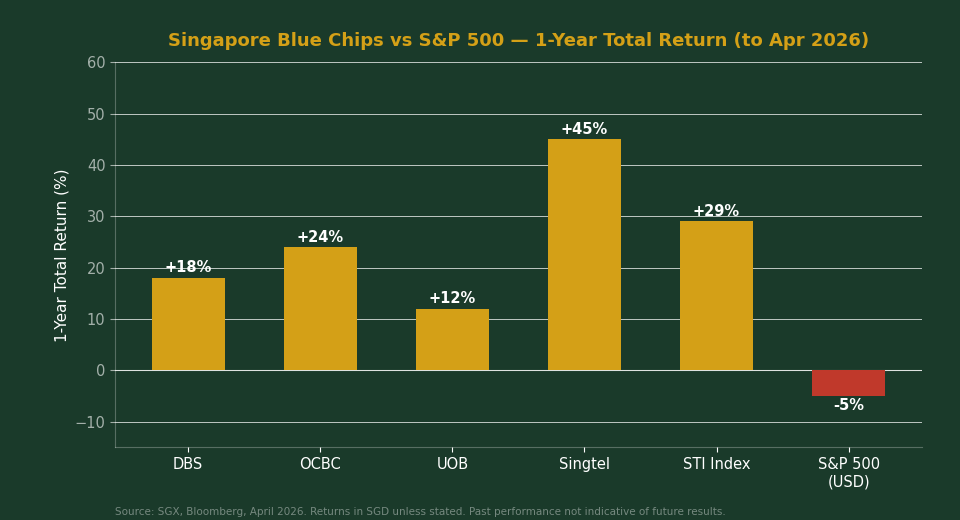
On 12 February 2026, the Straits Times Index crossed 5,000 for the first time in its history, closing at 5,016.76. It subsequently reached an all-time intraday high of 5,041.33 on 23 February 2026. Over the 12 months to April 2026, the STI delivered a price return of approximately 29% — substantially outpacing the S&P 500, which was essentially flat over the same period in USD terms.
Several macro tailwinds drove this outperformance:
- Banking sector strength: DBS, OCBC, and Singtel drove the index’s record-high move. The three banks maintained robust net interest margins and grew fee income aggressively.
- Singapore as a safe-haven: Global investors rotated into Asian markets perceived as more insulated from US trade policy uncertainty and dollar weakness.
- Singtel’s re-rating: News of KKR and Singtel’s advanced talks to acquire over 80% of ST Telemedia Global Data Centres sent Singtel’s shares to new all-time highs in early 2026.
- Data centre and digital economy tailwinds: Singapore’s position as Southeast Asia’s cloud and data centre hub benefited multiple blue chips.
The key question for investors today: is the STI still worth buying after a 29% rally? The answer depends on valuations, dividend yields, and your investment horizon — which we analyse for each major blue chip below.
Source: FTSE Russell / SGX STI data, Bloomberg, April 2026.
Singapore’s Top Blue Chip Stocks at a Glance (May 2026)
| Company | Ticker | Sector | Trailing Div Yield | 1Y Price Return | P/E (FY26E) |
|---|---|---|---|---|---|
| DBS Group | D05 | Banking | 5.43% | +18% | ~12x |
| OCBC Bank | O39 | Banking | 4.37% | +24% | ~11x |
| UOB | U11 | Banking | 5.15% | +12% | ~11x |
| Singtel | Z74 | Telecoms | 3.60% | +45% | ~20x |
| CapitaLand Invest. | 9CI | Real Assets | 4.20% | +8% | ~18x |
Source: SGX, company announcements, Bloomberg consensus estimates, May 2026. Returns in SGD. Past performance not indicative of future results.
DBS Group (D05): Singapore’s Dividend Engine
DBS Group is Asia’s largest bank by assets and the dominant component in the STI, with a market capitalisation exceeding SGD 100 billion. For FY2025, DBS reported total income of a record SGD 22.9 billion (up 3% year-on-year) and net profit of SGD 11 billion, with wealth management fees surging 28% YoY and return on equity (ROE) at 16.5%.
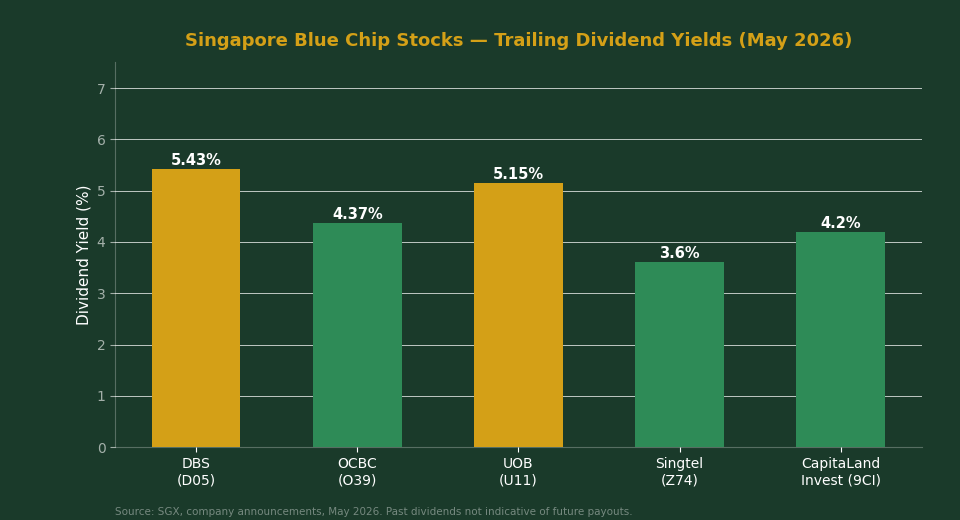
DBS is the clear choice for dividend-focused investors. It declared a final dividend of SGD 0.60 per share for Q4 2025 and has committed to a quarterly dividend structure, offering greater income predictability than its peers. Its trailing dividend yield of 5.43% (as at May 2026) is the highest among the three banks.
For a Singapore investor holding SGD 50,000 in DBS shares, the annual dividend income at a 5.43% yield would be approximately SGD 2,715 per year — tax-free. By comparison, the same sum in a 6-month T-bill would yield around SGD 1,750–1,900 at current rates, with no capital gain potential.
DBS is fully eligible under CPFIS (Ordinary Account tier). Investors using their CPF-OA to buy DBS would need to note the 35% limit on equities. For those looking to use CPF investment strategy Singapore to grow their retirement savings, DBS remains one of the most straightforward ways to deploy CPF-OA funds into a dividend-paying blue chip.
OCBC Bank (O39): Capital Strength Play
OCBC Bank is Singapore’s second-largest bank and arguably the most conservatively managed. Its CET1 capital ratio of 16.9% is among the highest in the region — a signal of financial resilience that gives it room for special dividends or share buybacks. In Q3 2025, OCBC achieved a record net profit of SGD 1.98 billion, driven by broad-based growth across all segments.
OCBC’s trailing dividend yield of 4.37% is lower than DBS’s, partly because its share price appreciated faster in the recent rally (+24% over one year). The bank has historically been more conservative with its payout ratio, preferring to retain capital. However, its Great Eastern Life subsidiary adds a wealth management and insurance dimension that pure banking competitors lack.
OCBC is the preferred pick for investors who prioritise capital preservation alongside income — and those who believe the bank’s wealth management franchise will drive earnings diversification in 2026 and beyond. Like DBS, OCBC dividends are tax-free for Singapore residents under the one-tier tax system.
UOB (U11): The ASEAN Banking Play
UOB is Singapore’s third major bank but its most ASEAN-focused: following the 2022 acquisition of Citigroup’s retail banking businesses in Thailand, Malaysia, Indonesia, and Vietnam, UOB now has a regional footprint that DBS and OCBC cannot easily replicate. This makes UOB a compelling play for investors who want exposure to Southeast Asian economic growth through a Singapore-listed, SGD-denominated vehicle.
FY2025 was a challenging year for UOB: net profit fell 23% YoY to SGD 4.68 billion, largely due to pre-emptive provisions taken in Q3. This weighed on its share price relative to peers, though its trailing dividend yield remains compelling at 5.15%. Its net interest margin of 1.89% and CET1 of 15.1% indicate a sound balance sheet, and consensus forecasts project a profit recovery in FY2026 as provisions normalise.
For dividend investors, UOB’s payout structure — an interim and final dividend each year — is consistent. The UOB dividend is declared in SGD and is tax-free for Singapore residents. Investors building a passive income Singapore portfolio often combine UOB with S-REITs and ETFs for a blended yield and diversified income stream.
Singtel (Z74): The Surprise Outperformer of 2026
Singtel’s 45% price gain over the past year has been the stand-out story among STI components. Two catalysts drove the re-rating. First, Singtel’s underlying business staged a meaningful recovery: for the first nine months of FY2025, underlying net profit increased 11% YoY to SGD 1.9 billion, led by Optus, NCS, and regional associates. Second, in early 2026, reports emerged that Singtel and KKR are in advanced talks to sell a majority stake in ST Telemedia Global Data Centres — a deal that would unlock significant asset value.
At a trailing yield of 3.6%, Singtel is the lowest-yielding major blue chip. But its total return story (capital gain + dividend) is compelling for investors who entered before the rally. For new investors today, the more relevant question is whether the data centre monetisation story has further to run — which depends on the KKR deal timeline and Singtel’s reinvestment strategy for the proceeds.
Singtel is eligible for purchase via SRS accounts and most brokerage platforms in Singapore, including Syfe referral code for those using Syfe Brokerage.
CapitaLand Investment (9CI): The Real Assets Angle
CapitaLand Investment (CLI) is Singapore’s largest real estate investment manager, with over SGD 100 billion in assets under management spanning office, retail, logistics, data centres, and lodging across Asia. It is distinct from the REITs it sponsors (CapitaLand Integrated Commercial Trust, CapitaLand Ascendas REIT): CLI is the fund manager and fee-earning platform, not the direct property owner.
CLI offers a trailing dividend yield of approximately 4.2% and trades at roughly 18x FY26E earnings. Its appeal is diversification: investors gain exposure to real estate fund management economics and performance fees, without the leverage constraints of a REIT structure. CLI also offers partial data centre exposure through its growing digital infrastructure portfolio.
For investors wanting a broader real estate play alongside direct REIT holdings, CLI is a natural complement. You can learn more about the REIT side of the CapitaLand family by reading our guide to the best S-REITs in Singapore 2026.
How to Invest in Singapore Blue Chip Stocks
There are four main ways for Singapore retail investors to build exposure to blue chip stocks:
| Method | Best For | Typical Cost | CPF/SRS? |
|---|---|---|---|
| Buying shares directly (SGX) | Stock-pickers, larger sums | ~0.08–0.25% per trade | Yes (CPFIS-OA eligible) |
| STI ETF (ES3 or G3B/GAB) | Diversification seekers | TER 0.20–0.30% p.a. | Yes (CPFIS-OA eligible) |
| Regular Savings Plan (RSP) | Dollar-cost averaging | ~SGD 1 fixed per trade | Cash only |
| Robo-advisor (Syfe, Endowus) | Beginners, passive investors | 0.35–0.65% p.a. | Yes (SRS via Endowus) |
Source: SGX, broker websites, May 2026. Costs are indicative — check current fee schedules before investing.
For most Singapore investors with no strong stock-selection conviction, the STI ETF remains the most cost-effective and diversified route into blue chips. The two available options — SPDR STI ETF (ES3) with a TER of 0.30% p.a., and Amova STI ETF (G3B) with a TER of 0.20% p.a. — are both listed on SGX and CPFIS-eligible. If you want to compare the two ETFs in detail, we have a dedicated guide to the Amova STI ETF.
For those using their Supplementary Retirement Scheme savings, platforms like Endowus referral code allow SRS funds to be invested into equity funds and ETFs including Singapore equity exposure. The tax savings from SRS top-ups, combined with long-term blue chip dividend compounding, can meaningfully boost your retirement nest egg — use our Singapore retirement calculator to model the impact.
STI ETF vs Buying Stocks Directly: Which Is Right for You?
The choice between buying an STI ETF and buying individual blue chip shares comes down to portfolio size, conviction, and cost sensitivity.
STI ETF is better if: you want instant diversification across all 30 STI components, prefer not to monitor individual stocks, are investing a smaller sum (e.g. SGD 1,000–10,000), or want to automate via dollar-cost averaging through a Regular Savings Plan.
Buying stocks directly is better if: you have a portfolio large enough to reduce per-trade transaction cost as a percentage (e.g. SGD 30,000+), have a view that a specific bank (e.g. DBS for highest yield, OCBC for capital safety) will outperform, or want to reinvest dividends manually on a selective basis.
A practical middle ground favoured by many Singapore investors: hold the STI ETF as a core position (e.g. 60% of Singapore equity allocation) and supplement with individual DBS and OCBC shares for additional dividend yield. This approach captures broad index gains while tilting toward the highest-yielding components.
Risks to Consider Before Investing
Even the most defensive blue chip stocks carry risk. Singapore’s blue chips are particularly exposed to:
- Interest rate risk: The Big 3 banks benefited enormously from high net interest margins in 2023–2025. As the US Federal Reserve cuts rates (and Singapore’s interbank rates follow), bank NIM compression could weigh on earnings and dividend capacity. Monitor the US Fed funds rate path — a faster-than-expected easing cycle is the key downside risk for bank dividends in 2026.
- Concentration risk in the STI: DBS, OCBC, and UOB together represent over 40% of the STI. An investor in the STI ETF has substantial banking sector concentration — more than most broad market investors realise. If all three banks re-rate downward simultaneously, the index will follow.
- Currency risk: For international investors, SGD appreciation increases returns but SGD depreciation reduces them. For Singapore residents investing locally, this is less of a concern.
- Valuation after the rally: At STI 5,041, the index trades at roughly 17x P/E — higher than its historical average of 12–14x. While dividends remain attractive relative to cash rates, the margin of safety for capital appreciation is narrower than it was two years ago. For the long-term income investor, this is less of a concern, but short-term traders should be cautious.
- Geopolitical risk: Singapore is deeply integrated into global trade flows. US-China trade tensions, Southeast Asian instability, or a sharp global growth slowdown could impair bank loan books and corporate earnings across the STI. For context on safe-haven alternatives, see our guide to Singapore T-bills 2026.
For investors seeking a more defensive income angle alongside equities, Singapore Savings Bonds and S-REITs offer complementary risk/return profiles. Our guide to Singapore Savings Bonds explains how to ladder SSBs alongside equity holdings for a balanced income portfolio.
Reminder: This article is for educational purposes only and does not constitute financial advice. All investment decisions should be made in light of your own financial situation, risk tolerance, and investment objectives.
Frequently Asked Questions
What are the best blue chip stocks to buy in Singapore in 2026?
The most widely held Singapore blue chip stocks in 2026 are DBS Group (D05), OCBC Bank (O39), UOB (U11), Singtel (Z74), and CapitaLand Investment (9CI). Among these, DBS offers the highest trailing dividend yield at 5.43%, making it the top pick for income investors. OCBC is preferred by more conservative investors due to its strong capital position (CET1 of 16.9%). UOB suits those seeking ASEAN banking exposure. All figures are as at May 2026 and should be independently verified before investing.
Are Singapore blue chip stocks safe investments?
Blue chip stocks are generally lower-risk than small- or mid-cap stocks due to their size, earnings track record, and liquidity — but they are not risk-free. Singapore’s Big 3 banks are exposed to interest rate cycles, and the STI’s high bank concentration (40%+) means the index is less diversified than it appears. The STI also trades at a higher P/E multiple (around 17x) following the 2026 record-high rally, which compresses the upside margin for new investors. For capital protection alongside equities, Singapore Savings Bonds and T-bills offer capital-safe alternatives.
Can I buy Singapore blue chip stocks using CPF?
Yes. DBS, OCBC, UOB, Singtel, and most other STI component stocks are eligible under the CPF Investment Scheme (CPFIS) for investment using CPF Ordinary Account (OA) funds. You must first set up a CPFIS-linked securities account through a CPFIS agent bank (DBS, OCBC, or UOB) and transfer funds above the minimum sum retained in your OA. Note that no more than 35% of your investible savings under CPFIS can be placed in equities and unit trusts. The STI ETFs (ES3 and G3B) are also CPFIS-OA eligible.
What dividend yield can I expect from Singapore blue chips?
As at May 2026, Singapore’s major blue chips offer trailing dividend yields of 3.6% (Singtel) to 5.43% (DBS). The Big 3 banks collectively yield around 4.4–5.4%, comfortably above the current 6-month T-bill yield of approximately 2.5–3.0%. Crucially, Singapore dividends are tax-free for residents under the one-tier tax system, which makes the after-tax yield even more attractive relative to fixed income instruments. Past dividend yields are not a guarantee of future payouts — always verify current dividend schedules before investing.
Is it too late to invest in Singapore blue chips after the STI record high?
The STI’s crossing of 5,000 in early 2026 and subsequent record high of 5,041 has prompted this question widely. From a pure valuation standpoint, the STI at roughly 17x P/E is above its historical average, meaning the valuation entry point is less attractive than it was in 2023–2024. However, for long-term dividend investors, the 4–5% tax-free yield from Singapore banks remains compelling relative to cash. A practical approach is to invest in tranches — allocate a portion now and hold cash to add on dips — rather than making an all-in decision at current levels.
What is the difference between the STI ETF and buying individual blue chip stocks?
The STI ETF (ES3 by State Street, or G3B/GAB by Amova) gives you diversified exposure to all 30 STI components in a single trade, with ongoing management fees (TER) of 0.20–0.30% p.a. Buying individual blue chip stocks gives you control over which companies you own and eliminates the ongoing TER, but requires more capital to diversify, and you bear individual stock selection risk. For most investors with portfolios under SGD 50,000 in Singapore equities, the STI ETF is more cost-efficient. For larger portfolios, a blend of direct shareholding in DBS/OCBC/UOB plus the STI ETF for the remaining 27 components is a common structure.
Start Building Your Singapore Blue Chip Portfolio
Use our referral links for sign-up bonuses, or run the numbers with our retirement calculator.
This article was researched with the help of AI. While we strive to keep all information accurate and up to date, there may be errors. If you notice any discrepancies, please contact us.