CPF Basic Healthcare Sum 2026: New Limits, Medisave Cap & What It Means For You
Updated May 2026 · CPF Board Data · Not Financial Advice
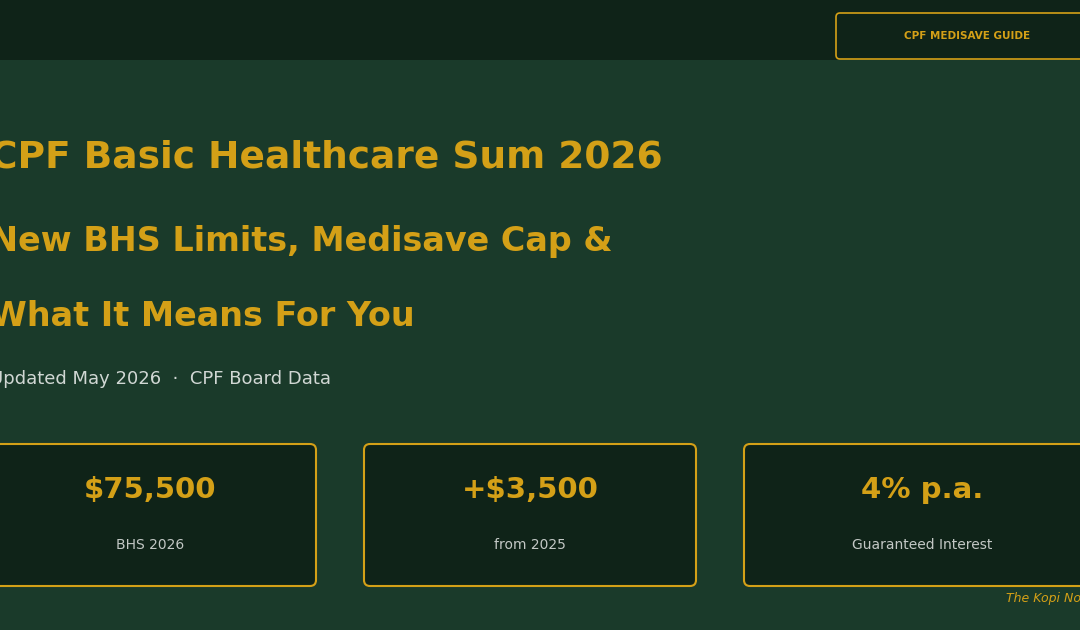
The CPF Basic Healthcare Sum (BHS) for 2026 has been raised to $75,500 — an increase of $3,500 from the 2025 limit of $72,000. The BHS is the cap on the amount you can hold in your Medisave Account (MA) before excess contributions are redirected to your Special Account (SA) or Retirement Account (RA). For Singapore residents below 65, this means you can now accumulate up to $75,500 in CPF Medisave before overflow kicks in — giving you a greater buffer for hospitalisation, MediShield Life premiums, and approved outpatient treatments.
Not financial advice. All figures are for educational reference only. Data as at May 2026 unless noted.
Table of Contents
What Is the CPF Basic Healthcare Sum?
The Basic Healthcare Sum (BHS) is a cap set by the CPF Board on the amount Singapore residents can retain in their Medisave Account (MA). It is adjusted annually to keep pace with projected increases in healthcare costs over a member’s lifetime.
Think of the BHS as the “full” point for your Medisave Account. Once your MA reaches the BHS, any new Medisave contributions — whether from your monthly CPF contributions or voluntary top-ups — automatically flow into your Special Account (SA) or Retirement Account (RA) instead. This “overflow” mechanism means your Medisave is never locked in limbo; excess funds simply accumulate in higher-interest-earning CPF accounts.
The BHS is not the same as the Medisave Contribution Ceiling (MCC), which is the annual cap on MediShield Life premium deductions. The BHS is specifically about the balance you can hold in Medisave at any point in time.
For members aged 65 and above who have met their Full Retirement Sum (FRS) in their Retirement Account, the BHS is considered cohort-based — it is fixed at the BHS prevailing in the year you turn 65, and it no longer increases annually. This gives older Singaporeans certainty about their Medisave target.
CPF BHS 2026 Amount: $75,500
The CPF Board announced that the BHS for 2026 is $75,500, effective 1 January 2026. This represents an increase of $3,500 (approximately 4.9%) from the 2025 BHS of $72,000.
This annual increase is calibrated to match projected long-term healthcare cost inflation, so your Medisave remains meaningful in real terms when you need it most — in retirement.
| Year | BHS Amount | Year-on-Year Increase |
|---|---|---|
| 2026 | $75,500 | +$3,500 |
| 2025 | $72,000 | +$3,000 |
| 2024 | $68,500 | +$2,500 |
| 2023 | $66,000 | +$2,000 |
| 2022 | $63,000 | +$2,500 |
| 2021 | $63,000 | $0 (COVID freeze) |
| 2020 | $60,000 | +$3,000 |
Source: CPF Board, BHS historical schedule. Data as at May 2026.
If your Medisave Account currently holds less than $75,500, your monthly CPF contributions will continue flowing into your MA until it reaches this cap. If you are already at or above $75,500, any new contributions earmarked for Medisave will automatically overflow to your SA or RA.
BHS Historical Increases (2019–2026)
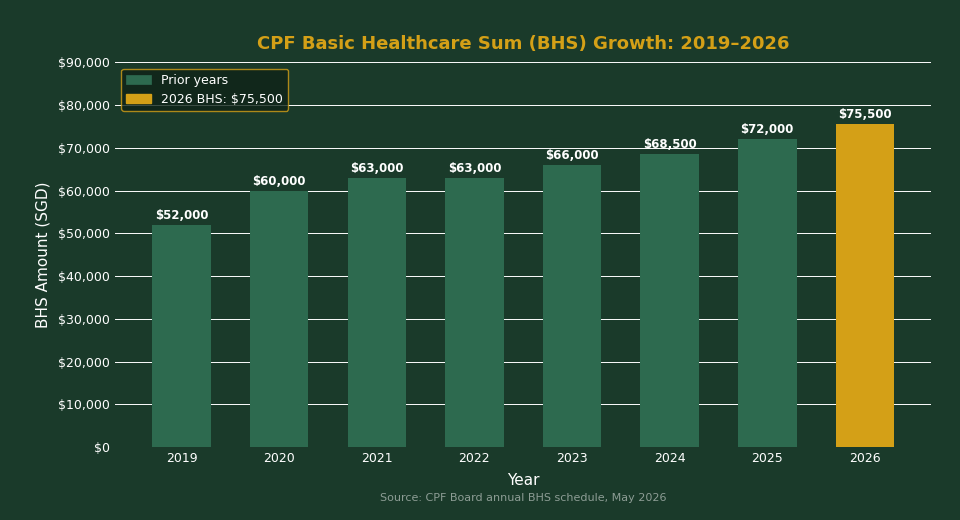
Since 2019, the CPF BHS has increased by a cumulative $23,500 (45.3%) — from $52,000 to $75,500. This steady upward trajectory reflects Singapore’s rising healthcare costs and the government’s goal of ensuring Medisave remains a meaningful financial buffer.
The average annual increase over 2019–2026 is approximately $3,357 per year. Younger Singaporeans in their 30s and 40s can expect the BHS to be significantly higher by the time they reach 65 — the CPF Board has projected it will approach around $100,000 by the mid-2030s.
| Year | BHS ($) | Cumulative Change from 2019 |
|---|---|---|
| 2019 | $52,000 | Baseline |
| 2020 | $60,000 | +$8,000 |
| 2022 | $63,000 | +$11,000 |
| 2024 | $68,500 | +$16,500 |
| 2026 | $75,500 | +$23,500 |
Source: CPF Board annual BHS schedule. Data as at May 2026.
For Singapore residents thinking about retirement adequacy alongside CPF, see our guide to Singapore Savings Bonds 2026 as a complementary low-risk savings vehicle.
How the BHS Cap Affects Your Medisave
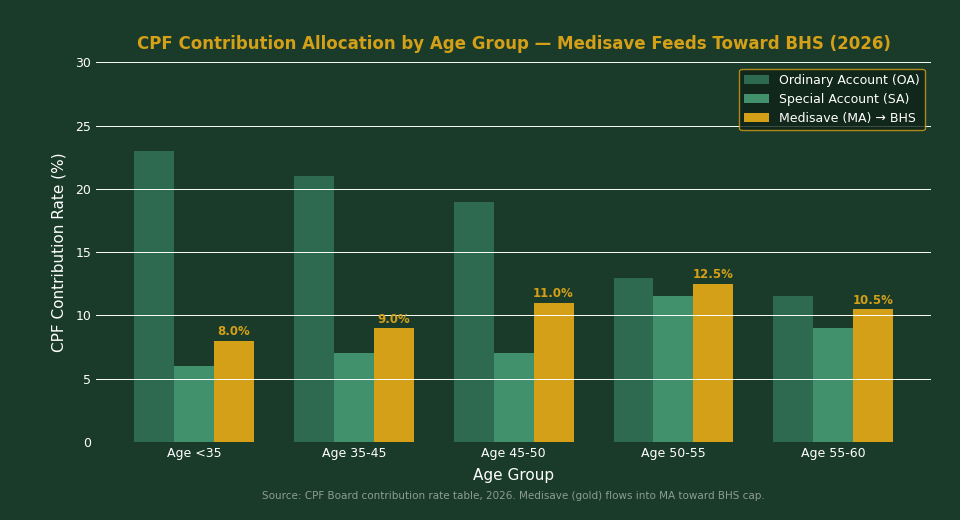
The BHS creates a practical “ceiling” for your Medisave Account. Here is exactly how the flow works depending on where your MA balance stands:
Scenario A — MA balance below $75,500: Your standard monthly CPF contributions continue to be split among OA, SA, and MA according to your age-based contribution rates. Medisave contributions keep filling up your MA toward the BHS.
Scenario B — MA balance at or above $75,500: Any CPF contributions that would have gone to your MA are automatically redirected to your Special Account (SA) if you are below 55, or your Retirement Account (RA) if you are 55 and above. This is the “overflow” mechanism — it is automatic.
| Age Group | Total CPF Rate | Medisave Allocation | Approx. Monthly MA Credit (on $6,800 OW) |
|---|---|---|---|
| Below 35 | 37% | 8% | ~$544/mo |
| 35–45 | 37% | 9% | ~$612/mo |
| 45–50 | 37% | 9.5% | ~$646/mo |
| 50–55 | 37% | 10.5% | ~$714/mo |
| 55–60 | 31% | 10.5% | ~$714/mo |
Source: CPF Board contribution rate table, 2026. OW = Ordinary Wages. Figures rounded to nearest dollar.
For a comprehensive look at how to pair your CPF strategy with investment planning, see our guide to CPF investment strategy for Singapore residents.
What Happens to BHS After Age 65?
When you turn 65 years old, your BHS becomes permanently fixed at the BHS prevailing in that year — this is called your cohort BHS. For a member who turns 65 in 2026, the cohort BHS is fixed at $75,500 for life.
After 65, your Medisave Account still earns 4% p.a. interest (with an additional 1% on the first $60,000 of combined CPF balances, and another 1% on the first $30,000 for members aged 55 and above). Even if your MA has hit its cohort BHS cap, it continues earning interest — the cap simply prevents new contributions from adding to the balance beyond the ceiling.
MediShield Life premiums are automatically deducted from your Medisave, which gently draws down the balance over time. This means your MA may periodically fall below the BHS, triggering contributions to flow back into it.
A member who turns 65 in 2030 may have a cohort BHS approaching $90,000–$95,000, based on the current annual BHS increase trajectory. Planning for a higher cohort BHS means working a few extra years could meaningfully boost your lifelong Medisave ceiling.
Planning your full retirement income picture? Try the Singapore retirement calculator to model your CPF LIFE payouts alongside your Medisave buffer.
What Can You Use Medisave For?
While your Medisave balance grows toward the BHS, it is important to understand what it can and cannot be used for. The CPF Board restricts Medisave withdrawals to approved healthcare expenses.
| Category | Examples | Medisave Usable? |
|---|---|---|
| Hospitalisation | Inpatient ward charges, surgery, ICU | ✓ Yes |
| MediShield Life Premiums | Annual MediShield Life premium deduction | ✓ Yes (auto-deducted) |
| Approved Outpatient Treatments | Chemotherapy, dialysis, chronic disease management | ✓ Yes (with limits) |
| Vaccinations | National Adult Immunisation Schedule vaccines | ✓ Yes (selected) |
| Dental Treatment | Routine dental, scaling, fillings | ✗ No (except surgical extractions) |
| Cosmetic Surgery | Aesthetic procedures, elective cosmetics | ✗ No |
| Integrated Shield Plan Premiums | AIA HealthShield Gold Max, GREAT SupremeHealth, etc. | ✓ Yes (basic component only) |
Source: CPF Board Medisave guidelines, May 2026. Limits apply per withdrawal type.
Medisave can also be used for immediate family members — your spouse, parents, children, and siblings (subject to specific conditions). This makes the Medisave Account particularly versatile for families managing healthcare costs across generations.
If you’re also thinking about how to build passive income streams beyond CPF, see our guide on passive income Singapore 2026 strategies using S-REITs and dividend stocks.
Smart Strategies Around the BHS Cap
Understanding the BHS is not just about knowing a number — it informs several practical CPF optimisation decisions. Here are the key strategies Singapore residents use in 2026:
1. Voluntary Medisave Top-Ups to Hit the BHS Faster
If your MA is below $75,500, you can make cash top-ups to your Medisave under the Medisave Contribution Ceiling (MCC of $88,000 for 2026). Voluntary top-ups earn 4% p.a. guaranteed by the Singapore government and are tax-deductible (subject to overall CPF relief caps of $8,000 for self and $8,000 for family top-ups).
2. Let Overflow Work For Your SA
Once your MA hits the BHS, new Medisave contributions automatically redirect to your Special Account or RA. The SA earns 4% p.a. — the same rate as Medisave — so there is no financial downside to the overflow. Reaching the BHS early means your SA grows faster through this automatic channel, accelerating your progress toward the Full Retirement Sum (FRS).
Our CPF investment strategy guide covers how to sequence OA, SA, and Medisave optimisation for different age groups.
3. Do Not Withdraw Medisave Early Just to Beat the BHS
Some members consider spending down Medisave on eligible treatments to “make room” below the BHS and then topping up again for the tax deduction. This is rarely optimal. The 4% guaranteed return on your MA is strong, and Medisave funds are protected from creditors. Unless you have an immediate healthcare need, it is generally better to let your Medisave compound at the BHS ceiling.
4. Consider SRS for Additional Tax Savings
Once you have maximised your CPF-related tax reliefs (including Medisave top-up relief), the Supplementary Retirement Scheme (SRS) offers another $15,300 per year in tax-deductible contributions. SRS funds can be invested in S-REITs, ETFs, Singapore T-bills, and more — making it a powerful complement to your CPF healthcare and retirement strategy.
For a broader view of retirement savings options, our Singapore T-bills 2026 guide covers current yields and how to apply via CPF OA or cash.
5. Plan the Cohort BHS Into Your Retirement Age Decision
Since the BHS is permanently fixed when you turn 65, working an extra year or two means you retire with a higher cohort BHS. Turning 65 in 2027 (assuming BHS rises to ~$79,000) versus 2026 ($75,500) adds approximately $3,500 to your lifelong Medisave ceiling — a meaningful difference for long-term healthcare coverage.
Looking for investment platforms to grow your SRS and cash savings alongside CPF? Check out our Syfe referral code and sign-up bonus and Endowus referral code — both platforms support CPF OA investing and SRS investing with no lock-in. You can also compare brokers via our FSMOne referral code page.
Start Investing Alongside Your CPF
While your Medisave compounds toward the BHS, put your cash savings and CPF OA to work with Singapore’s leading digital investment platforms.
Frequently Asked Questions
What is the CPF BHS for 2026?
The CPF Basic Healthcare Sum (BHS) for 2026 is $75,500, effective 1 January 2026. This is the cap on the balance you can hold in your CPF Medisave Account. Once your MA reaches this amount, further CPF contributions earmarked for Medisave automatically overflow to your Special Account (if below 55) or Retirement Account (if 55 and above).
What was the BHS in 2025 and how much did it increase?
The CPF BHS in 2025 was $72,000. The 2026 BHS of $75,500 represents an increase of $3,500 (approximately 4.9%) year-on-year. This annual increase reflects projected long-term healthcare cost inflation and is set by the CPF Board.
What happens if my Medisave exceeds the BHS?
If your Medisave Account (MA) balance equals or exceeds the BHS, any new CPF contributions that would normally go to your MA are automatically redirected to your Special Account (SA) if you are below 55, or your Retirement Account (RA) if you are 55 or above. This overflow is automatic. Your existing MA balance continues to earn 4% p.a. interest.
Is the BHS the same as the Medisave Contribution Ceiling?
No. The BHS and the Medisave Contribution Ceiling (MCC) are different figures. The BHS ($75,500 in 2026) is the cap on how much you can hold in your MA. The MCC ($88,000 in 2026) is the maximum total Medisave balance including contributions received within a year. For most practical purposes, the BHS is the number to focus on.
Can I top up my Medisave to reach the BHS faster?
Yes. You can make voluntary cash top-ups to your Medisave Account up to the Medisave Contribution Ceiling. Voluntary Medisave top-ups earn 4% p.a. and are tax-deductible under the CPF Cash Top-Up Relief scheme — subject to the overall cap of $8,000 per year for self top-ups and $8,000 for family members’ top-ups (combined limit $16,000 per year).
Does the BHS increase after I turn 65?
No. Once you turn 65, your BHS is permanently fixed at the prevailing BHS in the year you turn 65 — this is your cohort BHS. For members who turn 65 in 2026, the cohort BHS is $75,500 for life. After 65, your MA continues earning 4% p.a. interest, and MediShield Life premiums are still deducted automatically.
How does the BHS affect my CPF LIFE payouts?
The BHS affects CPF LIFE indirectly. Once your MA hits the BHS, your monthly CPF contributions overflow to your SA or RA — accelerating the growth of your RA balance. A larger RA balance means higher CPF LIFE monthly payouts when you start your CPF LIFE plan. This is why building your Medisave to the BHS early can have a compounding positive effect on your retirement income.
Disclaimer: This article is for general educational purposes only and does not constitute financial advice. CPF limits and policies are subject to change — always verify the latest figures at cpf.gov.sg. Consult a licensed financial adviser before making CPF-related decisions.
This article was researched with the help of AI. While we strive to keep all information accurate and up to date, there may be errors. If you notice any discrepancies, please contact us.