Keppel DC REIT Share Price 2026: Rate Cuts, DPU Forecast & Buy or Hold?
Singapore’s leading data centre REIT — a Q3 2026 deep dive on DPU sustainability, rate cut tailwinds, yield vs alternatives, and our buy/hold verdict for long-term investors.
Keppel DC REIT (SGX: AJBU) is Singapore’s first data centre REIT, holding 23 data centres across 8 countries with ~98% committed occupancy. At a share price of approximately SGD 2.00 and an annualised DPU of ~9.94 cents as at Sep 2026, the REIT offers a distribution yield of around 5.0% — well above risk-free alternatives like SSBs (2.9%) and T-bills (3.2%). Fed rate cuts are expected to reduce floating-rate borrowing costs and support DPU recovery into 2027.
Not financial advice. All figures are for educational reference only. Data as at September 2026 unless noted.
Table of Contents
What Is Keppel DC REIT?
Keppel DC REIT (SGX: AJBU) was listed on the Singapore Exchange in December 2014, becoming Singapore’s first pure-play data centre REIT. It is managed by Keppel DC REIT Management Pte. Ltd., a wholly-owned subsidiary of Keppel Ltd. As at September 2026, the REIT owns a portfolio of 23 data centres spread across Singapore, Australia, Germany, the Netherlands, Malaysia, Ireland, the United Kingdom, and Italy — with a total portfolio value of approximately SGD 3.7 billion.
Unlike office or retail REITs, data centres benefit from structural demand driven by cloud computing, artificial intelligence workloads, and enterprise digital transformation. Keppel DC REIT’s tenants include hyperscalers, co-location providers, and large enterprise clients — many on long-term triple-net leases with built-in rental escalations. This gives the REIT a high degree of income visibility that is relatively insulated from economic cycles.
The REIT distributes income semi-annually (H1 and H2), and distributions are paid in SGD. As at H1 2026, committed occupancy stood at approximately 98.2%, with a weighted average lease expiry (WALE) of approximately 7.1 years.
Key Facts at a Glance
| Metric | Detail |
|---|---|
| SGX Ticker | AJBU |
| Listed | SGX Mainboard (Dec 2014) |
| Number of Assets | 23 data centres across 8 countries |
| Portfolio Value | ~SGD 3.7 billion (as at Sep 2026) |
| Committed Occupancy | ~98.2% |
| WALE | ~7.1 years |
| Gearing Ratio | ~37.2% |
| H1 2026 DPU | 4.96 cents per unit |
| Annualised Yield | ~5.0% at SGD 2.00 |
| Distribution Frequency | Semi-annual (June & December) |
Source: Keppel DC REIT SGX announcements, TKN estimates. Data as at September 2026.
Rate Cuts & Share Price Impact
The Federal Reserve’s rate-cutting cycle that began in late 2025 has been a significant tailwind for S-REITs broadly, and Keppel DC REIT in particular. As at September 2026, the US Federal Funds Rate stands at approximately 3.75%, having been cut by a cumulative 175 basis points from the 2024 peak. With the Singapore Overnight Rate Average (SORA) tracking these moves, Keppel DC REIT’s floating-rate debt costs have declined meaningfully.
Keppel DC REIT carried approximately SGD 2.1 billion in total borrowings as at mid-2026, with roughly 60% on floating rates. Every 100bps reduction in borrowing rates saves the REIT approximately SGD 12.6 million in annual interest expense. With approximately 1.82 billion units outstanding, this translates to a theoretical DPU uplift of around 0.69 cents per unit annually — a material improvement that helps explain the REIT’s share price recovery from its 2024 lows.
From a share price perspective, Keppel DC REIT traded as low as SGD 1.58 in early 2024 when rate hike anxiety was at its peak. By September 2026, the share price had recovered to approximately SGD 2.00, representing a ~27% recovery. This recovery was driven by a combination of falling rates, robust data centre demand, and strong H1 2026 results. For passive income Singapore investors who held through the downturn, the total return including distributions was considerably positive.
DPU Forecast 2026–2027
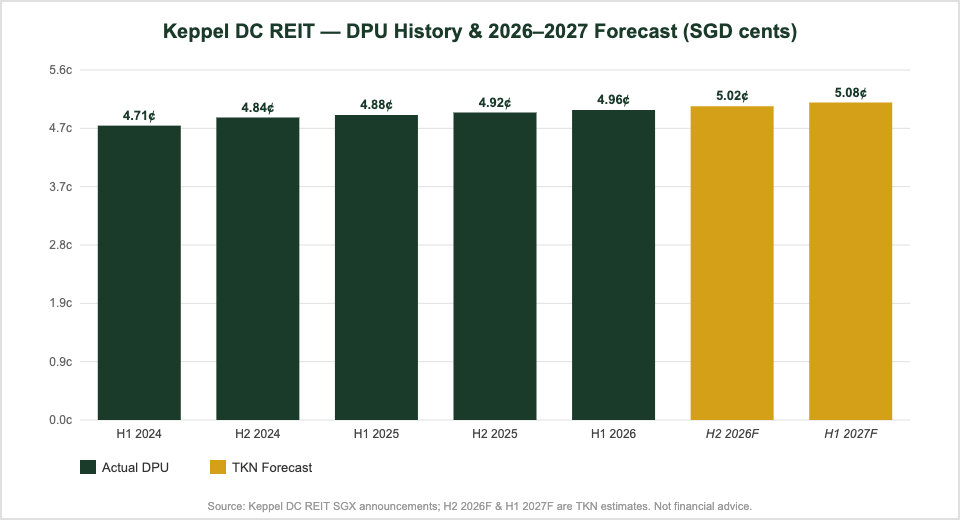
Keppel DC REIT’s DPU trajectory has been one of gradual recovery following the 2023–2024 headwinds from rising rates and FX pressures on its European and Australian assets. Here is TKN’s DPU forecast framework, based on publicly announced H1 2026 results and estimated H2 2026 and 2027 distributions:
| Period | DPU (cents) | Annualised | Yield at SGD 2.00 | Status |
|---|---|---|---|---|
| H1 2024 | 4.71¢ | 9.42¢ | 4.71% | Actual |
| H2 2024 | 4.84¢ | 9.68¢ | 4.84% | Actual |
| H1 2025 | 4.88¢ | 9.76¢ | 4.88% | Actual |
| H2 2025 | 4.92¢ | 9.84¢ | 4.92% | Actual |
| H1 2026 | 4.96¢ | 9.92¢ | 4.96% | Announced |
| H2 2026F | 5.02¢ | 9.98¢ | 4.99% | TKN Estimate |
| H1 2027F | 5.08¢ | 10.10¢ | 5.05% | TKN Estimate |
Source: Keppel DC REIT SGX announcements; H2 2026F and H1 2027F are TKN estimates based on interest cost trajectory and rental escalation assumptions. Not financial advice.
Our H2 2026 DPU estimate of 5.02 cents assumes: (1) continued portfolio occupancy above 98%; (2) approximately SGD 6.3M interest savings from H2 rate cuts flowing through to distributable income; and (3) stable FX contributions from European and Australian assets. The key risk to this estimate is any deterioration in the Chinese data centre assets, which have faced occupancy headwinds in prior periods. A downside scenario of 4.85 cents for H2 2026 cannot be ruled out if China asset vacancies increase.
By 2027, if the Fed cuts rates by a further 50–75bps, we estimate Keppel DC REIT’s annualised DPU could reach 10.0–10.2 cents — translating to a forward yield of approximately 5.0–5.1% at a share price of SGD 2.00. This would make it one of the more attractive data-centre plays among best S-REITs in Singapore 2026 for income-focused investors.
Yield vs Alternatives
One of the most frequent questions Singapore investors ask is: “Is Keppel DC REIT worth buying when I can get risk-free returns from T-bills?” This is the right question, and the answer lies in the yield spread and the nature of the risks involved.
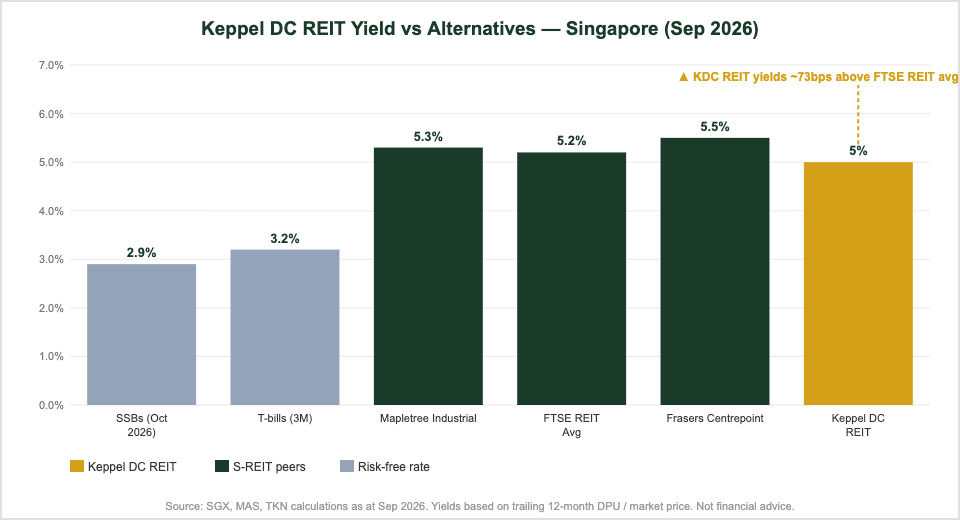
As at September 2026, the yield spread of Keppel DC REIT (5.0%) over the 3-month T-bill rate (3.2%) is approximately 180 basis points. Historically, Singapore REIT spreads of 150–250bps over risk-free rates have been considered fair value; spreads above 250bps have often preceded sharp re-ratings higher. At 180bps, Keppel DC REIT sits in “fair to slightly cheap” territory relative to its own history — but it is not a screaming bargain on yield spread alone.
The key differentiator between KDC REIT and SSBs or T-bills is capital appreciation potential and DPU growth. Unlike Singapore Savings Bonds, Keppel DC REIT’s distributions are not guaranteed — they depend on rental income, occupancy, and financing costs. However, REITs can also grow their DPU over time as rental escalations and new acquisitions increase distributable income.
| Instrument | Yield (Sep 2026) | Capital Risk | DPU Growth? | Suitable For |
|---|---|---|---|---|
| Keppel DC REIT | ~5.0% | Yes (moderate) | Yes | Income + growth investors |
| FTSE S-REIT Index Avg | ~5.2% | Yes (varies) | Some | Diversified REIT exposure |
| Singapore T-bills (3M) | ~3.2% | None | No (rolling) | Capital preservation |
| Singapore Savings Bonds | ~2.9% | None | No (fixed) | Ultra-conservative investors |
Source: SGX, MAS, TKN calculations as at September 2026. REIT yields are trailing 12M DPU / market price. Not financial advice.
For investors using the Singapore retirement calculator, the compounding difference between a 5.0% REIT yield and a 3.2% T-bill yield over 20 years is substantial — especially if distributions are reinvested.
Buy or Hold? Our Verdict
At current prices of approximately SGD 2.00, Keppel DC REIT trades at a price-to-NAV of roughly 1.10x (estimated NAV: SGD 1.82 per unit). This is not a deep value entry — data centre REITs historically trade at premiums to book value due to their scarcity and structural demand tailwinds. A P/NAV of 1.10x is within the 5-year average range for KDC REIT.
Buy case: (1) Data centre demand remains structurally underpinned by AI infrastructure build-out; (2) Rate cuts reduce borrowing costs, supporting DPU growth toward 5.1c+ per half-year by H1 2027; (3) Portfolio WALE of 7+ years provides cash flow visibility; (4) 5.0% yield premium of ~180bps over T-bills compensates for moderate capital risk. The CPF investment strategy guide outlines how to fund REIT purchases through SRS, which further enhances net returns for Singapore residents.
Hold case: For existing holders, the risk-reward remains attractive but not compelling enough to add aggressively. Wait for pullbacks toward SGD 1.85–1.90 (P/NAV ~1.02–1.04x) for better entry points. The China portfolio risk — approximately 5–8% of asset value — could weigh on sentiment if occupancy declines further.
Risks to watch: (1) China data centre vacancies — any further deterioration would reduce distributable income; (2) FX headwinds from AUD and EUR weakness; (3) Re-rating compression if global rates reverse; (4) Competition from new data centre supply in Singapore. As with all yield-seeking alternatives, investors should assess these risks against their own financial situation.
How to Buy Keppel DC REIT in Singapore
Keppel DC REIT (AJBU) is listed on the Singapore Exchange (SGX) and can be purchased through any SGX-linked brokerage. Here are the most popular options for Singapore retail investors:
Interactive Brokers (IBKR): Best for cost-conscious investors. SGX commissions as low as SGD 1.50 per trade (0.05%, min SGD 1.50). Requires a minimum account funding of USD 0. Referral: use code jianxiong368 for an IBKR bonus. Best for portfolios above SGD 20,000.
Syfe Brokerage: Ideal for beginners — simple, clean interface with competitive flat-fee pricing. Use the Syfe referral code SRPRFFFCD for a cash bonus on your first deposit. Supports SGX stocks and REITs directly.
FSMOne: Suitable for investors who also hold unit trusts or bonds. Use the FSMOne referral code P0544985 for a welcome bonus. FSMOne charges a flat SGD 10 commission per SGX trade for individual stocks.
Endowus: For SRS (Supplementary Retirement Scheme) account holders, Endowus allows investment in SGX-listed REITs. Use the Endowus referral code 2V343 for fee credits. SRS investments reduce taxable income dollar-for-dollar up to the annual cap, making this particularly tax-efficient for high-income earners.
To buy: (1) Open and fund your brokerage account; (2) Search for “AJBU” or “Keppel DC REIT”; (3) Select the SGX market; (4) Place a limit order (recommended over market orders for illiquid counters) at your desired price; (5) Set up a recurring DCA plan if your broker supports it.
Note: Keppel DC REIT is not eligible for CPF OA investment via the CPF Investment Scheme (CPFIS). SRS is the most tax-advantaged vehicle for buying this REIT in Singapore.
Frequently Asked Questions
What is Keppel DC REIT's DPU forecast for 2026 and 2027?
Based on TKN estimates as at September 2026, Keppel DC REIT’s H2 2026 DPU is forecast at approximately 5.02 cents per unit and H1 2027 at around 5.08 cents — assuming continued rate cuts reduce floating-rate interest costs, occupancy stays above 98%, and FX conditions remain stable. The annualised DPU trajectory points toward 10.0–10.2 cents by H1 2027. These are estimates only, not guarantees, and actual DPU may differ materially based on China portfolio performance and macro conditions.
Is Keppel DC REIT share price a buy in Q4 2026?
At approximately SGD 2.00 and a forward yield of ~5.0%, Keppel DC REIT offers a fair-value entry for long-term income investors. The REIT trades at ~1.10x NAV, within its historical norm for data centre assets. TKN’s base case is “Hold for existing investors; Buy on pullbacks to SGD 1.85–1.90.” The main risk is further deterioration in Chinese data centre assets, which could compress DPU. This is not financial advice — investors should assess their own risk tolerance and diversification needs.
How does the Fed rate cut affect Keppel DC REIT?
Every 100 basis point reduction in interest rates saves Keppel DC REIT approximately SGD 12.6 million in annual borrowing costs, based on ~SGD 1.26 billion in floating-rate debt. Divided across ~1.82 billion units, this translates to roughly 0.69 cents per unit per year in additional distributable income. As the Fed has cut rates by a cumulative 175bps since late 2025, the compounding benefit to DPU has been meaningful — helping drive both the share price recovery from 2024 lows and improving distribution sustainability.
Can I buy Keppel DC REIT with my CPF or SRS funds?
Keppel DC REIT (AJBU) is not eligible for CPF OA investment under the CPF Investment Scheme (CPFIS). However, it can be purchased using SRS (Supplementary Retirement Scheme) funds through eligible brokers such as Endowus, which allows SGX REIT investments via SRS. Investing via SRS reduces your taxable income by the amount contributed annually (up to the SRS contribution cap), making it a tax-efficient way for higher-income Singapore residents to hold REITs for retirement.
What are the main risks of investing in Keppel DC REIT?
Key risks include: (1) China data centre exposure — approximately 5–8% of portfolio by value, with some assets experiencing occupancy headwinds; (2) FX risk — European (EUR) and Australian (AUD) asset income can be impacted by currency moves; (3) Interest rate reversal risk — if rates rise again, DPU would be compressed and the share price may re-rate lower; (4) Concentration risk — heavy exposure to Singapore and European data centres; (5) Competition risk from new data centre supply in Singapore and key markets. Investors should diversify across sectors and not rely solely on one REIT for income.
What is Keppel DC REIT's gearing ratio and is it safe?
As at September 2026, Keppel DC REIT’s aggregate leverage (gearing ratio) is approximately 37.2%. MAS mandates a maximum gearing of 50% for S-REITs (or 55% with a minimum credit rating), so KDC REIT has significant headroom — approximately 12–17 percentage points before hitting regulatory limits. This means the REIT has capacity to acquire new assets without requiring equity fundraising (which dilutes existing unitholders). A gearing below 40% is generally considered conservative and supportive of investment-grade credit ratings, which lowers borrowing costs.
Start Investing in Singapore REITs Today
Open a brokerage account and earn sign-up bonuses with our exclusive referral codes.
This article was researched with the help of AI. While we strive to keep all information accurate and up to date, there may be errors. If you notice any discrepancies, please contact us.