Keppel DC REIT Share Price 2026: 2H Results Preview, Gearing & Is The Yield Sustainable?
SGX: AJBU | Data Centre REIT Deep-Dive | Updated September 2026
Keppel DC REIT (SGX: AJBU) is Singapore’s largest pure-play data centre REIT, owning 23 assets across Singapore, Europe, and Australia. As at September 2026, it trades at approximately S$2.10–2.20, offering a forward distribution yield of around 5.6–6.0%. With 1H2026 DPU at 5.14 Singapore cents and aggregate leverage at 36.2% — well within MAS limits — the yield appears sustainable heading into the 2H2026 results season.
Not financial advice. All figures are for educational reference only. Data as at September 2026 unless otherwise noted.
Keppel DC REIT at a Glance
Keppel DC REIT (SGX: AJBU) was listed on the Singapore Exchange in December 2014 as the first pure-play data centre REIT in Asia. Managed by Keppel Capital, it holds a geographically diversified portfolio of 23 data centres with a total lettable area of approximately 334,000 sqm and an aggregate portfolio valuation of around S$3.9 billion (as at 30 June 2026).
The REIT primarily serves hyperscalers, cloud service providers, and enterprise colocation clients on long-term leases — a structure that insulates DPU from short-term economic volatility. Weighted average lease expiry (WALE) stands at approximately 7.1 years by rental income as at 1H2026.
Singapore contributes roughly 27% of revenues, with Europe (UK, Germany, Netherlands, Italy, Ireland) at ~59%, and Australia at ~14%. This geographic mix provides diversification but also introduces SGD/EUR and SGD/GBP currency translation risk on a portion of distributable income.
| Metric | Detail |
|---|---|
| SGX Ticker | AJBU |
| Sector | Data Centre REIT |
| No. of Data Centres | 23 (as at 30 Jun 2026) |
| Portfolio Value | ~S$3.9 billion |
| Market Cap | ~S$3.7 billion (Sep 2026) |
| 1H2026 DPU | 5.14 Singapore cents |
| Annualised Forward Yield | ~5.8–6.0% (at S$2.15) |
| Aggregate Leverage | 36.2% (MAS limit: 50%) |
| WALE | ~7.1 years (by NPI, as at 1H2026) |
| Portfolio Occupancy | ~98% (as at 30 Jun 2026) |
Source: Keppel DC REIT 1H2026 results presentation, SGX filings. Data as at 30 June 2026.
1H2026 Financial Highlights
Keppel DC REIT delivered a resilient set of 1H2026 results despite the challenging rate environment. Gross revenue grew approximately 6.3% year-on-year to S$162.4 million (1H2025: S$152.7 million), driven by organic rental escalations across the European portfolio and contributions from the Kelsterbach data centre (Germany) acquired in late 2025.
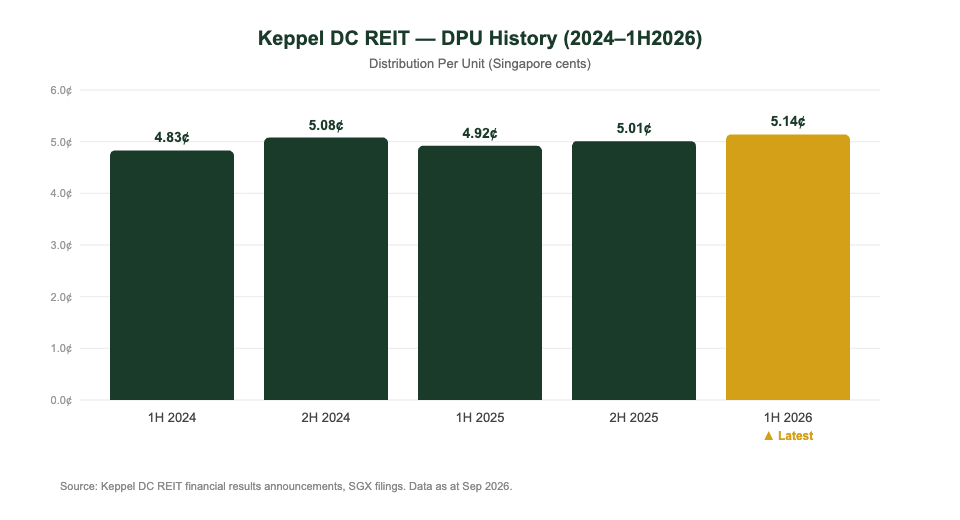
Net property income (NPI) rose 5.8% to S$143.2 million. Distributable income per unit (DPU) came in at 5.14 Singapore cents for 1H2026, up from 4.92 cents in 1H2025 — a recovery that reversed two consecutive half-year DPU declines. For Singapore retail investors at a cost of S$2.15 per unit, this 1H2026 DPU translates to a half-yearly yield of 2.39%, or 4.78% annualised — rising to approximately 5.8–6.0% when annualising the forward estimate that includes 2H2026 guidance.
| Metric | 1H2025 | 2H2025 | 1H2026 | YoY Change |
|---|---|---|---|---|
| Gross Revenue (S$m) | 152.7 | 158.1 | 162.4 | +6.3% |
| NPI (S$m) | 135.4 | 139.7 | 143.2 | +5.8% |
| DPU (Singapore cents) | 4.92 | 5.01 | 5.14 | +4.5% |
| Portfolio Occupancy | 97.8% | 97.5% | 98.1% | +0.3pp |
| Aggregate Leverage | 37.1% | 36.8% | 36.2% | -0.9pp |
Source: Keppel DC REIT financial results announcements, SGX filings. Data as at 30 June 2026.
Gearing & Debt Profile
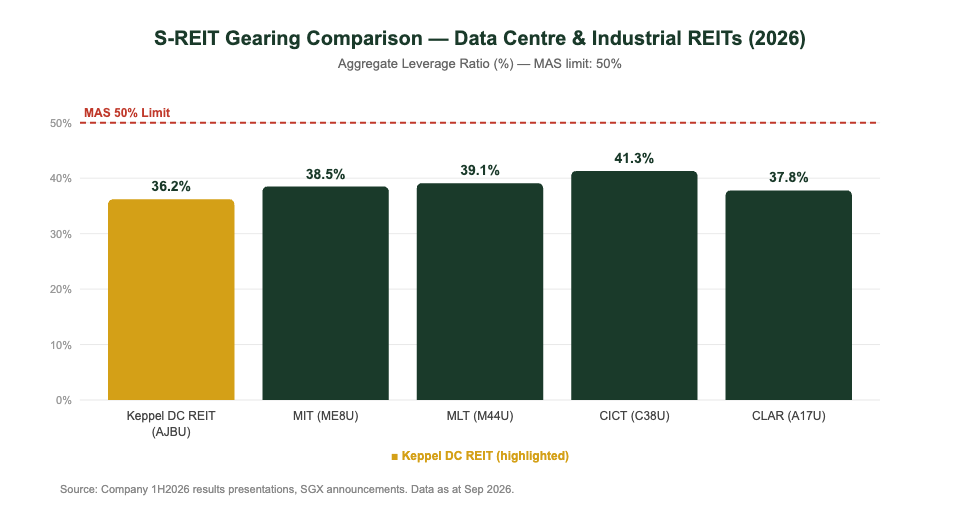
One of the key metrics Singapore REIT investors monitor is aggregate leverage — the ratio of total debt to total assets. Keppel DC REIT’s gearing of 36.2% as at 1H2026 is among the lowest in the S-REIT data centre and industrial sector, well below the MAS maximum of 50% and leaving headroom of approximately S$870 million for potential acquisitions or to weather asset value declines before breaching regulatory limits.
Approximately 75% of Keppel DC REIT’s borrowings are on fixed or hedged interest rates (as at June 2026), which limits near-term DPU sensitivity to changes in SORA or EURIBOR. The weighted average cost of debt as at 1H2026 stood at approximately 3.2% per annum, down from 3.6% in 1H2025 as higher-rate debt was refinanced at slightly improved margins following the Fed’s rate stabilisation. The REIT has no significant debt maturities until 2H2027, reducing refinancing risk through the near term.
For Singapore investors comparing Keppel DC REIT’s gearing against sector peers: MIT (ME8U) at 38.5%, MLT (M44U) at 39.1%, CapitaLand Ascendas REIT (A17U) at 37.8%, and CICT (C38U) at 41.3% — Keppel DC REIT’s balance sheet is the most conservative in this peer group. This financial flexibility supports the manager’s ability to pursue AI-demand-driven acquisitions in 2H2026 and 2027 without a dilutive rights issue. If you’re evaluating other best S-REITs in Singapore 2026, gearing is one of the most important safety metrics to compare.
DPU Sustainability Analysis
The central question for income investors is whether Keppel DC REIT’s DPU can sustain — and ideally grow — into FY2026 full-year results and beyond. Several factors support DPU stability:
1. Long WALE of ~7 years: The majority of income is locked in under long-term leases with built-in CPI-linked or fixed escalation clauses. Approximately 85% of leases expire beyond 2027, meaning near-term re-leasing risk is minimal.
2. Near-full occupancy: At 98.1% portfolio occupancy, there is almost no drag from vacant space. Even if a lease is not renewed, the structural undersupply of data centre capacity in Singapore and key European markets makes re-leasing at comparable or higher rates highly probable.
3. AI-driven demand tailwind: Hyperscaler and AI compute demand continues to drive data centre capacity absorption globally. Keppel DC REIT’s Singapore and European assets are well positioned to capture lease-up demand and command higher renewal rents. For a deeper analysis of how AI infrastructure demand is reshaping the REIT’s portfolio, see our earlier Keppel DC REIT AI infrastructure deep-dive.
4. Currency hedging: The REIT hedges a material portion of its EUR and GBP distributable income into SGD, partially buffering DPU against EUR/SGD depreciation. As at 1H2026, hedges are in place for approximately 70–75% of FY2026 foreign currency distributable income.
The primary risk to DPU is a sharper-than-expected weakening in EUR/SGD or GBP/SGD, given that European assets represent ~59% of revenues. Every 5% EUR/SGD depreciation reduces FY2026 DPU by an estimated 0.2–0.3 Singapore cents (unhedged portion), all else equal. To model how DPU changes affect your retirement income, try the Singapore retirement calculator.
Share Price & Analyst Targets
Keppel DC REIT’s share price has traded in a range of approximately S$1.90–S$2.40 over the 12 months to September 2026. From its 2021 peak of S$3.00+, the REIT re-rated lower as global interest rates rose sharply through 2022–2024, compressing S-REIT valuations across the board. The stock has partially recovered in 2025–2026 as the interest rate cycle peaked and began stabilising.
At S$2.15 (mid-September 2026), Keppel DC REIT trades at an estimated price-to-NAV (P/NAV) of approximately 1.1x, a premium to the broader S-REIT average of ~0.95x P/NAV, reflecting the market’s willingness to pay up for data centre assets given their structural growth profile. Consensus analyst target prices as reported in Bloomberg (as at Aug 2026) range from S$2.20 to S$2.55, with a median target of approximately S$2.38 — implying ~10.7% upside from S$2.15 plus the ~5.8% yield for a total return potential of ~16.5% over 12 months at consensus.
For Singapore investors who invest in REITs through managed platforms, services like Syfe offer REIT portfolio exposure with lower minimum investment thresholds. Use our Syfe referral code (SRPRFFFCD) when signing up for a bonus on your first transfer.
2H2026 Results Preview
Keppel DC REIT is expected to report 2H2026 full-year results in late January or February 2027. Key items to watch in the upcoming results:
DPU trajectory: With 1H2026 DPU at 5.14 cents, the market consensus for FY2026 full-year DPU is approximately 10.20–10.40 Singapore cents. This implies 2H2026 DPU of 5.06–5.26 cents. The upper end is achievable if EUR/SGD remains stable and the Kelsterbach asset delivers full half-year contribution.
Acquisition pipeline: Management has flagged an active pipeline of data centre acquisition targets in Singapore and Southeast Asia to capture AI-driven hyperscaler demand. Any accretive acquisition announced in 2H2026 would be a positive catalyst, provided it is funded through debt within comfortable gearing headroom (36.2% leaves considerable room to 45% before dilutive equity issuance).
Lease renewal activity: Three European leases representing approximately 4–5% of NPI expire in 2H2026 and 1H2027. Renewal of these at flat or positive rental reversion would confirm portfolio resilience; any downtime or rental decline would be a modest negative. Given structural data centre demand, management has guided for positive reversion across the expiring portfolio.
Hedging update: Investors should watch for updates on FY2027 currency hedge levels. If EUR/SGD weakens materially in Q4 2026, hedging costs for 2027 distributable income could be higher, creating a small headwind. If you hold Keppel DC REIT alongside other S-REITs, see our guide on passive income Singapore strategies for building a diversified income portfolio.
Key Risks for Investors
No investment is without risk. Singapore investors should weigh these specific risks before adding Keppel DC REIT to their portfolio:
Interest rate risk: While 75% of borrowings are on fixed/hedged rates, the remaining 25% (~S$360m notional) is on floating rate. Each 100bps rise in SORA/EURIBOR increases annual financing costs by approximately S$3.6m, reducing distributable income by an estimated 0.18 Singapore cents per unit per annum.
Currency risk (EUR/GBP translation): European assets (~59% of revenues) are denominated in EUR and GBP. Currency hedges mitigate but do not eliminate this risk. If EUR/SGD weakens 10% from current levels (~1.40 to ~1.26), unhedged DPU impact is approximately 0.4–0.5 cents per unit per half-year.
Concentration risk: The REIT’s top 10 clients represent over 90% of revenues. Loss of a major hyperscaler tenant — while unlikely given long leases and structural data centre demand — would have an outsized DPU impact.
Technological obsolescence: Next-generation AI compute requires higher power density per rack than traditional colocation. Some older European facilities may require capital expenditure upgrades to remain competitive. The manager has budget for such upgrades but significant capex could weigh on distributable income in specific periods.
P/NAV premium risk: At ~1.1x P/NAV, any de-rating of the S-REIT sector (e.g. from a hawkish Fed pivot) could compress the share price even without a deterioration in fundamentals. Investors buying at current levels should have a minimum 2–3 year time horizon. Use the Singapore retirement calculator to assess whether the yield fits your income withdrawal plan. You can also invest through platforms like FSMOne (referral code P0544985) which offers a regular savings plan (RSP) to dollar-cost average into S-REITs.
Is Keppel DC REIT Worth Buying in Q4 2026?
Case for buying: Keppel DC REIT offers a structural growth REIT at a forward yield of ~5.8–6.0% backed by data centre demand that is secular, not cyclical. The conservative 36.2% gearing, near-full occupancy, and 7-year WALE provide multiple layers of DPU protection. The 1H2026 results showed the DPU recovery is on track. For investors with a 3–5 year income-plus-growth horizon, the risk-reward at S$2.10–2.20 is attractive relative to S-REIT peers.
Case for caution: The ~1.1x P/NAV premium leaves limited margin of safety if interest rates rise again or if EUR/SGD weakens. Investors entering above S$2.30 would be paying a meaningful premium to NAV with limited yield protection (~5.4%). Newcomers to S-REIT investing should consider starting with a smaller position and dollar-cost averaging, using platforms like Endowus (referral code 2V343) for managed REIT fund exposure, or Syfe (code SRPRFFFCD) for a REIT portfolio approach.
This analysis is for educational purposes only and does not constitute financial advice. Past performance is not indicative of future returns. Consider your own financial circumstances and risk tolerance before investing.
Frequently Asked Questions
What is Keppel DC REIT's current share price and yield in 2026?
As at September 2026, Keppel DC REIT (SGX: AJBU) trades at approximately S$2.10–2.20 per unit. At S$2.15, the annualised forward distribution yield is approximately 5.8–6.0%, based on a FY2026 DPU estimate of S$0.1020–0.1040 per unit. Share price fluctuates daily — check the SGX website or your broker platform for the latest quote before investing.
Is Keppel DC REIT's DPU sustainable in 2H2026?
DPU sustainability looks solid heading into 2H2026. The REIT benefits from a 7.1-year WALE, 98.1% occupancy, and 75% fixed/hedged debt — all of which reduce DPU volatility. The main risk is EUR/SGD currency translation on European assets (~59% of revenues). With a consensus FY2026 DPU estimate of S$0.1020–0.1040 (vs 1H2026 actual of 5.14 cents), the distribution looks well-supported barring a sharp EUR/SGD decline.
What is Keppel DC REIT's gearing ratio in 2026?
Keppel DC REIT’s aggregate leverage stood at 36.2% as at 30 June 2026, well below the MAS regulatory limit of 50%. This is one of the lowest gearing ratios among major S-REITs in the data centre and industrial sector, providing meaningful headroom for debt-funded acquisitions or to absorb asset value declines without a rights issue.
Can I buy Keppel DC REIT using CPF or SRS funds?
Yes. Keppel DC REIT (SGX: AJBU) is an SGX-listed security eligible for investment under the CPF Investment Scheme (CPFIS) using CPF Ordinary Account funds, subject to the 35% stock limit on your investible savings. It is also eligible for Supplementary Retirement Scheme (SRS) investments. Always verify CPF Board’s current approved list before investing. For CPF investment strategy guidance, see our CPF investment strategy Singapore guide.
What is the risk of investing in Keppel DC REIT?
Key risks include: (1) Interest rate sensitivity on ~25% floating rate debt; (2) EUR/SGD and GBP/SGD currency risk on European assets (~59% of revenues); (3) Tenant concentration — top 10 clients represent >90% of income; (4) Technology obsolescence risk requiring capex upgrades for high-density AI compute; (5) Share price de-rating risk at the current ~1.1x P/NAV premium if S-REIT sector sentiment weakens. No REIT investment is risk-free — size your position according to your income needs and risk tolerance.
How does Keppel DC REIT compare to Mapletree Industrial Trust?
Both are industrial/technology REITs listed in Singapore with data centre exposure. Keppel DC REIT (AJBU) is a pure-play data centre REIT, offering direct exposure to the AI-driven demand theme but with currency risk from European assets. Mapletree Industrial Trust (ME8U) is more diversified — it owns Singapore hi-tech buildings, US data centres (via a JV), and flatted factories, with a slightly higher gearing at ~38.5%. Keppel DC REIT offers higher DPU yield (~5.8–6.0%) vs MIT (~5.2–5.5%), with Keppel carrying less Singapore industrial cyclicality. For broader S-REIT comparison, see our Singapore REIT ETF guide.
Start Building Your S-REIT Portfolio Today
Use our referral links for exclusive sign-up bonuses when opening a REIT investment account.
This article was researched with the help of AI. While we strive to keep all information accurate and up to date, there may be errors. If you notice any discrepancies, please contact us.