| REIT | Mapletree Logistics Trust (SGX: M44U) |
| 1Q FY27 DPU | 1.816 cents (+0.2% y-o-y) |
| Annualised DPU | ~7.26 cents |
| Dividend Yield | ~6.3% (at SGD 1.15) |
| Occupancy | 96.4% (Jun 2026) |
| NPI Growth | +2.0% y-o-y |
| Key Risk | China & Australia occupancy softness |
| TKN Verdict | Cautious Buy — DPU inflection visible, rate cut upside ahead |
Table of Contents
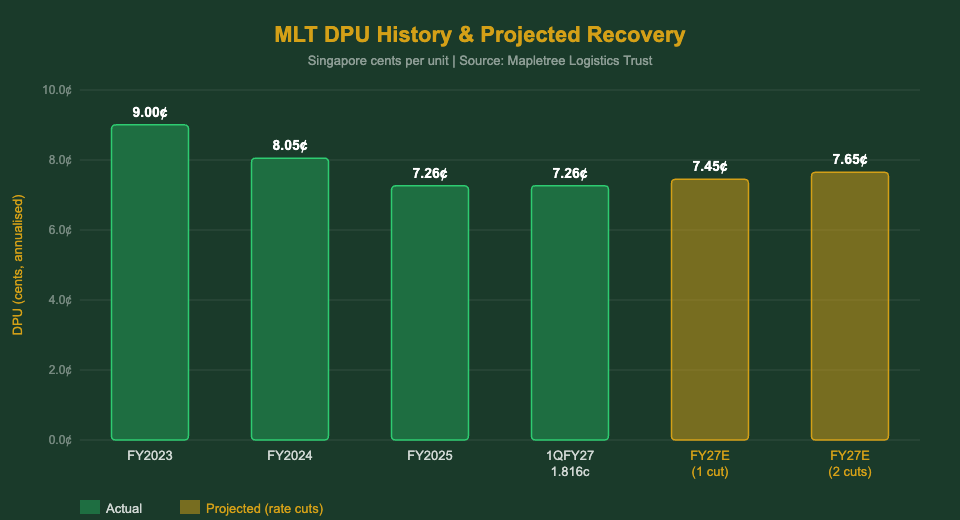
Mapletree Logistics Trust (SGX: M44U) just delivered something it has not managed in over a year: a year-on-year DPU increase. The 1Q FY2627 results — for the quarter ended June 2026 — showed DPU of 1.816 cents, up 0.2% from the same quarter last year. Small? Yes. But for income investors who have watched MLT distributions fall from a peak of over 9 cents annually to 7.26 cents, this inflection point matters.
This article breaks down what drove the recovery, what risks remain — particularly from China and Australia — and crucially, how the Fed rate cut cycle post-Jackson Hole 2026 could push MLT DPU materially higher through FY2027 and beyond. We also include a yield table at various entry prices and our investment verdict for Singapore dividend investors.
1Q FY2627 Results Snapshot
MLT reported its 1Q FY2627 (April to June 2026) results in late July 2026. Here are the headline numbers:
| Metric | 1Q FY2627 | 1Q FY2526 | Change |
|---|---|---|---|
| Gross Revenue | S$178.9M | S$177.5M | +0.8% |
| Net Property Income | S$156.4M | S$153.3M | +2.0% |
| Distributable Income | S$92.3M | S$91.3M | +1.1% |
| DPU | 1.816 cents | 1.813 cents | +0.2% |
| Portfolio Occupancy | 96.4% | 96.9% (prior qtr) | -0.5pp |
Source: Mapletree Logistics Trust 1Q FY26/27 Results Release, July 2026
The standout takeaway: 1Q FY2627 is the first quarter of y-o-y DPU growth since 2024. Net property income grew a healthy 2% despite headwinds, and lower borrowing costs are beginning to feed through to distributable income.
What Is Driving the DPU Recovery?
Three factors combined to push MLT distributable income higher in 1Q FY2627, even as China and Australia faced headwinds:
1. India Acquisition Contributing in Full
MLT recent India acquisition — adding high-quality logistics assets in key industrial corridors — delivered its first full-quarter NPI contribution in 1Q FY2627. India logistics sector is benefiting from strong e-commerce growth and supply chain diversification away from China. This was the single biggest positive driver in the quarter and reflects management proactive pivot toward higher-growth emerging markets.
2. Singapore Redevelopment Completed
A completed Singapore redevelopment project delivered its first full-quarter contribution. Singapore remains MLT highest-quality market, commanding premium rents and near-100% occupancy. The completion of this redevelopment adds accretive NPI that did not exist in the comparable quarter a year earlier.
3. Lower Borrowing Costs Beginning to Feed Through
With the Fed rate cut cycle now underway following the Jackson Hole 2026 conference, MLT has been able to refinance some maturing debt at lower rates. Management noted that lower borrowing costs contributed to the 1.1% increase in distributable income — even though the full benefit of rate cuts has yet to materialise across the entire debt book.
China and Australia: The Occupancy Drag
MLT portfolio occupancy fell from 96.9% to 96.4% quarter-on-quarter. The culprit: lower occupancy across Singapore, China, and Australia — partially offset by stronger occupancy in Hong Kong.
China Exposure Risk
China remains MLT biggest portfolio risk in 2026. Weak domestic consumption, property sector overhang, and supply chain re-routing away from China have hit logistics occupancies across the country. MLT has been actively managing this exposure by selectively divesting underperforming China assets — the Wuxi divestment earlier in 2026 being a prime example. However, occupancy softness persists in retained assets, and Chinese logistics rental growth remains subdued.
Australia Softening
Australia logistics market has seen moderating demand after a post-COVID surge. New supply entering the market has pushed vacancy rates modestly higher. For MLT, Australia represents a smaller portion of the overall portfolio, but it adds to the drag alongside China.
The Silver Lining
MLT Hong Kong portfolio actually recorded higher occupancy in 1Q FY2627, while Japan remains resilient. The geographic diversification — often seen as a drag versus pure Singapore REITs — is proving its value as different markets move on different cycles. As India and Vietnam grow as a proportion of the portfolio, the China drag should become progressively less impactful on overall DPU.
India and Vietnam: The New Growth Engine
While China faces structural headwinds, India is fast becoming the growth engine of MLT Asia-Pacific logistics portfolio. Here is why this matters for long-term DPU:
India logistics demand: India e-commerce market is growing at 20-25% annually, and government infrastructure investment — including the national logistics policy and dedicated freight corridors — is driving demand for modern, grade-A logistics space. MLT India assets benefit from long WALE (weighted average lease expiry) and strong tenant demand from FMCG, e-commerce, and 3PL operators.
Vietnam as a supply chain hub: Vietnam continues to attract manufacturing relocation from China, boosting demand for industrial and logistics properties. The country growing middle class and export-oriented manufacturing base supports long-term logistics demand. MLT Vietnam exposure positions it to capture this structural multi-year shift.
Why this matters for DPU: Higher-growth markets like India and Vietnam typically deliver above-average rental reversions — meaning rents increase when leases are renewed, directly lifting NPI and DPU over time. As these markets grow as a proportion of MLT portfolio, they provide a structural offset to China softness and add a growth dimension that pure Singapore logistics REITs cannot match.
Rate Cut Impact and DPU Projections
Following Jackson Hole in August 2026, the Fed confirmed its rate cut trajectory. For interest-rate-sensitive REITs like MLT, every 25bps reduction in the Fed Funds Rate translates into meaningful savings when fixed-rate debt matures and is refinanced at lower rates. MLT carries aggregate leverage of approximately 38-40%, with a weighted average debt maturity of around 3-4 years. As higher-rate debt rolls off and is replaced with cheaper financing, the savings flow directly into distributable income and DPU.
| Scenario | Rate Cut | Est. Annual Savings | FY27E DPU |
|---|---|---|---|
| Base Case (no new cuts) | 0bps | — | ~7.26 cents |
| 1 Cut | 25bps | ~S$7-10M | ~7.45 cents |
| 2 Cuts | 50bps | ~S$14-18M | ~7.65 cents |
| 3 Cuts | 75bps | ~S$20-25M | ~7.90 cents |
Note: Estimates based on ~38-40% gearing and floating or maturing debt exposure. Actual DPU depends on China recovery, FX movements, and acquisition pipeline. Not financial advice.
Even 1-2 rate cuts could push MLT annual DPU back toward the 7.5-7.7 cents range — a meaningful recovery from FY2026 7.26 cents, and a real yield boost for existing unitholders. The Sep 17 FOMC meeting is the next key catalyst to watch.
MLT Dividend Yield at Various Share Prices
Using MLT trailing FY2026 DPU of 7.262 cents and projected FY2627 DPU ranges under different rate cut scenarios, here is the yield picture at common entry prices:
| Share Price | FY2026 Yield (7.26c) | FY27E — 1 Cut (7.45c) | FY27E — 3 Cuts (7.90c) |
|---|---|---|---|
| SGD 1.00 | 7.26% | 7.45% | 7.90% |
| SGD 1.10 | 6.60% | 6.77% | 7.18% |
| SGD 1.20 | 6.05% | 6.21% | 6.58% |
| SGD 1.30 | 5.59% | 5.73% | 6.08% |
| SGD 1.40 | 5.19% | 5.32% | 5.64% |
Indicative only. Past distributions are not guaranteed. Not financial advice.
Investment Verdict: Buy, Hold or Sell?
The 1Q FY2627 results mark a turning point for MLT — the first y-o-y DPU increase since 2024 signals the worst of the distribution pressure may be behind us. Here is how to think about MLT at current prices:
Bullish Case: Rate cuts reduce cost of debt significantly over FY2627 to FY2728. India and Vietnam acquisitions continue delivering accretive NPI growth. Singapore portfolio maintains near-full occupancy. If these work out, DPU could recover toward 7.8-8.0 cents by FY2728, implying a 6.5-7%+ yield at SGD 1.15.
Bearish Case: China occupancy continues deteriorating. FX headwinds from a stronger SGD erode overseas income. Rate cuts materialise slower than expected. DPU stays flat at ~7.26 cents, limiting upside from current prices.
TKN View — Cautious Buy: At SGD 1.10 to 1.20, MLT offers a 6.0-6.6% trailing yield with meaningful rate cut upside. The DPU inflection is real. China risk is real but contained by active portfolio management. For income investors with a 2-3 year horizon, the risk/reward tilts positive. Dollar-cost averaging into share price weakness makes more sense than waiting for a perfect entry.
Start Investing in S-REITs
Ready to add MLT or other S-REITs to your portfolio? These platforms are trusted by Singapore investors — use TKN referral codes to earn bonus rewards when you sign up:
Frequently Asked Questions
What was Mapletree Logistics Trust DPU for 1Q FY2627?
What is Mapletree Logistics Trust current dividend yield?
How will Fed rate cuts affect MLT DPU?
Is China a major risk for Mapletree Logistics Trust?
When does Mapletree Logistics Trust pay dividends?
How does MLT compare to Mapletree Industrial Trust?
This article was researched with the help of AI. While we strive to keep all information accurate and up to date, there may be errors. If you notice any discrepancies, please contact us.