MediSave Limit 2026: Can You Pay Your Parents’ ISP Premiums From Your Own MediSave?
A practical guide for Singapore families — AWL rules by parent age, step-by-step setup and worked SGD examples.
Yes — you can use your own MediSave to pay your parents’ Integrated Shield Plan (ISP) premiums in Singapore, subject to the Additional Withdrawal Limit (AWL) based on the parent’s age. With the Basic Healthcare Sum at $79,000 in 2026, adult children with healthy MediSave balances can cover their parents’ full MediShield Life premium, up to $600–$900 per year of the private ISP component, and even CareShield Life premiums — all from their own account.
Not financial advice. All figures are for educational reference only. Data verified against CPF Board as at November 2026 unless noted.
Table of Contents
Contents — Click to expand
Why This Matters: When Parents’ MediSave Runs Low
Many Singaporeans in their 50s and 60s face a growing squeeze: MediShield Life premiums rose again in April 2025, CareShield Life deductions have been increasing each year, and ISP private component premiums for private hospital coverage are not cheap. For a parent in their mid-50s, the combined annual MediSave drain from healthcare insurance can easily exceed $2,000 per year.
If your parent’s MediSave balance is not growing fast enough — perhaps because they are self-employed, have gaps in CPF contributions, or retired early — the account can dip uncomfortably. The good news is that Singapore’s CPF framework lets immediate family members (spouse, children, grandchildren, parents, and grandparents) use their own MediSave to pay each other’s healthcare insurance premiums.
This is distinct from using MediSave to pay a parent’s hospitalisation bill — that covers hospital bills, while this covers ongoing insurance premiums. The MediSave limit 2026 (the BHS of $79,000) affects whether and how quickly your own MediSave grows, but does not cap your ability to pay your parents’ premiums from your account.
Which Premiums Can You Pay From Your MediSave?
There are three healthcare insurance premiums for your parents that may be payable from your MediSave:
| Premium Type | Payable From Your MediSave? | MediSave Limit |
|---|---|---|
| MediShield Life (base scheme) | Yes ✓ | Fully covered — no MediSave cap |
| ISP private component (e.g. AIA, Prudential, NTUC) | Yes ✓ (subject to AWL) | Up to AWL based on parent’s age |
| CareShield Life | Yes ✓ | Fully covered — no MediSave cap |
Source: CPF Board, November 2026
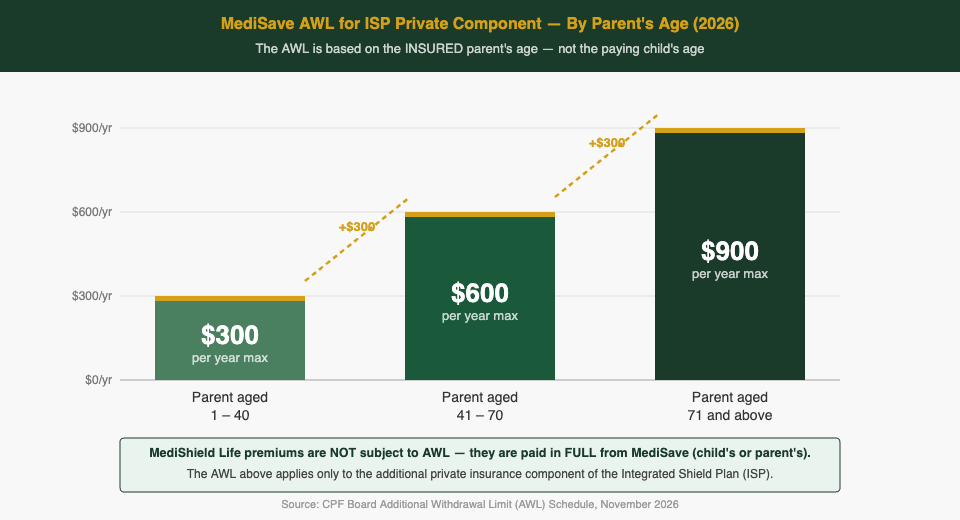
The key restriction is on the ISP private component — the top-up coverage from a private insurer (AIA, Prudential, NTUC Income, Great Eastern, Singlife) above what MediShield Life already provides. This is controlled by the Additional Withdrawal Limit (AWL). MediShield Life itself carries no AWL restriction and is paid in full from MediSave.
The AWL Rules: How Much Can You Use for the Private Component?
The AWL is the annual MediSave cap for the private ISP component. The critical rule that many families miss: the AWL is based on the age of the insured parent, not the age of the payer (you).
This matters enormously in practice. A 32-year-old child paying for a 73-year-old parent’s ISP private component can use up to $900 from their MediSave — the higher limit applies because it is the parent’s age that governs.
| Parent’s Age Next Birthday (ANB) | AWL per Year (ISP Private Component) |
|---|---|
| Age 1 – 40 | $300 |
| Age 41 – 70 | $600 |
| Age 71 and above | $900 |
Source: CPF Board AWL Schedule, November 2026
Any private ISP premium above the AWL must be paid in cash. This is a hard limit set by MOH to protect MediSave balances for future healthcare needs. When comparing Integrated Shield Plans for your parents, factor in this cash requirement — not just the total premium — to gauge the true out-of-pocket cost.
What About CareShield Life Premiums?
CareShield Life is Singapore’s compulsory long-term disability insurance scheme. It was auto-enrolled for Singaporeans born in 1980 or later (from age 30) and was open for voluntary enrolment for those born between 1970 and 1979. Those born before 1970 remain on the older ElderShield scheme unless they separately opted in.
If your parent is on CareShield Life, their premiums are fully payable from MediSave with no AWL restriction — yours or theirs. The 2026 monthly payout if severely disabled is $689 (increasing 4% per year through 2030), and premiums continue until the insured reaches age 67 (for those who enrolled by age 58). Premium amounts are personalised based on joining age, gender and applicable subsidies — check the actual figure on the CPF Member Portal.
For parents on the legacy ElderShield scheme (born before 1970), the same principle applies — ElderShield premiums can also be paid from a family member’s MediSave. For a detailed breakdown of how CareShield Life fits into retirement healthcare planning, see the CareShield Life Singapore guide.
How to Set It Up (Step-by-Step)
Paying your parents’ ISP premiums from your MediSave is not automatic — you need to arrange it with the insurer in advance.
For the MediShield Life component: CPF Board handles this directly. If your parent’s MediSave is insufficient, CPF will contact them to arrange alternative payment — which can include a family member’s MediSave.
For the ISP private component (subject to AWL):
- Contact your parent’s ISP insurer directly (AIA, Prudential, NTUC Income, Great Eastern, or Singlife).
- Request a family MediSave payment arrangement — most insurers offer this via their customer portal or by phone.
- Provide your CPF account number, NRIC, and your relationship to the insured.
- The insurer submits the deduction authority to CPF Board on your behalf.
- Deductions occur annually at renewal — confirm the arrangement is in place at least 4–6 weeks before the renewal date.
For CareShield Life: Log in to the CPF Member Portal and update the premium payer to your MediSave account under your parent’s CareShield Life policy settings.
Worked Example: Sponsoring a 55-Year-Old Parent
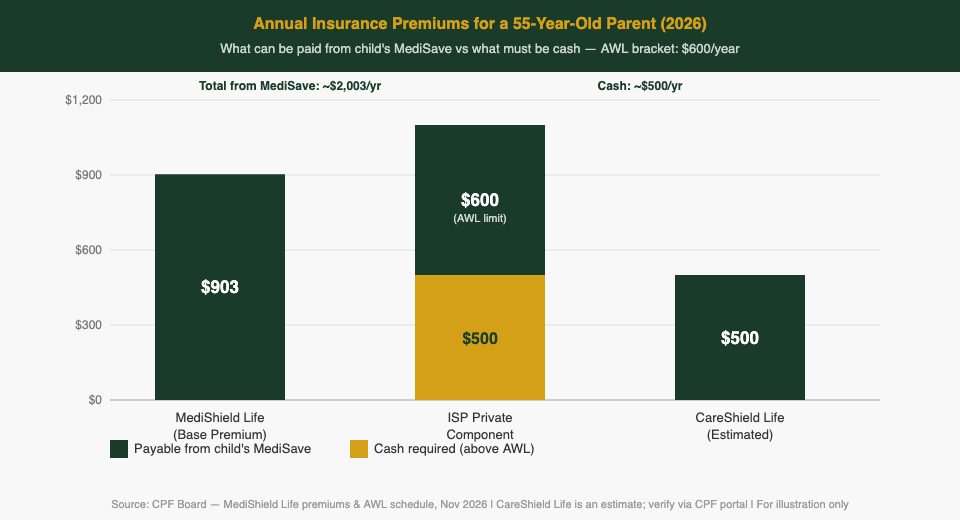
Rachel, 38, wants to help her mother Linda (age 55 next birthday, born 1971, voluntarily joined CareShield Life) manage her ISP costs. Linda holds an ISP covering Class A private hospital ward.
| Premium Type | Annual Total | Rachel Can Pay From MediSave? | From MediSave | Cash |
|---|---|---|---|---|
| MediShield Life | $903 | Yes, fully (no AWL) | $903 | $0 |
| ISP private component | $1,100 | Yes, up to AWL ($600) | $600 | $500 |
| CareShield Life (est.) | ~$500 | Yes, fully (no AWL) | ~$500 | $0 |
| Total | ~$2,503 | ~$2,003 | $500 |
Source: CPF Board MediShield Life premium table (Apr 2025), AWL schedule (Nov 2026). CareShield Life premium is estimated — actual varies by enrolment year, gender and subsidies. ISP private component is illustrative. Not financial advice.
By channelling $2,003 per year from her own MediSave toward her mother’s premiums, Rachel reduces her mother’s MediSave drain to near zero — with only $500 in cash required for the ISP private component above the AWL. This kind of family planning dovetails with broader CPF investment strategy thinking, particularly for adult children whose MediSave balances are well above the BHS and not growing further anyway.
Key Pitfalls to Avoid
Pitfall 1: Assuming the AWL is based on your age. The AWL is tied entirely to the insured parent’s age. A parent aged 72 gives an AWL of $900 — regardless of whether the paying child is 35 or 55.
Pitfall 2: Not arranging it in advance. The insurer must set up the deduction authority before the premium is due. If this isn’t in place by renewal date, the insurer defaults to cash payment — and re-instating the arrangement for the next year takes time.
Pitfall 3: Depleting your own MediSave buffer. Before redirecting MediSave to parents’ premiums, verify you have enough for your own hospitalisation needs and insurance. The 2026 BHS is $79,000 — if your MediSave exceeds this, further contributions go to your OA/SA and the redirect has minimal impact on your own planning. Run the numbers with a retirement planning calculator first.
Pitfall 4: Confusing MediShield Life and ISP private on the premium notice. The two components are listed separately on your insurer’s renewal notice. Only the private component is subject to the AWL. Applying the AWL to the wrong line leads to underpayment or confusion with the insurer.
Pitfall 5: Not checking your parent’s eligibility for CareShield Life. Parents born before 1970 are on ElderShield (or private disability insurance), not CareShield Life. CareShield Life rules apply only to those born in 1970 or later. Always verify which scheme your parent is on before making payment arrangements.
Not financial advice. This article is for educational purposes only. Consult a licensed financial adviser or the CPF Board for personalised guidance on your specific situation. Data verified as at November 2026.
Frequently Asked Questions
Can I use my MediSave to pay for my parents' Integrated Shield Plan premiums?
Yes. CPF rules allow you to use your MediSave to pay the healthcare insurance premiums of immediate family members, including your parents. This covers the MediShield Life base premium (fully payable from MediSave), the private ISP component (up to the AWL based on the parent’s age), and CareShield Life or ElderShield premiums (fully payable from MediSave). You need to arrange this with the insurer before the premium renewal date.
What is the MediSave limit 2026 I can use for my parent's ISP private component?
The Additional Withdrawal Limit (AWL) for the private ISP component is $300/year for a parent aged 1–40, $600/year for a parent aged 41–70, and $900/year for a parent aged 71 or above. These limits are based on the insured parent’s age next birthday, not your own age. Any premium above the AWL must be paid in cash.
Is the AWL based on my age or my parent's age?
The AWL is entirely based on the age of the insured person — your parent — not your age as the payer. So if your parent is 72, the AWL for the ISP private component is $900 per year, regardless of whether you are 30 or 55. This means that adult children paying for older parents automatically benefit from the higher AWL tier.
Does using my MediSave for my parent's premiums affect my own MediSave balance?
Yes — any amount you use from your MediSave for your parent’s premiums reduces your own MediSave balance. Ensure you have enough buffer for your own hospitalisation costs and premiums before redirecting funds. If your MediSave is well above the Basic Healthcare Sum of $79,000 in 2026, the impact is minimal since further contributions redirect to your OA or SA anyway. It is still wise to check using a retirement planning calculator.
How do I set up MediSave payment from my account for my parent's ISP?
Contact your parent’s ISP insurer directly (AIA, Prudential, NTUC Income, Great Eastern, or Singlife) and request a family MediSave payment arrangement. You will need to provide your NRIC, CPF account number, and your relationship to the insured. The insurer will submit the deduction authority to CPF. For CareShield Life premiums, update the premium payer through the CPF Member Portal. Arrange this at least 4–6 weeks before your parent’s renewal date.
Can I pay for my parent's CareShield Life or ElderShield premiums from my MediSave?
Yes. Both CareShield Life and ElderShield premiums can be paid from a family member’s MediSave with no AWL restriction — the full premium amount is eligible for MediSave payment. CareShield Life applies to Singaporeans born in 1980 or later (auto-enrolled) and those born 1970–1979 who opted in voluntarily. Those born before 1970 are typically on ElderShield. The same MediSave payment-by-family-member rule applies to both schemes.
Plan Your Family’s Healthcare Finances
Understanding how MediSave, ISP premiums and CareShield Life interact is the first step to sustainable family healthcare planning.
Get Free Insurance Advice
Speak with a licensed insurance advisor. No obligation, no cost.
By submitting this form, you agree to our Privacy Policy.
This article was researched with the help of AI. While we strive to keep all information accurate and up to date, there may be errors. If you notice any discrepancies, please contact us.